Team Shieldworkz
Ask a compliance manager at any registered utility what keeps them up at night, and very few will say "the standards." The standards are written down. They can be read, interpreted, and debated. What actually causes the sleepless weeks before an audit is something else entirely: the gap between what an organization believes it is doing and what it can actually prove it did, on a specific date, for a specific asset, with a record that has not been reconstructed from memory.
That gap has widened as operational technology environments have grown. A control center that once managed a few dozen relevant devices now oversees substations, generation sites, remote terminal units, and vendor-supported systems spread across hundreds of miles. Every one of those assets may generate a compliance obligation. Every obligation generates evidence. And evidence, unlike policy, does not take care of itself.
This is the pressure that has created an entire category of NERC CIP compliance software. The promise is appealing , replace the spreadsheets, retire the shared folders, and let a platform carry the administrative weight. The reality is more nuanced. Some platforms genuinely reduce audit effort and improve security visibility at the same time. Others simply move manual work into a nicer interface, leaving the same people doing the same reconciliation with an added subscription cost.
This Blog is written for the people who have to make that call. It breaks down the nine capabilities that matter most when comparing NERC CIP compliance software, explains what each one looks like when it is implemented well, and sets out the questions that reveal whether a platform will hold up inside a real substation environment or only inside a demo.
Why NERC CIP Has Stopped Being a Documentation Exercise
Critical Infrastructure Protection standards were built on a straightforward premise: entities that can affect the reliable operation of the bulk electric system should identify their critical cyber assets, protect them, monitor them, and be able to demonstrate all of the above. In the early years, much of that demonstration was narrative. Teams wrote procedures, collected screenshots, and assembled binders.
Three forces have changed that permanently.
The first is scale. Digital substations, remote engineering access, cloud-connected historians, and distributed generation have multiplied the number of in-scope systems. Manual tracking that worked for a single control center becomes unmanageable across fifty sites.
The second is cadence. Many requirements are not annual events , they are recurring clocks. Security patches must be evaluated for applicability at least once every 35 calendar days. Baseline configuration changes must be monitored on a similar cycle for the highest-impact systems. Access authorization records must be verified at least once each calendar quarter. Privilege reviews follow a 15-calendar-month cycle. A missed cycle is not a gap in intent; it is a documented deviation.
The third is financial consequence. Civil penalties for violations can exceed one million dollars per violation, per day. The largest publicly settled enforcement action in the history of the standards involved a single registered entity, 127 separate violations, and a ten-million-dollar settlement. What stood out in that case was not the presence of sophisticated attackers , there were none. The findings centered on incomplete asset inventories, inconsistent process execution across business units, and documentation that could not demonstrate what had actually been done.
The most expensive compliance failures in this sector have rarely involved a breach. They have involved organizations that were doing reasonable work and could not prove it.
That distinction matters when evaluating software. A platform that improves security posture but produces unusable evidence will still fail an audit. A platform that produces beautiful reports from stale data will fail in a different and more dangerous way , it will create confidence that is not earned.
What NERC CIP Compliance Software Actually Has to Do in an OT Environment
Enterprise compliance tools were designed for environments where endpoints can be scanned aggressively, agents can be deployed freely, and a reboot is an inconvenience rather than an operational event. Control networks do not work that way.
A protective relay cannot be probed without consideration for how it responds. A programmable logic controller running a continuous process cannot absorb an unscheduled agent installation. Serial devices on legacy buses do not announce themselves to network discovery. Many assets carry vendor support agreements that restrict what may be installed on them. And in a significant number of plants, the people responsible for compliance evidence are also the people responsible for keeping the process running , which means every added minute of manual effort competes directly with operations.
So the real evaluation question is not "does this platform cover the standards?" Nearly all of them claim to. The question is whether it can gather, organize, and defend evidence under operational constraints that were never designed with compliance in mind.
The nine capabilities below are the ones that determine that outcome.
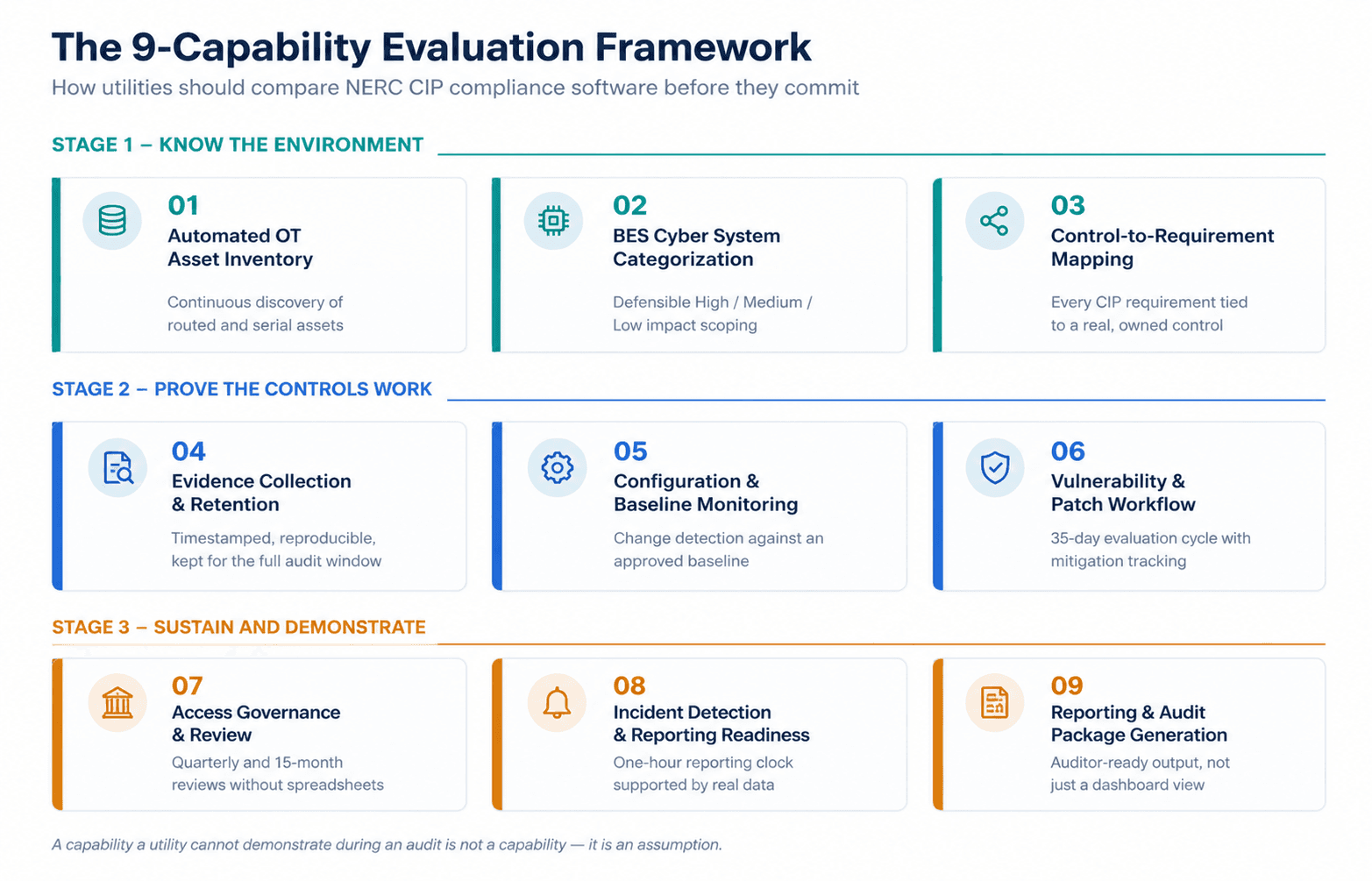
Figure 1: The nine capabilities utilities should compare, grouped by the outcome each one delivers.
The 9 Capabilities Utilities Should Compare
1. Automated and Continuous OT Asset Inventory
Everything downstream depends on this. Categorization, baselines, patch tracking, access control, and reporting all inherit the accuracy , or the errors , of the underlying asset list. When enforcement findings are traced back to a root cause, an incomplete inventory is one of the most common origins.
A capable platform builds inventory passively wherever possible, observing network communications without injecting traffic that could disturb a control loop. It should identify make, model, firmware revision, installed software, network position, and communication relationships. It should also handle what passive monitoring alone cannot see: serial-connected devices, air-gapped segments, and equipment that speaks only when polled.
What to test during evaluation: bring a device online in a test segment and see how long the platform takes to detect, classify, and place it in the correct network zone , and whether it does so without manual data entry.
2. BES Cyber System Identification and Categorization
Once assets are known, they must be grouped into systems and categorized by impact. High, medium, and low impact classifications determine which requirements apply , and misclassification carries risk in both directions. Under-scoping creates violations. Over-scoping creates years of unnecessary operational burden on systems that never warranted it.
Strong platforms support categorization as a living, documented process rather than a one-time spreadsheet exercise. They record the criteria applied, retain the rationale behind each decision, flag assets whose role or connectivity has changed, and support the 15-calendar-month review cycle without requiring the entire assessment to be rebuilt from scratch.
What to ask: when a new asset appears, does the platform propose a categorization with reasoning attached, or does it simply add a row and wait for a human to decide?
3. Control-to-Requirement Mapping
This is where many evaluations go wrong. A platform lists the standards, shows a compliance percentage, and the demonstration feels complete. But a requirement list is not a control map.
Useful mapping connects each requirement to the specific technical or procedural control that satisfies it, the system or location where that control operates, the person accountable for it, and the evidence artifact that demonstrates it. That chain is what an auditor follows. If any link is missing, the organization is describing an intention rather than demonstrating a control.
Mapping should also work in reverse. When a firewall rule changes or a control is retired, the platform should immediately show which requirements are affected , before the next audit reveals it.
4. Evidence Collection, Retention, and Reproducibility
Evidence is the product that compliance teams actually deliver. Everything else supports it.
The critical distinction is between evidence that is collected continuously and evidence that is assembled retroactively. A screenshot taken during audit preparation shows a configuration as it exists today. It says nothing about the eighteen months in between. Continuous collection captures state as it changes, with timestamps, source attribution, and the context that makes a record defensible.
Retention matters just as much. Audit periods can look back several years. A platform that stores only rolling recent data forces teams back into manual archives precisely when the pressure is highest.
What to verify: ask to see a specific evidence artifact from a date eighteen months in the past , not a report generated today, but the record as it was captured then, with the chain of custody intact.
5. Configuration Baseline and Change Monitoring
Baseline management is one of the most operationally demanding areas of the standards. Systems must have documented baseline configurations, changes must be authorized and documented, and changes must be monitored on a defined cycle , at least once every 35 calendar days for the highest-impact systems.
This is also where compliance and genuine security align most cleanly. Unauthorized configuration change is both a violation indicator and one of the earliest signals of intrusion or unsafe engineering practice.
A capable platform maintains baselines automatically, detects deviation, distinguishes authorized change from unauthorized change by integrating with the change management process, and preserves a complete revision history. Weaker platforms simply store a document called a baseline and ask a human to compare it manually.
What to ask: does the platform detect a firmware revision change on a field controller, or only on servers and workstations?
6. Vulnerability and Patch Management Built for Operational Reality
The patch requirement is frequently misunderstood. It does not demand that every patch be installed. It requires that patches be evaluated for applicability on a recurring 35-day cycle, and that within 35 calendar days of completing that evaluation the organization either applies the patch, documents a dated mitigation plan, or updates an existing plan.
That framing is deliberate. Regulators understand that a running turbine cannot be patched on a whim. What they will not accept is silence , a vulnerability that was never evaluated, or a mitigation plan that exists only as a verbal understanding between two engineers.
Good software tracks the evaluation cycle, maps advisories to the specific asset versions actually present in the environment, supports structured mitigation plans with owners and review dates, and prioritizes by operational exposure rather than by generic severity score alone. A critical-rated flaw on an isolated device with no remote access may warrant less urgency than a moderate flaw on a system reachable through a remote access path.
7. Access Governance and Recurring Review
Access requirements span several dimensions: who is authorized, what they are authorized for, whether that authorization is still valid, how quickly it is removed when someone leaves, and how remote access is controlled and monitored. Reviews recur quarterly for authorization records and on a 15-calendar-month cycle for privilege accuracy. Access removal after termination is measured in days, not weeks.
The operational difficulty is that OT access lives in many places at once , domain accounts, local device accounts, shared engineering credentials, vendor accounts, remote access gateways, and physical badge systems. Reconciling them manually is slow and error-prone, and shared or local accounts on field equipment are where reviews most often break down.
A strong platform consolidates these sources into a single reviewable view, tracks review completion as evidence in its own right, and flags accounts that exist on devices but appear nowhere in the authorization record.
8. Incident Detection and Reporting Readiness
Reporting obligations for reportable incidents are measured in a single hour from the moment of determination, with attempted compromises reportable by the end of the next calendar day. That timeline is not survivable if the response process begins with a search for basic facts.
Reporting readiness means the information required to make a determination and file a report is already assembled: which assets were involved, what their impact categorization is, what changed and when, who had access, and what network communication preceded the event. A platform that contributes here reduces the first hour from an investigation into a confirmation.
It should also support the exercise and documentation requirements around response plans , because a plan that has never been tested tends to be discovered as inadequate at the worst possible moment.
9. Reporting, Audit Package Generation, and Self-Assessment
The final capability is the one most often demonstrated first and evaluated last. Dashboards are easy to build and easy to admire. What matters is whether the platform can produce an evidence package structured the way an auditor expects to receive it , organized by requirement, with artifacts attached, sources identified, and dates intact.
Equally valuable is honest internal reporting. The most useful platforms show where evidence is thin, which controls are supported only by assertion, and where cycles are approaching their limits. A tool that always displays a comfortable compliance score is not helping; it is delaying a conversation that will eventually happen under less favorable conditions.
The table below summarizes what to verify for each capability.
Capability | Primary Compliance Focus | What to Verify During Evaluation |
1. Asset inventory | Identification and scoping of in-scope cyber assets | Detection of serial and non-routable devices; time to classify a newly connected asset |
2. System categorization | Impact classification and 15-month review cycle | Retained rationale for each decision; automatic flagging when asset role changes |
3. Control mapping | Requirement coverage and accountability | Reverse traceability , which requirements break when a control changes |
4. Evidence collection | Demonstrable proof across the full audit window | Retrieval of an artifact captured 18+ months ago with source and timestamp |
5. Configuration monitoring | Baseline integrity and 35-day change review | Change detection on field controllers, not only servers and workstations |
6. Vulnerability and patch | 35-day evaluation cycle and documented mitigation | Advisory matching to actual firmware versions present in the environment |
7. Access governance | Quarterly and 15-month review cycles | Discovery of local and shared accounts on field devices |
8. Incident readiness | One-hour reporting determination window | Speed of assembling asset, access, and change context after an alert |
9. Reporting and audit output | Audit package quality and self-assessment | Export structured by requirement with artifacts attached, not a screenshot of a dashboard |
What Real Incidents Reveal About Compliance Gaps
Enforcement findings and public incidents tell a consistent story. The failures that matter are rarely exotic. They are ordinary gaps that persisted because nobody could see them.
A Known Vulnerability, an Unpatched Edge Device, and Ten Hours of Lost Visibility
In March 2019, a Western United States power provider experienced what was described publicly as the first cyber-related event in the region to disrupt grid operations. The cause was not an advanced intrusion. A vulnerability in internet-facing firewall equipment was exploited, causing the devices to reboot repeatedly over roughly ten hours. Each reboot severed communication between the control center and remote wind and solar generation sites for several minutes at a time.
Generation itself was never lost. Visibility was. Operators were flying blind across distributed sites in short, repeated intervals, unable to confirm the state of assets they were responsible for.
The most instructive detail is that a firmware update addressing the flaw had been available. The organization simply had not applied it , and, critically, had not identified that these particular devices sat in a position where their failure would degrade operational visibility. This is precisely the intersection where asset inventory, patch evaluation cycles, and network position awareness either work together or fail together.
The Ten-Million-Dollar Documentation Problem
The largest publicly known enforcement settlement in the history of the standards did not stem from an attack. It resulted from 127 violations accumulated across multiple business units and years, involving inconsistent implementation of processes that the entity genuinely believed were in place.
Several themes ran through the findings: assets that were in scope but missing from inventory, evidence that could not be produced for the required period, and processes that were executed differently in different parts of a large organization. Each individual gap was minor. Together they became the most expensive compliance outcome in the sector.
For anyone evaluating software, this case defines the standard to measure against. The question is not whether a platform can display compliance. It is whether the platform would have surfaced those gaps while they were still small.
Attacks That Redefined What Control System Intrusion Looks Like
In December 2015, coordinated attacks on three electricity distribution operators in Ukraine left roughly 225,000 customers without power. The attackers did not break control systems through brute force. They obtained legitimate remote access credentials, studied the environment patiently, and then used the operators' own tools against them , opening breakers through normal interfaces, corrupting firmware on serial-to-Ethernet converters to prevent remote recovery, wiping operator workstations, and flooding the utility's call center to delay awareness.
A year later, a second attack against a transmission substation demonstrated malware capable of speaking industrial protocols natively, issuing valid commands without needing to compromise an operator session at all. In 2022, an evolved version of that same capability was deployed against high-voltage substations and was identified before it caused impact. In the same period, a modular toolkit designed specifically to manipulate programmable logic controllers across multiple vendors was disclosed publicly , the first widely known capability built to be reused across different industrial environments rather than tailored to a single target.
The common thread is that legitimate access, valid protocol commands, and unmonitored configuration change are the attacker's preferred path. Those are exactly the areas the standards require to be controlled and documented , which is why compliance evidence and security telemetry are increasingly the same data.
The Shutdown That Started in the Business Network
In May 2021, a major fuel pipeline operator halted roughly 5,500 miles of pipeline operations after a ransomware infection in its business systems. The control systems themselves were not compromised. The operator shut down because it could not confidently determine the boundary between the affected environment and the operational one, and because billing systems were unavailable.
The resulting fuel shortages across the eastern United States, and the regulatory response that followed, demonstrated something important for utility leaders: the consequence of poor segmentation visibility is not only breach risk. It is the inability to make a fast, confident operational decision under pressure. Documented boundaries, current asset records, and clear access mapping are what allow an operator to keep running when the answer is genuinely "the control network is unaffected."
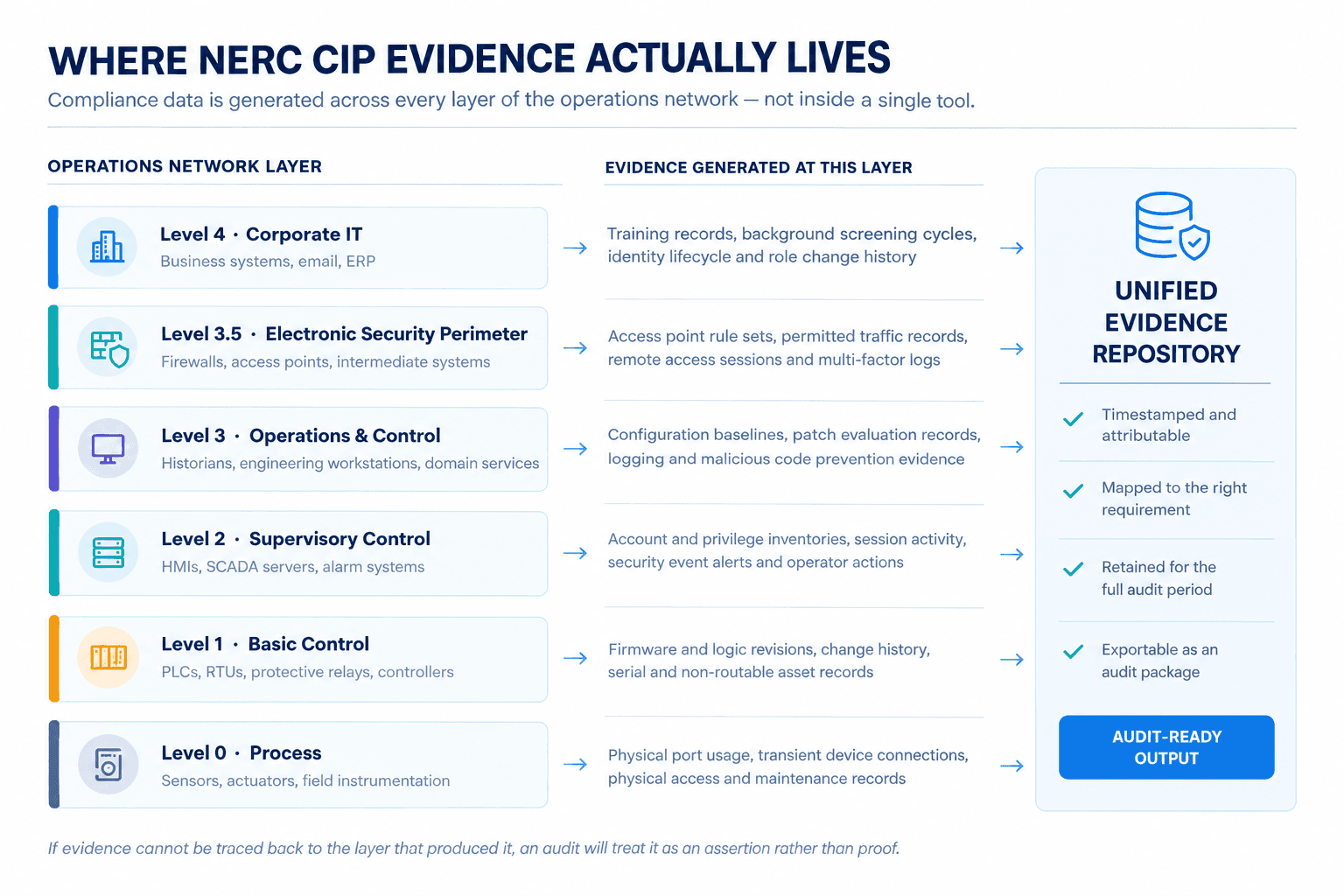
Figure 2: Compliance evidence originates across every layer of the operations network , which is why consolidation, not collection alone, is the differentiator.
Risks and Challenges Utilities Run Into During Selection
Buying the Dashboard Instead of the Data
Visual polish is the easiest thing to build and the hardest thing to evaluate objectively. A compliance percentage is only as meaningful as the inputs behind it. Before being impressed by a score, ask what data produced it, how recently that data was collected, and what happens to the score when an asset stops reporting. If a device goes silent and the number does not move, the number is decoration.
The Serial and Non-Routable Blind Spot
Many platforms are built on network traffic analysis, which works well on routed networks and poorly everywhere else. Substations and plants contain substantial populations of devices on serial links, isolated engineering networks, and point-to-point connections. These assets are frequently the oldest, the most operationally critical, and the least documented. A platform that quietly excludes them produces an inventory that looks complete and is not.
Evidence That Degrades Over Time
Evidence has a half-life. A record captured with full context is defensible for years. A record captured as a screenshot with no source attribution becomes questionable within months, particularly after staff turnover. Many organizations discover this only when the engineer who performed a task has left and no one can explain what the artifact actually shows.
Enterprise Tooling Pushed Into Control Environments
Standard enterprise security platforms are often extended into OT because they are already licensed. The economics are appealing; the outcomes are frequently not. Aggressive scanning, agent deployment on constrained devices, and assumptions about patch windows all carry real operational risk. There are documented cases across industries of routine enterprise scanning activity disrupting control devices that were never designed to handle it. Compliance software for OT must be built around restraint.
Treating Low-Impact Assets as Low-Effort Assets
Low-impact classification reduces the number of applicable requirements. It does not eliminate obligations around policy, awareness, physical security, electronic access control, incident response, and transient device management. Nor does it reduce attacker interest. The 2019 visibility event described earlier involved assets in exactly this category. Platforms that concentrate entirely on high and medium impact systems leave the largest population of devices least observed.
The contrast below reflects what typically changes when these capabilities are implemented well.
Compliance Activity | Manual or Spreadsheet-Based Approach | Supported by Purpose-Built OT Capability |
Asset inventory maintenance | Periodic manual surveys; drifts out of date between reviews | Continuously updated as devices appear, change, or go silent |
Patch applicability evaluation | Advisory review against a static list; frequent version mismatch | Advisories matched to firmware and software actually present |
Baseline change detection | Manual comparison, often discovered after the fact | Deviation flagged against an approved baseline with revision history |
Quarterly access review | Exports from multiple systems reconciled by hand | Consolidated review view with completion recorded as evidence |
Evidence assembly for audit | Weeks of retroactive collection across teams and archives | Export of continuously captured artifacts organized by requirement |
Incident context gathering | Ad hoc investigation under a one-hour reporting clock | Asset, access, and change context available at the moment of alert |
Practical Recommendations for Evaluating NERC CIP Compliance Software
Start With Your Evidence Burden, Not the Feature List
Before speaking to any provider, document where the time actually goes. Which requirements consume the most hours? Which evidence is hardest to produce? Where did the last audit generate questions? That internal picture becomes the evaluation criteria. Without it, every demonstration will look impressive, because every demonstration is designed to.
Insist on a Proof of Value in a Real Environment
Demonstrations run on curated data. Deploy a limited evaluation in one representative substation or plant , ideally one with a mix of modern and legacy equipment. Measure how many assets are discovered versus how many are known to exist, how much manual enrichment is required, and how the platform behaves with equipment it does not recognize.
Evaluate the Failure Modes, Not the Happy Path
Ask what happens when a sensor loses connectivity, when a device type is unknown, when an integration breaks, or when two data sources disagree. Platforms that surface uncertainty clearly are more trustworthy than platforms that silently fill gaps with assumptions. Silent failure is the most dangerous property a compliance tool can have.
Confirm Operational Safety in Writing
Request explicit documentation of what the platform does on the network , every active query, every protocol interaction, every agent requirement. Confirm compatibility with vendor support agreements on critical equipment. Any reluctance to provide this detail should be treated as a finding in itself.
Verify Integration Where Work Actually Happens
Compliance data must connect to change management, ticketing, identity systems, and existing monitoring. A platform that cannot participate in existing workflows becomes a second system of record, and second systems of record always drift from the first.
Plan for Personnel Turnover
Experienced OT and compliance staff are retiring faster than they are being replaced, and institutional knowledge leaves with them. Evaluate whether the platform captures reasoning , why an asset was categorized a certain way, why a mitigation plan was chosen , or only outcomes. Systems that hold context survive turnover. Systems that hold only data do not.
Use the questions below to structure vendor conversations.
Question to Ask | What a Strong Answer Demonstrates |
How do you discover assets that do not generate routed network traffic? | Genuine coverage of serial, legacy, and isolated equipment rather than routed-network-only visibility |
Show me evidence captured 18 months ago, exactly as it was recorded. | Continuous collection and retention, not retroactive report generation |
What active interaction, if any, does the platform have with control devices? | Operational safety awareness and transparency about network behavior |
How are advisories matched to the specific firmware versions we run? | Precision in vulnerability handling instead of generic advisory feeds |
When a control is removed, which requirements are flagged automatically? | Bidirectional mapping between controls, requirements, and evidence |
What does the platform show when data is missing or stale? | Honest handling of uncertainty rather than silent gap-filling |
What does an exported audit package look like? | Audit-ready structure organized by requirement with artifacts attached |
What happens to our data and evidence if we change platforms? | Portability and clear ownership of compliance records |
How Shieldworkz Supports Organizations
Shieldworkz works with utilities, generation operators, manufacturers, and critical infrastructure organizations that need compliance outcomes and security outcomes from the same effort , not two parallel programs competing for the same engineers. Our approach is grounded in how control environments actually behave, which means visibility is built without introducing operational risk, and evidence is produced as a by-product of monitoring rather than as a separate administrative project.
Comprehensive OT asset discovery and inventory of every connected and non-routable asset across substations, plants, and remote sites, including serial-connected equipment that traffic analysis alone cannot reveal.
Defensible system categorization support that documents impact classification decisions along with the reasoning behind them, supports recurring review cycles, and flags assets whose role or connectivity has changed.
Control-to-requirement mapping that ties each requirement to a specific control, an accountable owner, and the artifact that demonstrates it , with reverse traceability when controls change.
Continuous evidence capture with timestamps, source attribution, and retention aligned to full audit look-back periods, so evidence is retrieved rather than reconstructed.
Configuration and baseline monitoring that maintains baselines automatically, distinguishes authorized change from unauthorized change, and preserves complete revision history across control-layer devices.
Vulnerability and patch workflow support that tracks recurring evaluation cycles, matches advisories to the versions actually deployed, and supports structured mitigation plans where patching is not operationally feasible.
Access governance and review consolidation that consolidates domain, local, shared, vendor, and remote access records into a single reviewable view with review completion captured as evidence.
Incident readiness that assembles asset, access, and change context at the moment of detection, so determination and reporting decisions can be made within required timelines.
Audit package generation organized by requirement, with artifacts attached and sources intact , alongside honest internal reporting that highlights thin evidence before an auditor does.
Advisory and implementation expertise from engineers who have worked inside operating plants and substations, supporting assessment, architecture review, segmentation design, program development, and ongoing operations.
The objective is straightforward: reduce the manual burden on teams who are already stretched, improve genuine visibility into the operational environment, and make audit readiness a continuous state rather than a recurring emergency.
Conclusion
Selecting NERC CIP compliance software is not primarily a procurement decision. It is a decision about how an organization will know what is true about its own operational environment , and how it will prove that knowledge to a regulator, an executive team, or itself during an incident.
The nine capabilities in this guide are useful because they are testable. Asset inventory can be measured against reality. Evidence retrieval can be demanded from eighteen months ago. Configuration monitoring can be verified on a field controller rather than a server. Audit output can be inspected before a contract is signed. A platform that performs well against all nine will reduce administrative load and improve security visibility at the same time. A platform that performs well only in a demonstration will eventually be discovered , usually at the least convenient moment.
The utilities that handle this well tend to share a common trait. They stopped treating compliance as a periodic project and started treating it as an operational discipline, supported by systems that observe continuously and record honestly. The regulatory benefit is real. The security benefit is larger.
Compliance proves what you did. Visibility tells you what is happening. The right platform delivers both from the same foundation.
Book a Free Consultation with Our Experts If your team is evaluating NERC CIP compliance, or simply wants an objective view of where evidence gaps exist today, a short conversation with an experienced OT security engineer is often the fastest way to gain clarity. In a free consultation, our specialists will review your current compliance workflow, identify where manual effort is concentrated, discuss the capabilities most relevant to your environment, and outline a practical path toward continuous audit readiness. No obligation, no scripted sales pitch , just a technical discussion grounded in operational reality. Schedule your free consultation with Shieldworkz today and turn audit preparation into an ongoing capability rather than an annual scramble. |
Additional resources:
Comprehensive Guide to Network Detection and Response NDR in 2026 here
NERC CIP-015 Internal Network Security Monitoring Readiness Checklist for Electric Utilities here
OT SOC Foundational Guide here
Managed SOC Service here
OT Cyber Threat Intelligence Advisory - Middle East here
NIS2 Directive Achieving NIS2 Compliance Through IEC 62443 here
What Is Removable Media? Risks, Policies, and Industrial OT Security Solutions here
Free Removable Media Policy Template for OT and IT Teams here
Recibe semanalmente
Recursos y Noticias
Vea cómo nuestras soluciones de seguridad de OT líderes en la industria abordan los desafíos de seguridad críticos
También te puede interesar

The OT Lull: What a 30-day decline in direct intrusion activity actually tells us
Prayukth K V

Inside the Revolut data disclosure incident
Prayukth K V

Investigative Cyber Threat Research Report: Alleged Cyberattack and U.S. Investigation of VLCC VL Prosperity
Prayukth K V

Central Electricity Authority Cyber Security Regulations: Complete Guide
Team Shieldworkz

Inside the Kimberly-Clark / ShinyHunters Incident
Team Shieldworkz

IEC 62443 Series Explained: Every Standard You Need to Know
Team Shieldworkz