Determinístico · Nativo de OT · Cierre seguro ante fallas

Un archivo que no ha sido inspeccionado no ha sido confiable. Simplemente se ha ignorado.

Un archivo que no ha sido inspeccionado no ha sido confiable. Simplemente se ha ignorado.

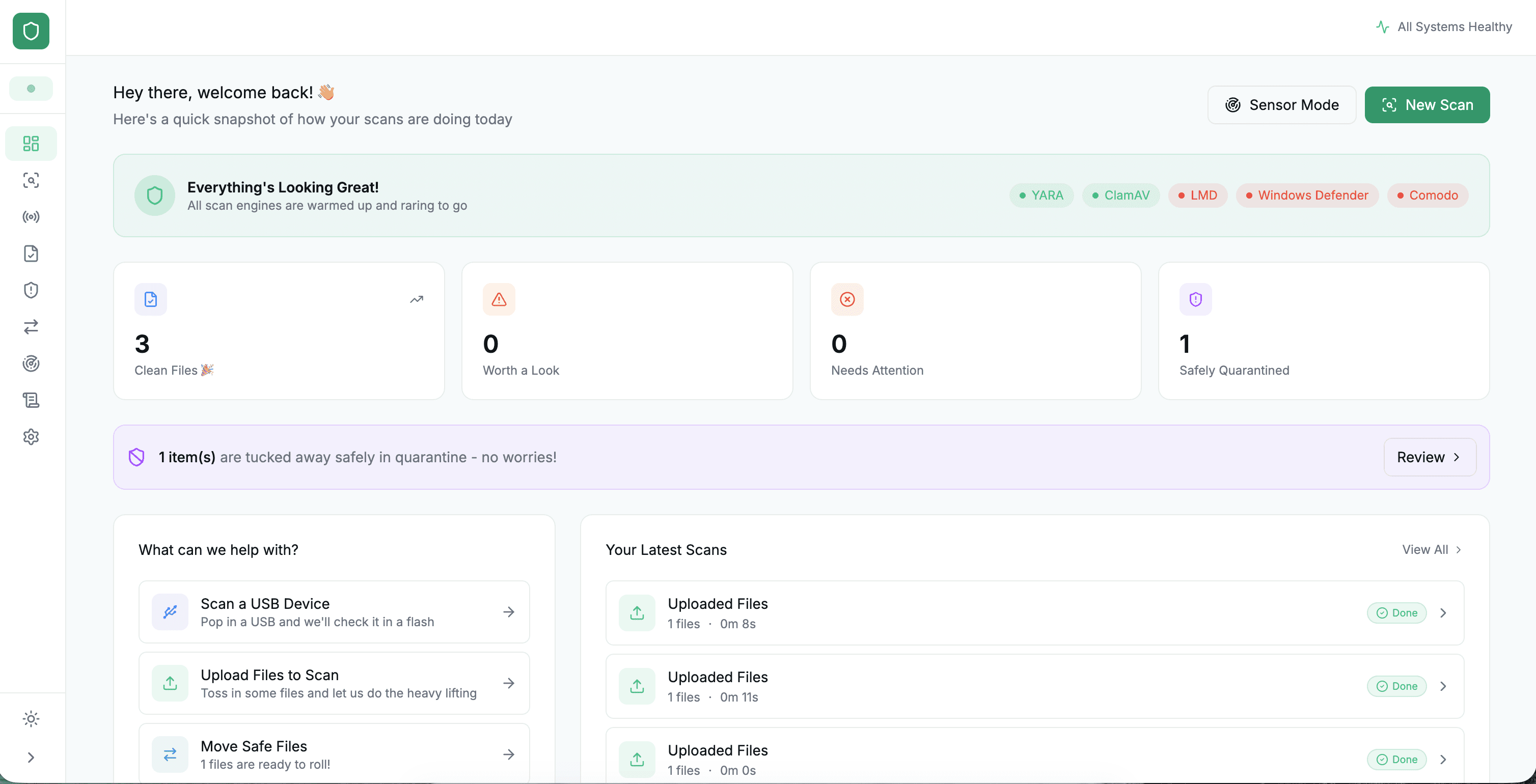
Media Scan controla cada archivo que entra o sale de su entorno OT. No clasifica amenazas. No marca el comportamiento sospechoso para revisión. Inspecciona cada archivo mediante una canalización fija y determinista, y emite un único veredicto aplicable: limpio, retenido o bloqueado. El mismo archivo siempre recibe el mismo resultado. Sin variaciones. Sin posibilidad de elusión.

Media Scan controla cada archivo que entra o sale de su entorno OT. No clasifica amenazas. No marca el comportamiento sospechoso para revisión. Inspecciona cada archivo mediante una canalización fija y determinista, y emite un único veredicto aplicable: limpio, retenido o bloqueado. El mismo archivo siempre recibe el mismo resultado. Sin variaciones. Sin posibilidad de elusión.

Logotipo de ciberseguridad

Determinístico · Nativo de OT · Cierre seguro ante fallas
Detection is not control.
Most OT environments have one but not the other.

Traditional security tools detect threats. They flag suspicious files, issue warnings, and prompt a review. In an IT environment where misses are recoverable, that is acceptable. In an OT environment where a single infected firmware update can take a production line offline for weeks, it is not. Control requires something detection cannot provide: a deterministic outcome for every file, every time, with no exceptions and no bypass.

Detection tells you what it found. Not what it missed.

A scanning tool that flags 99% of threats still allows 1% through. In an environment with thousands of files moving across the boundary daily, that 1% is a real and recurring exposure. Probabilistic detection is not a policy. It is a best effort.

Removable media is the most common OT attack vector.

USB drives, laptops, external hard drives, every device a technician, contractor, or vendor brings on-site is a potential entry point. Air-gapped OT environments are only air-gapped until someone plugs something in. Inspection at the point of insertion is the only control that holds.

Compliance requires evidence, not effort.

IEC 62443, NIST SP 800-82, NIS2, NCA OTCC, all require demonstrable control over file transfer at OT boundaries. A scanning tool that issues alerts does not satisfy a compliance requirement. A deterministic pipeline with per-file audit logs does.

Determinístico · Nativo de OT · Cierre seguro ante fallas

Detection is not control.
Most OT environments have one but not the other.

Traditional security tools detect threats. They flag suspicious files, issue warnings, and prompt a review. In an IT environment where misses are recoverable, that is acceptable. In an OT environment where a single infected firmware update can take a production line offline for weeks, it is not. Control requires something detection cannot provide: a deterministic outcome for every file, every time, with no exceptions and no bypass.

Detection tells you what it found. Not what it missed.

A scanning tool that flags 99% of threats still allows 1% through. In an environment with thousands of files moving across the boundary daily, that 1% is a real and recurring exposure. Probabilistic detection is not a policy. It is a best effort.

Removable media is the most common OT attack vector.

USB drives, laptops, external hard drives, every device a technician, contractor, or vendor brings on-site is a potential entry point. Air-gapped OT environments are only air-gapped until someone plugs something in. Inspection at the point of insertion is the only control that holds.

Compliance requires evidence, not effort.

IEC 62443, NIST SP 800-82, NIS2, NCA OTCC, all require demonstrable control over file transfer at OT boundaries. A scanning tool that issues alerts does not satisfy a compliance requirement. A deterministic pipeline with per-file audit logs does.

Four Form Factors

One inspection pipeline.
Four ways to deploy it.

Every form factor runs the same inspection pipeline, produces the same verdict types, and generates the same audit log. The difference is where and how they sit in your environment.

Four Form Factors

One inspection pipeline.
Four ways to deploy it.

Every form factor runs the same inspection pipeline, produces the same verdict types, and generates the same audit log. The difference is where and how they sit in your environment.

Detection tells you what it found. Not what it missed.

Portable USB

Goes where your technician goes.

A portable USB-based inspection unit carried by field engineers, maintenance teams, and site visitors. Every file on the USB is inspected before it enters the network, at the device, before connection. No infrastructure required. No network dependency. Verdict before contact.

Field maintenance visits

Vendor firmware delivery

Contractor site access

Remote and temporary locations

Media Scan Gate

Kiosk

Holds the line at every entry point.

A fixed inspection kiosk positioned at the physical boundary of the OT environment, plant entrance, control room access point, or engineering bay. Operators and visitors present their media at the kiosk. Nothing enters without a verdict. Enforced workflow, every time.

Control room access control

Engineering bay entry

Plant floor boundary enforcement

High-traffic entry points

Detection tells you what it found. Not what it missed.

Portable USB

Goes where your technician goes.

A portable USB-based inspection unit carried by field engineers, maintenance teams, and site visitors. Every file on the USB is inspected before it enters the network, at the device, before connection. No infrastructure required. No network dependency. Verdict before contact.

Field maintenance visits

Vendor firmware delivery

Contractor site access

Remote and temporary locations

Media Scan Inline

Fully Virtual

Every transfer. Every direction. Always on.

A software-only deployment that inspects every file moving across the IT-OT boundary, in both directions. No physical hardware. No additional workflow steps for operators. Media Scan Inline sits invisibly, enforcing the same inspection pipeline on every file transfer that passes through the network boundary.

IT-OT boundary inline inspection

OT-IT data extraction control

Cloud-connected OT environments

Large-scale multi-site deployment

Detection tells you what it found. Not what it missed.

Portable USB

Goes where your technician goes.

A portable USB-based inspection unit carried by field engineers, maintenance teams, and site visitors. Every file on the USB is inspected before it enters the network, at the device, before connection. No infrastructure required. No network dependency. Verdict before contact.

Field maintenance visits

Vendor firmware delivery

Contractor site access

Remote and temporary locations

Detection tells you what it found. Not what it missed.

Portable USB

Goes where your technician goes.

A portable USB-based inspection unit carried by field engineers, maintenance teams, and site visitors. Every file on the USB is inspected before it enters the network, at the device, before connection. No infrastructure required. No network dependency. Verdict before contact.

Field maintenance visits

Vendor firmware delivery

Contractor site access

Remote and temporary locations

Media Scan Gate

Kiosk

Holds the line at every entry point.

A fixed inspection kiosk positioned at the physical boundary of the OT environment, plant entrance, control room access point, or engineering bay. Operators and visitors present their media at the kiosk. Nothing enters without a verdict. Enforced workflow, every time.

Control room access control

Engineering bay entry

Plant floor boundary enforcement

High-traffic entry points

Media Scan Inline

Fully Virtual

Every transfer. Every direction. Always on.

A software-only deployment that inspects every file moving across the IT-OT boundary, in both directions. No physical hardware. No additional workflow steps for operators. Media Scan Inline sits invisibly, enforcing the same inspection pipeline on every file transfer that passes through the network boundary.

IT-OT boundary inline inspection

OT-IT data extraction control

Cloud-connected OT environments

Large-scale multi-site deployment

Inspection Pipeline

Cinco etapas. Un veredicto. Sin excepciones.

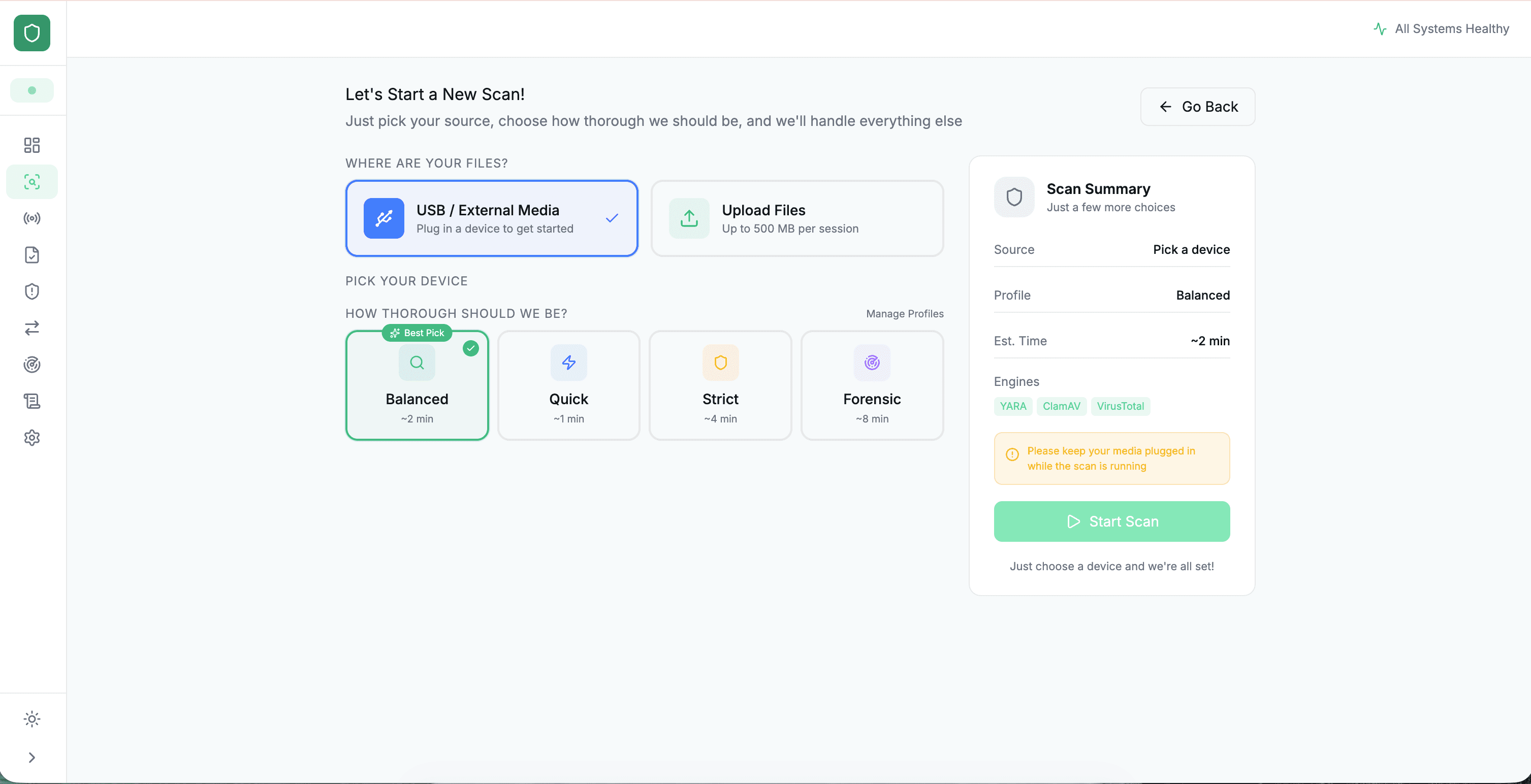
Cada archivo, sin importar su origen, formato o factor de forma, pasa por la misma secuencia fija de inspección. La canalización es determinista: las mismas entradas siempre producen las mismas salidas. No hay atajos, no hay omisión para fuentes de confianza, ni lista de excepciones.

1

Análisis Estático

Inspección basada en patrones de la estructura de archivos antes de cualquier ejecución. Identifica firmas de malware conocidas, codificación sospechosa y amenazas incrustadas en los encabezados y metadatos de los archivos.

2

Escaneo con múltiples motores

Inspección paralela en más de 17 motores de análisis independientes al mismo tiempo. Ningún motor por sí solo actúa como árbitro. El consenso entre múltiples enfoques de detección elimina los puntos únicos de falla.

3

Desarme y reconstrucción de contenido (CDR)

Los archivos no solo se escanean, se reconstruyen. Se eliminan el contenido activo, las macros, los objetos incrustados y los vectores de explotación. El resultado es un archivo seguro y funcional que no contiene ninguna carga maliciosa. La amenaza original se destruye, no se pone en cuarentena.

4

Reputation Validation

Hash validation against global threat intelligence databases, OT-specific malware repositories, and industrial control system attack pattern libraries. Every file checked against what is already known.

5

Deterministic Verdict

One outcome. Clean. Hold. Blocked. No probabilistic scoring. No ambiguity. The same file always receives the same verdict. Every outcome is logged, traceable, and auditable.

LIMPIO

DETENER

BLOQUEADO

5

Veredicto determinista

Un solo resultado. Limpio. En espera. Bloqueado. Sin puntuación probabilística. Sin ambigüedad. El mismo archivo siempre recibe el mismo veredicto. Cada resultado queda registrado, es trazable y auditable.

LIMPIO

DETENER

BLOQUEADO

Media Scan
OThello-Media-Scan

Fail-closed by design.

If Media Scan cannot reach a verdict, connectivity issue, unrecognised format, inspection engine error, the file is held, not passed. The default is control, not convenience. A file that cannot be inspected does not enter your environment.

Full audit trail, every file.

Every file generates a timestamped audit record: source, format, inspection stages completed, verdict issued, disposition applied. The log is complete, immutable, and exportable. Compliance evidence is produced automatically, not assembled after the fact.

Why Media Scan

Control is not detection with a stricter threshold.

The difference between Media Scan and traditional AV or scanning tools is not sensitivity, it is architecture. Media Scan was built to enforce a policy, not to detect a threat.

Why Media Scan

Control is not detection with a stricter threshold.

The difference between Media Scan and traditional AV or scanning tools is not sensitivity, it is architecture. Media Scan was built to enforce a policy, not to detect a threat.

Escaneo de medios

Herramientas tradicionales de antivirus / escaneo

Tipo de veredicto

Determinístico: el mismo archivo siempre produce el mismo resultado

Probabilístico, basado en puntuación, variable según la versión del motor

Modo de falla

En modo fail-closed, los archivos desconocidos se retienen

En modo fail-open, lo desconocido suele pasar

Gestión de contenido

CDR reconstruye archivos, el contenido activo se destruye

Archivos escaneados en su lugar; las amenazas pueden permanecer incrustadas

Compatibilidad con protocolos OT

Compatibilidad nativa con formatos de archivo OT (.bin, .s7p, .acd, .dat y más)

Formatos centrados en TI; el soporte para OT varía

Registro de auditoría

Registro completo de auditoría por archivo con marcas de tiempo

Solo registro parcial a nivel de eventos

Despliegue

Aislamiento físico, en las instalaciones, virtual en línea; todos compatibles

En la nube o en las instalaciones, el air gap normalmente no es compatible

Aplicación del flujo de trabajo

Aplicado, los archivos no pueden omitir la inspección

Se recomienda una inspección de carácter orientativo, no es obligatoria

Technical Specifications

Built for industrial environments. Not adapted to them.

Technical Specifications

Built for industrial environments. Not adapted to them.

File format support

500+

Including native OT formats: .bin, .s7p, .acd, .rsp, .prj, .dat, .cfg, .xml, and engineering file types from Siemens, Rockwell, Schneider, ABB, and others. IT formats fully covered.

Throughput

10,000+ files/day

Sub-5-second average inspection time. Pipeline is parallelised across all 17+ engines simultaneously, not sequential. High-volume operational environments supported without workflow bottleneck.

Deployment models

4 options

On-premise. Air-gapped. IT-OT boundary inline (Media Scan Inline). All four form factors (Field, Gate, Desk, Inline) supported. Mixed deployments are standard.

Integration

Full API

Active Directory, SIEM integration, ITSM workflow integration, SFTP/MFT for secure file transfer. Full API for custom integration. Audit logs exportable in standard formats.

Compliance

IEC 62443+

Designed against IEC 62443, NIST SP 800-82, ISO 27001, and NIS2. Per-file audit logs satisfy compliance evidence requirements.

Availability

99.9%+

Fail-closed architecture means failure mode is hold, not pass. No dependency on external connectivity for core inspection functions. Air-gapped deployments operate fully offline.

Proteja los sistemas OT de forma proactiva

Proteja los sistemas OT de forma proactiva

Proteja los sistemas OT de forma proactiva

Conéctese con nuestros expertos en seguridad OT para una consulta y análisis detallado gratuito.

Conéctese con nuestros expertos en seguridad OT para una consulta y análisis detallado gratuito.

Conéctese con nuestros expertos en seguridad OT para una consulta y análisis detallado gratuito.

Determinístico · Nativo de OT · Cierre seguro ante fallas

Detection is not control.
Most OT environments have one but not the other.

Traditional security tools detect threats. They flag suspicious files, issue warnings, and prompt a review. In an IT environment where misses are recoverable, that is acceptable. In an OT environment where a single infected firmware update can take a production line offline for weeks, it is not. Control requires something detection cannot provide: a deterministic outcome for every file, every time, with no exceptions and no bypass.

Determinístico · Nativo de OT · Cierre seguro ante fallas

Detection is not control.
Most OT environments have one but not the other.

Traditional security tools detect threats. They flag suspicious files, issue warnings, and prompt a review. In an IT environment where misses are recoverable, that is acceptable. In an OT environment where a single infected firmware update can take a production line offline for weeks, it is not. Control requires something detection cannot provide: a deterministic outcome for every file, every time, with no exceptions and no bypass.

Detection tells you what it found. Not what it missed.

A scanning tool that flags 99% of threats still allows 1% through. In an environment with thousands of files moving across the boundary daily, that 1% is a real and recurring exposure. Probabilistic detection is not a policy. It is a best effort.

Removable media is the most common OT attack vector.

USB drives, laptops, external hard drives, every device a technician, contractor, or vendor brings on-site is a potential entry point. Air-gapped OT environments are only air-gapped until someone plugs something in. Inspection at the point of insertion is the only control that holds.

Compliance requires evidence, not effort.

IEC 62443, NIST SP 800-82, NIS2, NCA OTCC, all require demonstrable control over file transfer at OT boundaries. A scanning tool that issues alerts does not satisfy a compliance requirement. A deterministic pipeline with per-file audit logs does.

Technical Specifications

Built for industrial environments. Not adapted to them.

File format support

500+

Including native OT formats: .bin, .s7p, .acd, .rsp, .prj, .dat, .cfg, .xml, and engineering file types from Siemens, Rockwell, Schneider, ABB, and others. IT formats fully covered.

Throughput

10,000+ files/day

Sub-5-second average inspection time. Pipeline is parallelised across all 17+ engines simultaneously, not sequential. High-volume operational environments supported without workflow bottleneck.

Deployment models

4 options

On-premise. Air-gapped. IT-OT boundary inline (Media Scan Inline). All four form factors (Field, Gate, Desk, Inline) supported. Mixed deployments are standard.

Integration

Full API

Active Directory, SIEM integration, ITSM workflow integration, SFTP/MFT for secure file transfer. Full API for custom integration. Audit logs exportable in standard formats.

Compliance

IEC 62443+

Designed against IEC 62443, NIST SP 800-82, ISO 27001, and NIS2. Per-file audit logs satisfy compliance evidence requirements.

Availability

99.9%+

Fail-closed architecture means failure mode is hold, not pass. No dependency on external connectivity for core inspection functions. Air-gapped deployments operate fully offline.