Equipo Shieldworkz
Controles ISA/IEC 62443 y NIST: Creación de un marco de cumplimiento resiliente para sistemas ciberfísicos
Tarde o temprano, todos los operadores industriales llegan a la misma incómoda conclusión: los sistemas de control que operan una planta, un oleoducto, una subestación eléctrica o una empresa de servicios de agua nunca se diseñaron pensando en la ciberseguridad. Se construyeron para ofrecer tiempo de actividad, precisión y seguridad, y han cumplido esa promesa durante décadas. Pero en el momento en que esos sistemas comenzaron a comunicarse con redes corporativas, paneles en la nube y herramientas de mantenimiento remoto, heredaron una nueva categoría de riesgo para la cual sus ingenieros originales nunca planificaron.
Este es el mundo de los sistemas ciberfísicos (CPS, por sus siglas en inglés): la fusión de la maquinaria física con el control digital y la conectividad. Proteger ese mundo requiere más que un firewall y una lista de verificación. Exige un enfoque estructurado y basado en estándares, y dos marcos de referencia han surgido como la columna vertebral de ese enfoque en todo el mundo: el estándar ISA/IEC 62443 y la familia de guías del NIST, que incluye el Marco de Ciberseguridad de NIST, el SP 800-82 y el Marco de CPS de NIST.
Este artículo analiza detalladamente lo que realmente requieren estos marcos, dónde se superponen, dónde difieren y cómo los líderes de seguridad de OT, los gerentes de planta y los CISO pueden utilizarlos en conjunto para construir un programa de cumplimiento que no sea solo un ejercicio de auditoría, sino una reducción genuina del riesgo operativo.
Qué son los sistemas ciberfísicos y por qué necesitan un modelo de seguridad diferente
Un sistema ciberfísico es cualquier entorno donde el software y la comunicación digital gobiernan directamente un proceso físico: un controlador lógico programable que abre una válvula, un sistema de control distribuido que ajusta la velocidad de una turbina, una plataforma de automatización de edificios que gestiona enfriadores o una capa SCADA que coordina subestaciones a lo largo de una red eléctrica. El rasgo definitorio es la consecuencia. Una laptop comprometida puede filtrar datos. Un CPS comprometido puede detener la producción, dañar equipos o poner a las personas en riesgo físico.
La difusa línea entre IT, OT e IoT
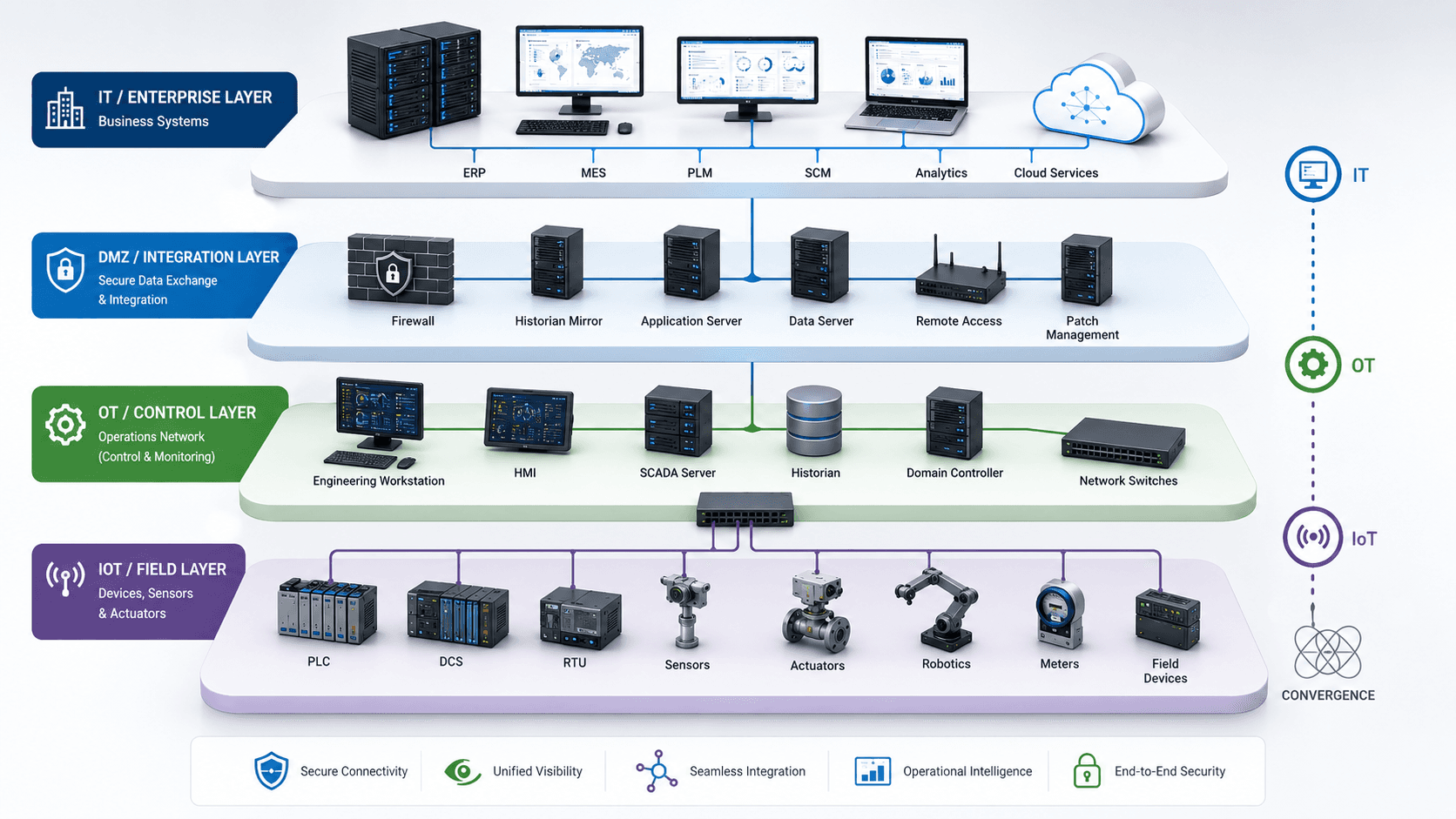
La seguridad tradicional de la tecnología de la información (IT) asume que se puede aplicar parches rápidamente, reiniciar libremente y priorizar la confidencialidad. Los entornos de tecnología operativa (OT) invierten ese orden de prioridad: la disponibilidad y la seguridad física suelen ser lo primero, las ventanas de mantenimiento para aplicar parches se miden en meses en lugar de días, y muchos dispositivos no se pueden tocar sin una parada planificada. Si a esto se suman los sensores de IoT industrial, las puertas de enlace de acceso remoto y los historiales conectados a la nube, la superficie de ataque se expande mucho más allá de lo que un programa convencional de seguridad de IT fue diseñado para defender.
Esta convergencia es precisamente la razón por la que los reguladores, las aseguradoras y las juntas directivas exigen ahora pruebas de un marco de control formal en lugar de un esfuerzo informal de buena fe. Las guías ISA/IEC 62443 y NIST existen para dar a esas pruebas una estructura común.
El panorama de amenazas detrás del impulso de cumplimiento
Los marcos de referencia no se escriben en el vacío. Las guías industriales de ISA/IEC 62443 y NIST se formaron, y se siguen revisando, en respuesta directa a incidentes que demostraron cuán frágiles son realmente muchos entornos de control.
In 2021, una intrusión de ransomware en la red de IT corporativa de un importante operador de oleoductos de EE. UU. obligó a un cierre total de las operaciones del oleoducto como medida de precaución, a pesar de que los propios sistemas de control industrial no se vieron directamente comprometidos. El evento provocó escasez de combustible en todo el este de los Estados Unidos y se convirtió en un ejemplo definitorio de cómo una brecha en el lado de IT puede desencadenar una crisis operativa cuando la segmentación entre las redes comerciales y las redes de control es débil.
Ese mismo año, un operador de una instalación de tratamiento de agua en Florida notó que un cursor se movía por sí solo a través de una sesión de acceso remoto, aumentando brevemente el nivel de hidróxido de sodio dosificado en el suministro de agua a un nivel peligroso. Un operador alerta revirtió el cambio antes de que ocurriera algún daño, pero el incidente expuso cómo una sola credencial de acceso remoto compartida, sin ninguna capa adicional de autenticación, era lo único que se interponía entre un operador legítimo y un atacante.
Más atrás en el tiempo, los ataques coordinados a la red de distribución de energía de un país europeo en 2015 y nuevamente en 2016 causaron apagones reales y físicos que afectaron a cientos de miles de clientes, uno de los primeros casos confirmados de un ciberataque que interrumpió directamente el suministro de electricidad. Un fabricante global se vio afectado por una variante destructiva de ransomware en 2019 que lo obligó a cambiar a operaciones manuales en docenas de sitios de producción durante semanas, con un costo estimado en decenas de millones de dólares.
Ninguna de estas organizaciones carecía de presupuesto para seguridad. Lo que les faltaba, en cada caso, era un marco de control estructurado que hiciera cumplir la segmentación de red, el gobierno de accesos y el monitoreo adaptados específicamente a su entorno industrial. Esa es la brecha que los controles de ISA/IEC 62443 y NIST están diseñados para cerrar.
Vale la pena detenerse en la dimensión financiera de estos eventos, ya que a menudo es lo que finalmente transforma un programa de seguridad de CPS de una lista de deseos técnicos a una iniciativa financiada. Más allá de los pagos directos de rescate y los costos de recuperación, los operadores suelen absorber la pérdida de ingresos por producción, sanciones regulatorias, responsabilidades contractuales con clientes intermedios, primas de ciberseguros más altas en la renovación y, en algunos casos, la pérdida de confianza de los accionistas o del público que tarda años en reconstruirse. Las aseguradoras que suscriben riesgos industriales exigen cada vez más pruebas documentadas de un marco de control reconocido antes de extender o renovar la cobertura, y las juntas directivas están comenzando a tratar la postura de seguridad de OT como una cuestión fiduciaria en lugar de un asunto puramente técnico.
Por qué los reguladores están elevando el nivel de exigencia
La presión regulatoria ha seguido la misma trayectoria que el panorama de amenazas. Las empresas de energía eléctrica en América del Norte ya operan bajo las normas de confiabilidad NERC CIP, que exigen controles específicos en torno al acceso, el monitoreo y la gestión de la configuración para los activos del sistema eléctrico principal. Los operadores de agua y aguas residuales están experimentando un mayor escrutinio vinculado a guías específicas del sector. A los fabricantes que abastecen a clientes gubernamentales o de defensa se les pide que demuestren una madurez de control que se asocie directamente con las publicaciones de NIST. En casi todos los casos, la expectativa subyacente es la misma: demostrar, con evidencia, que realmente se está siguiendo un marco reconocido, y no simplemente hacer referencia a él en un documento de política que nadie fuera del equipo de seguridad ha leído.
Comprensión del marco ISA/IEC 62443
ISA/IEC 62443 es la serie de normas reconocidas internacionalmente y desarrolladas específicamente para la seguridad de los sistemas de automatización y control industrial. A diferencia de los marcos generales de seguridad empresarial, fue escrita por personas que entienden que una red de control no puede tratarse simplemente como una red de oficina con más candados en la puerta.
Zonas y conductos
La base de la norma IEC 62443 es la idea de dividir una red industrial en zonas (agrupaciones lógicas o físicas de activos que comparten los mismos requisitos de seguridad) conectadas por conductos, que son las vías de comunicación entre ellas. Un sistema instrumentado de seguridad, una red de control de procesos y una red comercial corporativa nunca deben estar en la misma zona. Cada conducto entre zonas se convierte en un punto de control monitoreado y restringido, en lugar de una vía libre para el movimiento lateral.
Niveles de seguridad (SL 0 a SL 4)
La norma IEC 62443 define cinco niveles de seguridad, desde SL 0 (sin protección específica) hasta SL 4 (protección contra adversarios sofisticados y con amplios recursos). En lugar de aplicar un nivel de protección general en todas partes, la norma espera que las organizaciones evalúen el nivel de seguridad objetivo que cada zona realmente necesita en función de las consecuencias de una vulneración, y luego diseñen controles para cumplirlo. Un servidor de historial en una zona de informes podría situarse razonablemente en SL 1 o SL 2. El controlador que gestiona un sistema de alivio de presión casi con certeza necesita un nivel SL 3 o superior.
Requisitos fundamentales
Cada control exigido por la norma se remonta a siete requisitos fundamentales: control de identificación y autenticación, control de uso, integridad del sistema, confidencialidad de los datos, flujo de datos restringido, respuesta oportuna a eventos y disponibilidad de recursos. Estas siete categorías brindan a los equipos de seguridad un lenguaje común para describir brechas, independientemente del proveedor, el protocolo o el tipo de planta.
La serie ISA/IEC 62443 de un vistazo
Parte de la norma | Área de enfoque | Audiencia principal |
IEC 62443-1-1 | Terminología, conceptos y modelos para el marco general | Todas las partes interesadas |
IEC 62443-2-1 | Establecimiento de un sistema de gestión de ciberseguridad para un operador | Propietarios de activos, líderes de seguridad de OT |
IEC 62443-3-2 | Metodología de evaluación de riesgos y definición de zonas/conductos | Equipos de ingeniería y seguridad |
IEC 62443-3-3 | Requisitos de seguridad a nivel de sistema y niveles de seguridad | Integradores de sistemas, arquitectos |
IEC 62443-4-1 | Requisitos del ciclo de vida de desarrollo de productos seguros | Proveedores de equipos y software |
IEC 62443-4-2 | Requisitos técnicos de seguridad a nivel de componente | Fabricantes de componentes |
Dónde encajan las guías de NIST en este panorama
Si la norma IEC 62443 proporciona los detalles a nivel de ingeniería para los sistemas de control, el NIST aporta el lenguaje de gestión de riesgos más amplio que vincula la seguridad de OT con el gobierno corporativo general, el cumplimiento y la conversación sobre riesgos de negocio de una organización, lo cual es sumamente importante cuando un líder de seguridad necesita justificar el presupuesto ante una junta directiva o satisfacer a un regulador.
El Marco de Ciberseguridad de NIST (CSF)
El Marco de Ciberseguridad de NIST organiza la actividad de seguridad en funciones principales: Gobernar, Identificar, Proteger, Detectar, Responder y Recuperar. Es un marco diseñado intencionalmente de manera agnóstica respecto al sector, lo que lo hace útil como una estructura de reporte común que una planta de fabricación, una empresa de servicios públicos y un hospital pueden utilizar para comunicar su postura de riesgo en los mismos términos, a pesar de que sus controles técnicos subyacentes difieran sustancialmente.
NIST SP 800-82: Guía para la seguridad de la tecnología operativa (OT)
La Publicación Especial 800-82 de NIST es el documento que más directamente se compara con la norma IEC 62443 en cuanto a profundidad técnica. Aborda temas específicos de ICS, como la arquitectura de red, la protección de fronteras de red, las limitaciones de la gestión de parches y las realidades operativas de entornos donde un lazo de control no puede desconectarse simplemente para una actualización de la forma en que se haría con un servidor de oficina.
El Marco de Sistemas Ciberfísicos de NIST
El Marco de CPS de NIST da un paso atrás y analiza los sistemas ciberfísicos como una disciplina de ingeniería por derecho propio, cubriendo simultáneamente la confiabilidad a través de la seguridad física, la seguridad digital, la fiabilidad, la resiliencia y la privacidad. Es especialmente útil para organizaciones que diseñan nuevas implementaciones de CPS, ya que promueve que los requisitos de seguridad se integren desde el diseño en lugar de adaptarse después de la puesta en marcha.
Cómo se complementan los controles ISA/IEC 62443 y NIST
Los líderes de seguridad a veces preguntan qué marco deberían elegir. La respuesta sincera es que nunca fueron diseñados para competir. La norma IEC 62443 le indica a un equipo de ingeniería exactamente cómo segmentar una red y qué controles técnicos necesita un componente. La guía de NIST le indica a un equipo ejecutivo cómo gobernar el programa, reportar sobre él y alinearlo con la gestión de riesgos empresariales más amplia, incluidas las obligaciones que puedan corresponder bajo NERC CIP para el sector eléctrico u otros regímenes regulatorios.
Alineación de marcos para un programa de seguridad de CPS
Necesidad del programa | Contribución de IEC 62443 | Contribución de NIST |
Evaluación de riesgos | Metodología de riesgo basada en consecuencias y zonas/conductos (62443-3-2) | Función Identificar; categorización de activos y riesgos |
Controles técnicos | Requisitos detallados del sistema y componentes (62443-3-3, 4-2) | Referencias cruzadas del catálogo de controles (SP 800-53, SP 800-82) |
Gobernanza y reportes | Sistema de gestión de ciberseguridad (62443-2-1) | Función Gobernar; comunicación de riesgos a nivel de junta directiva |
Respuesta a incidentes | Respuesta oportuna a eventos (requisito fundamental) | Funciones Responder y Recuperar con planes de acción definidos |
Garantía de proveedores | Ciclo de vida de desarrollo de productos seguros (62443-4-1) | Guía de gestión de riesgos en la cadena de suministro |
Utilizados en conjunto, ambos marcos dotan a un programa de seguridad tanto de precisión técnica como de credibilidad en su gobierno corporativo, que es exactamente lo que los auditores, las aseguradoras y las juntas directivas esperan ver cada vez más.
Desafíos comunes que enfrentan los operadores al construir un programa de cumplimiento
Casi todas las organizaciones que inician este camino se topan con el mismo puñado de obstáculos. Reconocerlos a tiempo evita meses de esfuerzo perdido.
Visibilidad incompleta de los activos: muchos sitios aún no pueden generar un inventario preciso y actualizado de cada PLC, RTU, HMI y switch de red en el entorno, lo que hace que cualquier evaluación de riesgos sea poco confiable desde el principio.
Equipos heredados sin funciones de seguridad: los controladores instalados hace quince o veinte años nunca se diseñaron para soportar métodos modernos de autenticación o cifrado, lo que obliga a aplicar controles de compensación en lugar de una remediación directa.
Redes planas y no segmentadas: sin zonas y conductos definidos, una sola estación de trabajo comprometida puede potencialmente alcanzar controladores críticos para la seguridad sin ningún punto de control intermedio.
Acceso remoto no gestionado: los proveedores externos y los ingenieros remotos a menudo se conectan a través de credenciales compartidas o túneles VPN persistentes, sin registro de sesiones ni acceso limitado en el tiempo.
Fricción cultural entre los equipos de IT y OT: las diferencias de prioridad en torno al tiempo de actividad, el control de cambios y la aplicación de parches pueden frenar el progreso a menos que ambos equipos se integren en el mismo proceso de gobernanza.
Fatiga de auditoría sin mejoras medibles: algunos programas generan documentación de cumplimiento sin reducir de manera efectiva el riesgo explotable, lo que desgasta el apoyo de la dirección con el paso del tiempo.
Recomendaciones prácticas para construir un marco de controles de seguridad de CPS
Un programa de cumplimiento que realmente resista un incidente, una auditoría o una revisión de seguros tiende a seguir una secuencia lógica. El orden importa: pasar directamente a los controles técnicos antes de establecer la visibilidad y el gobierno corporativo es una de las razones más comunes por las que se estancan los programas de seguridad de OT.
Comience con un inventario de activos completo y activo en cada sistema de control, segmento de red y punto de acceso remoto; esta es la base no negociable para ambos marcos.
Realice una evaluación de riesgos basada en consecuencias alineada con la norma IEC 62443-3-2 para definir zonas, conductos y niveles de seguridad objetivo para cada parte del entorno.
Establezca una segmentación de red con una zona desmilitarizada (DMZ) debidamente diseñada entre IT y OT, en lugar de una única regla de firewall que separe a ambos entornos.
Reemplace las credenciales de acceso remoto compartidas y permanentes por accesos atribuidos individualmente y con límite de tiempo, junto con autenticación multifactor para cada conexión externa a la red de control.
Desarrolle un proceso de gestión de parches y vulnerabilidades que tenga en cuenta las ventanas de mantenimiento y las limitaciones de seguridad física, en lugar de asumir que se aplican los mismos ciclos de parches que en IT.
Implemente un monitoreo con reconocimiento de OT que entienda los protocolos industriales, de modo que se puedan detectar comandos anómalos y no solo un volumen de tráfico inusual.
Mapee los controles existentes y planificados tanto con los requisitos fundamentales de IEC 62443 como con las funciones principales de NIST CSF para identificar brechas reales en lugar de duplicar esfuerzos.
Documente y practique un plan de respuesta a incidentes específico para OT (consulte la siguiente sección), en lugar de depender únicamente de un manual corporativo de IT que asuma que los sistemas simplemente se pueden desconectar.
Extienda los requisitos de la cadena de suministro a los proveedores e integradores, haciendo referencia a las normas IEC 62443-4-1 y 4-2 en el lenguaje de adquisición para nuevos equipos y software.
Revise la evaluación de riesgos y los niveles de seguridad en un ciclo definido, ya que la nueva conectividad, los nuevos proveedores y las nuevas amenazas cambian el panorama continuamente.
Respuesta y recuperación ante incidentes para entornos ciberfísicos
La respuesta a incidentes en un entorno CPS no puede ser una copia exacta del plan corporativo de IT. Un evento de ransomware en una red comercial es disruptivo; un evento de ransomware que alcanza una red de control puede obligar a un cierre de emergencia de un proceso físico, con consecuencias de seguridad física y ambientales que un manual estándar de IT nunca fue diseñado para abordar.
Un plan eficaz de respuesta a incidentes de OT define, de antemano, exactamente qué sistemas se pueden aislar sin comprometer la seguridad, quién tiene la autoridad para ordenar una parada manual, cómo operarán los operadores el proceso si se pierde el control digital y cómo se restaurarán los sistemas a partir de copias de seguridad verificadas y en buen estado, en lugar de simplemente volver a conectarlos. Las funciones Responder y Recuperar de NIST proporcionan la estructura de gobernanza para esto, mientras que el requisito fundamental de IEC 62443 para la respuesta oportuna a eventos define la capacidad técnica de detección y alerta que debe existir para que todo esto funcione en la práctica.
La planificación de la recuperación también debe tener en cuenta la preservación de pruebas forenses. En varios de los incidentes mencionados anteriormente, los investigadores determinaron posteriormente que los datos de registro críticos se habían sobrescrito o nunca se habían capturado en la capa de OT, lo que ralentizó el análisis de causa raíz y dificultó confirmar si la intrusión se había contenido por completo antes de volver a poner los sistemas en línea.
Un plan de respuesta a incidentes de OT bien estructurado se pone a prueba, no solo se escribe. Los ejercicios de simulación de escritorio que guían a equipos multidisciplinarios (ingeniería, operaciones, seguridad de IT, seguridad física y liderazgo ejecutivo) a través de una intrusión simulada o un evento de ransomware en la red de control tienden a revelar brechas que ninguna revisión de documentos detecta: falta de claridad sobre la autoridad para declarar una parada de emergencia, datos de contacto inexistentes de un proveedor clave a las dos de la mañana o un proceso de restauración de copias de seguridad que nunca se ha probado de principio a fin. Realizar estos ejercicios al menos una vez al año, y después de cualquier cambio significativo en la arquitectura de red, mantiene el plan vigente y realista.
Por qué esto pertenece a la agenda de liderazgo y no solo al equipo de seguridad
Vale la pena ser directo sobre por qué los líderes de seguridad de OT, los gerentes de planta y los CISO se benefician específicamente de comprender este material en profundidad, en lugar de delegarlo por completo a una función de cumplimiento. Un incidente en sistemas ciberfísicos es, por definición, un evento operativo con consecuencias en la seguridad física, el medio ambiente y la producción. Las decisiones sobre el tiempo de inactividad aceptable, la autoridad para la parada manual y la secuencia de recuperación son decisiones de negocio y de ingeniería tanto como lo son de seguridad, y conllevan un peso legal y reputacional cuando las cosas salen mal.
Presentar la adopción de ISA/IEC 62443 y NIST puramente como una obligación de cumplimiento tiende a producir exactamente el problema de fatiga de auditoría descrito anteriormente: papeleo que satisface a un auditor sin cambiar de manera significativa lo que sucede en el piso de la planta. Presentarlo en cambio como un programa de resiliencia operativa, donde el cumplimiento es una consecuencia natural de hacer el trabajo de forma correcta, suele producir el resultado opuesto: una postura de seguridad que resiste bajo presión real y una documentación que se genera por sí sola porque los controles realmente están implementados y en uso activo.
Cómo apoya Shieldworkz a las organizaciones
Shieldworkz trabaja junto a los operadores industriales para traducir las guías ISA/IEC 62443 y NIST en un programa de seguridad práctico y específico para cada planta, en lugar de una carpeta estática de documentos de políticas. Ese apoyo incluye típicamente:
Descubrimiento integral de activos de OT y CPS para establecer un inventario verificado y continuamente actualizado en redes de control y dispositivos de campo.
Evaluaciones de riesgo basadas en consecuencias alineadas con la norma IEC 62443-3-2, lo que resulta en zonas, conductos y niveles de seguridad objetivo claramente definidos para cada parte de la operación.
Análisis de brechas que compara los controles actuales con los requisitos fundamentales de la norma IEC 62443 y el Marco de Ciberseguridad de NIST, priorizados por el riesgo operativo real en lugar del volumen de una lista de verificación.
Diseño de segmentación de red y acceso remoto seguro, incluida la arquitectura DMZ y el acceso de proveedores con límite de tiempo y atribución individual.
Monitoreo y detección de amenazas con reconocimiento de OT ajustados a protocolos industriales, para que las anomalías se identifiquen en su contexto operativo y no solo como ruido de red.
Desarrollo y pruebas de simulación de escritorio de planes de respuesta y recuperación ante incidentes específicos de OT, construidos en torno a limitaciones operativas reales y requisitos de seguridad física.
Orientación sobre seguridad de proveedores y cadena de suministro alineada con las normas IEC 62443-4-1 y 4-2, respaldando las decisiones de adquisición de nuevos equipos de sistemas de control.
Soporte continuo de cumplimiento para auditorías y revisiones regulatorias, presentando evidencia de controles en el lenguaje que tanto los ingenieros como los auditores comprenden.
El objetivo es un programa de seguridad que un gerente de planta pueda operar en su día a día, un CISO pueda defender ante la junta directiva y un auditor pueda verificar con confianza, todo ello sin interrumpir los procesos físicos de los que depende la organización.
Medición del progreso: Cómo se ve un programa de seguridad de CPS maduro
Debido a que ambos marcos están estructurados en torno a la mejora continua y no a una certificación única, resulta útil contar con indicadores concretos de que un programa realmente está madurando y no simplemente generando documentación. Un puñado de señales medibles suele correlacionarse estrechamente con una reducción real del riesgo en el piso de la planta.
Indicadores de madurez del programa de seguridad de CPS
Indicador de madurez | Programa en etapa inicial | Programa maduro |
Inventario de activos | Hoja de cálculo manual, actualizada ocasionalmente | Descubrimiento automatizado, validado continuamente |
Segmentación de red | Red plana o un único límite de firewall | Zonas y conductos definidos con puntos de control monitoreados |
Acceso remoto | Credenciales compartidas, acceso VPN permanente | Atribuido individualmente, con límite de tiempo y MFA obligatorio |
Respuesta a incidentes | Plan genérico de IT referenciado pero no probado | Plan específico de OT, probado mediante simulaciones anualmente |
Requisitos de proveedores | No se abordan en las adquisiciones | Lenguaje de las normas IEC 62443-4-1/4-2 en contratos |
Hacer un seguimiento de la evolución a lo largo de indicadores como estos le da a un líder de seguridad algo mucho más útil que el resultado de aprobado/reprobado de una auditoría: una narrativa basada en evidencias y defendible sobre la reducción de riesgos que puede mostrarse a una junta directiva, a una aseguradora o a un regulador cuando lo soliciten.
Conclusión
Los sistemas ciberfísicos se sitúan en la intersección del riesgo digital y la consecuencia física, y esa intersección es exactamente el espacio donde los controles ISA/IEC 62443 y NIST fueron diseñados para operar. La norma IEC 62443 proporciona a los equipos industriales la precisión a nivel de ingeniería para segmentar redes, definir niveles de seguridad y asegurar componentes individuales. Las guías de NIST otorgan a la organización la estructura de gobernanza para gestionar ese trabajo como un programa continuo de riesgo en lugar de un proyecto de una sola vez, y para comunicar el progreso con claridad al liderazgo y a los reguladores.
Ninguno de los dos marcos, si se utiliza de forma aislada o como un simple trámite administrativo, reduce el riesgo de manera significativa. Utilizados en conjunto, e implementados teniendo en cuenta las realidades operativas de un entorno industrial en vivo, ofrecen a los líderes de seguridad de OT un camino creíble, defendible y genuinamente eficaz, basado en una visibilidad real, una segmentación real y una capacidad real de detección y respuesta cuando algo sale mal.
¿Listo para conocer el estado de su programa de seguridad de CPS?
Cada entorno industrial presenta su propia combinación de equipos heredados, conectividad y riesgos. Nuestro equipo puede analizar su configuración actual, analizar cómo se aplican los controles ISA/IEC 62443 y NIST a su operación y delinear pasos prácticos a seguir, sin ningún compromiso.
Reserve una consulta gratuita con nuestros expertos
Recursos adicionales
Guía completa de detección y respuesta de red (NDR) en 2026 aquí
Libro de trabajo de la calculadora de exposición al riesgo de seguridad de OT aquí
Un informe descargable sobre el ciberincidente de Stryker aquí
Guías de remediación aquí
Mejores prácticas de seguridad de OT y guía de evaluación de riesgos aquí
Lista de verificación para la evaluación de riesgos de OT/ICS basada en IEC 62443 para el sector de fabricación de alimentos y bebidas aquí
Recibe semanalmente
Recursos y Noticias
Vea cómo nuestras soluciones de seguridad de OT líderes en la industria abordan los desafíos de seguridad críticos
También te puede interesar

Fresenius medical care cyber incident: Investigating trusted access, third-party exposure and enterprise blast radius
Team Shieldworkz

OT Removable Media Security: Close the USB Risk Gap Before It Reaches Production
Team Shieldworkz
The Canva breach and the hidden risk of third-party trust
Prayukth K V

NERC CIP Compliance Assessment: Find Gaps Before Auditors Do
Team Shieldworkz

Beyond substitution: Strategic takeaways from India’s SCADA indigenisation
Team Shieldworkz

Investigative cyber threat research report: Colorado water utilities OT attacks
Prayukth K V