Team Shieldworkz
On September 22, 2026, Fresenius Medical Care disclosed that it was investigating a cybersecurity incident involving unauthorized access to a limited number of internal systems. The company stated that medical devices, patient care, manufacturing operations and business continuity had not been impacted. It did not disclose the date of initial access, the systems involved, the attack vector, or whether data had been accessed or exfiltrated.
Rather than treating this event as an isolated narrative, this Threat Intelligence Report uses the Fresenius Medical Care incident as a focal case study to analyze the operational realities of modern enterprise intrusions. We examine how unauthorized access penetrates enterprise perimeters, how incident responders must evaluate potential initial access vectors without resorting to ungrounded assumptions, and how the convergence of clinical, corporate, and supplier ecosystems expands the enterprise blast radius
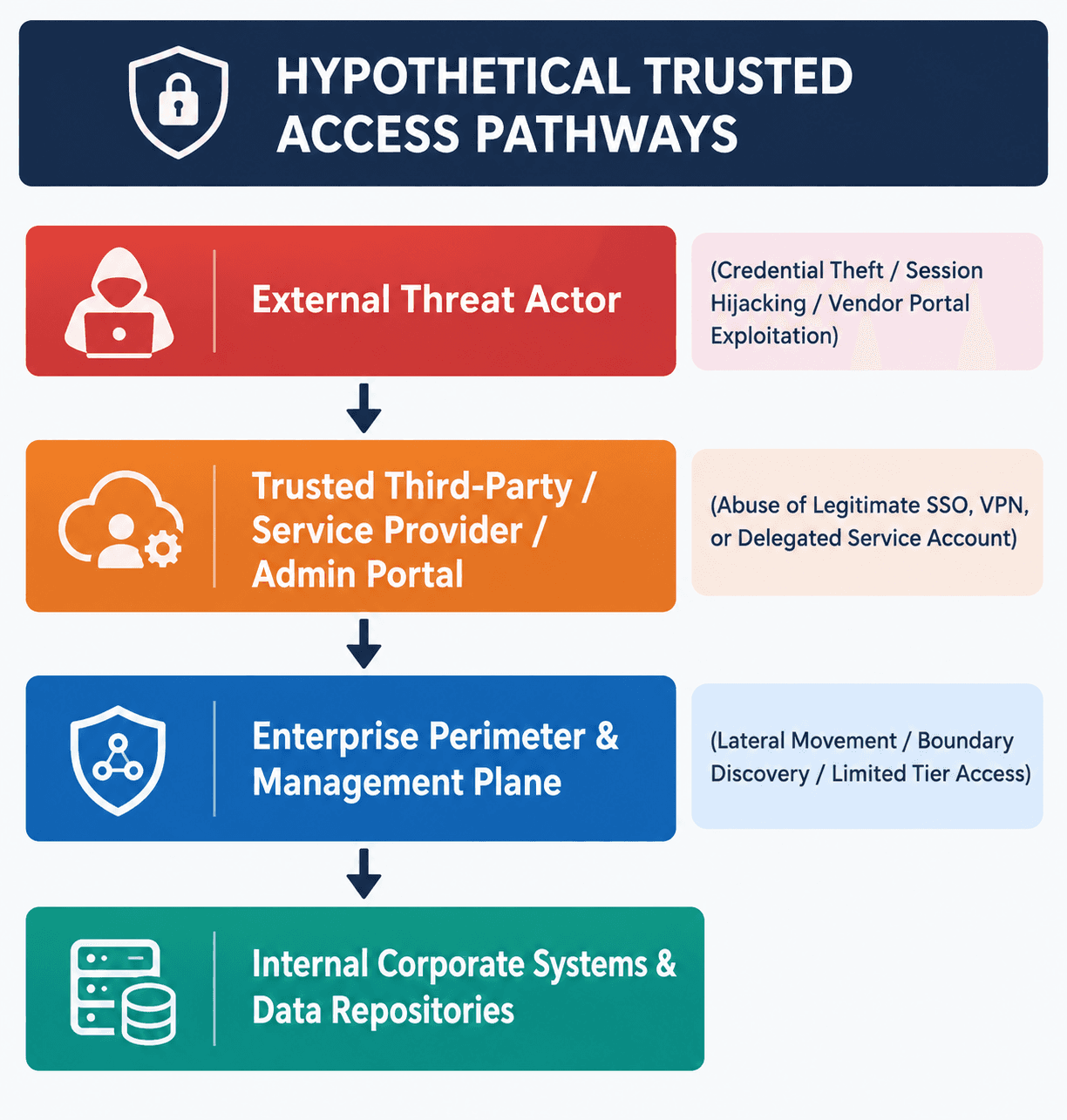
One of the most consequential enterprise risks illustrated by incidents of this type is the asymmetry of trusted access: an attacker who obtains legitimate credentials, delegated permissions or access through a trusted service relationship may inherit capabilities that are difficult to distinguish from legitimate business activity.
What we know
Based exclusively on official disclosures from Fresenius Medical Care, regulatory filings, and verified authoritative sources, the confirmed facts are limited to the following parameters:
Unauthorized System Access: An unauthorized third party gained access to a limited number of Fresenius Medical Care’s internal corporate IT systems.
Operational Isolation: Clinical patient care, dialysis operations, medical devices (such as kidney dialysis machines and connected care platforms), and manufacturing infrastructure were not impacted by the incident. (FMC reported no impact to medical devices, patient care, manufacturing operations or business continuity.)
Containment Execution: FMC stated that it took steps to contain and address the incident upon discovery. The company has not publicly disclosed the specific containment mechanisms used.
External Investigation: Forensic experts from external cybersecurity experts were retained to investigate the scope, root cause, and depth of the intrusion.
Regulatory & Law Enforcement Engagement: Law enforcement agencies were formally notified. FMC stated that it would comply with applicable legal and regulatory obligations as the investigation progresses.
What we do not yet know
In strict accordance with CTI evidence standards, the following aspects remain unconfirmed and must be classified as open investigative hypotheses:
Initial Access Vector: The specific entry point (e.g., stolen credentials, unpatched edge device vulnerability, phishing, or third-party supply chain compromise) has not been publicly disclosed or independently verified.
Threat Actor Attribution: No specific threat group (nation-state, ransomware affiliate, or cybercrime syndicate) has been conclusively linked to this activity by official forensic leads.
Dwell Time: The precise date of initial access and the duration of unauthorized actor presence prior to detection remain unstated.
Exfiltration Status: Whether data was staged, previewed, or exfiltrated from the affected internal systems is currently unconfirmed by public forensic statements.
Monetary / Extortion Claims: No verifiable ransom demand or public dark-web leak site post directly corroborated by forensic evidence has been validated at the time of publication.
Incident timeline
The following timeline details confirmed disclosures and analytical milestones associated with the September 2026 incident.
Date / Period | Event | Evidence status |
Unknown | Initial unauthorized access allegedly occurred | Unknown |
Unknown | FMC detected the incident | Confirmed that the incident was discovered; detection mechanism/date unknown |
22 Sep 2026 | FMC publicly disclosed unauthorized access to a limited number of internal systems | Confirmed |
22 Sep 2026 | FMC stated that medical devices, patient care, manufacturing operations and business continuity were not impacted | Confirmed company statement |
22 Sep 2026 | FMC stated that containment measures were taken and external cybersecurity experts engaged | Confirmed company statement |
22 Sep 2026 | FMC stated that law enforcement was notified | Confirmed company statement |
24 Sep 2026 | Public technical details concerning initial access, affected systems and data access remain unavailable | Public-record assessment |
Evidence and confidence matrix
To ensure rigorous intelligence discipline, available statements and claims are mapped against standard CTI analytical confidence levels.
Question | Current Evidence | Classification | Confidence |
Did unauthorized activity reach clinical or manufacturing systems? | FMC states these operations were not impacted; no technical evidence has been publicly disclosed. | UNKNOWN / NO PUBLIC EVIDENCE OF IMPACT | Low–Moderate |
Did network segmentation prevent lateral movement? | No technical architecture or forensic evidence has been publicly released. | UNKNOWN | None |
Reconstructing the potential attack path
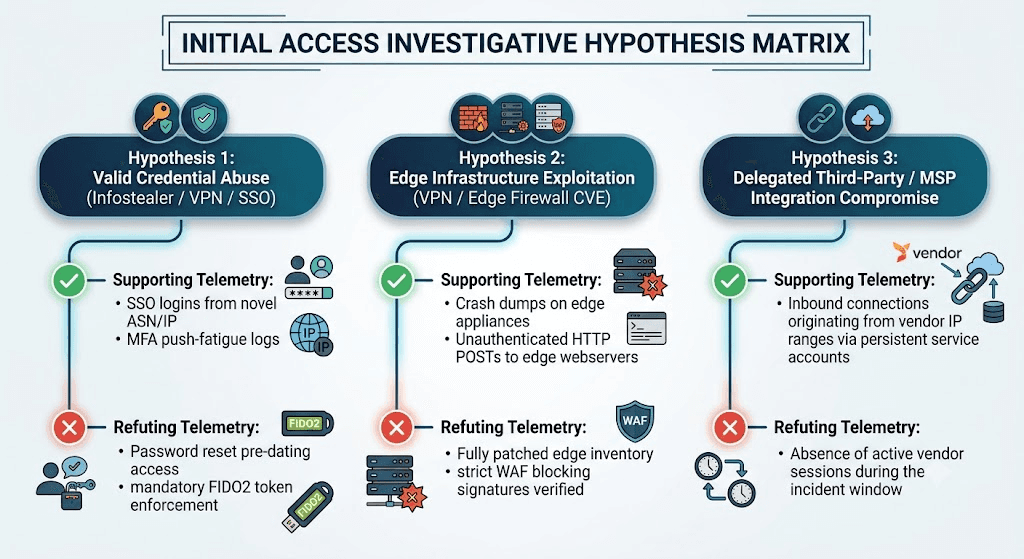
To assist security teams in understanding how complex enterprise breaches occur, we present an Investigative Hypothesis Matrix. This matrix outlines potential initial access mechanisms, their corresponding investigative requirements, and the specific telemetry required to validate or refute them.
Forensic artefact requirements by vector
Compromised Credentials / Session Hijacking:
Logs to Analyze: Identity Provider (IdP) sign-in logs, SAML response assertions, Conditional Access evaluation events, browser cookie/token issuance logs.
Key Indicators: Impossible travel alerts, anomalous User-Agent strings, cookie replay from non-corporate IP addresses.
Exploitation of Edge Appliances:
Logs to Analyze: Perimeter firewall netflow, VPN concentrator system logs, unauthenticated web server access logs, reverse proxy telemetry.
Key Indicators: Memory crash dumps on edge gateway devices, unexpected outbound SSL/TLS connections from network appliances.
Abuse of Delegated Third-Party / Vendor Access:
Logs to Analyze: Service account authentication events, OAuth authorization grant logs, jump-box remote desktop (RDP/SSH) access logs.
Key Indicators: Administrative actions executed outside agreed vendor service windows, bulk query execution by service accounts.
The trusted-access problem
In modern healthcare and enterprise environments, threat actors routinely bypass perimeter controls by abusing legitimate access channels.
Exploitation vs. Abuse of Trust
Traditional Exploitation Path:
[Attacker] ──(RCE Payload)──► [Vulnerable Edge Server] ──(Privilege Escalation)──► [Internal Network]
Trusted Access Abuse Path:
[Attacker] ──(Stolen Valid Token/Key)──► [Legitimate SSO/API Gateway] ──(Pre-Authorized Rights)──► [Internal Systems]
When an attacker uses valid credentials, stolen session tokens, or pre-authorized API keys, traditional signature-based intrusion detection systems (IDS) do not trigger. The activity mirrors normal business operations. Detectability shifts entirely from signature matching to behavioral anomaly detection (e.g., a finance service account querying identity directories, or an administrative session established outside standard geographic zones).
Why "Limited Internal Systems" does not necessarily mean limited risk
In public disclosures, organizations frequently refer to unauthorized access being restricted to a "limited number of systems." From a threat intelligence and forensic perspective, system count does not equal blast radius.
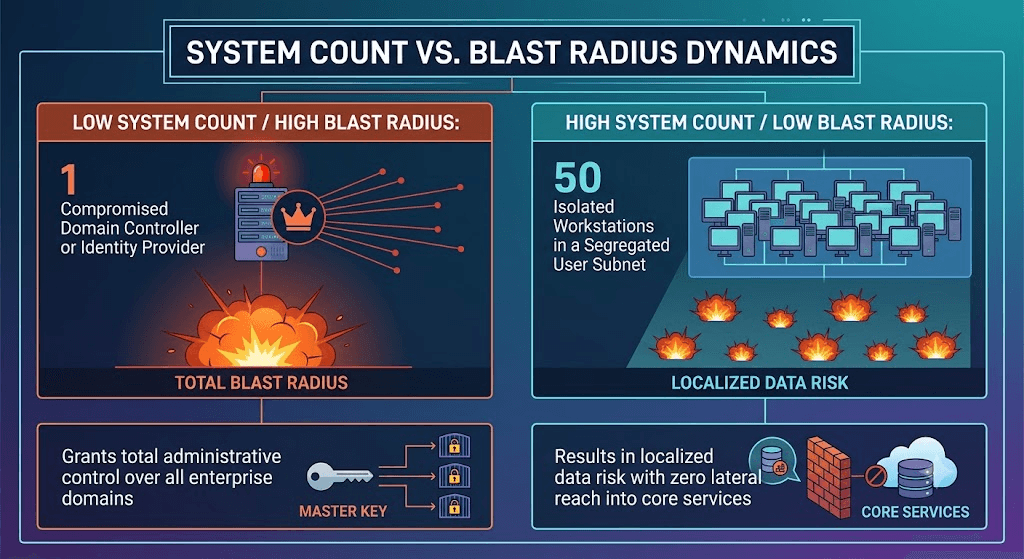
A compromise involving a single identity, management or secrets infrastructure component can create a disproportionate blast radius if that component possesses privileged access to multiple downstream systems.
Critical High-Impact System Types
A compromise of just one of the following system categories exposes the entire enterprise to catastrophic risk:
Active Directory / Identity Providers (IdP): Compromise of a highly privileged identity-management component can provide pathways to broad downstream access, depending on its configuration, trust relationships and administrative privileges.
Centralized Management Platforms: Tools like Microsoft Intune, SCCM, or Ansible can be weaponized to distribute malicious software to thousands of endpoints simultaneously.
Credential Vaults & Key Management Services: Access to CyberArk, HashiCorp Vault, or AWS Secrets Manager provides keys to all connected databases and cloud platforms.
Healthcare's Interconnected Attack Surface
Healthcare enterprises present an exceptionally complex, highly converged attack surface where clinical, corporate, and manufacturing environments intersect.

Illustrative Healthcare Enterprise Trust Model — Not a Representation of FMC's Actual Network Architecture
Architectural Segmentation Requirements
To achieve the operational isolation demonstrated in the Fresenius incident—where corporate system issues did not spill over into clinical care or manufacturing—organizations must enforce:
Network Microsegmentation: Physical or logical firewalls enforcing zero-trust ingress/egress rules between Corporate IT, Medical OT (operational technology), and Clinical IoT networks.
Identity Segmentation: Ensuring corporate Active Directory domains do not share administrative credentials or trust relationships with clinical or manufacturing networks.
Out-of-Band Monitoring: Deploy monitoring appropriate to the technologies actually present in each clinical, medical-device, manufacturing and corporate environment. Protocol-specific monitoring should be selected based on the organization's validated asset inventory rather than assumed architecture.
The Investigator's Playbook: Third-Party Compromise Checklist
When conducting forensic investigations into unauthorized access incidents, IR teams must use a structured checklist to systematically isolate the blast radius:
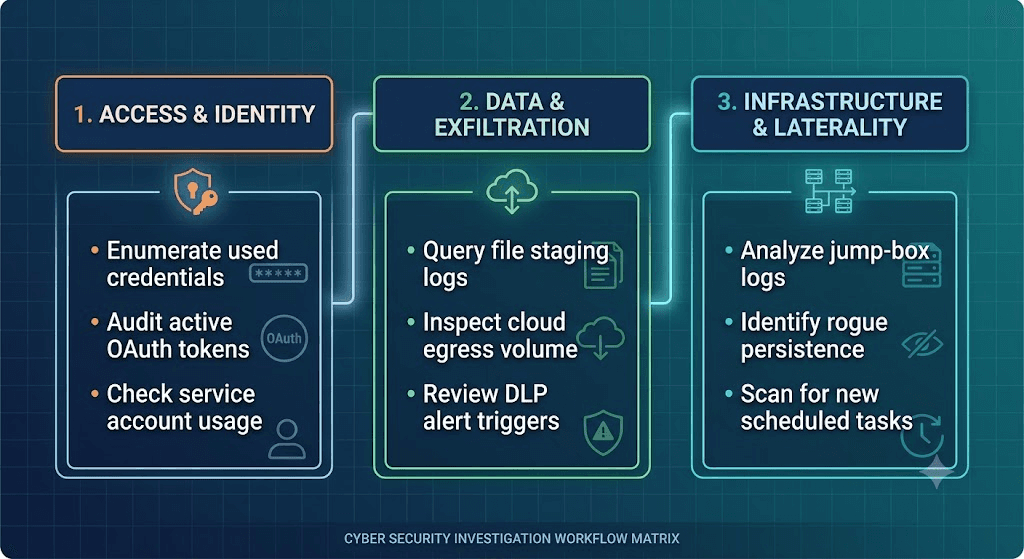
Investigative Question | Evidence to Collect | Why It Matters |
Was a vendor involved? | VPN, PAM, IdP, remote-support and vendor-session logs | Establishes whether trusted access was involved |
Which identities were used? | IdP, AD, PAM, service-account telemetry | Determines privilege and potential lateral movement |
What systems were reachable? | Firewall, NAC, segmentation and routing data | Establishes theoretical blast radius |
Was data accessed? | File, database, SaaS and API audit logs | Separates access from data compromise |
Was data staged? | Endpoint, filesystem and cloud telemetry | Identifies preparation for exfiltration |
Was data exfiltrated? | Proxy, firewall, DNS, cloud egress and DLP | Establishes actual outbound transfer |
Was persistence established? | Scheduled tasks, new accounts, tokens, OAuth grants | Determines whether access survived containment |
Essential Forensic Artifacts to Preserve
Identity Telemetry: Unified Audit Logs (UAL), Entra ID Sign-in/Audit logs, Okta SystemLog files.
Network & Perimeter Logs: NetFlow/IPFIX records, VPN authentication/session logs, Web Application Firewall (WAF) logs.
Endpoint Telemetry: Endpoint Detection and Response (EDR) process execution history, PowerShell script-block logging, Event ID 4624/4625 (Windows Logon Events).
Third-Party Breach Containment: The First 24 Hours
When an organization suspects unauthorized access originating from or involving a connected third-party or internal administrative portal, the SOC must execute a rapid containment workflow:
1.1. Isolation & Access Revocation:
Immediately suspend active SAML/SSO federations, terminate active VPN/RDP sessions, and revoke OAuth refresh tokens linked to the suspected access pathway.
2.2. Credential Emergency Rotation:
Rotate all service account credentials, API tokens, and administrative secrets shared between the affected segment and external networks.
3.3. Telemetry Preservation:
Take immutable forensic snapshots of memory, endpoint disk state, IdP audit logs, and perimeter network traffic before clearing sessions or rebooting systems.
4.4. Targeted Threat Hunting:
Execute targeted hunts across endpoint and cloud telemetry searching for lateral movement indicators (e.g., unauthorized use of psexec, WMI, or unexpected RDP connections).
5.5. Perimeter Verification:
Audit network microsegmentation boundaries to confirm that non-impacted zones (e.g., clinical networks, OT manufacturing environments) remain isolated from corporate zones.
Essentially we can consider three breach scenarios
Scenario A — Third party is suspected as initial access
Vendor → FMC
Scenario B — FMC is compromised independently but a third party has privileged access
Attacker → FMC → vendor relationship becomes secondary risk
Scenario C — FMC and supplier are both affected through a common dependency
Attacker → common provider → FMC + other customers
Illustrative Access-Path Risk Model
Organizations must develop a technical and governance mechanism known as a Third-Party Kill Switch: the ability to programmatically identify, map, suspend, and isolate all access paths belonging to a vendor or system segment within minutes of a detected anomaly.
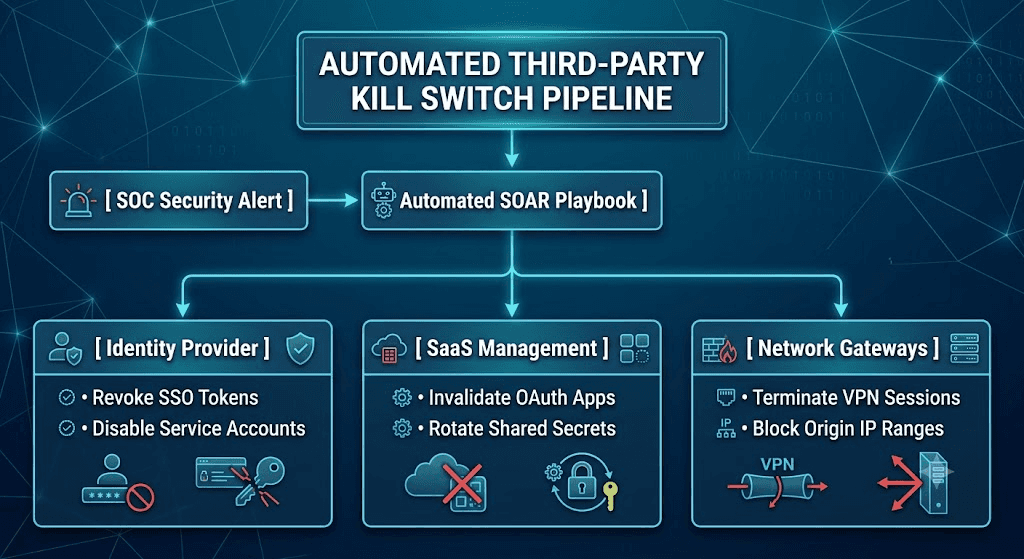
Core Architecture Requirements
Centralized Integration Registry: Maintaining a live, programmatic inventory of every third-party integration, service account, and OAuth token.
Automated Revocation Playbooks: Leveraging Security Orchestration, Automation, and Response (SOAR) platforms to disable accounts across multiple SaaS platforms simultaneously via API.
Emergency Access Procedures: Pre-approved authorization workflows allowing SOC leaders to sever vendor connections without requiring length business-side approval during an active incident.
Governance: From Vendor Risk to Access-Path Risk
Traditional TPRM mechanisms provide useful assurance about governance and control environments, but they do not necessarily reveal the operational blast radius created by a vendor's current technical access to an enterprise.
Traditional TPRM Focus:
"Does the vendor have a ISO 27001 certificate?" ──► Measures Static Compliance
Access-Path Risk Focus:
"What systems can this vendor's service account reach if compromised?" ──► Measures Operational Blast Radius
The Access-Path Risk Formula
The following is a conceptual risk model rather than a standardized quantitative methodology:
Third-Party Access Governance Framework
To mitigate trusted-access risk, enterprise security architectures must implement concrete governance controls designed to reduce access persistence and visibility gaps.
Domain | Tactical Control | Target Risk Vector |
Identity | Phishing-Resistant MFA (FIDO2 / WebAuthn) | Credential theft, SIM swapping, MFA fatigue attacks. |
Privilege Management | Just-In-Time (JIT) Privileged Access | Standing administrative privileges exploited by threat actors. |
API Security | Short-lived tokens and tightly governed refresh-token lifecycles appropriate to the application's risk profile | Token hijacking and long-term session persistence. |
Network Architecture | Zero Trust Network Access (ZTNA) | Unrestricted network-level lateral movement via VPN. |
Monitoring | Behavioral API & Session Monitoring | Misuse of legitimate valid credentials and service accounts. |
Secondary attack risks
An unauthorized access incident often serves as the initial phase of a multi-stage campaign. CISOs and threat teams must prepare for follow-on threats:
[ Initial Enterprise Intrusion ]
│
├──► Business Email Compromise (BEC) & Invoice Fraud
├──► Spear-Phishing Targeting Employees / Partners
├──► Impersonation of Vendor / Support Desk Staff
└──► Extortion & Data Staging Exploitation
Targeted Phishing & Social Engineering: Stolen internal directory information or email metadata can be weaponized to construct highly believable phishing campaigns against employees or clinical partners.
Business Email Compromise (BEC): Access to internal email systems allows threat actors to intercept ongoing commercial or billing conversations to execute payment fraud.
Vendor Impersonation: Threat actors may use compromised communication channels to message downstream partners, posing as internal IT support to harvest additional credentials.
What investigators should not conclude
To maintain analytical integrity, investigators, executives, and media analysts must avoid drawing unverified conclusions regarding the September 2026 Fresenius Medical Care incident:
Do not conclude that patient data was exfiltrated: Public statements confirm access to internal systems, but exfiltration of sensitive patient records has not been forensic confirmed.
Do not conclude that ransomware was deployed: The occurrence of unauthorized system access does not automatically imply the execution of file-encrypting malware.
Do not conclude that a third-party vendor caused the incident: While third-party access is a common enterprise attack path, no evidence currently links this specific event to a supply chain breach.
Do not infer the specific control mechanism responsible for maintaining operational continuity. FMC has stated that medical devices, patient care, manufacturing operations and business continuity were not impacted, but the public disclosure does not provide sufficient technical evidence to determine whether segmentation, access controls, detection, containment or another control was principally responsible.
Do not assign attribution to a specific threat group: Cybercrime syndicates frequently misrepresent claims on extortion sites; attribution requires rigorous digital artifact matching.
Shieldworkz assessment
Attribution: No threat actor has been publicly attributed to the incident.
Initial Access: The initial access vector remains unknown. Current public reporting does not establish whether the incident involved credential compromise, exploitation, phishing, third-party access, insider activity or another mechanism.
Objective: The available evidence is insufficient to establish attacker motivation.
Operational Impact: FMC reports no impact to medical devices, patient care, manufacturing operations or business continuity.
Data Impact: It remains publicly unknown whether information was accessed, staged or exfiltrated.
Third-Party Involvement: No public evidence currently establishes that a
was the initial access vector. Nevertheless, FMC's broader disclosures demonstrate that third-party cyber events are a material enterprise dependency risk.
Confidence: Low-to-moderate for incident-specific CTI conclusions; high for the limited set of facts directly stated by FMC.
What FMC's Historical Disclosures Tell Us
The 2024 third-party incident and the September 2026 incident should not be conflated. The former was explicitly described as a cyberattack against a third-party service provider; the latter has currently only been described by FMC as unauthorized access to a limited number of internal systems. Their relevance lies in demonstrating two different manifestations of third-party cyber risk: disruption through supplier dependency and potential compromise through enterprise access.
Dimensions of third-party risk
1. Dependency Risk
The supplier is compromised → the business service is disrupted.
Example: the 2024 financial-clearinghouse incident.
2. Access Risk
The supplier is compromised → attacker potentially inherits access into the organization’s environment.
The September 2026 FMC incident does not currently establish this, but it is the investigative question your report examines.
3. Concentration Risk
One common supplier is compromised → multiple customers become exposed simultaneously.
Key questions for CISOs and incident responders
In the wake of this incident, security leaders should put the following questions to their SOC, engineering, and risk teams:
Do we possess a live, automated inventory of every third-party service account and OAuth integration currently connected to our primary identity provider?
If an internal corporate system is compromised today, can we definitively prove that our clinical, OT, or manufacturing networks remain logically isolated?
What is our current mean-time-to-containment (MTTC) for revoking all access tokens and active sessions assigned to a specific vendor or department?
Are our SOC analysts trained to detect behavioral anomalies within valid, authenticated administrative sessions?
How frequently do we conduct tabletop exercises simulating the complete compromise of a core management platform or identity provider?
Strategic lessons
The September 2026 incident underscores two foundational principles for enterprise security design:
Defense in Depth Works When Enforced: Operational continuity is an important security outcome, but the underlying control mechanism must still be established. The absence of reported impact to medical devices, patient care and manufacturing demonstrates an important outcome; it does not, by itself, establish which security controls prevented further impact.
Identity is the New Perimeter: As physical perimeters continue to dissolve into multi-cloud and SaaS environments, identity management, token lifecycle control, and behavioral monitoring represent the primary battleground for enterprise defense.
The Fresenius Medical Care incident does not yet tell us how the attacker entered. It does, however, provide a useful investigative case study in a more important question: how should organizations determine whether trusted identities, suppliers and interconnected systems can turn a seemingly limited compromise into a much larger enterprise exposure?
When an organization cannot realistically control every connected system, device, or third-party relationship that reaches its environment, it can no longer rely on perimeter defense alone. The more actionable lesson is that enterprise exposure increasingly depends on relationships between systems, identities and organizations—not merely on the assets an organization directly owns.
By building robust microsegmentation, deploying automated third-party containment mechanisms, and focusing on behavioral anomaly detection, enterprise security teams can ensure that an intrusion into a "limited number of internal systems" remains strictly contained—protecting core business operations, critical infrastructure, and human lives.
Sources and further reading
1. Investigative report on the Stryker cyberattack
Becker’s Hospital Review: Fresenius Medical Care Says Cyber Incident Hit Internal Systems. (September 2026).
Fresenius Medical Care: Official Public Statements and Regulatory Disclosures regarding September 2026 Security Event.
CISA & HHS Health Sector Cybersecurity Coordination Center (HC3): Joint Cyber Guidance on Segmenting Clinical IoT and Corporate IT Networks.
NIST Special Publication 800-207: Zero Trust Architecture.
MITRE ATT&CK Framework: Enterprise Tactics: Trusted Relationship (T1199) and Valid Accounts (T1078).
Recibe semanalmente
Recursos y Noticias
Vea cómo nuestras soluciones de seguridad de OT líderes en la industria abordan los desafíos de seguridad críticos
También te puede interesar

OT Removable Media Security: Close the USB Risk Gap Before It Reaches Production
Team Shieldworkz
The Canva breach and the hidden risk of third-party trust
Prayukth K V

NERC CIP Compliance Assessment: Find Gaps Before Auditors Do
Team Shieldworkz

Beyond substitution: Strategic takeaways from India’s SCADA indigenisation
Team Shieldworkz

Investigative cyber threat research report: Colorado water utilities OT attacks
Prayukth K V

CEA Cyber Incident Response Requirements: How Power Utilities Can Build a Practical Security Plan
Team Shieldworkz