Deep-Dive: Der Gentlemen-Ransomware-Angriff auf Mackay Sugar


Prayukth K V
Am 10. Juni 2026 wurde Mackay Sugar, Australiens zweitgrößter Rohzuckerproduzent, Opfer eines folgenschweren Ransomware-Angriffs. Dieser ereignete sich während der kritischen Anfangswochen der jährlichen Zuckerrohr-Erntesaison. Der Vorfall erzwang die sofortige Einstellung des Zuckerrohrtransports und des Mahlbetriebs in zwei der primären Industrieanlagen in North Queensland (den Werken Farleigh und Racecourse). Die Betriebsunterbrechung löste rasch spürbare Auswirkungen auf die gesamte regionale landwirtschaftliche Lieferkette aus und zwang die lokalen Erzeuger, ihre Ernteaktivitäten aufgrund des vollständigen Ausfalls der Logistik-, Planungs- und Annahmekoordinierungssysteme komplett einzustellen.
The Gentlemen, eine hochgradig aggressive, schnell expandierende Ransomware-as-a-Service (RaaS)-Plattform, hat die Verantwortung für den Vorfall übernommen. Die Gruppe wurde erstmals Mitte 2025 gesichtet und stieg bis Anfang 2026 nach Opferzahlen zur zweitaktivsten Ransomware-Bande auf. Sie zeichnet sich durch eine beispiellose und aggressive 90/10-Umsatzaufteilung für Affiliates aus. Zudem ist sie für den Einsatz eines fortschrittlichen, sich selbst propagierenden Go-basierten Verschlüsselungswerkzeugs bekannt, das wurmartige Fähigkeiten zur lateralen Bewegung (Lateral Movement) besitzt.
Die Reaktion von Mackay Sugar erfolgte prompt. Es wurden manuelle Notfallprozesse initiiert – so wurde am 12. Juni im Werk Farleigh ein eingeschränkter, kontrollierter manueller Mahlbetrieb wieder aufgenommen, ausschließlich zur Verarbeitung von bereits geerntetem Zuckerrohr. Die vollständige Wiederherstellung der zentralen IT-OT-Orchestrierungssysteme dauert zum Zeitpunkt der Erstellung dieses Berichts jedoch noch an.
Dieser Vorfall liefert zahlreiche Erkenntnisse. Er dient als Paradebeispiel für eine indirekte Beeinträchtigung der Operational Technology (OT). Zudem verdeutlicht er, wie strukturell anfällig moderne agrarindustrielle Sektoren gegenüber cyber-physischen Ausfallzeiten sind. Selbst wenn die Schadsoftware eines Angreifers Level-1/2-Prozessleitsysteme (DCS) oder speicherprogrammierbare Steuerungen (PLCs) nicht direkt kompromittiert, kann die Verschlüsselung von Level-3/3.5-Manufacturing-Execution-Systemen (MES), der Logistikplanung und von ERP-Ressourcen die physische Produktion vollständig lahmlegen.
Weitere Vorfälle im Zusammenhang mit der Gruppe „The Gentlemen“ können hier und hier nachgelesen werden.
Chronologie der Ereignisse
Die Chronologie des Vorfalls umfasst ein enges operatives Zeitfenster während der saisonalen Hochphase:

3. Juni – 9. Juni 2026 (Mögliches Infiltrationszeitfenster): Analysteneinschätzung: Basierend auf den Standard-TTPs der Gruppe „The Gentlemen“ hat der Angreifer höchstwahrscheinlich bereits einige Tage vor Ausführung der Payload eine initiale Persistenz über Schwachstellen im Edge-Netzwerk oder kompromittierte Unternehmenszugangsdaten aufgebaut und interne Aufklärung sowie Datenabfluss (Data Exfiltration) durchgeführt.
10. Juni 2026 (Tagesanbruch): Mackay Sugar stellt einen schwerwiegenden Cybersicherheitsvorfall fest, der den Betrieb beeinträchtigt. Sicherheitsmitteilungen und -protokolle werden umgehend initiiert. Kernsysteme des Unternehmens, die Koordinierung der Zuckerrohrlieferung und Logistikplattformen sind entweder deaktiviert oder verschlüsselt.
10. Juni 2026 (Vormittag): Der Industriebetrieb in den Werken Farleigh und Racecourse wird eingestellt. Das mechanische Mahlen und der schienengebundene Rohrtransport kommen zum Stillstand. Eine dritte regionale Anlage, das Werk Marian, entgeht der unmittelbaren Störung, da der Saisonstart dort erst für die folgende Woche geplant war.
10. Juni 2026 (Mittag): Der Verband „Canegrowers Mackay“, der die regionalen landwirtschaftlichen Erzeuger vertritt, erlässt eine Notfallanweisung an alle lokalen Zuckerrohrbauern, die Erntearbeiten unverzüglich einzustellen. Geerntetes Zuckerrohr ist extrem leicht verderblich; eine Ernte ohne anschließende industrielle Verarbeitung führt zum Totalverlust der Ernte.
12. Juni 2026: Mackay Sugar gibt die Aktivierung des manuellen Notbetriebs bekannt. Ein stark eingeschränkter, manueller Mahlbetrieb wird im Werk Farleigh gestartet, um das vor der Unterbrechung geerntete Rohr zu verarbeiten. Das Unternehmen stellt ausdrücklich klar, dass zentrale Systeme für Rohrlieferung und Logistik weiterhin offline sind und kein neues Zuckerrohr angenommen wird.
15. Juni 2026: Mackay Sugar veröffentlicht ein operatives Update, das auf erhebliche Fortschritte am Wochenende bei der Wiederherstellung der zentralen IT/OT-Planungsinfrastruktur hinweist. Dampferprobungen werden zur Validierung der Systeme durchgeführt. Gleichzeitig listet die Ransomware-Gruppe „The Gentlemen“ Mackay Sugar auf ihrer Tor-basierten Leak-Seite und startet einen Countdown-Timer für die Veröffentlichung der erbeuteten Daten.
Akteursprofil: The Gentlemen (auch bekannt als Storm-2697)
Hintergrund
Die Ransomware-Operation „The Gentlemen“ wurde von globalen Cyber-Intelligence-Einheiten erstmals Mitte 2025 dokumentiert. Die Gruppe agierte anfangs als geschlossene, private Cyberkriminalitätszelle und ging um September 2025 zu einem formalisierten Ransomware-as-a-Service (RaaS)-Geschäftsmodell über.
Um sich gegen die Konkurrenz durchzusetzen und Marktanteile von etablierten RaaS-Akteuren zu gewinnen, führten die Hauptadministratoren der Gruppe, Zeta88 und Hastalamuerte, eine beispiellose 90/10-Umsatzaufteilung ein (wobei sie nur 10 Prozent der Lösegeldsumme als Provision von den Affiliates einbehalten, im Vergleich zum branchenüblichen Standard von 80/20 oder 70/30).
Es folgte eine aggressive Rekrutierungsstrategie, die hochprofessionelle Initial Access Broker (IABs), Netzwerk-Penetrationstester und erfahrene Akteure für human-operated Ransomware anzog. Im November 2025 traten innerhalb einer einzigen Woche fast 23 Affiliates dem Netzwerk bei, was den Erfolg dieser Kampagne unterstreicht.
Bekannte Werkzeuge und technische Differenzierung
Das technische Markenzeichen von „The Gentlemen“ ist ihre spezialisierte Verschlüsselungskomponente (Encryptor Payload).
Programmiersprache und Obfuskation: Die Ransomware ist in Go (Golang) kompiliert, was eine plattformübergreifende Flexibilität bietet, und mittels Garble stark obfuskert, um statische Signaturen zu verschleiern und das Reverse Engineering zu erschweren.
Kryptografische Architektur: Der Encryptor nutzt eine hochperformante Doppel-Schlüssel-Struktur, die temporäre Curve25519-Schlüssel (Elliptic Curve Cryptography) pro Datei mit der XChaCha20-Stromchiffre kombiniert. Dies gewährleistet eine extrem schnelle Verschlüsselung auch auf großen Speichersystemen und minimiert das Zeitfenster für Erkennungs- und Reaktionsteams, um vor der vollständigen Sperrung der Daten zu intervenieren.
Wurmartige Ausbreitung: Im Gegensatz zu typischen Ransomware-Varianten, die manuelle administrative Skripte (wie PsExec oder Gruppenrichtlinienobjekte) zur Verteilung im internen Netzwerk erfordern, verfügt der Encryptor von „The Gentlemen“ über integrierte, parallele Selbstverbreitungsfunktionen. Nach der Ausführung startet er selbstständig automatisierte Routinen zur lateralen Bewegung in benachbarten Subnetzen, wodurch innerhalb weniger Stunden ganze Active-Directory-Strukturen autonom kompromittiert werden können.

Mackay Sugar: Vorfallsbericht
Um die Integrität dieser Analyse zu wahren, trennt sie strikt zwischen verifizierten offiziellen Erklärungen des Unternehmens und fundierten Analystenbewertungen auf Basis von Cyber-Intelligence-Erkenntnissen.
Bestätigte Fakten
Betriebsstillstand: Mackay Sugar bestätigte, dass ein Cybersicherheitsvorfall am 10. Juni 2026 die Betriebskontinuität beeinträchtigt hat. Der Transport und der Mahlbetrieb in den Werken Farleigh und Racecourse wurden unverzüglich eingestellt.
Auswirkungen auf die Lieferkette: Die Anlieferung landwirtschaftlicher Erzeugnisse wurde gestoppt. Canegrowers Mackay bestätigte die Einstellung der Ernte in mehreren Bezirken.
Erpressungsstatus: Am 15. Juni 2026 fügte die Ransomware-Gruppe „The Gentlemen“ Mackay Sugar zu ihrem Register auf der Tor-Leak-Seite hinzu. Derzeit gibt es keine öffentlich zugänglichen Beweise dafür, dass Unternehmensdaten vollständig exfiltriert oder im Internet veröffentlicht wurden, und Mackay Sugar hat eine Datenpanne oder Verhandlungen über Lösegeldzahlungen nicht öffentlich bestätigt.
Wiederherstellungsmaßnahmen: Der Industriebetrieb wurde am 12. Juni teilweise über manuelle Prozesse wieder aufgenommen, um spezifische Dampferprobungen durchzuführen und vorhandene Bestände abzuarbeiten. Die vollständige Wiederherstellung der automatisierten Logistiksysteme ist noch im Gange.
Analysteneinschätzung
Die IT/OT-Schnittstellenproblematik: Es gibt keine expliziten Hinweise darauf, dass die Angreifer Zugriff auf Steuerungsnetzwerke der Ebene 1 oder Ebene 2 erlangt haben (wie etwa durch die Kompromittierung von SCADA-Servern oder speicherprogrammierbaren Steuerungen der Sicherheitsgerichtetheit). Unsere analytische Bewertung deutet vielmehr darauf hin, dass der Betriebsstillstand durch die Abhängigkeit der physischen Prozesse von der industriellen IT-Infrastruktur auf Ebene 3/3.5 verursacht wurde.
Logistik als operativer Notausschalter: Die moderne Rohzuckerproduktion erfordert eine präzise, kontinuierliche Just-in-Time-Logistik. Zuckerrohr muss innerhalb von 24 bis 48 Stunden nach dem Schnitt gemahlen werden, um einen Abbau der Saccharose zu verhindern. Die Systeme zur Steuerung des automatisierten Schmalspur-Werkbahnnetzes, der Transportpläne und der Waagen an der Werkannahme sind nativ mit der IT-Domäne des Unternehmens verbunden. Durch die Lahmlegung dieser Planungsdatenbanken haben die Angreifer effektiv einen physischen Stillstand der Werke herbeigeführt, ohne ein einziges physisches Ventil oder einen drehzahlgeregelten Antrieb manipulieren zu müssen.
Möglicher Angriffspfad
Basierend auf dem historisch dokumentierten Verhalten von Storm-2697 und den typischen Netzwerktopologien in regionalen agrarindustriellen Umgebungen hat Shieldworkz die folgende, hochgradig plausible hypothetische Angriffskette rekonstruiert. Hierbei handelt es sich um ein analytisches Modell und nicht um eine gerichtlich bestätigte forensische Sequenz des Vorfalls bei Mackay Sugar.
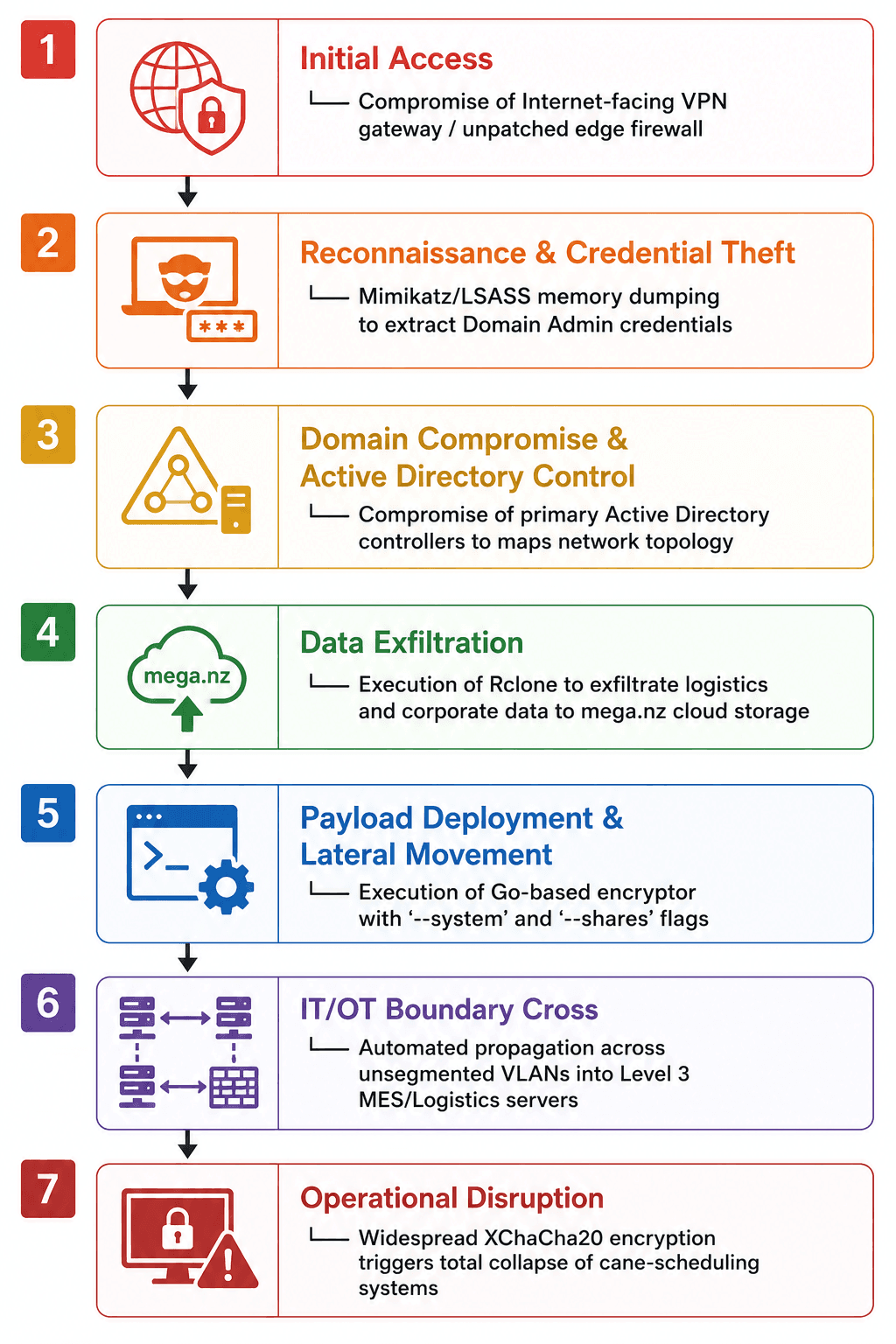
Initialer Zugriff: Der Angreifer nutzt eine bekannte Schwachstelle in einem externen VPN-Gateway aus oder erlangt Zugriff über kompromittierte Zugangsdaten eines Drittanbieters, für die keine Multifaktor-Authentisierung (MFA) eingerichtet war.
Diebstahl von Zugangsdaten und Privilegienausweitung: Sobald der Angreifer im Unternehmensnetzwerk ist, führt er automatisierte Tools zum Diebstahl von Zugangsdaten aus (z. B. Auslesen des LSASS-Speichers), um administrative Zugangsdaten zu kompromittieren und sich schnell Berechtigungen als Domänen-Administrator zu verschaffen.
Ausspähung und Datenabfluss: Der Akteur analysiert interne Dateifreigaben mit Fokus auf Level-3-Manufacturing-Execution-Systeme (MES), ERP-Systeme und Logistikdatenbanken. Kritische Verzeichnisse werden komprimiert und über verschlüsselte Kanäle (z. B. Rclone über HTTPS) zu Cloud-Speicheranbietern exfiltriert.
Ausführung der Payload: Der primäre Akteur führt den Encryptor von „The Gentlemen“ aus. Die Binärdatei führt sofort Befehle aus, um lokale Sicherheitsfunktionen zu deaktivieren, Schattenkopien zu löschen (vssadmin delete shadows) und Sicherheits-Agents zu stoppen.
Autonome Verbreitung: Unter Verwendung des Parameters --shares fragt die Go-basierte Wurm-Routine das Active Directory und SMB-Freigaben ab. Sie kopiert die ausführbare Datei in benachbarte Netzwerkzonen und überwindet so unsegmentierte oder unzureichend abgesicherte IT/OT-Grenzen hinweg den Weg in die industrielle demilitarisierte Zone (IDMZ) und die Level-3-Produktionsnetzwerke.
Physischer Stillstand: Die automatisierten Systeme zur Koordinierung der Zuckerrohrannahme, die Dashboards zur Überwachung der Industriekessel und die Telemetriedatenbanken werden zeitgleich verschlüsselt. Dies zwingt die Bediener dazu, eine manuelle Notabschaltung der Werke durchzuführen, um die Sicherheit der Anlagen zu gewährleisten.
Ursachenanalyse: Die Verwundbarkeit agrarindustrieller Infrastrukturen
Agrarindustrielle Umgebungen und die lebensmittelverarbeitende Industrie weisen spezifische historisch gewachsene Engineering- und Architekturmerkmale auf, die sie zu attraktiven Zielen für moderne RaaS-Gruppen machen:
Das Just-in-Time-Verwundbarkeitsprofil: Angreifer wissen, dass landwirtschaftliche Verarbeitungsbetriebe an strikte, saisonale Zeitfenster gebunden sind (wie die Erntesaison beim Zuckerrohr). Ausfallzeiten in diesen Wochen führen zu exponentiellen finanziellen Verlusten. Dies erhöht das Erpressungspotenzial und die Wahrscheinlichkeit einer schnellen Lösegeldzahlung.
Die Realität historisch gewachsener „flacher Netzwerke“: Viele landwirtschaftliche Betriebe und Verarbeitungsanlagen sind organisch gewachsen. IT-Umgebungen von Unternehmen teilen sich häufig direkte Kommunikationspfade mit industriellen Netzwerken ohne restriktive Firewalls. Wenn ein Client im Office-Netzwerk von Ransomware befallen wird, gibt es kaum strukturelle Barrieren, die verhindern, dass ein selbstverbreitender Wurm in die industriellen Netzwerke der Ebene 3 vordringt.
Unzureichende Identitätstrennung: Eine häufige strukturelle Schwachstelle ist die Nutzung einer einheitlichen Active-Directory-Architektur (AD). Wenn derselbe Active-Directory-Forest sowohl die geschäftliche E-Mail-Kommunikation als auch industrielle Human-Machine-Interfaces (HMIs) verwaltet, führt eine vollständige Kompromittierung der Office-Domäne unweigerlich zum Kontrollverlust über die Identitätsinfrastruktur der gesamten Produktionsanlage.
Mangelnde Transparenz im OT-Netzwerk: Viele Industrieumgebungen verfügen im Vergleich zu reifen IT-Umgebungen in Unternehmen nur über eine begrenzte Sichtbarkeit des Ost-West-Datenverkehrs und von lateralen Bewegungen. Anomalien auf Netzwerklebene, unautorisierte SMB-Scans und laterale Bewegungen bleiben oft gänzlich unbemerkt, bis die Payload der Ransomware mit der Verschlüsselung der Systeme beginnt.
Relevanz dieses Vorfalls für Industrieunternehmen
Der Vorfall bei Mackay Sugar ist keine isolierte Anomalie im Agrarsektor. Er repräsentiert vielmehr einen systemischen Trend, bei dem kriminelle Akteure betriebliche Ausfallzeiten gezielt als Hebel zur Monetarisierung nutzen (KRITIS).
Ernährungssektor: In diesem Sektor wurde der physischen Sicherheit (Safety) und einem hohen Durchsatz historisch oft Vorrang vor digitaler Segmentierung eingeräumt. Da die Gewinnmargen von kontinuierlicher Produktion abhängen, kann ein mehrtägiger Stillstand die Rentabilität einer gesamten Saison zerstören und die nachgelagerte Lieferkette beeinträchtigen.
Wasserversorgung und Energie: Die Logik des Angriffs auf Mackay Sugar lässt sich direkt auf regionale Wasserwerke und Energieversorger übertragen. Wenn Remote-Telemetrie-Verbindungen, Abrechnungsdatenbanken oder Portale für die Betriebsplanung kompromittiert werden, muss der physische Betrieb unter Umständen aufgrund fehlender Lagebilder und regulatorischer Compliance-Vorgaben eingestellt werden.
Interdependenzen kritischer Infrastrukturen: Moderne industrielle Ökosysteme sind eng miteinander verflochten. Ein Stillstand in der Rohzuckerverarbeitung wirkt sich auf die Lebensmittelherstellung, die Transportlogistik, den regionalen Schienenverkehr und Exportpläne aus. Dies zeigt, wie ein einzelnes lokales Cyber-Ereignis kaskadierende wirtschaftliche Schäden in einer ganzen Region auslösen kann.
Mapping nach MITRE ATT&CK
Taktik | Technik-ID | Technik-Name | Spezifisches operatives Verhalten / Artefakt |
Initial Access | T1190 | Exploit Public-Facing Application | Ausnutzung von Schwachstellen an der Netzwerkgrenze in Edge-Firewalls oder Gateways zur Erlangung des Erstzugangs. |
T1133 | External Remote Services | Nutzung kompromittierter, veralteter VPN-Endpunkte ohne Mehrfaktor-Authentisierung oder über Zugangsportale von Drittanbietern. | |
Execution | T1059.003 | Command and Scripting Interpreter: Windows Command Shell | Ausführung von Batch-Dateien (.bat) und cmd.exe-Unterroutinen zur systematischen Beendigung lokaler Sicherheitsprozesse. |
T1053.005 | Scheduled Task/Job: Scheduled Task | Registrierung eines persistenten Tasks zur Ausführung der Binärdatei unter dem Alias gentlemen_system zur Erlangung von Berechtigungen auf Systemebene. | |
Persistence | T1136.001 | Create Account: Local Account | Einrichtung lokaler administrativer Backdoor-Konten während der Ausspähungsphase, um Passwortrücksetzungen zu überdauern. |
Privilege Escalation | T1068 | Exploitation for Privilege Escalation | Einsatz lokaler Kernel-Exploits zur Umgehung der Benutzerkontensteuerung (UAC) und Eskalation auf NT AUTHORITY\SYSTEM. |
T1547.001 | Boot or Logon Autostart Execution: Registry Run Keys / Startup Folder | Modifikation von Registry-Run-Schlüsseln, um sicherzustellen, dass die Payload des sich selbst verbreitenden Wurms bei einem Systemneustart erneut ausgeführt wird. | |
Defense Evasion | T1562.001 | Impair Defenses: Disable or Modify Tools | Automatisierte Deinstallation oder Deaktivierung von Microsoft Defender for Endpoint und lokalen Anti-Malware-Diensten. |
T1070.001 | Indicator Removal: Clear Windows Event Logs | Automatisiertes Löschen von Sicherheits-, System- und Anwendungsereignisprotokollen via wevtutil zur Verschleierung forensischer Spuren. | |
Discovery | T1018 | Remote System Discovery | Integration von automatisiertem Subnetz-Scanning in der Go-basierten Binärdatei zur aggressiven Erfassung benachbarter IP-Bereiche. |
T1083 | File and Directory Discovery | Rekursives Scannen lokaler und verbundener Netzlaufwerke zur Identifizierung kritischer Ziele (Datenbanken, Backup-Systeme). | |
Lateral Movement | T1021.002 | Remote Services: SMB/Windows Admin Shares | Automatisierte Ausbreitung in internen Subnetzen unter Verwendung gültiger Zugangsdaten in Kombination mit dem Parameter --shares. |
Collection | T1005 | Data from Local System | Zusammenführung sensibler Planungsdatenbanken, Finanzprotokolle und Inventardateien in lokalen Staging-Verzeichnissen. |
Exfiltration | T1567.002 | Exfiltration Over Web Service: Exfiltration to Cloud Storage | Automatisierte Übertragung der komprimierten Archivdaten in Cloud-Speicherstrukturen (z. B. Mega) unter Verwendung des Rclone-Tools. |
Impact | T1486 | Data Encrypted for Impact | Multi-threaded Dateiverschlüsselung unter Verwendung einer hochperformanten kryptografischen XChaCha20-Curve25519-Architektur. |
T1490 | Inhibit System Recovery | Löschen von Volume-Schattenkopien (vssadmin delete shadows /all /quiet), um eine lokale Systemwiederherstellung unmöglich zu machen. |
Absicherung des Angriffspfads (Zuordnung nach IEC 62443 / NIST Controls)
Um diese spezifische Kette von Techniken zu unterbrechen, sollten defensive Engineering-Teams die folgenden strukturellen Sicherheitsmaßnahmen priorisieren:
Unterbindung des Erstzugriffs (T1190, T1133): Implementierung von restriktiven Zero Trust Network Access (ZTNA)-Endpunkten, abgesichert durch phishing-resistente Mehrfaktor-Authentisierung (FIDO2) für alle externen Remotedienste.
Unterbindung der lateralen Ausbreitung (T1021.002): Umsetzung einer strikten Netzwerksegmentierung zwischen der IT-Unternehmensdomäne und den industriellen OT-Zonen der Ebenen 3/3.5 in Übereinstimmung mit dem ISA/IEC 62443-3-2 Zones and Conduits-Standard. Active-Directory-Forests sind vollständig voneinander zu isolieren.
Schadensbegrenzung (T1486, T1490): Etablierung von unveränderlichen (immutable), physisch getrennten (air-gapped) Backups, die in einer Offline-Architektur aufbewahrt werden, die keinerlei Verbindung zur IT-Domäne oder zu produktiven OT-Subnetzen aufweist.
OT-Sicherheitserkenntnisse und konkrete Handlungsempfehlungen
Um das Risiko durch sich selbst verbreitende RaaS-Bedrohungen wie „The Gentlemen“ zu minimieren, müssen Industrieunternehmen eine Sicherheitsstrategie umsetzen, die explizit auf cyber-physische Sicherheit ausgelegt ist.
Architektonische Segmentierung & Härtung der Netzwerkgrenzen
Implementierung einer echten industriellen DMZ (IDMZ): Setzen Sie eine strikte strukturelle Trennung zwischen dem Office-IT-Netzwerk und dem OT-Produktionsnetzwerk in Übereinstimmung mit dem Purdue-Modell um. Es dürfen keine direkten Kommunikationsverbindungen zwischen Unternehmens-IT und OT existieren. Jeder Datenaustausch (z. B. Prozessdatenarchivierung, MES-Updates) muss innerhalb einer stark restriktiven IDMZ terminieren.
Ablösung permanenter VPN-Zugänge: Migrieren Sie alle internen und externen Remoteverbindungen von klassischen, permanenten VPN-Architekturen zu einem Zero Trust Network Access (ZTNA)-Modell. Der Fernzugriff muss sitzungsbasiert sein, explizit über phishing-resistente Mehrfaktor-Authentisierung (MFA) verifiziert und auf spezifische Engineering-Endpunkte beschränkt werden.
Identitätsisolierung und Absicherung von Zugangsdaten
Aufbau getrennter Active-Directory-Architekturen: Die Active-Directory-Strukturen der Office-IT müssen vollständig von den Domänen der industriellen Steuerungssysteme getrennt sein. Vertrauensstellungen zwischen IT- und OT-AD-Forests sind vollständig aufzulösen, um zu verhindern, dass eine Kompromittierung der Office-Domäne als Generalschlüssel für die Produktion missbraucht werden kann.
Härtung von Engineering Workstations: Isolieren Sie Engineering Workstations der Ebenen 2/3 vom allgemeinen Internetzugang. Blockieren Sie die SMB-Kommunikation zwischen Workstations innerhalb desselben lokalen Subnetzes, um wurmartige Ausbreitungsmechanismen, wie sie von Gruppen wie Storm-2697 genutzt werden, zu neutralisieren.
Kontinuierliche Sicherheitsüberwachung und Netzwerk-Sichtbarkeit
Einsatz von OT-spezifischen Network Detection and Response (NDR)-Lösungen: Klassische IT-EDR-Lösungen können auf älteren Steuerungen (PLCs) oder spezialisierten Industrieplattformen oft nicht installiert werden. Betreiber müssen passive, rückwirkungsfreie OT-Monitoring-Tools einsetzen, die in der Lage sind, industrielle Protokolle (z. B. Modbus, EtherNet/IP, Profinet) tiefgehend zu analysieren, um ungewöhnliches Asset-Discovery, laterale Bewegungen oder unbefugte Konfigurationsänderungen zu erkennen.
Zentralisierung und Analyse von Protokolldaten (Logs): Stellen Sie sicher, dass Protokolldaten von IDMZ-Firewalls, industriellen Switches und Sicherheitsgateways sicher in einem isolierten, schreibgeschützten Repository zusammengeführt werden. Dies ermöglicht es Vorfallreaktionsteams (Incident Response), im Ernstfall schnelle forensische Analysen durchzuführen, ohne dass die Gefahr besteht, dass der Angreifer Protokolle löscht.
Resiliente Backup- und Wiederherstellungsprozesse
Implementierung unveränderlicher Offline-Backups (Air-Gapped): Der Encryptor von „The Gentlemen“ zielt explizit darauf ab, lokale Windows-Schattenkopien und erreichbare Netzwerkfreigaben zu löschen. Industrieunternehmen müssen eine strikte 3-2-1-1-Backup-Strategie verfolgen: 3 Kopien der Daten auf 2 unterschiedlichen Medientypen, davon 1 Kopie an einem externen Standort und 1 Kopie vollständig offline oder in einem unveränderlichen (immutable) Cloud-Repository.
Durchführung regelmäßiger „Cold-Start“-Tests: Proben Sie regelmäßig die Wiederherstellung des Anlagenbetriebs ausschließlich auf Basis von Offline-Backups auf physisch unbeschriebener Hardware (Bare-Metal). Validieren Sie die exakte Reihenfolge der Betriebsrückführung, um sicherzustellen, dass die Engineering-Teams kritische Infrastruktursegmente auch dann manuell steuern können, wenn die IT-Systeme dauerhaft ausfallen.
Zuordnung der Sicherheitsempfehlungen zu globalen Standards
Um Sicherheitsverantwortlichen dabei zu helfen, diese Investitionen gegenüber der Geschäftsführung und im Rahmen von Compliance-Vorgaben (wie KRITIS) zu begründen, sind die oben genannten Empfehlungen hier etablierten globalen Cybersicherheitsstandards zugeordnet:
Empfohlene Sicherheitsmaßnahme | IEC 62443 Alignment | NIST CSF 2.0 | Australian Essential Eight | CIS Controls v8 |
Netzwerksegmentierung | ISA/IEC 62443-3-2 (Zones & Conduits) | PR.DS-05 (Network Segregation) | Network Segmentation Best Practice | Control 12: Network Infrastructure Management |
Multi-Factor Authentication | ISA/IEC 62443-4-2 (FR 1 - IAC) | PR.AA-02 (MFA Implementation) | MFA (Level 3 Maturity) | Control 6: Access Control Management |
Kontinuierliche Überwachung | ISA/IEC 62443-3-3 (FR 6 - Restricting Malicious Code) | DE.AE-01 (Anomaly Detection) | Continuous Monitoring Framework | Control 13: Network Monitoring and Defense |
Datensicherung und Wiederherstellung | ISA/IEC 62443-4-2 (FR 7 - Resource Availability) | RC.RP-01 (Recovery Planning) | Regular Backups (Level 3 Maturity) | Control 11: Data Recovery |
Wichtige Erkenntnisse für CISOs und Vorstandsmitglieder
Der Vorfall bei Mackay Sugar zeigt deutlich, dass Cyber-Abwehr kein rein abstraktes IT-Thema mehr ist. Sie ist vielmehr eine fundamentale Säule der betrieblichen Resilienz und der Corporate Governance eines Unternehmens.
Strategische Risiken
Der Mythos „Wir sind kein Ziel“: RaaS-Aktivitäten wie die von „The Gentlemen“ sind hochgradig opportunistisch und auf Masse ausgelegt. Die Angreifer suchen nicht nach bestimmten Branchen, sondern scannen das Internet automatisiert nach ausnutzbaren Schwachstellen. Jedes Unternehmen, das verwundbare, direkt aus dem Internet erreichbare Systeme betreibt, ist ein potenzielles Ziel.
Finanzielle Schäden weit über das Lösegeld hinaus: Der primäre finanzielle Schaden eines industriellen Cybersicherheitsvorfalls entsteht durch Produktionsausfälle, Vertragsstrafen in der Lieferkette, Vertragsbrüche und den Verlust von Reputation – nicht durch die geforderte Lösegeldsumme an sich.
Fragen, die Aufsichtsräte und Vorstände der operativen Führung stellen sollten
„Wenn unser geschäftliches E-Mail-Netzwerk morgen früh vollständig kompromittiert und verschlüsselt ist, können unsere Produktionswerke und Logistiknetzwerke isoliert und sicher weiterlaufen?“
„Verfügen wir über einen vollständig dokumentierten, getesteten und validierten Prozess für den manuellen Notbetrieb, der es uns ermöglicht, die Produktion auch ohne unsere zentrale IT-Infrastruktur aufrechtzuerhalten?“
„Sind unsere industriellen Backups in einer unveränderlichen oder physisch vollständig getrennten (air-gapped) Umgebung gesichert, die für einen sich selbst verbreitenden Ransomware-Wurm strukturell unerreichbar ist?“
Sofortige Maßnahmen für Sicherheitsverantwortliche
Auditierung der externen Angriffsfläche: Führen Sie unverzüglich Scans und Audits aller internetbasierten Systeme, Firewalls und Fernzugriffspfade durch und stellen Sie ein lückenloses Patch-Management für bekannte, aktiv ausgenutzte Schwachstellen sicher.
Überprüfung der Identitätsisolierung: Führen Sie eine sofortige Überprüfung der Active-Directory-Strukturen durch, um sicherzustellen, dass administrative Konten für IT und OT strikt getrennt sind und MFA an allen kritischen Schnittstellen erzwungen wird.
Durchführung gemeinsamer Krisenübungen: Initiieren Sie Tabletop-Simulationsübungen, die IT-Sicherheit, OT-Engineering, Werksleiter und die Geschäftsführung zusammenbringen, um das Szenario einer vollständigen Verschlüsselung des Unternehmens realistisch durchzuspielen.
Referenzen
ABC News Australia: “The Gentlemen ransomware group claims cyberattack on North Queensland sugar producer Mackay Sugar.” (Veröffentlicht am 18. Juni 2026).
SecurityWeek: “Ransomware Attack Shuts Down Mills of Australia's Second-Largest Sugar Producer.” (Veröffentlicht am 15. Juni 2026).
Cyber Daily: “Exclusive: Mackay Sugar cyber attack claimed by The Gentlemen ransomware.” (Veröffentlicht am 16. Juni 2026).
Microsoft Threat Intelligence Blog: “The Gentlemen ransomware: Dissecting a self-propagating Go encryptor (Storm-2697 TTP Analysis).” (Veröffentlicht am 28. Mai 2026).
Industrial Cyber Feature: “State-backed and RaaS ransomware activity raises new concerns over escalating threats to OT, critical infrastructure operations.” (Veröffentlicht am 16. Juni 2026).
The Record Media: “Cyberattack shuts down major Australian sugar mills, disrupting harvest.” (Veröffentlicht am 11. Juni 2026).
Empfohlene Lektüre
Reaktion auf einen Ransomware-Angriff in OT-Umgebungen
https://shieldworkz.com/regulatory-playbooks/how-to-respond-to-a-ransomware-attack-in-ot-environmentsICS Ransomware-Abwehr-Leitfaden: Handbuch zur OT- und ICS-Cybersicherheit 2025
https://shieldworkz.com/regulatory-playbooks/ics-ransomware-defense-playbook-ot-ics-cybersecurity-guide-2025Wie Ransomware-Angriffe industrielle Systeme beeinträchtigen
https://shieldworkz.com/blogs/how-ransomware-attacks-disrupt-industrial-systemsOT-Sicherheitsvorfall-Checkliste
https://shieldworkz.com/regulatory-playbooks/operational-technology-ot-incident-response-checklistCheckliste zur OT-Cybersicherheits-Basisbewertung
https://shieldworkz.com/regulatory-playbooks/ot-cybersecurity-baseline-assessment-checklist
Wöchentlich erhalten
Ressourcen & Nachrichten
Erfahren Sie, wie unsere branchenführenden OT-Security-Lösungen kritische Sicherheitsherausforderungen gemäß KRITIS-Anforderungen bewältigen
Dies könnte Ihnen auch gefallen.

Investigative cyber threat research report: Colorado water utilities OT attacks
Prayukth K V

CEA Cyber Incident Response Requirements: How Power Utilities Can Build a Practical Security Plan
Team Shieldworkz

IEC 62443 for Pharmaceutical Manufacturing: Secure Critical Production OT
Team Shieldworkz

Investigative cyber threat research report: Cyberattacks on U.S.-bound energy tankers
Team Shieldworkz

The OT Lull: What a 30-day decline in direct intrusion activity actually tells us
Prayukth K V

Inside the Revolut data disclosure incident
Prayukth K V