Equipo Shieldworkz
Toda operación industrial, desde una planta de procesamiento de alimentos de tamaño mediano hasta una red eléctrica nacional, funciona gracias a una alianza silenciosa entre las máquinas y el software que las vigila. Esa alianza tiene un nombre: el sistema ciberfísico, o CPS (por sus siglas en inglés). Es la arquitectura invisible detrás de las bombas que arrancan a tiempo, las turbinas que se ajustan a la demanda y las líneas de ensamblaje que se detienen por sí mismas antes de que una falla se convierta en una avería. Para los líderes de seguridad de OT, entender de qué está compuesto realmente un sistema ciberfísico ya no es un conocimiento opcional. Es la base para cada evaluación de riesgos, cada decisión de segmentación de red y cada conversación con el consejo de administración sobre la resiliencia operativa.
Antes de avanzar, no olvide consultar nuestra publicación de blog anterior sobre la Preparación de la infraestructura crítica europea para la próxima fase de operaciones cibernéticas rusas aquí
Este blog desglosa los componentes esenciales de un sistema ciberfísico en un lenguaje sencillo y práctico. Analizaremos cómo trabajan juntos los sensores, controladores, redes y motores de análisis, veremos cómo se implementa la arquitectura de CPS en la manufactura, la energía y los servicios públicos, y examinaremos qué sucede cuando cualquiera de estas capas se deja desprotegida. A lo largo del camino, nos apoyaremos en incidentes reales que han dado forma a la manera en que la industria piensa hoy en día sobre la seguridad de CPS, porque la teoría solo llega hasta cierto punto cuando un controlador comprometido puede detener un oleoducto o contaminar el suministro de agua.
También hay una razón práctica por la que esto importa en este momento. A medida que las organizaciones industriales buscan mejorar la eficiencia a través de la automatización, el monitoreo remoto y el análisis predictivo, el número de conexiones en el sistema ciberfísico se sigue multiplicando. Cada nueva conexión añade capacidad, pero también agrega un punto de entrada potencial. Comprender la anatomía de un CPS es lo que permite a los equipos de seguridad e ingeniería tener una conversación precisa e informada sobre dónde están esos puntos de entrada, en lugar de tratar a todo el entorno como una caja negra indiferenciada.
Qué es un sistema ciberfísico y por qué es importante en entornos industriales
Un sistema ciberfísico es cualquier entorno donde los procesos informáticos, de red y físicos están estrechamente integrados, de modo que las decisiones de software producen cambios reales y medibles en el mundo físico. A diferencia de un sistema de TI tradicional, donde el peor de los casos tras una brecha suele ser la pérdida de datos o el tiempo de inactividad, un sistema ciberfísico comprometido puede hacer que una válvula permanezca abierta demasiado tiempo, que un motor funcione más allá de su velocidad nominal o que una bomba dosificadora de productos químicos libere una cantidad incorrecta de una sustancia peligrosa. Lo que está en juego es físico, no solo digital.
El CPS es la columna vertebral técnica de lo que muchas industrias llaman ahora manufactura inteligente, plantas digitales o Industria 4.0. Abarca todo, desde un único controlador programable que gestiona una cinta transportadora hasta una red distribuida de sensores y sistemas de control que se extienden por toda una refinería. Lo que une a estos entornos es un bucle continuo: sensar el mundo físico, procesar esa información, tomar una decisión y actuar nuevamente sobre el mundo físico. Cada componente de esta guía juega un papel para mantener ese bucle preciso, oportuno y seguro.

Figura 1: Vista por capas de cómo un sistema ciberfísico mueve datos desde el proceso físico hacia los sistemas empresariales y de la nube.
Los componentes principales de un sistema ciberfísico
Aunque cada entorno industrial se configura de manera diferente, la mayoría de los sistemas ciberfísicos se construyen a partir de las mismas seis capas funcionales. Comprender cada una de ellas, y cómo pueden ser explotadas, es el punto de partida para cualquier programa serio de seguridad de OT.
1. Proceso físico y activos a nivel de campo
En la base de todo CPS se encuentra el proceso físico en sí: las bombas, válvulas, turbinas, transportadores, reactores, brazos robóticos y sistemas mecánicos que realmente realizan el trabajo. Estos activos son la razón por la que existe el resto del sistema. Todo lo que está por encima de esta capa, desde los sensores hasta los paneles de control empresariales, está diseñado para observar, controlar u optimizar lo que ocurre aquí. Debido a que estos activos suelen tener vidas útiles de décadas, muchos se instalaron mucho antes de que la ciberseguridad fuera una consideración de diseño, que es precisamente por lo que hoy en día necesitan estrategias de protección dedicadas en lugar de un enfoque de TI único para todos.
2. Sensores y actuadores: el sistema nervioso del CPS
Los sensores y actuadores forman el tejido conectivo entre el mundo físico y el digital. Los sensores miden condiciones como la temperatura, la presión, el caudal, la vibración y la composición química, y luego convierten esos datos en señales que un controlador puede interpretar. Los actuadores hacen lo contrario: toman una instrucción digital y la convierten en movimiento físico, ya sea abriendo una válvula, activando un motor o ajustando un amortiguador. Una lectura de sensor manipulada puede ser tan peligrosa como una instrucción manipulada, porque tanto los operadores como los sistemas automatizados toman decisiones basadas en lo que informa el sensor, no necesariamente en lo que ocurre físicamente.
3. Controladores: PLC, RTU y DCS
Los controladores lógicos programables (PLC), las unidades de terminal remota (RTU) y los sistemas de control distribuido (DCS) son los cerebros de toma de decisiones de un sistema ciberfísico. Ejecutan la lógica que determina cómo se comporta un proceso bajo condiciones normales y anormales, operando a menudo en ventanas de tiempo medidas en milisegundos. Debido a que los controladores se sitúan más cerca del proceso físico, las modificaciones no autorizadas en su lógica, ya sea a través de malware, una conexión remota insegura o una actualización de firmware manipulada, pueden traducirse directamente en resultados físicos inseguros. Los controladores se encuentran constantemente entre los activos más atacados en los incidentes de seguridad industrial precisamente debido a esta línea directa con las consecuencias físicas.
4. Redes de comunicación y protocolos
Las redes de comunicación industrial transportan el flujo constante de datos entre sensores, controladores y sistemas de nivel superior. Estas redes a menudo funcionan con protocolos creados hace décadas para ofrecer confiabilidad y rendimiento en tiempo real, no para brindar seguridad, incluyendo Modbus, DNP3, Profinet y OPC-UA. Muchos de estos protocolos nunca se diseñaron pensando en la autenticación o el cifrado, lo que significa que cualquiera con acceso a la red puede potencialmente leer o inyectar tráfico. A medida que más redes industriales se conectan a la TI corporativa y, cada vez más, a Internet para el monitoreo remoto, esta capa se ha convertido en uno de los puntos de exposición de mayor consecuencia en toda la pila de CPS.
5. Motores de procesamiento de datos y analítica
Por encima de la capa de control se encuentra la infraestructura de procesamiento de datos: historiadores de datos, plataformas de análisis en el borde (edge), gemelos digitales y, de manera creciente, modelos de aprendizaje automático que predicen la falla de equipos antes de que ocurra. Esta capa transforma los datos operativos brutos en conocimiento útil, lo que ayuda a los ingenieros a identificar tendencias, planificar el mantenimiento y optimizar el rendimiento. También representa una superficie de ataque en crecimiento, ya que estos sistemas frecuentemente sirven de puente entre las redes de OT y TI, agregan datos de muchos activos sensibles en un solo lugar y a menudo se gestionan con controles de acceso menos rigurosos que la propia capa de control.
6. Interfaces hombre-máquina y sistemas de supervisión
Las interfaces hombre-máquina (HMI), el software de supervisión SCADA y las estaciones de trabajo de ingeniería ofrecen a los operadores visibilidad y control sobre todo el proceso. Estas interfaces son el punto donde los humanos y las máquinas realmente se encuentran: un operador observa un panel de control, recibe una alarma y emite una instrucción. Debido a que las HMI están diseñadas para la usabilidad y la velocidad bajo presión operativa, también son objetivos atractivos. Una pantalla de HMI falsificada puede inducir a un operador a tomar una acción incorrecta, incluso mientras el proceso subyacente se comporta de manera anormal, lo cual es uno de los riesgos más inquietantes en la ciberseguridad industrial.
7. Capas de integración en la nube, el borde y la empresa
Los sistemas ciberfísicos modernos se extienden cada vez más allá de la planta de producción hacia plataformas en la nube, sistemas de planificación de recursos empresariales (ERP) y herramientas de acceso remoto que permiten a proveedores e ingenieros dar soporte a los equipos desde cualquier lugar. Esta capa aporta un valor empresarial real, desde el mantenimiento predictivo hasta la visibilidad de la cadena de suministro, pero también disuelve la brecha de aire tradicional (air gap) que alguna vez separó a la OT del mundo exterior. Cada conexión remota, integración en la nube y enlace con un proveedor externo es un punto de entrada potencial que debe tenerse en cuenta en la arquitectura de seguridad general.
Tabla 1: Vista rápida de los componentes de CPS
Componente | Función principal | Ejemplos comunes | Consideración clave de seguridad |
Proceso físico | Realiza el trabajo industrial real | Bombas, turbinas, reactores, transportadores | La seguridad física nunca debe depender únicamente de supuestos cibernéticos |
Sensores y actuadores | Miden condiciones y ejecutan acciones físicas | Sensores de presión, caudalímetros, electroválvulas | Las lecturas falsificadas pueden desencadenar decisiones automatizadas inseguras |
Controladores | Ejecutan lógica de control en tiempo real | PLC, RTU, controladores DCS | Los cambios de lógica no autorizados se traducen directamente en impacto físico |
Red de comunicación | Mueve datos entre capas | Modbus, DNP3, Profinet, OPC-UA | Los protocolos heredados a menudo carecen de autenticación y cifrado |
Motor de datos y analítica | Convierte datos en información operativa útil | Historiadores de datos, análisis en el borde, gemelos digitales | Agrega datos sensibles y a menudo sirve de puente entre OT y TI |
Sistemas HMI y de supervisión | Ofrece visibilidad y control a los operadores | Software SCADA, estaciones de trabajo de ingeniería | Una pantalla manipulada puede inducir a error en la toma de decisiones humana |
Capa empresarial y de nube | Conecta la OT con los sistemas de negocio | Integración con ERP, acceso remoto de proveedores, paneles en la nube | Amplía la superficie de ataque más allá del perímetro tradicional de la planta |
Cómo operan los sistemas ciberfísicos en diferentes industrias
La misma estructura de seis capas se presenta en formas sorprendentemente diferentes según el sector, y entender esas diferencias es fundamental al diseñar un programa de seguridad.
Manufactura y producción discreta
En una planta de fabricación, los sistemas ciberfísicos coordinan brazos robóticos, sistemas de cintas transportadoras y estaciones de inspección de calidad en secuencias estrechamente sincronizadas. Unos pocos milisegundos de falta de comunicación entre un sensor y un controlador pueden provocar una soldadura desalineada, una pieza caída o un enclavamiento de seguridad que no se activa. Los fabricantes confían cada vez más en análisis en tiempo real para detectar estas desviaciones antes de que se conviertan en costosos reprocesamientos o, en casos más graves, en lesiones laborales.
Energía y servicios públicos
Las redes de generación y distribución de energía son algunos de los sistemas ciberfísicos más grandes y geográficamente más distribuidos que existen, extendiéndose por plantas de generación, subestaciones y miles de unidades de terminal remota a lo largo de una red eléctrica. La interdependencia aquí es crítica: una decisión de control tomada en una subestación puede repercutir en toda una red regional en cuestión de segundos. Este es también el sector donde los incidentes de seguridad de CPS han tenido las consecuencias públicas más visibles, reforzando el porqué las empresas de servicios públicos suelen ser de las primeras en adoptar estrategias dedicadas de monitoreo y segmentación de OT.
Tratamiento de agua y aguas residuales
Las instalaciones de tratamiento de agua dependen de un control preciso y continuo de los sistemas de dosificación química, filtración y presión para mantener el agua segura para el consumo público. Debido a que muchas de estas instalaciones operan con poco personal y sistemas de control heredados, frecuentemente se les cita como un sector donde las medidas básicas de higiene de seguridad, como eliminar credenciales predeterminadas y restringir el acceso remoto, ofrecen una reducción de riesgos extraordinariamente alta.
Procesamiento de petróleo, gas y productos químicos
En los entornos de petróleo, gas y productos químicos, los sistemas ciberfísicos gestionan procesos donde la temperatura, la presión y la composición química deben mantenerse dentro de tolerancias extremadamente estrechas. Los sistemas instrumentados de seguridad (SIS), una categoría especializada de controladores diseñados exclusivamente para prevenir fallas catastróficas, añaden otra capa crítica aquí. Estos entornos ilustran por qué la seguridad de los CPS no puede separarse de la seguridad de los procesos: en este sector, un incidente de ciberseguridad y un incidente de seguridad física pueden ser exactamente el mismo evento.
Qué han enseñado los incidentes reales a la industria
Los incidentes públicos de la última década han demostrado repetidamente lo que sucede cuando se deja expuesta una sola capa de un CPS. Un ataque en 2015 a la red de distribución de energía de Ucrania manipuló los sistemas de control de forma remota, cortando la electricidad a cientos de miles de clientes al explotar debilidades en el acceso remoto y la segmentación de red. Un evento de ransomware en 2021 contra un importante operador de oleoductos de EE. UU. no necesitó afectar directamente a los controladores operativos; interrumpir los sistemas de facturación y de negocio conectados a OT fue suficiente para obligar a un cierre total del oleoducto por precaución, lo que ilustra lo estrechamente vinculados que están ahora el riesgo de TI y de OT. En un caso de 2021, más pequeño pero igualmente revelador, un operador de una planta de tratamiento de agua en Florida notó que un usuario remoto alteraba brevemente los niveles de dosificación de productos químicos a través de una herramienta de acceso remoto, un recordatorio de que una sola HMI o conexión remota expuesta puede poner en riesgo directo la seguridad pública. Estos no son casos aislados. Son patrones recurrentes: controles de acceso remoto débiles, redes planas sin segmentación y monitoreo insuficiente en las capas de controladores y HMI.
Infraestructura de transporte y logística
Los puertos, las redes ferroviarias y los centros de distribución automatizados dependen cada vez más de sistemas ciberfísicos para coordinar grúas, clasificación en transportadores y rutas de vehículos en tiempo real. Una interrupción aquí rara vez se limita a una sola instalación; repercute en las cadenas de suministro, retrasando envíos y creando costos en cascada para cada negocio downstream. Debido a que estos entornos mezclan maquinaria pesada con intercambio de datos de alta velocidad, ilustran una verdad más amplia sobre los CPS: el valor de la automatización y el riesgo de interrupción tienden a crecer juntos, razón por la cual la seguridad tiene que escalar a la par de las ganancias en eficiencia, en lugar de quedarse atrás.
El caso de negocio: por qué la seguridad de CPS pertenece a la agenda de liderazgo
Es tentador catalogar la seguridad de los sistemas ciberfísicos como una preocupación puramente técnica, mejor dejarla en manos de ingenieros y equipos de TI. En la práctica, las consecuencias de un incidente de CPS repercuten directamente en los resultados empresariales de los que el liderazgo ya es responsable: tiempo de inactividad en la producción, exposición regulatoria, costos de seguros, confianza del cliente y, en los casos más graves, la seguridad de los empleados. Unas pocas horas de inactividad imprevista en un sitio de manufactura pueden costar mucho más que todo un año de inversión proactiva en seguridad, y ese cálculo ni siquiera tiene en cuenta el daño a la reputación o el escrutinio regulatorio que puede seguir a un incidente público.
Los consejos de administración y los equipos ejecutivos hacen cada vez preguntas más incisivas sobre la resiliencia operativa, y a los líderes de seguridad de OT se les pide responderlas en términos de negocio en lugar de jerga técnica. Plantear la seguridad de CPS en torno al tiempo de actividad, la seguridad y la continuidad, en lugar de un riesgo cibernético abstracto, suele resonar de manera mucho más eficaz con las partes interesadas no técnicas y libera el presupuesto y el apoyo organizativo que requieren los programas de seguridad duraderos. Las organizaciones que se adelantan a este cambio son las que tratan la resiliencia de los sistemas ciberfísicos como una métrica operativa principal, monitoreada con la misma seriedad que los incidentes de seguridad o el rendimiento de producción.
El ciclo de vida de los CPS: desde el diseño hasta el desmantelamiento
Garantizar la seguridad de un sistema ciberfísico no es un proyecto de una sola vez; es una disciplina de ciclo de vida. La gestión del ciclo de vida de los CPS significa aplicar el pensamiento de seguridad en cada etapa por la que pasa un activo, desde el momento en que se especifican sus características hasta el día en que finalmente se retira. Las organizaciones que tratan la seguridad como una fase añadida después del despliegue terminan constantemente adaptando controles a sistemas que nunca fueron diseñados para soportarlos, lo cual es más lento, más costoso y menos eficaz que integrar la seguridad desde el principio.
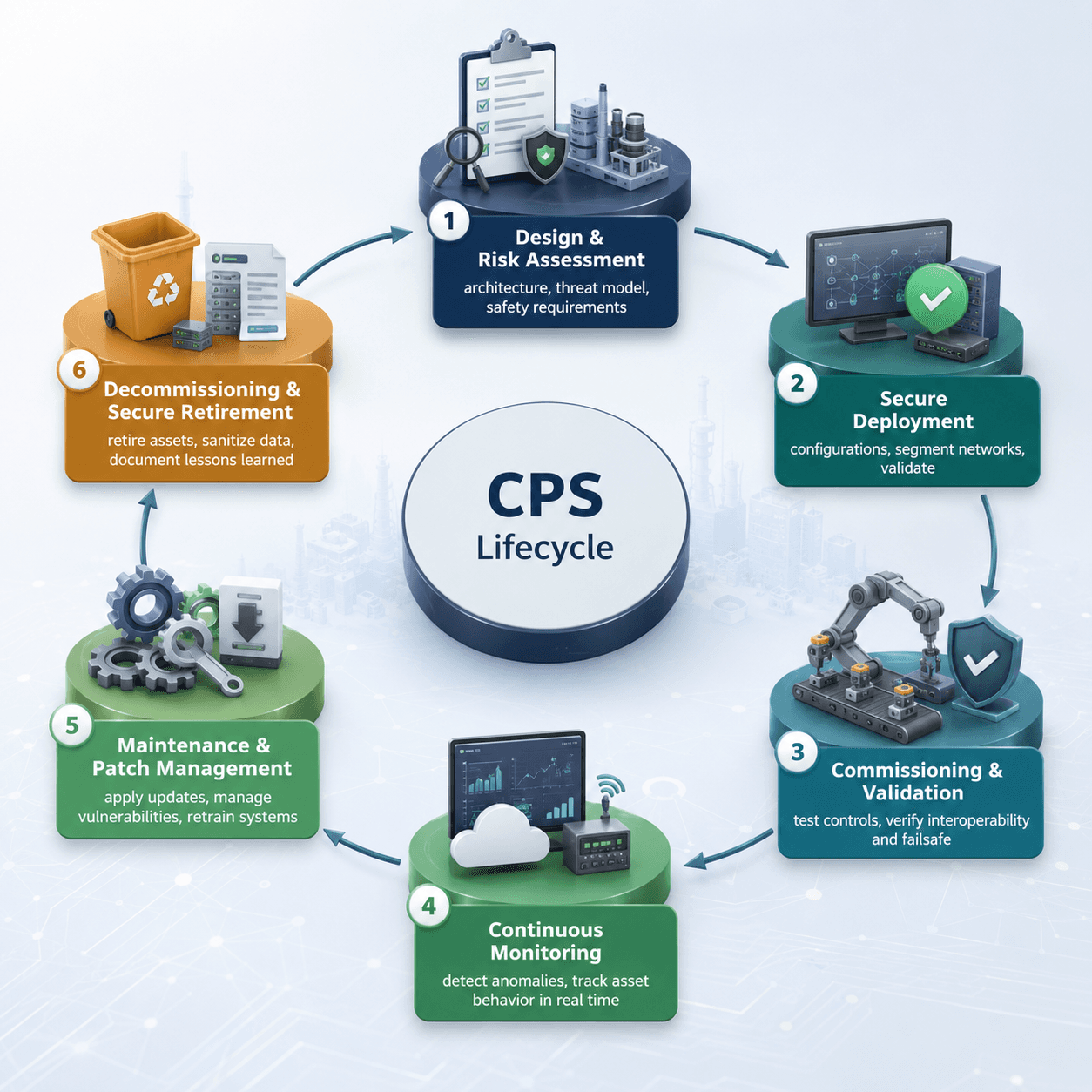
Figura 2: Las seis etapas de la gestión del ciclo de vida de los CPS, desde el diseño inicial hasta el desmantelamiento seguro.
Tabla 2: Etapas del ciclo de vida de CPS y prioridades de seguridad
Etapa del ciclo de vida | Qué sucede | Prioridad de seguridad |
Diseño y evaluación de riesgos | Se definen la arquitectura, la selección de proveedores y los requisitos de seguridad física | Integrar la segmentación y los principios de seguridad por diseño en la arquitectura desde el principio |
Despliegue seguro | Se instalan, configuran y conectan los sistemas a la red | Robustecer las configuraciones predeterminadas, eliminar servicios innecesarios y validar las configuraciones |
Comisionamiento y validación | Se prueban la funcionalidad, la lógica de seguridad y el comportamiento de respaldo ante fallas | Confirmar que los controles funcionen tanto bajo condiciones normales como de falla |
Monitoreo continuo | El sistema funciona en producción | Detectar anomalías, cambios no autorizados y patrones de comunicación anormales |
Mantenimiento y parcheo | Se aplican actualizaciones, parches y cambios de configuración | Gestionar vulnerabilidades sin interrumpir la disponibilidad o la seguridad física |
Desmantelamiento | Los activos se retiran o se reemplazan | Desinfectar datos, revocar accesos y documentar la transición de manera segura |
Un detalle que a menudo se pasa por alto es la etapa de desmantelamiento. Los controladores y las estaciones de trabajo retirados frecuentemente conservan credenciales de red, archivos de configuración e históricos de datos de procesos. Sin un proceso de desmantelamiento documentado y aplicado, estos activos retirados pueden convertirse silenciosamente en un riesgo latente guardado en un almacén o, lo que es peor, ser revendidos sin haber sido desinfectados adecuadamente.
Riesgos, desafíos y perspectivas de la industria
Incluso las organizaciones con programas maduros de seguridad de TI con frecuencia subestiman lo diferente que se ve el riesgo de OT en la práctica. Hay algunos desafíos que surgen constantemente en todas las industrias:
Tecnología heredada con largas vidas útiles: Muchos controladores y dispositivos de campo permanecen en servicio de quince a veinticinco años, mucho más que los ciclos típicos de renovación de hardware de TI, lo que significa que las vulnerabilidades pueden persistir por años sin una ruta realista de parcheo.
La disponibilidad supera a la confidencialidad: En entornos de OT, mantener el proceso en funcionamiento de manera segura es casi siempre la máxima prioridad, lo que cambia la forma en que se deben abordar el parcheo, el monitoreo y la respuesta a incidentes en comparación con la TI tradicional.
Convergencia de redes de TI y OT: A medida que las plantas adoptan analítica en la nube y herramientas de soporte remoto, la frontera antes clara entre las redes comerciales y operativas se sigue erosionando, ampliando las vías que un atacante puede utilizar para llegar a los sistemas de control.
Visibilidad limitada del inventario de activos: Muchas organizaciones aún no pueden generar un inventario preciso y en tiempo real de cada dispositivo en su red de OT, lo que hace casi imposible evaluar el riesgo con confianza.
Protocolos sin seguridad integrada: Los protocolos industriales de uso común fueron diseñados para ofrecer confiabilidad, no autenticación, por lo que el tráfico a menudo puede ser leído o manipulado por cualquiera que tenga acceso a la red.
Brechas de habilidades y de personal: Los equipos de seguridad suelen comprender a fondo el riesgo de TI pero carecen de familiaridad práctica con la ingeniería de sistemas de control, mientras que los ingenieros de OT pueden no tener una capacitación profunda en ciberseguridad, lo que crea una brecha de comunicación precisamente en el momento en que la colaboración es más importante.
Ninguno de estos desafíos es motivo para retrasar la acción. Son razones para abordar la seguridad de CPS como una disciplina distinta, que respete las consecuencias físicas de las decisiones digitales y construya controles en torno a cómo operan realmente los entornos industriales.
Recomendaciones prácticas y mejores prácticas
Fortalecer un sistema ciberfísico no requiere reemplazar cada activo heredado de la noche a la mañana. Requiere un enfoque estructurado y priorizado que reduzca el riesgo sin interrumpir las operaciones. Las siguientes prácticas ofrecen de manera constante el mejor retorno de inversión en entornos industriales:
Construir y mantener un inventario de activos en vivo: No se puede proteger lo que no se puede ver. Un inventario preciso y continuamente actualizado de cada controlador, sensor y dispositivo de red es la base para cualquier otro control.
Segmentar las redes por función y criticidad: Separar los sistemas de seguridad física, las redes de control y las redes comerciales limita qué tan lejos puede avanzar un intruso si un segmento se ve comprometido.
Monitorear anomalías de comportamiento, no solo firmas conocidas: Debido a que muchos ataques contra sistemas de control utilizan instrucciones legítimas de maneras anormales, el monitoreo basado en el comportamiento detecta amenazas que las herramientas basadas en firmas no ven.
Reforzar los controles de acceso remoto: Cada conexión remota debe requerir autenticación multifactor, registro de sesión y el acceso mínimo necesario para la tarea en cuestión.
Establecer un proceso realista de gestión de parches: Donde el parcheo no sea viable de inmediato, los controles compensatorios como la segmentación de red y el monitoreo mejorado deben cubrir esa brecha.
Probar la respuesta a incidentes con escenarios específicos de OT: Un plan de respuesta diseñado únicamente en torno a escenarios de brechas de TI no preparará adecuadamente a un equipo para un compromiso de sistema de control con implicaciones en la seguridad física.
Alinear a los equipos de seguridad cibernética y seguridad física: En entornos de CPS, la ciberseguridad y la seguridad de los procesos son dos caras del mismo objetivo, y tratarlas como funciones separadas crea puntos ciegos.
Cómo apoya Shieldworkz a las organizaciones
Shieldworkz trabaja junto a operadores industriales, líderes de seguridad de OT y equipos de infraestructura crítica para fortalecer cada capa del sistema ciberfísico, desde los sensores a nivel de campo hasta la integración empresarial. Nuestro enfoque está estructurado en torno a las realidades de los entornos operativos en vivo, donde la seguridad física, el tiempo de actividad y la ciberseguridad deben trabajar en conjunto, no uno contra el otro.
Visibilidad integral de activos de OT e ICS, incluidos dispositivos heredados que las herramientas de TI tradicionales suelen pasar por alto
Evaluaciones de riesgos adaptadas a entornos industriales, alineadas con sus procesos específicos y requisitos de seguridad física
Estrategias de segmentación de red diseñadas en torno a la continuidad operativa, no plantillas genéricas de TI
Monitoreo continuo basado en el comportamiento a través de controladores, redes y HMI para detectar anomalías de manera oportuna
Asesoría en arquitectura de acceso remoto seguro para proveedores, ingenieros y equipos de soporte
Soporte en la gestión del ciclo de vida de los CPS, desde revisiones de diseño seguro hasta el desmantelamiento
Planificación de respuesta a incidentes y ejercicios de simulación estructurados en torno a escenarios reales de OT e ICS
Capacitación del personal que cierra la brecha entre los equipos de ingeniería y los de seguridad
Ya sea que esté construyendo un programa de seguridad desde cero o reforzando uno existente, nuestro equipo aporta experiencia práctica en ciberseguridad industrial a cada proyecto, enfocándose en resultados prácticos en lugar de listas de verificación genéricas.
Preguntas frecuentes
¿Cuál es la diferencia entre un sistema ciberfísico y un dispositivo IoT?
Un dispositivo IoT individual a menudo es solo un sensor o un punto final conectado a una red. Un sistema ciberfísico es el entorno más amplio en el que muchos de estos dispositivos, junto con controladores, redes y plataformas de análisis, trabajan juntos para detectar y actuar sobre un proceso físico. En entornos industriales, el CPS normalmente implica control en tiempo real e implicaciones de seguridad física que van mucho más allá de un único dispositivo conectado.
¿Con qué frecuencia deben las organizaciones industriales evaluar la postura de seguridad de sus CPS?
La mayoría de los programas maduros de seguridad de OT realizan una evaluación de riesgos formal al menos una vez al año, con un monitoreo continuo ejecutándose en segundo plano durante todo el año. Cualquier cambio significativo, como una nueva conexión con un proveedor, un rediseño de red o una actualización importante de equipos, también debería desencadenar una reevaluación específica en lugar de esperar a la próxima revisión programada.
¿Se pueden asegurar los sistemas de control heredados sin un reemplazo total?
En la mayoría de los casos, sí. La segmentación de red, el monitoreo y los controles estrictos de acceso pueden reducir significativamente el riesgo en torno a los controladores heredados, incluso cuando el hardware subyacente no se puede parchear o reemplazar a corto plazo. Una estrategia de reemplazo total rara vez es necesaria o realista; un enfoque de controles compensatorios por capas suele ser tanto más económico como más eficaz.
¿Quién debería ser el propietario de la seguridad de CPS dentro de una organización?
Los programas más robustos tratan la seguridad de los CPS como una responsabilidad compartida entre la ingeniería de OT y los equipos de ciberseguridad, en lugar de asignarla por completo a un solo grupo. Los equipos de ingeniería aportan conocimientos sobre procesos y seguridad física de los que los equipos de ciberseguridad suelen carecer, mientras que los equipos de ciberseguridad aportan inteligencia sobre amenazas y experiencia en monitoreo de la que los ingenieros de OT suelen carecer. La propiedad conjunta, con responsabilidades claras, supera de manera constante a los modelos aislados.
Conclusión
Un sistema ciberfísico es tan fuerte como su capa más débil y, como muestran los incidentes analizados a lo largo de esta guía, esa capa más débil rara vez es obvia hasta que ya ha sido puesta a prueba. Los sensores, controladores, redes, motores de análisis, interfaces humanas e integraciones empresariales dependen unos de otros, lo que significa que la seguridad debe considerarse en toda la arquitectura, no aplicarse de forma fragmentada después de que algo sale mal. Las organizaciones que comprenden esto y que integran un pensamiento de seguridad basado en el ciclo de vida en la forma en que diseñan, despliegan y mantienen sus CPS, están constantemente mejor posicionadas para proteger tanto sus operaciones como a las personas que dependen de ellas.
Los sistemas ciberfísicos solo se volverán más interconectados, más basados en datos y más centrales para la competitividad industrial en los próximos años. Las organizaciones que inviertan hoy en comprender y asegurar estos sistemas serán las mejor equipadas para operar de manera segura, confiable y segura el día de mañana.
¿Listo para fortalecer su sistema ciberfísico?
Cada entorno industrial tiene su propio perfil de riesgo, sus propias limitaciones heredadas y su propio camino a seguir. Hable con nuestros especialistas en seguridad de OT sobre cuál es la situación actual de su sistema ciberfísico y cómo se ve una hoja de ruta práctica y priorizada.
Reserve una consulta gratuita con nuestros expertos
Recursos adicionales
Guía completa de detección y respuesta de red NDR en 2026 aquí
Libro de trabajo para el cálculo de la exposición al riesgo de seguridad de OT aquí
Un informe descargable sobre el ciberincidente de Stryker aquí
Guías de remediación aquí
Mejores prácticas de seguridad de OT y guía de evaluación de riesgos aquí
Lista de verificación de evaluación de riesgos de OT/ICS basada en IEC 62443 para el sector de fabricación de alimentos y bebidas aquí
Recibe semanalmente
Recursos y Noticias
Vea cómo nuestras soluciones de seguridad de OT líderes en la industria abordan los desafíos de seguridad críticos
También te puede interesar

What the French supermarket cyberattack reveals about OT security
Prayukth K V

Inside the Albert Heijn cyber incident: Investigating the attack, the IT/OT exposure, and the risks to critical operations
Team Shieldworkz
50°C by cyberattack? Inside France’s supermarket refrigeration crisis
Prayukth K V

Automating IEC 62443 Compliance Assessments Without Losing Expert Control
Team Shieldworkz

Investigative cyber threat intelligence report: Daiichi Kosho supply-chain data exposure
Prayukth K V

How AI Is Changing IEC 62443 Assessments
Team Shieldworkz