Investigative assessment of cyber incidents affecting Japanese railway operators

Team Shieldworkz
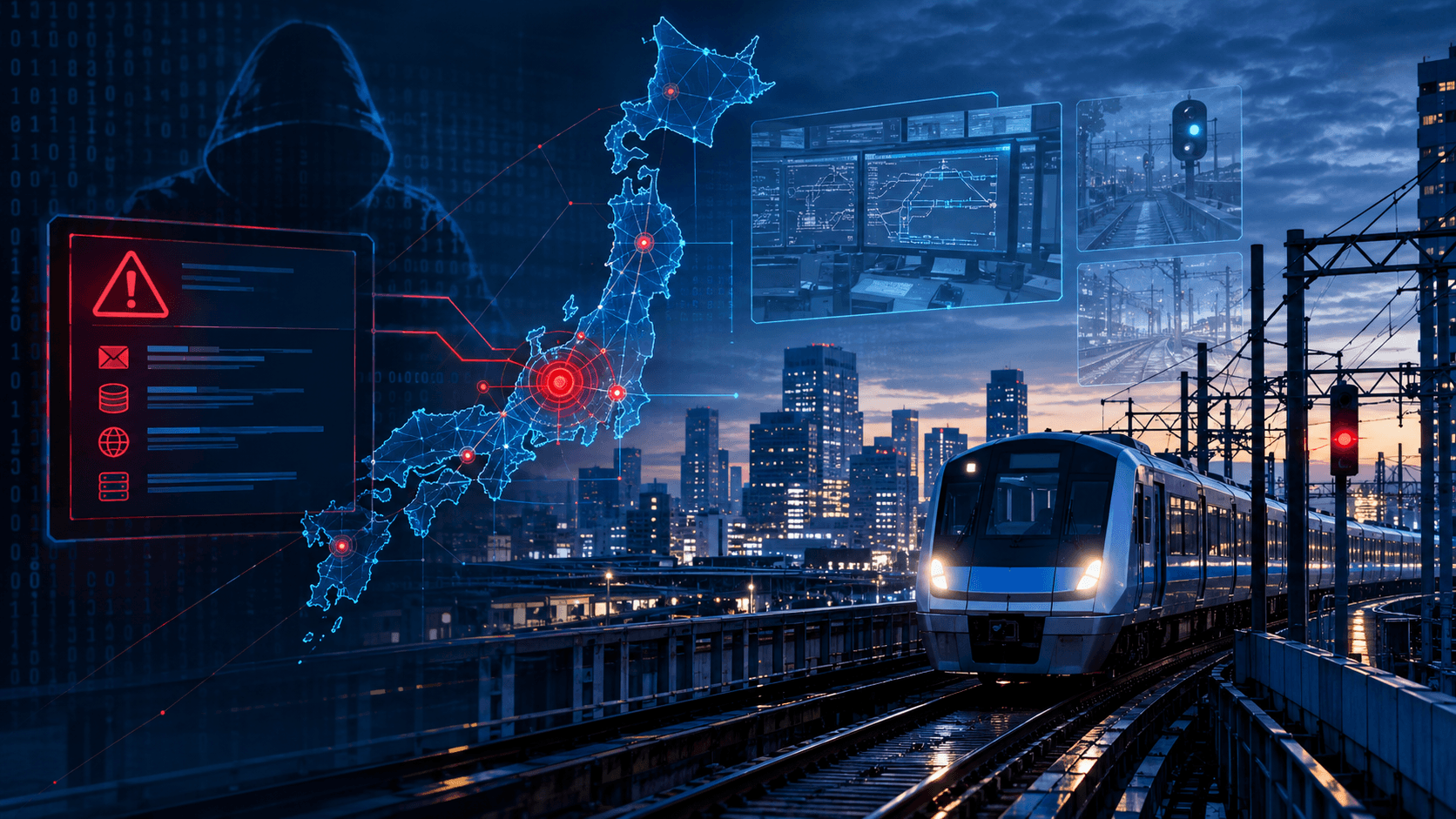
In late September 2026, multiple major Japanese regional transport operators—most notably Keio Corporation and Tokyo Metro were impacted by severe cybersecurity incidents. Keio Corporation confirmed a full-scale ransomware intrusion affecting core business and corporate group infrastructure, while Tokyo Metro reported administrative disruptions impacting customer web inquiries and reservation services.
Crucially, physical train operations, automatic train control (ATC), interlocking, and line safety systems were completely unaffected across all impacted networks.
This incident demonstrates a critical structural reality in modern railway cyber risk: ransomware actors do not need to penetrate safety-critical Operational Technology (OT) to induce severe business, operational, and financial paralysis.
By compromising corporate Active Directory environments, internal IT logistics, administrative communications, and customer portals, threat actors can force operators into degraded operational states. This report decomposes the incident, models potential IT-to-OT attack vectors, evaluates broader global railway targeting patterns, and establishes a practical OT security architecture and governance framework for railway operators worldwide.
Incident reconstruction and forensic evidence model
incident chronology and system scope
Variable | Keio Corporation Details | Tokyo Metro Details |
Affected Entities | Keio Corporation (parent) and select commercial group subsidiaries. | Tokyo Metro Co., Ltd. (administrative systems & portals). |
Detection Window | Early morning hours of Friday, September 26, 2026. | Weekend of September 26–27, 2026. |
Impacted Systems | Corporate IT servers, internal network infrastructure, subsidiary business applications. | Official web portals, public contact/inquiry forms, web reservation infrastructure. |
Operational State | Trains fully operational. Zero impact on passenger transportation safety or schedules. | Trains fully operational. Metro lines carrying over 7M daily passengers unaffected. |
Nature of Attack | Confirmed Ransomware / File Encryption attack. | Service disruption / public web resource impairment. |
Data Exfiltration | Forensic investigation ongoing; potential exfiltration unconfirmed. | No confirmed customer database exfiltration disclosed. |
Containment Actions | Network isolation, server shutdown, engagement of external IR, police notification. | Customer service notice deployment, web channel traffic filtering. |
Evidence-confidence model
Confirmed Fact: Keio Corporation suffered a ransomware attack on September 26, 2026, affecting internal IT applications while safety-critical railway operations remained fully functional. External forensics and law enforcement were engaged.
Reported Claim: Tokyo Metro experienced website contact and reservation system responsiveness delays stemming from concurrent cyber activity over the same weekend.
Analytical Assessment: Attackers compromised the enterprise environment via exposed remote access infrastructure or secondary corporate subsidiary trust links, using Active Directory domain domination to encrypt central IT servers. The absence of reported OT impact may reflect network segmentation, architectural independence, operational containment, or simply the limited scope of publicly available reporting. The underlying railway network architecture has not been established from the available evidence. In the absence of a publicly available forensic post-mortem, several enterprise attack paths are technically plausible, including compromise of internet-facing remote-access infrastructure, credential theft, or compromise of a connected subsidiary environment.
Technical Hypothesis: Initial access was likely obtained weeks prior to the payload deployment via a compromised SSL-VPN/edge device vulnerability or targeted credential harvesting against a non-critical corporate subsidiary.
Unknown: Specific ransomware strain (such as LockBit descendant, BlackCat variant, or custom agentic ransomware initial entry vulnerability CVE, and whether corporate data exfiltration occurred prior to encryption.
Plausible attack chain reconstruction
In the absence of a published post-mortem, three technical attack paths represent the most probable vectors based on threat-intelligence telemetry in the Japanese critical infrastructure sector during 2025–2026:
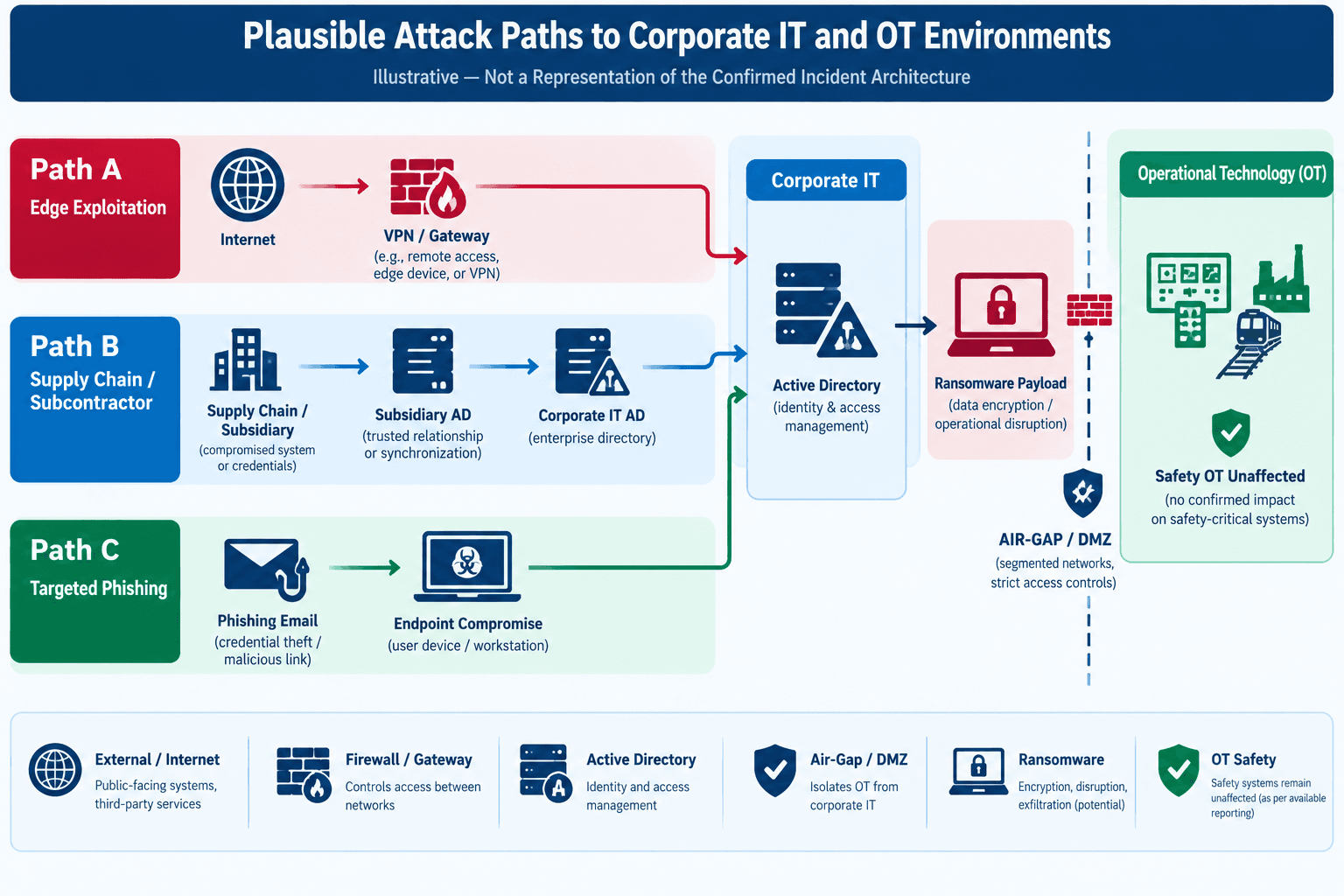
Path A: Edge Appliance Exploitation (Highest Probability)
Initial Access: Exploitation of unpatched edge devices (e.g., Citrix ADC, WatchGuard, Fortinet) on corporate perimeter systems.
Execution & Discovery: Web shell deployment, local LSASS credential dumping, Active Directory domain enumeration via PowerShell/ADFind.
Lateral Movement: RDP/SMB traversal across corporate server VLANs; compromise of hypervisors (ESXi/Hyper-V).
Impact: Mass execution of ransomware via Group Policy Objects (GPO) or centralized management toolsets.
Supporting Evidence: Extreme prevalence of automated zero-day perimeter scanning targeting Japanese enterprise edge devices in late 2026.
Confidence Level: High.
Path B: Corporate Subsidiary / Business Unit Ingress
Initial Access: Infiltration of a subsidiary (e.g., hotel, real estate, retail, or maintenance sub-entity owned by the railway group).
Lateral Movement: Traversal across two-way Active Directory forest trusts or shared management networks connecting the subsidiary to parent IT systems.
Impact: Escalation to root forest domains followed by GPO-driven mass encryption.
Supporting Evidence: Keio's broader corporate structure includes non-railway businesses. Such structures can create potential identity, network and third-party dependency risks, although no public evidence currently establishes that a subsidiary relationship was involved in this incident.
Confidence Level: Medium-High.
Path C: Spear-Phishing & Credential Theft
Initial Access: Targeted phishing email delivering an info-stealer (e.g., Lumma, RedLine) to a administrative workstation user, capturing valid VPN/MFA session tokens.
Lateral Movement: Session hijacking, privileged identity compromise, remote access to administrative environments.
Impact: Execution of ransomware binaries on primary domain controllers and file stores.
Confidence Level: Medium.
Disambiguating IT compromise from railway OT disruption
A persistent analytical flaw in critical-infrastructure cybersecurity reporting is equating corporate IT disruption in a transit company with Operational Technology (OT) compromise.

Key functional differences
Dimension | Corporate IT Environment | Railway Operational Technology (OT) |
Primary Systems | Mail, ERP, HR, Web Portals, Ticketing API, Retail Systems. | Electronic Interlocking (EI), Automatic Train Control (ATC), SCADA, Traction Power. |
Safety Role | Zero safety criticality. Business, financial, and informational continuity only. | Safety-Critical. Failure directly endangers passenger lives and train physics. |
Protocols | HTTP/S, SMB, RDP, DNS, Kerberos, REST APIs. | Modbus, DNP3, IEC 60870-5-104, IP-based signalling (CBTC), serial protocols. |
Pace of Change | High patch frequency, dynamic user access, frequent updates. | Low change frequency, deterministic, rigorously validated release cycles. |
Observed Impact | ENCRYPTED/DISRUPTED (Business disruption, form delays). | UNTOUCHED. Physical train movement and signalling intact. |
Why this distinction matters
Lumping corporate IT ransomware under "train hacking" triggers disproportionate public alarm while obscuring real defensive priorities. Modern Japanese passenger rail systems rely on air-gapped or heavily segmented OT domains with fail-safe hardware interlocks. The risk in this incident was not a train collision or derailment; it was the paralysis of enterprise management and operational decision-support systems.
Architectural Analysis: Potential IT-to-OT vulnerability vectors
While OT safety networks remained secure during this incident, modern railway digital transformation creates lateral exposure pathways that defensive teams must secure:
Shared Identity Infrastructure: Leveraging identical Active Directory domains (or trusted Kerberos realms) across IT systems and OT management jump hosts.
Dual-Homed Maintenance Workstations: Vendor and engineering laptops simultaneously connected to corporate Wi-Fi/VPN and OT programming interfaces.
Enterprise Historians and Data Bridges: Historian and telemetry bridges that transfer operational data into enterprise environments can create conduits requiring explicit access control, protocol validation and monitoring. Where unidirectional transfer is required, hardware-enforced data diodes may provide stronger isolation than conventional firewall rules.
Third-Party Vendor Remote Access: External maintenance VPNs terminating directly inside station control networks without Multi-Factor Authentication (MFA) or session recording.
Shared Backup Facilities: Storing enterprise IT backups and OT controller/PLC configuration image backups on the same network NAS or cloud repository.
Global railway cyber-threat landscape analysis
To contextualize the Japanese incidents, we evaluate global railway cyber-attack patterns across key jurisdictions:
Region / Year | Target & Incident Summary | Threat Category | Primary Target System | Operational Impact |
Japan (2026) | Keio / Tokyo Metro:Business system ransomware & web disruption. | Cybercrime / Extortion | Corporate IT & Public Portals | Enterprise disruption; zero train/safety impact. |
Denmark (2022) | DSB Subcontractor: Cloud vendor testing environment outage. | Supply Chain / IT Dependency | Single-vendor software testing app | Complete 4-hour train fleet stoppage due to driver protocol loss. |
Poland (2023) | PKP Network:Unencrypted radio command injection (Radio-Stop). | Sabotage / Spoofing | VHF 150 MHz analogue train radio | Automated emergency braking triggered on over 20 trains. |
Ukraine (2022-25) | Ukrzaliznytsia: State-sponsored destructive wiping attacks. | Destructive Warfare / Cyber | Ticketing, IT infrastructure, OT links | Temporary booking outages; manual dispatch fallback engaged. |
Germany (2022) | Deutsche Bahn: Physical fiber cable cutting / GSM-R disruption. | Physical / Cyber Hybrid | GSM-R operational radio network | Multi-hour transit shutdown across northern Germany. |
Key macro trends identified
Extortion Shifts to Indirect Operational Paralysis: Attackers realize that shutting down IT back-office infrastructure (crew scheduling, passenger info, ticketing) can halt train operations without touching safety-critical signalling.
Ecosystem Exposure Over Direct OT Infiltration: Vendors, cloud services, and maintenance suppliers present the weakest defensive link in transit supply chains.
Information Harvesting for Future Conflict: State-sponsored threat actors quietly index network topologies, signal control schematics, and supply logistics without triggering disruption.
Threat actor analysis and structured attribution assessment
Non-attribution principles
Attribution cannot be established based on IP geography, reverse-proxy exit nodes, public claims, or victim nationality. Modern threat groups routinely leverage bulletproof hosting, compromised residential proxy networks (RESIPs), leased VPS infrastructure, and open-source tooling to obfuscate their origins.
Structured assessment: Hypothesis evaluation
Analytical assessment on potential Iranian state actor involvement
Evidence Supporting: Iranian actors (such as CyberAv3ngers, Agrius) have historically targeted transportation and SCADA/PLC systems (e.g., Unitronics PLCs in 2023) using noisy disruption tactics.
Evidence Contradicting:
Complete absence of Iranian-linked wipers (e.g., Apostle, CaddyWiper) or political hacktivist leak portals.
The attack pattern reflects financially motivated double-extortion criminal ransomware rather than state-directed strategic sabotage or political messaging.
Attribution Confidence: Low Confidence in any state-sponsor hypothesis. High Confidence that the incident represents financially motivated cybercrime executed by an opportunistic ransomware affiliate.
Deep-dive: Systemic implications for railway OT architecture
The Japanese railway incidents challenge the conventional wisdom that "air-gapping" or basic perimeter firewalls guarantee operational resilience.
The operational dependency cascade
A safety-critical network (Signalling/Interlocking) can be 100% secure, yet trains may still be brought to a standstill due to Operational Dependencies residing in corporate or IT-adjacent zones:
Crew Management & Rostering (IT/Corporate Zone): If crew scheduling databases are encrypted by ransomware, drivers cannot be legally or safely assigned to trains, paralyzing transport schedules despite operational signals working perfectly.
Passenger Information Systems (PIS) & Platform Safety (IT-Adjacent): Inability to update platform display boards or emergency public address (PA) systems creates severe crowd control risks at mega-stations (e.g., Shinjuku, Tokyo), forcing manual station closures.
Depot & Fleet Maintenance Logistics: Modern rolling stock requires automated diagnostic uploads prior to service dispatch. Loss of maintenance databases grounds train fleets within 24–48 hours.
Strategic security dimensions
Safety: Maintained via physical/hardware fail-safe design principles. Digital compromise of corporate IT cannot override signal hardware interlocks.
Availability: Severely degraded across administrative, ticketing, and customer service domains.
Integrity: Operational integrity of train control systems remained intact due to network isolation.
Confidentiality: High potential exposure of corporate records, employee data, vendor contracts, and internal system documentation.
Financial & Regulatory: Significant direct remediation expenses, incident-response fees, and regulatory scrutiny under Japan's Act on Promotion of Cybersecurity for Critical Infrastructure.
The "Quiet Compromise" problem in critical infrastructure
While ransomware creates immediate visibility, the most dangerous critical infrastructure threat is pre-positioning without disruption:
Risk Elements of Unobserved Persistence
Operational Reconnaissance: Attackers map signal block layouts, traction substation topologies, and station camera coverage for future geopolitical leverage.
Engineering Workstation Exposure: Accessing CAD schematics, PLC programming project files (.ACD, .MWW), and interlocking logic layouts allows sophisticated actors to build custom ICS payloads offline.
Credential Harvesting for Future Use: Silently harvesting kerberos tickets and administrative credentials for jump servers allows actors to maintain persistent access through major IT rebuilds.
Operational Distinction: The absence of operational disruption during the September 2026 Japanese rail attacks confirms containment at the corporate layer; it does not prove that silent reconnaissance was not previously attempted.
Key analytical insights and operational lessons
Ransomware Threat Model Optimization: Ransomware actors realize that compromising railway corporate IT generates equal financial leverage without triggering national anti-terrorism military responses associated with OT safety compromise.
Subsidiary Conglomerate Attack Surface: Railway groups with sprawling corporate subsidiaries (retail, real estate, hotels) create vast lateral access paths into core transit infrastructure networks.
Operational Disruption vs. Operational Uncertainty: When corporate dispatch/crew databases fail, operators face operational uncertainty—forcing them to halt services for safety compliance even if train physics controls are completely secure.
Identity as the Real OT Perimeter: Physical air-gaps are routinely bypassed by shared Active Directory identity architectures crossing IT/OT DMZs.
Engineering Workstation Exposure: The most critical asset in railway OT is not the PLC or signal relay—it is the engineering workstation used to program them.
Backup Facility Dependency: Ransomware routinely targets online IT backup repositories; off-site, immutable, air-gapped OT configuration backups are vital for rapid recovery.
Maintenance Vendor Remote Access: Poorly governed vendor remote access can create a high-consequence pathway into OT and OT-adjacent environments.
Need for "OT Blast-Radius" Metrics: Operators must quantify how many operational services fail if specific IT support systems (e.g., driver mobile apps) go offline.
Cyber Incident as Safety Management: Loss of digital situational awareness (e.g., CCTV, station intercoms) requires immediate transition to degraded manual safety operating modes.
Information Value for State Actors: Network schematics stolen during "corporate" ransomware breaches can be resold to state-sponsored actors for strategic pre-positioning.
Practical defensive architecture for railway OT

Asset Visibility: Deploy passive network monitoring (OT NDR) supporting deep packet inspection (DPI) for railway-specific protocols (e.g., Modbus, DNP3, IEC 60870-5-104, CBTC). Maintain real-time inventory of all engineering workstations and PLCs.
Network Segmentation & Micro-Segmentation: Enforce ISA/IEC 62443 Zones and Conduits. Establish an isolated OT DMZ with no direct IP routing between corporate IT and train control networks. Mandate hardware data diodes for egress telemetry.
Identity & Access Management: Enforce complete separation between IT Active Directory and OT identity infrastructure. Implement Privileged Access Management (PAM) with Hardware MFA (e.g., FIDO2 keys) for all OT jump-host connections.
Remote Maintenance Security: Eliminate permanent, vendor-managed "always-on" remote access. Implement Just-In-Time (JIT) access workflows with mandatory session recording and real-time operator approval for external maintenance.
OT Detection & Threat Hunting: Integration of OT network telemetry into a specialized OT-SOC. Establish behavioral baselines for engineering workstations (e.g., alert on any new logic download or firmware update command).
Resilience & Degraded Operations: Maintain offline, immutable configuration backups for all interlocking software, SCADA databases, and controller firmware. Regularly exercise manual, non-digital train dispatching and signal operation scenarios.
OT Security Key Performance & Risk Indicators (KPIs/KRIs)
Metric | Metric Category | Why It Matters | Recommended Objective | Executive Interpretation |
% OT Assets Inventoried with Owner | Visibility KPI | Unmanaged devices cannot be protected or monitored during an incident. | 100% | Measures foundational operational visibility and control. |
Unauthorized IT-to-OT Flow Attempts | Threat KRI | Indicates lateral movement attempts from corporate IT toward control zones. | 0 Per Month | Early warning indicator of corporate breach expansion. |
Direct Internet-Exposed OT Systems | Exposure KRI | Direct exposure bypasses all perimeter security defenses. | 0 Systems | Identifies critical architectural vulnerabilities and perimeter flaws. |
Active Dual-Homed Workstations | Exposure KRI | Bridges isolated OT networks to untrusted corporate or wireless networks. | 0 Systems | Measures strict enforcement of network isolation policy. |
% Monitored Vendor Remote Sessions | Governance KPI | Third-party access represents a major indirect compromise vector. | 100% Session Recording | Ensures accountability and auditability for external contractors. |
Mean Time to Contain (MTTC) OT Incident | Resilience KPI | Limits lateral spread and operational downtime during an attack. | < 1 Hour | Demonstrates SOC/IR agility and operational containment capabilities. |
Degraded Operation Drill Frequency | Readiness KPI | Ensures staff can run trains safely if all IT/OT management systems fail. | Quarterly Per Line | Measures true physical resilience independent of digital systems. |
Standards and regulatory mapping
Framework / Standard | Relevant Railway Systems | Core Cybersecurity Scope | Practical Application | Common Industry Gaps |
IEC 62443-3-2 | Entire Railway Infrastructure | Risk assessment, target Security Levels (SL-T), zone definition. | Partition signalling, traction power, and PIS into distinct zones. | Failure to conduct realistic risk assessments for IT-adjacent OT zones. |
IEC 62443-3-3 | SCADA, Signalling, Interlocking | System security requirements and capability levels (SL-C). | Enforce authentication, data integrity, and network micro-segmentation. | Lack of granular access control on legacy controller interfaces. |
CLC/TS 50701 | European / Global Rail Networks | Railway-specific adaptation of IEC 62443 for rail applications. | Guides cybersecurity management across train control, rolling stock, and trackside. | Siloed implementation between railway safety teams and IT security teams. |
EN 50126 / 50128 / 50129 | Safety-Critical Signalling & ATC | Functional safety standards for railway RAMS and software. | Ensures cybersecurity controls do not compromise functional safety integrity (SIL 4). | Treating functional safety and cybersecurity as mutually exclusive disciplines. |
NIST SP 800-82 Rev 3 | SCADA & OT Control Systems | Operational technology security architecture and controls. | Practical guidance for securing OT firewalls, jump hosts, and protocol flows. | Misconfiguration of OT DMZs resulting in direct IT-to-OT routing. |
MITRE ATT&CK for ICS | OT SOC / Threat Intelligence | Taxonomy of adversary tactics and techniques in control systems. | Threat modeling, SOC rule development, and incident response playbook alignment. | Over-reliance on IT ATT&CK matrices for monitoring OT control networks. |
Threat detection use cases for railway SOC / OT-SOC
Use Case 1: Unauthorized IT-to-OT Network Boundary Crossing
Detection Signal: Any traffic originating from corporate IT VLANs attempting to connect directly to OT IP ranges without passing through the OT jump host.
Data Source: OT Firewall logs, Core Switch NetFlow/IPFIX, OT NDR.
Analytic Logic:
src_ip IN Corporate_IT_Subnets AND dst_ip IN OT_Control_Subnets AND dst_port NOT IN (Allowed_DMZ_Ports).ATT&CK Technique: T0866 (Remote Services), T0886 (Remote Services / Lateral Movement).
Investigation Steps:
Identify source host and logged-in user in corporate Active Directory.
Verify if connection attempt correlates with an approved, scheduled maintenance ticket.
Check source host for concurrent ransomware or credential-dumping activity.
Response Action: Immediately isolate source corporate host at the switch port/EDR level. Block destination IP at OT firewall.
Use Case 2: Abnormal Engineering Workstation (EWS) Program Transfer
Detection Signal: A PLC programming command (e.g., logic write, stop command, firmware update) sent to a trackside controller outside an active maintenance window.
Data Source: OT NDR (DPI logs analyzing Modbus/S7/CIP/DNP3 function codes).
Analytic Logic:
event_type == "PLC_WRITE_LOGIC" AND system_time NOT IN (Maintenance_Window_Schedule).ATT&CK Technique: T0831 (Manipulation of Control), T0855 (Unauthorized Command Message).
Investigation Steps:
Identify EWS sending the command; verify physical workstation location and active user logon.
Confirm whether emergency maintenance was authorized by the Chief Signal Engineer.
Inspect EWS for unauthorized remote management tools (e.g., AnyDesk, TeamViewer).
Response Action: Place SCADA and signalling networks into local, autonomous control mode.
Use Case 3: Vendor Remote Access Anomaly
Detection Signal: External vendor VPN connection established outside scheduled maintenance hours or originating from an anomalous geographic location.
Data Source: PAM logs, VPN Gateway logs, OT Jump Host Audit Logs.
Analytic Logic:
event == "VENDOR_VPN_CONNECT" AND (time NOT IN (Vendor_SLA_Hours) OR src_country != "Approved_Country").ATT&CK Technique: T0886 (Remote Services), T0859 (Valid Accounts).
Investigation Steps:
Contact vendor security contact to verify authorization of active user.
Review active session video logs via PAM tool for suspicious command execution.
Inspect connected endpoints for credential theft telemetry.
Response Action: Terminate active VPN session immediately; disable vendor service account pending verification.
Transition affected systems to the operator's pre-approved degraded operating mode in accordance with railway safety procedures and the authority of the designated operational controller.
Incident Response Playbook: Degraded Mode Operations
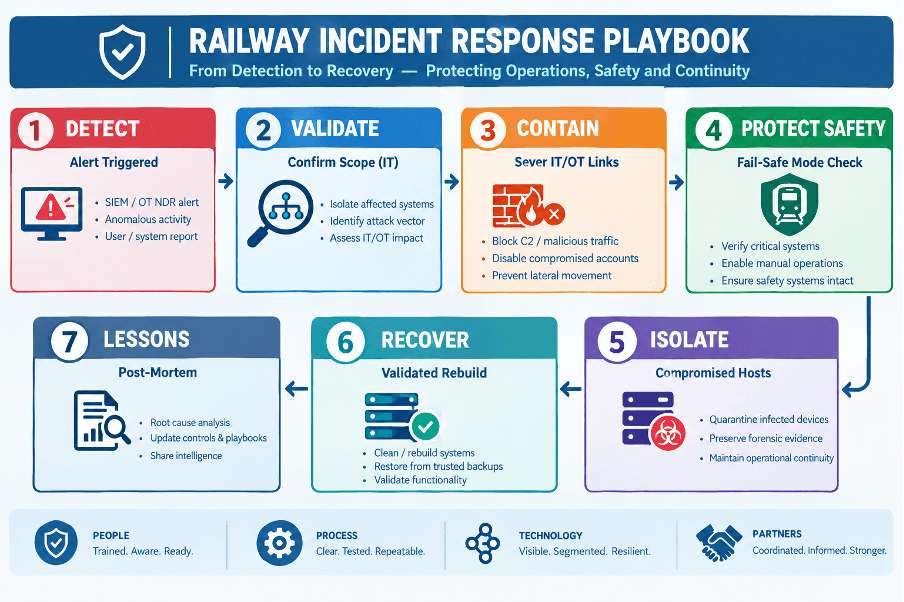
Detect and Validate: Identify source alert. Determine whether impact is confined to Corporate IT or extending into OT-adjacent DMZ zones.
Safety-First Containment:
If IT-Only Compromise: Isolate corporate network segments. Do NOT indiscriminately shut down train control OT networks. Confirm operational air-gaps remain intact.
If OT-Adjacent Compromise: Sever all logical conduits between IT and OT DMZs. Place SCADA and signalling networks into local, autonomous control mode.
If Confirmed Safety-System Anomaly: Transition affected railway line to manual train dispatching and visual block operating protocols immediately.
Preserve Evidence: Capture forensic disk images and RAM captures of compromised domain controllers, jump hosts, and edge appliances before rebooting or rebuilding.
Establish Trusted Operations: Re-establish core Active Directory identity infrastructure from known-good offline backups. Validate integrity of OT jump hosts before restoring network conduits.
Recovery & Monitoring: Incrementally reconnect business applications under strict network monitoring. Maintain heightened threat-hunting cadence for persistent backdoors.
Practical implementation roadmap (30 / 90 / 180 Days)
Timeframe | Recommended Action | Responsible Owner | Priority | Evidence of Completion | Risk Reduced |
0–30 Days | Emergency audit and patching of all internet-facing edge appliances (VPNs, firewalls). | Network Security Team | Critical | Zero high-risk CVEs on edge perimeter. | Prevents initial perimeter ingress via known exploits. |
0–30 Days | Verify and enforce strict firewall rules blocking direct IP traffic between IT and OT networks. | OT Security Engineer | Critical | Firewall audit report confirming zero direct IT-to-OT routing. | Eliminates immediate lateral movement risks. |
0–30 Days | Audit all active vendor remote-access accounts; revoke permanent connections and enforce JIT access. | CISO / Third-Party Risk | High | Approved vendor account register & disabled stale VPN profiles. | Mitigates supply chain and remote credential abuse vectors. |
31–90 Days | Deploy passive OT Network Detection & Response (NDR) sensors at key OT network conduits. | SOC Lead / OT Team | High | Live NDR dashboard rendering DPI telemetry for OT protocols. | Provides real-time visibility into control-system traffic. |
31–90 Days | Decouple Active Directory identity trusts between corporate parent and subsidiary group networks. | Enterprise Identity Team | High | Active Directory trust architecture diagram showing isolated domains. | Limits breach blast-radius across corporate subsidiaries. |
31–90 Days | Implement offline, immutable, write-once-read-many (WORM) backups for all critical IT/OT systems. | Infrastructure Team | High | Successful test restoration from isolated offline backup media. | Guarantees recovery capability against destructive ransomware. |
91–180 Days | Implement Privileged Access Management (PAM) with Hardware MFA (FIDO2) for all OT jump hosts. | Identity Security Team | Medium-High | 100% enforcement of PAM for OT administrative access. | Secures identity layer against credential theft and session hijacking. |
91–180 Days | Conduct joint OT-SOC and Railway Safety live exercise simulating loss of IT dispatch applications. | CISO / Operations VP | Medium | Validated joint exercise report and updated degraded mode SOPs. | Ensures operational continuity during corporate cyber paralysis. |
Executive conclusions
What Actually Happened: Keio Corporation suffered a severe ransomware attack impacting enterprise corporate IT servers, while Tokyo Metro faced concurrent administrative web service disruptions.
What Remains Unknown: The precise initial attack vector, ransomware variant, and whether pre-attack corporate data exfiltration occurred remain unconfirmed by forensic authorities.
Was Railway OT Compromised? No. Safety-critical railway operational technology, interlocking systems, automatic train control, and physical line safety were completely isolated and unaffected throughout the incidents.
Most Important Technical Lesson: Modern cybercriminals do not need to target complex control systems to disrupt a critical infrastructure operator. Disrupting enterprise Active Directory and administrative networks generates massive business pressure.
Most Important Architectural Lesson: Operational dependency management is as critical as network segmentation. Railway operators must ensure that loss of corporate IT applications (crew scheduling, PIS, portals) does not force a shutdown of physical transport services.
Immediate Action Required: Railway CISOs must immediately audit corporate subsidiary Active Directory trusts, mandate JIT access for third-party maintenance vendors, and verify air-gapped, immutable backup restoration procedures.
Recommended reading and resources
For critical infrastructure security leaders, OT analysts, and risk executives seeking to deepen their operational resilience frameworks, the following industry publications and playbooks are strongly recommended:
Shieldworkz Regulatory & Playbook Library:
Operational Technology Regulatory Playbook: Navigating IEC 62443 and NIS2 Compliance in Transportation.
IT/OT Convergence Security Guide: Architecting Secure DMZs and Zero-Trust Identity for Critical Infrastructure.
Incident Response Playbook: Ransomware Containment in Industrial Control Systems.
Available via Shieldworkz Regulatory Assets: https://shieldworkz.com/regulatory-playbooks.
Authoritative Standards & Frameworks:
CISA / ENISA Joint Guidance: Securing Rail Transportation Operational Technology and Control Systems.
MITRE ATT&CK for ICS: Threat Modeling and Detection Strategies for Control System Networks.
Wöchentlich erhalten
Ressourcen & Nachrichten
Erfahren Sie, wie unsere branchenführenden OT-Security-Lösungen kritische Sicherheitsherausforderungen gemäß KRITIS-Anforderungen bewältigen
Dies könnte Ihnen auch gefallen.

Deep investigation: Cyber compromise and data exfiltration at Air Traffic and Navigation Services (ATNS)
Prayukth K V

Anatomy of the Adif and Renfe Cyber Breach: AI-Assisted Intrusion and Impact
Team Shieldworkz

Fresenius medical care cyber incident: Investigating trusted access, third-party exposure and enterprise blast radius
Team Shieldworkz

OT Removable Media Security: Close the USB Risk Gap Before It Reaches Production
Team Shieldworkz
The Canva breach and the hidden risk of third-party trust
Prayukth K V

NERC CIP Compliance Assessment: Find Gaps Before Auditors Do
Team Shieldworkz