IEC 62443 for Pharmaceutical Manufacturing: Secure Critical Production OT


Team Shieldworkz
A pharmaceutical production line does not behave like a typical factory floor. Every controller, sensor, and recipe parameter is tied to a validated process that regulators, auditors, and patients ultimately depend on. When operational technology in this environment is compromised, the consequence is rarely limited to downtime. Batch records can be questioned, product quality can be disputed, and in the worst cases, the safety of finished medicines can be called into doubt. This is precisely why IEC 62443, the internationally recognized series of standards for industrial automation and control systems security, has become a reference point for pharmaceutical manufacturers building a defensible, risk-based approach to OT security.
This Blog walks through the risks unique to pharmaceutical production environments, explains how the IEC 62443 framework applies to validated manufacturing systems, and offers practical, field-tested recommendations that OT security leaders, plant managers, and CISOs can act on without disrupting production continuity or product quality.
Why Pharmaceutical Manufacturing Needs IEC 62443
Pharmaceutical plants sit at an unusual intersection of two demanding disciplines. On one side is process automation, where programmable logic controllers, distributed control systems, and SCADA platforms manage temperature, pressure, mixing, and fill volumes with extreme precision. On the other side is a regulatory framework built around validation, where any change to a qualified system can trigger documentation, testing, and approval cycles that take weeks or months.
IEC 62443 was developed specifically for this kind of environment. Unlike general IT security frameworks, it was written with the realities of industrial control systems in mind: long equipment lifecycles, safety-critical operations, deterministic communication requirements, and the fact that a control system cannot simply be rebooted or patched on a Tuesday afternoon without careful planning. For pharmaceutical manufacturers, this makes IEC 62443 a natural fit because it provides a structured, risk-based methodology rather than a rigid checklist that ignores operational reality.
Regulatory bodies overseeing pharmaceutical manufacturing have also increased their attention on data integrity and system security as part of good manufacturing practice expectations. Inspectors reviewing electronic batch records increasingly ask how a manufacturer protects the systems that generate, store, and transmit that data. Demonstrating alignment with a recognized international standard like IEC 62443 gives OT security leaders a credible, auditable answer to that question.
A Framework Built Around Zones, Conduits, and Security Levels
At the core of IEC 62443 is the idea that not every system in a plant needs, or can practically receive, the same level of protection. Instead of treating the entire OT environment as one flat network, the standard introduces the concept of zones, which are logical or physical groupings of assets that share similar security requirements, and conduits, which are the defined communication pathways connecting those zones.
A fermentation suite, for example, may be grouped into its own zone separate from a packaging line, and both would be separate from the quality control laboratory network. Communication between these zones passes through conduits that can be monitored, restricted, and controlled, rather than allowing unrestricted traffic to move freely across the entire plant network.
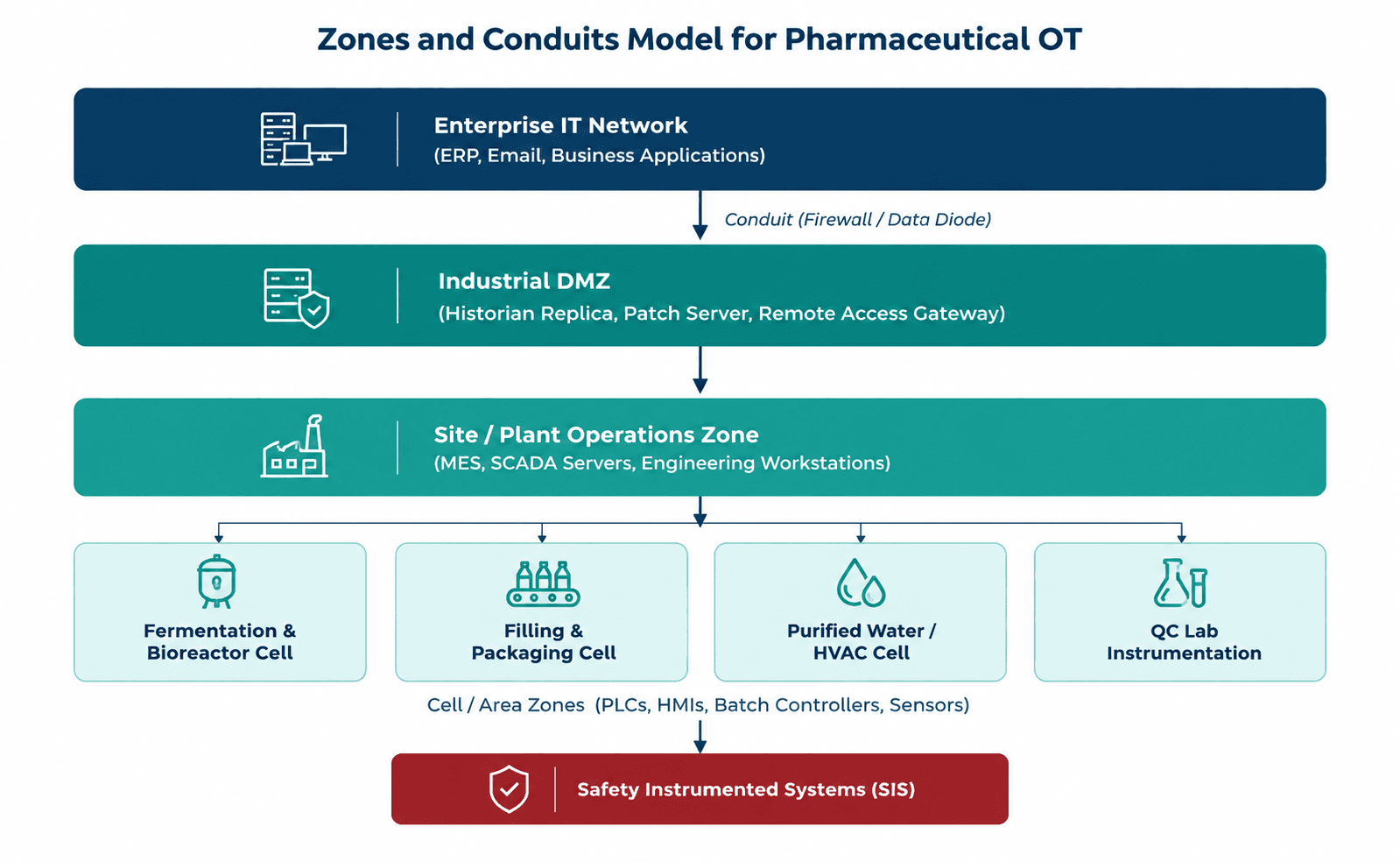
Figure 1: A representative zones and conduits architecture for a pharmaceutical production environment
Each zone is then assigned a target security level, ranging from SL 0 to SL 4, based on the sophistication of threat the zone needs to withstand. A packaging line facing minimal external exposure may only need SL 1 or SL 2, while a zone containing recipe management systems or connected to external vendor access might warrant SL 3. This tiered approach allows security investment to be directed where it matters most, rather than applying uniform controls everywhere regardless of actual risk.
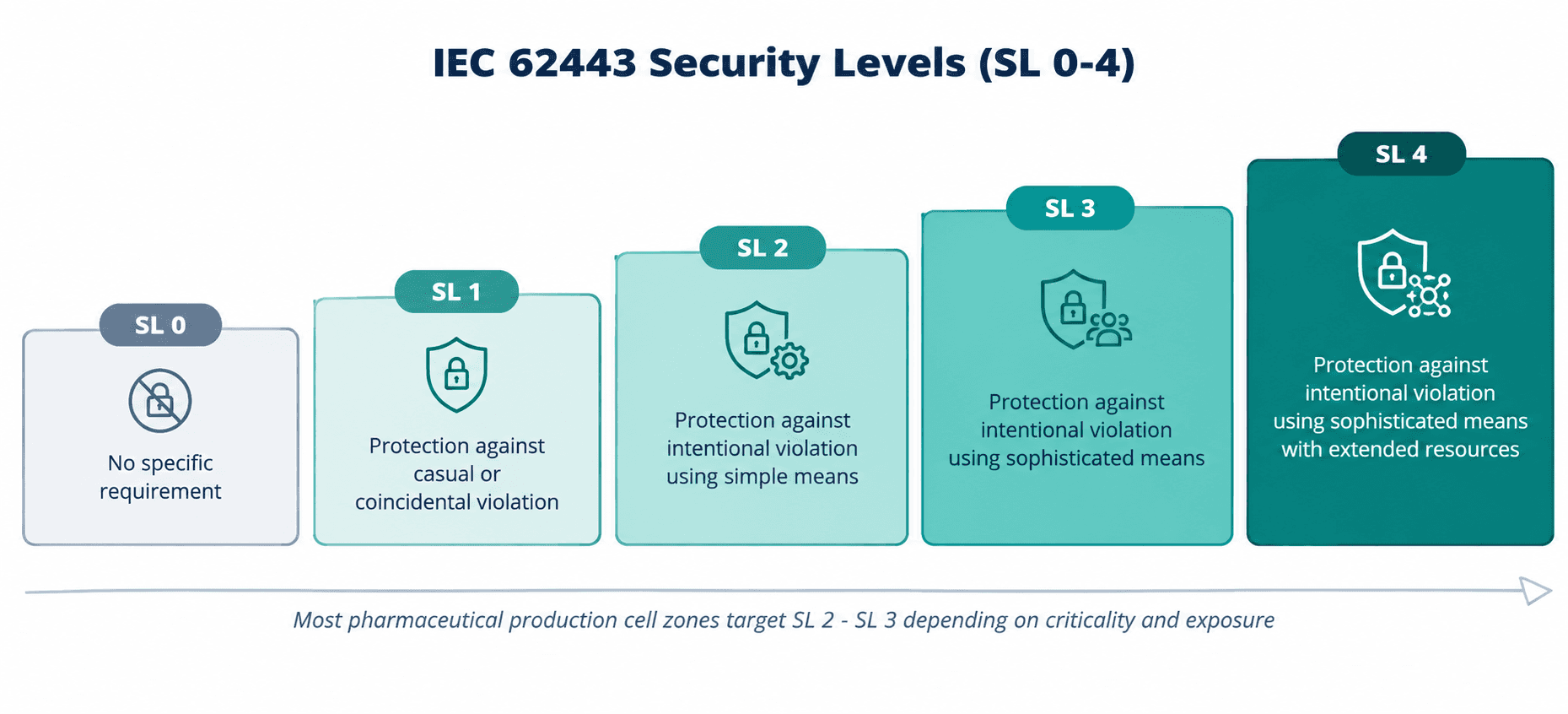
Figure 2: IEC 62443 security levels describe the sophistication of threat a zone is designed to resist
The Business Case: Why This Goes Beyond Compliance
It is tempting to frame OT security as a compliance exercise, something to satisfy an auditor's checklist once a year. In pharmaceutical manufacturing, that framing understates the stakes considerably. A single serious OT security incident can touch nearly every part of the business at once, from the production floor to the boardroom to the regulatory relationship the company depends on.
Production continuity: A ransomware event that forces a plant offline can halt batches mid-process, and depending on the product, work-in-progress material may need to be destroyed rather than resumed
Data integrity: If the systems generating electronic batch records cannot be trusted, the records themselves become suspect, which can delay product release or trigger regulatory action
Patient safety: In the most severe scenarios, a compromised control system could affect dosing accuracy, sterility assurance, or environmental conditions tied directly to product safety
Regulatory standing: Inspectors increasingly ask pointed questions about system security during facility audits, and a poor answer can affect inspection outcomes
Reputation and market trust: Supply disruptions at a pharmaceutical manufacturer draw attention from healthcare providers, patients, and industry partners in a way that is difficult to reverse quickly
Viewed through this lens, IEC 62443 alignment is less about satisfying a document review and more about protecting the operational and reputational foundation the business is built on. OT security leaders who can present this business case clearly tend to secure the executive sponsorship and budget needed to run a sustained program, rather than a short-lived initiative that loses momentum after the first audit passes.
Risks, Challenges, and Industry Insights
Pharmaceutical OT environments face a distinct combination of technical, operational, and regulatory constraints that do not exist in the same form in other manufacturing sectors. Understanding these challenges is the first step toward building a workable security program rather than one that looks good on paper but fails in daily operation.
Challenge Area | Why It Matters in Pharma OT | Typical Business Impact |
Legacy control systems | Many batch controllers, PLCs, and SCADA platforms were validated years ago and cannot be patched without re-validation | Extended exposure windows to known vulnerabilities |
Connected equipment & IIoT sensors | Smart sensors on fermenters, autoclaves, and environmental monitoring systems increase the attack surface | New entry points outside traditional perimeter controls |
Flat or under-segmented networks | Production, lab, and utility networks often share the same broadcast domain | A single infected host can reach multiple production lines |
Third-party vendor access | Equipment vendors and system integrators frequently require remote access for calibration and support | Uncontrolled remote sessions become a common intrusion path |
Validated manufacturing environments | Changes to validated systems can trigger lengthy re-qualification under GxP requirements | Security teams hesitate to apply controls, delaying remediation |
Long technology lifecycles | Production equipment often stays in service for fifteen to twenty-five years | Systems routinely outlive their vendor's security support |
Limited OT visibility | Many plants still lack a verified, current inventory of connected assets | Unknown assets cannot be assessed, monitored, or protected |
Connected Equipment Expands the Attack Surface
Modern pharmaceutical production increasingly depends on connected instrumentation. Continuous manufacturing lines, single-use bioprocessing skids, environmental monitoring systems, and building management platforms controlling cleanroom pressure differentials are now routinely networked for data collection and remote diagnostics. Each connection point is a potential entry path, and many of these devices were designed by equipment vendors with functionality as the primary goal rather than security.
Legacy Systems and Long Technology Lifecycles
It is common to find control systems in pharmaceutical plants that have been in continuous operation for fifteen years or longer. These systems were qualified against a specific software and hardware configuration, and any change, including a security patch, can require formal change control, revalidation testing, and quality assurance sign-off. This creates a structural tension: the systems most in need of security updates are often the hardest to update without significant operational cost.
Third-Party and Vendor Remote Access
Specialized production equipment, from lyophilizers to isolators to packaging robotics, frequently requires vendor support that includes remote diagnostic access. Without strict controls, this access can become a persistent, loosely monitored channel into the production network. A well-known industry example that reshaped how manufacturers think about this risk was the 2017 NotPetya incident, which spread through a compromised software update mechanism and disrupted operations at a major global pharmaceutical manufacturer, forcing the company to halt production of certain products and rebuild thousands of systems. The incident demonstrated that a threat did not need to specifically target pharmaceutical manufacturing to cause severe operational and financial damage; it simply needed a foothold and unrestricted lateral movement.
Validated Environments Slow Down Remediation
In most industries, a critical vulnerability can be patched within days. In a validated manufacturing environment, patching a system tied to an active batch process may require a documented risk assessment, a change control request, and in some cases, a partial revalidation. This is not a flaw in pharmaceutical quality systems; it exists to protect patients. But it does mean security teams need compensating controls, such as network segmentation and monitoring, to reduce risk while formal remediation is planned and executed.
Limited Visibility into OT Assets
Many plants that have grown through acquisitions, facility expansions, or decades of incremental automation projects do not have a single, accurate inventory of every connected device on the production floor. Spreadsheets go out of date, engineering changes go undocumented, and shadow connections appear when a technician plugs in a laptop for troubleshooting. Without complete visibility, it is not possible to assess risk accurately or detect when something has changed unexpectedly.
Data Integrity and Batch Record Risk
Electronic batch records depend entirely on the trustworthiness of the systems that create them. If a historian, MES interface, or controller has been tampered with, even briefly, the resulting data may no longer meet the accuracy and reliability standards regulators expect. This creates a risk that is easy to overlook: an attacker does not need to shut down a production line to cause serious harm. Quietly altering a timestamp, a sensor reading, or a recipe parameter can be just as damaging, because it undermines confidence in every record the system has ever produced, not just the ones affected during the incident.
Convergence of IT and OT Networks
As pharmaceutical manufacturers adopt data-driven initiatives such as predictive maintenance and real-time process analytics, the historical separation between business IT networks and plant floor OT networks continues to narrow. This convergence delivers real operational value, but it also means a compromise that begins in a corporate email inbox can, without proper segmentation, reach all the way to a bioreactor controller. The NotPetya event referenced earlier is a clear illustration of exactly this pathway in action across a global manufacturing footprint.
Practical Recommendations and Best Practices
Implementing IEC 62443 in a pharmaceutical environment is not about applying every control from the standard on day one. It is about building a structured, risk-prioritized program that respects validation requirements while steadily closing the gaps that matter most. The following practices reflect how experienced OT security teams approach this work in real production environments.
1. Start With a Risk Assessment, Not a Tool Purchase
Every credible IEC 62443 program begins with understanding what needs protecting and why. A structured risk assessment identifies critical assets, existing vulnerabilities, and the potential consequence of compromise for each production area. This assessment becomes the foundation for everything that follows, including zone definitions, target security levels, and budget prioritization.
Map critical production processes to the systems that control them
Identify single points of failure that could halt a batch or compromise product quality
Rank risks by combining likelihood of exploitation with business and patient safety impact
2. Build a Verified Asset Inventory
Asset visibility is the practical starting point for almost every other control in IEC 62443. A manufacturer cannot secure, patch, monitor, or segment a device it does not know exists. Passive discovery techniques that observe network traffic without interrogating sensitive controllers are generally preferred in OT environments, since they avoid the risk of disrupting a live production process.
Maintain an inventory that includes firmware versions, network location, and system owner
Reconcile the inventory regularly against engineering change records
Flag any device communicating outside its expected zone as an investigation priority
3. Design Security Zones Around Production Reality
Effective zoning reflects how the plant actually operates, not an idealized network diagram. Zones should be organized around functional production areas, such as a specific bioreactor suite or a packaging line, so that a security incident in one area cannot easily spread to another. Conduits between zones should be limited to the specific protocols and destinations required for operation, with everything else denied by default.
4. Apply Strong, Role-Based Access Control
Shared logins and generic operator accounts remain common in older pharmaceutical facilities, largely because they were never designed with individual accountability in mind. Moving toward unique credentials, role-based permissions, and multi-factor authentication for remote and administrative access closes one of the most frequently exploited gaps in industrial environments.
Require unique accounts for engineers, operators, and vendor personnel
Apply least-privilege permissions so users can only perform actions required for their role
Use time-limited, supervised access for third-party vendor connections
5. Protect System Integrity With Change Detection
Because controller logic directly governs batch parameters, unauthorized changes to a PLC program or controller configuration can silently affect product quality without triggering an obvious alarm. Configuration and logic change-detection tools give security and engineering teams an audit trail, allowing them to distinguish an approved engineering change from an unauthorized modification.
6. Establish a Structured Vulnerability Management Process
Vulnerability management in a validated environment looks different from a typical IT patch cycle. Rather than patch-everything-immediately, mature programs combine vulnerability scanning tuned for OT protocols with a formal risk acceptance and compensating control process for systems that cannot be patched on a normal schedule.
Assess new vulnerabilities against actual exposure, not just severity score
Document compensating controls, such as segmentation, for systems awaiting formal patching
Coordinate patch windows with production and quality assurance planning cycles
7. Deploy Continuous, OT-Aware Monitoring
Traditional IT security monitoring tools often do not understand industrial protocols and can misinterpret normal control system behavior as noise, or worse, generate disruptive false alerts. OT-aware monitoring is built to recognize the specific communication patterns of PLCs, HMIs, and SCADA systems, allowing a security operations center to detect genuinely abnormal behavior, such as an unexpected write command to a controller, without overwhelming analysts with irrelevant alerts.
8. Manage Supplier and Third-Party Risk Formally
Equipment vendors, system integrators, and calibration technicians are a routine part of pharmaceutical operations, but their access needs to be governed by a formal process rather than informal trust. This includes contractual security requirements, scheduled rather than standing access, and logging of every remote session for audit purposes.
Require vendors to disclose known vulnerabilities in the equipment they supply
Route all remote sessions through a monitored, centrally managed access gateway
Review and revoke standing vendor accounts that are no longer actively needed
9. Prepare an OT-Specific Incident Response Plan
A generic IT incident response plan rarely accounts for the realities of a production environment, where isolating a system might mean halting a batch, and where forensic evidence collection has to be balanced against the need to restore operations quickly. Pharmaceutical manufacturers benefit from a dedicated OT incident response plan that defines clear roles for engineering, quality assurance, and security teams, along with pre-approved isolation procedures for critical zones that will not compromise product safety or batch integrity if invoked.
10. Build Security Awareness on the Plant Floor
Operators, technicians, and engineers interact with control systems every day, which makes them a valuable line of defense when they know what to look for. Awareness training tailored to the plant floor, rather than generic phishing simulations borrowed from the corporate office, helps staff recognize suspicious behavior such as an unexpected system prompt, an unfamiliar USB device, or a vendor requesting access outside a scheduled window.
Mapping IEC 62443 Foundational Requirements to Pharma Controls
IEC 62443-3-3 defines seven foundational requirements that describe the technical capabilities a secure industrial system should have. The table below translates each requirement into a practical control a pharmaceutical plant can implement.
Foundational Requirement | What It Covers | Practical Application in a Pharma Plant |
FR1 - Identification & Authentication Control | Verifying the identity of users, devices, and software before granting access | Unique logins for engineers on HMIs and historian terminals, rather than shared operator accounts |
FR2 - Use Control | Enforcing what an authenticated user or device is permitted to do | Role-based permissions so a contractor can view batch data but cannot change setpoints |
FR3 - System Integrity | Protecting systems and communications from unauthorized manipulation | Change-detection on PLC logic and controller configuration to catch unapproved modifications |
FR4 - Data Confidentiality | Preventing unauthorized disclosure of sensitive process and recipe data | Encrypting batch recipe files and restricting export of proprietary formulation data |
FR5 - Restricted Data Flow | Segmenting networks so traffic only moves where it is required | Zones and conduits separating fermentation, filling, and QC lab networks from each other |
FR6 - Timely Response to Events | Detecting and responding to security events without delay | OT-aware monitoring that alerts the security operations center to abnormal controller behavior |
FR7 - Resource Availability | Ensuring systems remain available and resilient under stress or attack | Backup and recovery procedures for controllers that support batch record integrity requirements |
Getting Started: A Phased Roadmap
Organizations that try to implement every IEC 62443 control simultaneously often stall within the first year, overwhelmed by the scope of the effort. A phased roadmap, sequenced around risk and operational readiness, tends to produce steadier, more durable progress. While every facility's timeline will differ based on size and starting maturity, the following structure reflects a realistic sequence many pharmaceutical manufacturers follow.
Phase | Primary Focus | Typical Outcomes |
Phase 1 (0-3 months) | Risk assessment and asset visibility across priority production areas | Verified asset inventory, prioritized risk register, initial quick-win fixes |
Phase 2 (3-9 months) | Zone and conduit design, access control, and initial monitoring deployment | Segmented network architecture, role-based access, live OT visibility |
Phase 3 (9-18 months) | Vulnerability management, incident response, and supplier security programs | Formalized processes, audit-ready documentation, tested response plans |
Phase 4 (Ongoing) | Continuous monitoring, periodic reassessment, and program maturity reviews | Sustained resilience as equipment, threats, and regulations evolve |
How Shieldworkz Supports Organizations
Shieldworkz works alongside pharmaceutical manufacturers to translate the principles of IEC 62443 into a practical, phased program that fits real production environments and validation constraints. Rather than a one-size-fits-all approach, the focus is on understanding each facility's specific processes, equipment, and regulatory obligations before recommending controls.
Conducting OT-specific risk assessments that map critical production assets to potential business and patient-safety impact
Building verified, continuously updated asset inventories using passive discovery methods that will not disrupt live production
Designing zone and conduit architectures aligned with IEC 62443 and tailored to each facility's production layout
Implementing role-based access control and secure remote access frameworks for internal staff and vendor personnel
Establishing vulnerability management programs that respect validation and change control requirements
Deploying OT-aware continuous monitoring to give security operations teams real visibility into control system behavior
Supporting documentation and evidence needed for audits, inspections, and regulatory reviews
Providing ongoing advisory support as production lines expand, equipment is upgraded, or new facilities come online
Common Questions OT Security Leaders Ask
1.Does IEC 62443 require replacing legacy equipment?
No. The standard is designed to be applied through a combination of technical controls, procedural safeguards, and compensating measures. A legacy PLC that cannot be patched can still operate within a well-segmented zone with restricted communication paths and active monitoring, which meaningfully reduces risk without requiring a costly and disruptive equipment replacement.
2.How does IEC 62443 relate to existing GxP validation requirements?
The two frameworks are complementary rather than conflicting. GxP validation confirms that a system performs its intended function consistently and reliably, while IEC 62443 addresses the security of that system against unauthorized access or manipulation. Security changes still need to move through the appropriate change control process, but many foundational controls, such as network segmentation and monitoring, can be implemented at the infrastructure level without altering the validated system itself.
3.Where should a plant with limited resources start?
Asset visibility and a structured risk assessment consistently deliver the highest return on the first investment. Without knowing what exists on the network and where the greatest risk sits, every subsequent control is essentially a guess. Facilities with constrained budgets are usually better served by securing a clear picture of their environment before purchasing additional tools.
4.How long does it typically take to reach a mature security posture?
Most pharmaceutical manufacturers see meaningful risk reduction within the first six to twelve months, with a fuller program, including formal governance, supplier management, and tested incident response, taking twelve to twenty-four months depending on the number of facilities and the starting level of maturity. Security in an OT environment is best treated as a continuous program rather than a project with a fixed end date, since new equipment, new vendors, and new threats continue to emerge.
Conclusion
Pharmaceutical manufacturing carries a level of responsibility that few other industries share, since the systems on the production floor ultimately affect the medicines that reach patients. IEC 62443 offers a practical, risk-based path for OT security leaders to strengthen those systems without treating validation and production continuity as obstacles to work around. The organizations that succeed with this framework are the ones that start with a clear understanding of their risk, build visibility before adding controls, and treat security as an ongoing discipline rather than a one-time project.
Every facility is different, and the right sequence of priorities depends on the specific processes, equipment, and regulatory context of each plant. A structured conversation with experienced OT security professionals is often the fastest way to identify where to begin.
Ready to Strengthen Your Pharmaceutical OT Security Posture?
Book a Free Consultation with Our Experts
Speak with Shieldworkz OT security specialists about applying IEC 62443 to your production environment, on your timeline and within your validation constraints.
Additional resources
A downloadable report on the Stryker cyber incident here
Removable media scan solution vendor evaluation and selection checklist here
IEC 62443-based OT/ICS risk assessment checklist for the food and beverage manufacturing sector here
IEC 62443-based remediation guides here
Wöchentlich erhalten
Ressourcen & Nachrichten
Erfahren Sie, wie unsere branchenführenden OT-Security-Lösungen kritische Sicherheitsherausforderungen gemäß KRITIS-Anforderungen bewältigen
Dies könnte Ihnen auch gefallen.

Investigative cyber threat research report: Cyberattacks on U.S.-bound energy tankers
Team Shieldworkz

The OT Lull: What a 30-day decline in direct intrusion activity actually tells us
Prayukth K V

Inside the Revolut data disclosure incident
Prayukth K V

NERC CIP Compliance Software: 9 Capabilities Utilities Should Compare
Team Shieldworkz

Investigative Cyber Threat Research Report: Alleged Cyberattack and U.S. Investigation of VLCC VL Prosperity
Prayukth K V

Central Electricity Authority Cyber Security Regulations: Complete Guide
Team Shieldworkz