Prayukth K V
Recent official statements on suspected cyber interference with freezer and cold-storage systems at U.S. military installations have drawn sharp focus to the convergence of enterprise networks, building management platforms, and operational technology (OT) in physical infrastructure. While public disclosures are at a high-level and investigative proceedings are ongoing, treating refrigeration anomalies as a potential cyberattack highlights a critical blind spot in modern facility security: the assumption that mundane physical processes are insulated from digital threat vectors. This is a theme that stays with the reader till the end of this research article.
This report by Shieldworkz analzyes the publicly available evidence along with OSINT surrounding the suspected incidents. It also analyzes the technical and organizational attack surface of modern cold-chain infrastructure, explores competing threat and non-threat hypotheses, and outlines a rigorous defensive framework. Rather than assuming a confirmed malicious compromise or attributing activity to a specific threat actor, this assessment provides a structured, evidence-led examination of why refrigeration assets are attractive targets, how disruptions propagate, and what defense and critical infrastructure operators must do to ensure physical-process integrity.
The reported similarities between U.S., Dutch and French incidents warrant investigation, but do not independently establish common infrastructure, tooling, intent or attribution.
As mentioned earlier, the security significance is substantial. Refrigeration systems combine digital control, physical processes, time-sensitive inventory and dependence on reliable temperature measurement. If the reported temperature changes resulted from unauthorized digital commands, the case would illustrate how compromise of a relatively unremarkable facility system could produce tangible material loss without the conventional indicators of a destructive cyberattack. If the cause proves mechanical, electrical or operational, the incident still raises a different question: how quickly can operators distinguish equipment failure from malicious interference, preserve evidence and maintain confidence in the safety of stored goods?
This report also examines the available evidence, evaluates competing explanations, compares the incidents with documented refrigeration and OT cases, and identifies defensive measures for military-support facilities and civilian cold-chain operators. It distinguishes reported facts from analytical hypotheses and does not attribute the events to a state or non-state actor without supporting evidence.
The incident
In, August freezer malfunctions were reported across commissaries in the United States. In most cases, the freezers switched to defrost mode leading to warming up and spoilage of food. Just like the supermarket incident in France, these changes were carried out overnight. The Pentagon is treating this incident as a cyberattack. As per published information, the US Cyber Command has joined the investigation.
The timing is not a coincidence and seems to point to a new playbook that hackers have developed. The most important feature of this hypothetical playbook is the possible combination of control manipulation, delayed detection, and physical consequences related to food items. Merely disabling a controller might generate an immediate fault and trigger a technician response. While a system that continues to appear operational while its physical output deviates from safe conditions presents a different risk altogether.
The available evidence supports investigating that pattern. Further, elements from this hypothetical playbook can be extended to other sectors and hackers can launch coordinated attacks to displace multiple supply chain arms in one attack.
Looking again at the larger picture, the French Supermarket incident has a documented controller-exposure context, and the U.S. investigation concerns similar physical symptoms. But it has to be noted that such similarities can also arise without a common operator.
What would strengthen it: Different access paths or tooling, different controller versions, and no shared infrastructure or forensic artefacts.
What would weaken it: Evidence of a common intrusion infrastructure, shared compromised accounts, or matching unusual artefacts across affected environments.
Key judgments and confidence
Judgment 1 (Official Status): It is confirmed that the U.S. Department of Defense and associated officials have investigated freezer malfunctions at 6 military bases as suspected cyberattacks. However, it remains unconfirmed whether malicious cyber activity directly caused these malfunctions, as opposed to equipment failure, misconfiguration, or software anomalies. (Confidence: High)
Judgment 2 (Target Attractiveness): Cold-storage and refrigeration systems represent high-asymmetry targets. They offer low visibility, time-sensitive physical consequences (spoilage and supply chain bottlenecks), and frequent reliance on third-party remote maintenance vendors. (Confidence: High)
Judgment 3 (Attack Vectors): The primary technical pathways for potential digital interference involve third-party vendor access, unsegmented Building Management Systems (BMS), and misconfigured remote-monitoring gateways rather than direct exploitation of hardened air-gapped industrial controllers. (Confidence: Moderate)
Judgment 4 (Attribution Warning): The absence of public claims of responsibility cannot be interpreted as evidence of sophisticated state-sponsored operations or covert strategic positioning. Absent forensic artefacts, premature attribution remains speculative. (Confidence: High)
Judgment 5 (Operational Impact): The primary operational risk in cold-storage disruption stems as much from loss of measurement integrity and alarm suppression—leading to delayed discovery—as from direct physical equipment damage. (Confidence: High)
Known facts, reported details, and what remains unknown
Confirmed facts
Military and defense authorities have initiated investigations into unusual refrigeration and freezer malfunctions at installations. The malfunction involved switching freezers to defrost mode.
Modern military cold-storage facilities rely heavily on networked Industrial Control Systems (ICS), Building Management Systems (BMS), and vendor-supported remote monitoring platforms.
Publicly reported claims
Media reporting (originating from outlets such as The Straits Times and Reuters referencing defense disclosures) indicates that defense officials treat certain cold-storage anomalies with heightened suspicion regarding potential cyber interference.
Speculation surrounds whether the target of interest was food logistics, medical supply integrity, or general facility operations.
Remaining unknowns
The specific military installations affected.
The precise technical mechanism or intrusion vector (if any cyber activity occurred).
Whether any actual spoilage, material loss, or mission disruption occurred.
The identity, motivation, or affiliation of any suspected threat actor.
Incident chronology and evidence assessment
Date | Event | Evidence status |
26 August 2026 | Fort Huachuca's contemporaneous public post reportedly described a freezer entering defrost mode and heating food. | Reported in the Reuters article |
Late August 2026 | At least six U.S. military commissaries reportedly experienced freezer malfunctions. | Reported |
28 August 2026 | The Signal and Silence blog reportedly first raised the possibility of cybersabotage. | Reported by Reuters; original post requires separate examination |
29 October 2026 | Reuters reported that defense authorities were treating the malfunctions as suspected cyberattacks. | Published report; investigation outcome unknown |
30thOctober 2026 | Shieldworkz presents its research on the incident | Published report |
Technical anatomy of cold-storage and refrigeration systems
Modern cold-storage facilities are complex cyber-physical environments. Understanding how they can be affected requires modeling their technical architecture.
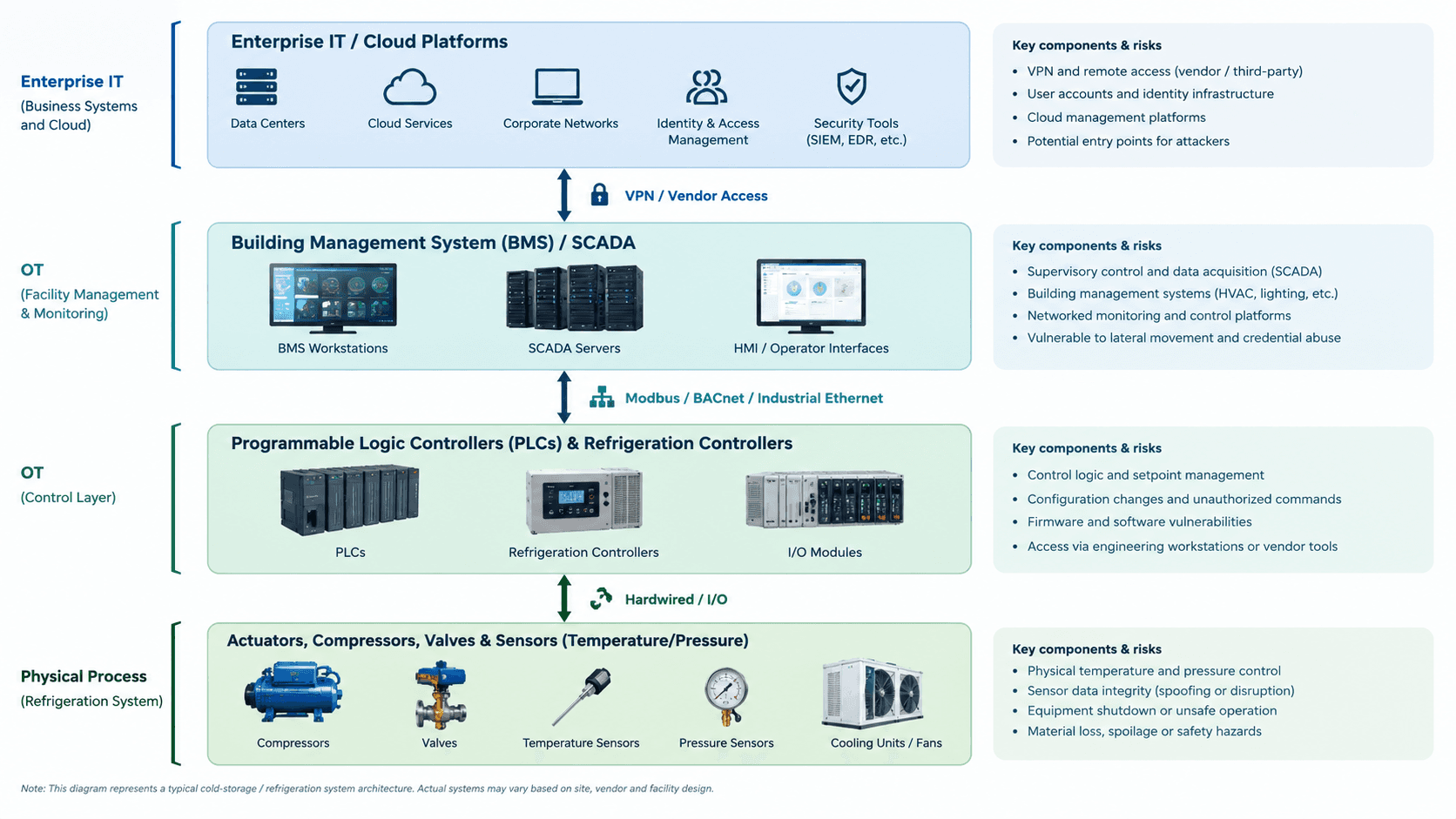
Note: The architecture above is a representative model. Actual military installation configurations vary widely based on facility age, contractor management, and classification levels.
Core components and failure modes
Refrigeration controllers and PLCs: Execute local control loops to maintain setpoints. Compromise or unauthorized logic changes can force compressors off or open expansion valves improperly.
Instrumentation (sensors): Temperature and pressure sensors provide telemetry. If sensor readings are spoofed (integrity attack), operators may believe a freezer is at a certain operational level while actual temperatures rise, causing silent spoilage.
Building Management Systems (BMS): Aggregate multi-system data (HVAC, refrigeration, lighting). BMS platforms are frequent targets due to IT-OT convergence and weak perimeter segmentation.
Vendor support and remote access: Third-party maintenance providers often maintain persistent VPN tunnels or remote desktop access into refrigeration management networks, creating lateral movement opportunities for attackers.
Attack or failure class | Potential effect | Evidence to seek |
Unauthorized control change | Setpoint, defrost schedule or control behavior changes | Controller configuration history, event logs, engineering workstation activity |
Measurement manipulation | Displayed temperature differs from actual conditions | Independent temperature records, sensor diagnostics, historian data |
Alarm or monitoring impairment | Abnormal conditions are not detected or escalated promptly | Alarm histories, threshold changes, monitoring availability, notification records |
Availability disruption | Supervisory monitoring or control becomes unavailable | Network logs, service events, controller status, power and equipment records |
Non-cyber failure | Similar physical symptoms without malicious access | Maintenance records, component diagnostics, electrical logs and manufacturer analysis |
Competing attack and non-attack hypotheses
To maintain analytical rigor, multiple competing hypotheses must be evaluated to explain refrigeration anomalies:
Hypothesis 1: Targeted Cyber Disruption (State or Criminal)
Rationale: Intentional sabotage of logistics or creation of supply bottlenecks.
Required Capability: Access to BMS/refrigeration networks via stolen credentials or vulnerable remote access gateways.
Observables: Unauthorized configuration changes, anomalous controller log entries, unexpected external IP connections.
Confidence: Low-to-Moderate (unconfirmed without forensic data).
Hypothesis 2: Opportunistic Ransomware / Extortion Collateral Damage
Rationale: Enterprise IT ransomware spreading into facility management networks sharing Active Directory domains or flat internal routing.
Required Capability: Commodity initial access (phishing, exposed RDP).
Observables: Encryption of management servers, ransom notes on HMI screens.
Confidence: Moderate.
Hypothesis 3: Non-Cyber Equipment Failure or Environmental Stress
Rationale: Mechanical wear, compressor burnout, power grid instability, or extreme ambient weather overloading aging refrigeration units.
Required Capability: None (physical breakdown).
Observables: Hardware faults, electrical logs showing voltage spikes, maintenance records showing deferred servicing.
Confidence: Moderate-to-High (historically the most common cause of refrigeration failure).
Hypothesis 4: Human Error / Maintenance Misconfiguration
Rationale: Accidental setpoint modification or incorrect calibration during routine servicing.
Required Capability: Internal access.
Observables: Audit logs showing local engineering changes preceding the incident.
Confidence: Moderate.
State and non-state threat landscape
When evaluating cyber threats to operational technology in military-support infrastructure, historical context provides important baselines:
Industrial Control System Targeting: State-sponsored actors have repeatedly demonstrated the capability to target OT (such as Industroyer, Triton), though these historically targeted high-consequence processes like electric grids and safety instrumented systems rather than food storage.
Ransomware Impact on Supply Chains: Criminal syndicates (such as DarkSide attack on Colonial Pipeline, REvil attack on JBS Foods) have shown willingness to disrupt logistics, meatpacking, and fuel distribution—either intentionally for extortion or opportunistically affecting adjacent systems.
The Risk of False Equivalence: An enterprise ransomware infection affecting a meat processor is fundamentally different from a targeted physical disruption of military cold storage. Analysts must avoid forcing disparate incidents into a single threat narrative.
Why cold-chain and freezer systems may be attractive targets
If an actor deliberately targets refrigeration, several operational characteristics make these systems appealing:
Low Visibility and Delayed Detection: Unlike a downed server or a blank radar screen, a temperature excursion inside an insulated freezer does not immediately broadcast an alert unless monitoring systems are intact and actively supervised.
Asymmetric Physical Consequences: Modest digital interference (e.g., altering a defrost cycle or raising setpoints by a few degrees over time) can ruin entire inventories of perishable food, vaccines, or sensitive biological materials without requiring destructive malware.
Complex Third-Party Dependencies: Refrigeration assets are rarely managed directly by elite military cyber personnel; they rely on civilian contractors, specialized vendors, and legacy maintenance software.
Attribution analysis and the absence of public claims
As of this report's timeframe, no group or state actor has claimed responsibility for the reported military freezer malfunctions.
Analytical Explanations for Silence:
No Cyberattack Occurred: The event was mechanical, electrical, or operational; there is no threat actor to claim responsibility.
Espionage / Pre-positioning: If an advanced actor gained access for reconnaissance or establishing persistent access, publicizing the intrusion would burn valuable access vectors.
Criminal Disinterest: If criminal extortionists accessed a military facility and realized monetization is constrained or legally perilous, they may abandon the effort without issuing a public ransom note.
Core Principle: The absence of a public claim cannot be used to infer sophisticated state-sponsored stealth. Attribution requires positive technical evidence.
Military vulnerability versus broader industrial exposure
Defense installations share many vulnerabilities with commercial cold-chain operators (hospitals, food distributors, pharmaceutical warehouses), but face unique structural challenges:
Dimension | Military Installations | Commercial Operators |
Legacy Equipment | Long asset lifecycles; mixed legacy and modern controllers. | Variable; often updated based on commercial margins. |
Vendor Ecosystem | Heavy reliance on defense contractors and specialized facility vendors. | Commercial supply chain vendors and maintenance contractors. |
Network Segmentation | Strict formal policies, but often challenged by flat legacy utility networks. | Variable segmentation; heavy reliance on cloud management platforms. |
Security Governance | Managed via defense cyber frameworks alongside strict operational readiness rules. | Regulated by commercial standards (FDA, HACCP, ISO). |
Findings and strategic implications
Finding 1: Loss of Measurement Integrity Equals Loss of Control
Supporting Evidence: ICS telemetry analysis across modern smart facilities.
Reasoning: Attackers do not need to cut power to a freezer to cause damage; manipulating sensor calibration or spoofing SCADA displays allows thermal degradation to occur silently while operators believe systems are nominal.
Security Implication: Defenders must implement independent out-of-band temperature verification loops.
Finding 2: The Vendor Remote-Access Blind Spot
Supporting Evidence: Industry incident response trends highlighting contractor-managed OT assets.
Reasoning: Refrigeration units are frequently monitored via persistent vendor connections that bypass internal enterprise firewalls.
Security Implication: Vendor access must be treated as untrusted zero-trust zones requiring time-bounded session approvals and full packet/session logging.
Potential operational, material, financial, and safety impacts
Material Spoilage: Loss of perishable rations, medical provisions, or specialized chemicals.
Logistical Bottlenecks: Forcing emergency resupply operations during heightened readiness windows.
Safety Risks: Consumption of spoiled goods if monitoring integrity is compromised and tainted items bypass inspection.
Defensive architecture and incident-response priorities
Prevention
Enforce strict IT/OT network segmentation with hardware firewalls and unidirectional gateways where feasible.
Deploy phishing-resistant Multi-Factor Authentication (MFA) for all remote and privileged administrative access.
Eliminate persistent vendor VPN connections; mandate on-demand, jump-host-mediated, session-recorded access.
Detection
Monitor for unauthorized setpoint modifications, alarm threshold changes, and logic uploads on PLCs and BMS controllers.
Implement independent secondary sensors that compare physical thermocouple readings against digital SCADA telemetry to detect sensor spoofing.
Response and recovery
Preserve forensic evidence (controller logs, gateway event logs, firewall traffic captures) before rebooting or isolating equipment.
Establish verified, offline backup configurations for all programmable refrigeration controllers.
Overall, the defensive response should address both the control system and the wider operational dependency chain.
Priority 1: Eliminate direct internet exposure
Inventory refrigeration controllers, BMS platforms, gateways and remote-management services. Remove unnecessary public access and restrict authorised maintenance to controlled, monitored access paths. Validate remediation through external exposure checks.
Priority 2: Enforce IT/OT and site-level segmentation
Restrict communication to documented requirements. Separate corporate identity, warehouse applications, BMS and refrigeration controls where operationally feasible. Avoid allowing compromise of one store, vendor account or enterprise service to provide unrestricted access to others.
Priority 3: Monitor physical outcomes independently
Use independently monitored temperature sensors and alerting paths that do not rely exclusively on the potentially compromised controller or its management interface. Alert on unexplained temperature deviations, abnormal defrost duration, changes outside approved maintenance windows and loss of monitoring visibility.
Priority 4: Secure remote maintenance
Require MFA, individual accounts, least privilege, time-limited access and session logging. Remove dormant vendor accounts and persistent access paths that are not operationally necessary. Verify firmware support status with the manufacturer and establish a controlled plan for legacy devices that cannot be patched.
Priority 5: Test degraded operations and recovery
Exercise scenarios where refrigeration telemetry is untrusted, enterprise systems are unavailable, warehouse automation cannot receive instructions, or a remote-access service must be isolated. Define safe local operating procedures, food-hold and release decisions, manual logistics processes, and recovery criteria before an incident occurs.
KPI/KRI framework
Metric / Indicator | Formula / Unit | Source / Owner | Target Approach |
Refrigeration Asset Inventory Coverage | Facilities / OT Engineering | 100% visibility of connected controllers. | |
Strong Auth on Remote Access | CISO / IT Security | 100% enforcement. | |
Independent Sensor Verification Coverage | Facilities Security | Critical assets: 100%. | |
Time to Detect Setpoint Anomalies | Elapsed time from unauthorized change to alert generation (Minutes/Hours) | SOC / OT Monitoring | minutes. |
Standards and control mapping
NIST CSF 2.0: Protect (PR.DS-6: Integrity of data is checked) and Detect (DE.CM-01: Networks and network service monitoring).
NIST SP 800-82 Rev. 3: Guide to Operational Technology (OT) Security, specifically Section 5 on system hardening and risk management.
IEC 62443-3-3: Security levels for industrial automation and control systems, focusing on zone segmentation and restricted data flow.
CISA Cross-Sector CPGs: Control 2.3 (Restrict Remote Access) and Control 5.2 (Implement Network Segmentation).
Intelligence gaps and priority collection plan
Gap 1: Exact nature of the reported anomalies (sensor drift vs. forced compressor shutdown).
Priority: High.
Collection Method: Direct technical telemetry from affected installations and official investigative disclosures.
Gap 2: Presence or absence of third-party vendor credential compromise.
Priority: High.
Collection Method: Forensic log analysis of VPN gateways and maintenance portals.
Outlook and implications for critical infrastructure operators
The investigation into military-base freezer malfunctions serves as a bellwether for critical infrastructure security. As cyber operations increasingly intersect with physical and building management systems, operators across both defense and civilian sectors must move beyond traditional IT perimeter defense. Securing the cold chain requires treating physical process instrumentation, vendor access pathways, and measurement integrity as core national security priorities.
Lastly we have to break the cyber attack paths to ensure hackers are unable to convert such attacks into a playbook.
Sources and methodology
Primary Source: Reuters, "Pentagon treating military base freezer malfunctions as suspected cyberattack, officials say."
Frameworks Referenced: NIST SP 800-82 Rev. 3, IEC 62443, CISA Cross-Sector Cybersecurity Performance Goals (CPGs).
Methodology: Structured analytical techniques (Hypothesis Generation, Evidence Reliability Grading, and Threat Modeling); OSINT correlation investigation of all available data followed by validation.
Recibe semanalmente
Recursos y Noticias
Vea cómo nuestras soluciones de seguridad de OT líderes en la industria abordan los desafíos de seguridad críticos
También te puede interesar

MITRE ATT&CK for ICS: What v20 Changes for Plant Security Teams
Team SHieldworkz

OT Security in Pharma: Protecting GxP Production Systems
Team Shieldworkz

The Purdue Model for OT Security: Levels 0-5 with Examples and Latest Updates
Team Shieldworkz

CISCO SD-WAN Attack: CVE-2026-20127 Exploited to Deploy KeyDrift Malware and Collect Encryption Keys
Team Shieldworkz

Hitachi Energy Vulnerabilities 2026: High-Severity Flaws in TRO600 and CoreTec, and What PCM600 Owners Should Do
Team Shieldworkz

SL1 to SL4: How to Pick the Right Target Security Level per Zone
Team Shieldworkz