Inside the alleged onsemi Cyberattack: How Far Did Qilin Really Get?


Team Shieldworkz
Today’s investigative assessment evaluates the reported cyber security incident involving ON Semiconductor Corporation (onsemi), published on October 5, 2026. It is structured as a threat-intelligence case study for semiconductor Chief Information Security Officers (CISOs), Operational Technology (OT) security leaders, Security Operations Center (SOC) teams, fab engineers, and critical-infrastructure executives.
The significance of an onsemi cyber incident is not simply that "semiconductors are critical." It is that onsemi sits across automotive electrification, industrial automation, sensing, power electronics and defense-relevant supply chains, while operating a geographically distributed manufacturing footprint.
Establishing what happened
On October 5, 2026, cybersecurity tracking entities reported that the Qilin ransomware operation added onsemi (ON Semiconductor Corporation) to its dark-web leak site. The listing asserts that Qilin exfiltrated sensitive internal data, including employee personal information, Social Security Numbers (SSNs), financial records, internal corporate documents, vendor contacts, and proprietary intellectual property (IP).
Onsemi public confirmation: No public confirmation identified as of October 6, 2026. No Item 1.05 Form 8-K identified as of the research cutoff.
Question | Assessment |
Qilin listed onsemi? | Confirmed as a public threat-intelligence observation |
Qilin actually compromised onsemi? | Unconfirmed |
Data stolen? | Threat-actor claim / unverified |
Ransomware executed? | Unknown |
Encryption occurred? | Unknown |
Corporate IT accessed? | Unknown |
Manufacturing IT/MES accessed? | No public evidence identified |
Fab OT accessed? | No public evidence identified |
Production disrupted? | No public evidence identified |
Customer supply disrupted? | No public evidence identified |
Data samples independently validated? | Not established from available evidence |
Onsemi publicly acknowledged incident? | Not identified as of cutoff |
Fact Reconstruction
• First Reported Date: October 5, 2026.
• Reporting Entity: Third-party breach intelligence aggregation services referencing Qilin’s dark-web extortion portal.
• Affected Entity: ON Semiconductor Corporation (onsemi) — global producer of power management ICs, silicon carbide (SiC), and image sensors.
• Corporate Acknowledgment: As of early October 2026, onsemi has not issued an official statement, filed an SEC Form 8-K, or confirmed a breach.
• Scope of Alleged Compromise: Allegations focus on enterprise data repositories (file shares, HR records, financial databases, commercial IP). There is no evidence indicating access to Manufacturing Execution Systems (MES), process control domains, cleanroom automation, or facility OT.
• Malware & Ransomware Deployment: Unconfirmed whether Qilin’s ransomware payload successfully executed on corporate endpoints or whether this represents a pure data-exfiltration and extortion attempt.
• No reported downtime across onsemi’s global fab network (e.g., Bucheon, South Korea; East Fishkill, NY; Roznov, Czech Republic). No public reporting of production disruption, fab downtime, customer allocation disruption or manufacturing-system outage was identified as of October 6, 2026.
• Proof Samples Published: File tree listings and selected document screenshots consistent with corporate administration and engineering repositories were published on Qilin's leak portal.
Analytical Verdict: THREAT-ACTOR CLAIM. Ransomware leak-site listings must never be conflated with verified operational compromise. Without independent forensic telemetry, regulatory notifications, or SEC filings, this event must be classified as an unconfirmed extortion attempt targeting enterprise data, with no operational technology (OT) or manufacturing impact.
The current public evidence does not establish:
that onsemi's corporate network was successfully compromised;
that Qilin encrypted onsemi systems;
that data was exfiltrated;
that the claimed data originated directly from onsemi;
that manufacturing IT or MES was accessed;
that engineering systems were accessed;
that semiconductor equipment was accessed or manipulated;
that any fab experienced operational disruption;
that customer deliveries were affected;
that the intrusion was state-sponsored;
or that Iran was involved.
Threat actor profile and claims assessment: Qilin (Agenda)
Qilin (originally emerging as Agenda in July 2022) is a sophisticated Russian-speaking Ransomware-as-a-Service (RaaS) group known for targeting critical infrastructure, healthcare, high-tech engineering, and industrial manufacturing.

Technical Tradecraft and TTPs
• Language & Architecture: Rewritten in Rust (Qilin.B variant) in late 2022 to evade signature-based detection, facilitate cross-platform execution (Windows, Linux, VMware ESXi), and speed up multi-threaded encryption.
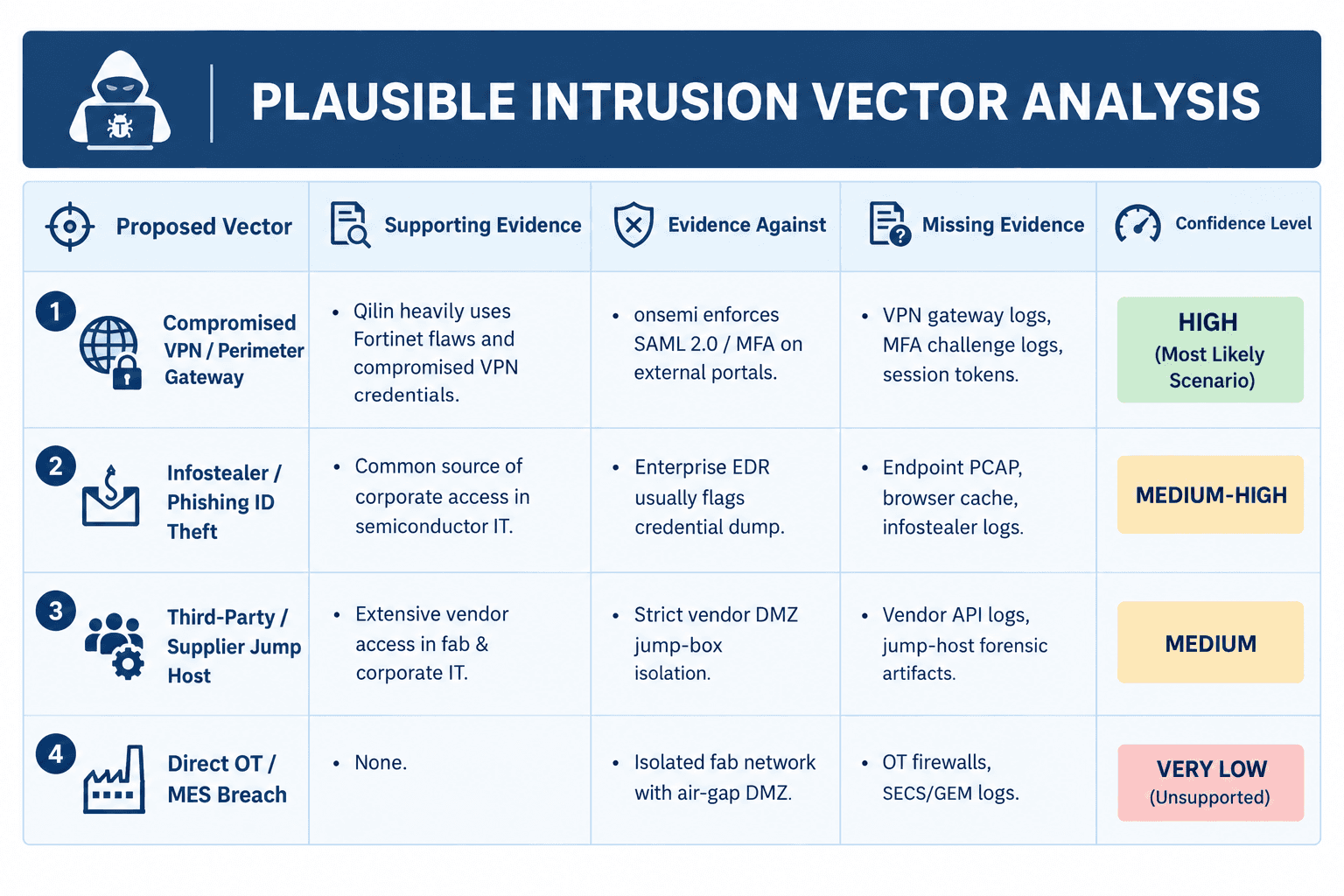
• Initial Access Vectors: Frequently relies on stolen VPN/RDP credentials, infostealers (e.g., RedLine, Raccoon targeting Chrome passwords), phishing, or exploitation of unpatched perimeter appliances (e.g., Fortinet CVE-2024-21762).
• Defense Evasion & EDR Disruption: Utilizes Bring Your Own Vulnerable Driver (BYOVD) attacks. In early 2025, Qilin was observed deploying a signed binary (upd.exe) to sideload avupdate.dll, which loads a customized build of EDRSandblast to strip kernel callbacks and kill active EDR processes.
• Lateral Movement & Exfiltration: Employs Living-off-the-Land Binaries (LotL) such as PowerShell, psexec, masscan, and ProxyChains. Data exfiltration is typically executed via Rclone, WinSCP, or custom MegaSync scripts before encryption.
• Leak Site Behavior & Integrity: Qilin operates a double-extortion dark web portal. While Qilin has claimed responsibility for major breaches (e.g., London NHS partner Synnovis in 2024), its affiliates occasionally list targets based on partial or third-party vendor leaks to fabricate leverage.
Reconstructing the potential attack chain
Because no official incident response report has been published, we evaluate plausible initial access scenarios using threat-intelligence telemetry, Qilin’s historical TTPs, and semiconductor network architectures.
Distinguishing IT compromise from semiconductor OT compromise
A critical error in industrial cybersecurity reporting is labeling an enterprise data breach as an "OT attack" simply because the victim operates manufacturing facilities.

Technical Evidence Evaluation Across Domains
• Corporate IT: Alleged compromise of enterprise file servers, administrative systems, and IP repositories.
• Manufacturing IT (MES): No evidence of access. Manufacturing Execution Systems (e.g., Applied Materials SmartFactory, Critical Manufacturing MES) remained fully operational. Lot tracking, wafer dispatching, and yield management systems were unaffected. No public evidence currently establishes compromise or disruption of onsemi MES or manufacturing systems.
• Fab OT / Equipment Controls: No public evidence of access or manipulation. Photolithography steppers, Chemical Vapor Deposition (CVD) chambers, Ion Implanters, and Automated Material Handling Systems (AMHS) operated without interruption.
• Facilities OT: No evidence of access. Ultrapure Water (UPW) filtration, bulk gas delivery (Silane, Nitrogen, Ammonia), Toxic Gas Monitoring Systems (TGMS), and HVAC cleanroom pressurization systems were untouched.
Why semiconductor OT is unique and hyper-sensitive
Semiconductor manufacturing facilities (fabs) are among the most complex industrial environments on Earth. Operating 24/7/365, a modern 300mm or SiC fab processes silicon or silicon carbide wafers through hundreds of sequential micro-lithographic steps over 60 to 90 days.
Layer | Potential cyber consequence |
Manufacturing IT/MES | Lot dispatch, scheduling, genealogy or production coordination disruption |
Engineering systems | Unauthorized or erroneous process-program/configuration changes |
Equipment network | Loss of equipment availability or unauthorized process interaction |
Facilities OT | Environmental-control disruption affecting production conditions |
Safety systems | Potential safety consequences depending on architecture and interlocks |
Micro-dependencies and physical cascades
Advanced semiconductor processes depend on tightly controlled environmental conditions including temperature, humidity, vibration, chemical contamination and particulate levels with tolerances varying by process and equipment.
1 Sub-Nanometer Precision: Lithography tools require environmental stability down to $\pm 0.05^\circ\text{C}$ and near-zero micro-vibrations. Cyber-induced disruptions to cleanroom HVAC PLCs can ruin thousands of wafers in process.
2 Sequential Process Dependency: A 300mm wafer undergoes up to 1,000 individual process steps (etching, deposition, CMP, implant). If a cyber incident corrupts an MES recipe on step 450, all subsequent processing yields dead die. Advanced semiconductor manufacturing involves hundreds of process operations and can have long cycle times, making integrity failures difficult to isolate once affected material has progressed through multiple process stages.
3 Continuous Flow Requirements: Facilities OT (UPW pumps, hazardous gas scrubbers) cannot be paused gracefully. An unexpected tripping of safety PLCs triggers automatic emergency gas purges, taking weeks to re-qualify cleanroom baselines.
Semiconductor "Crown Jewels" and strategic value
In a semiconductor organization, data assets vary significantly in strategic and financial value depending on the adversary's intent.

Threat modeling: The "Yield Attack" problem
Illustrative scenario. This is not evidence of activity at onsemi: An attacker with appropriate engineering access modifies a process parameter sufficiently to remain within an apparently plausible operating range but eventually causes abnormal process output.
A yield attack is a subtle integrity manipulation where an attacker does not shut down the fab, but instead slightly alters manufacturing parameters to corrupt output quality.
[Normal Operation] ──────> Yield: 92% (High Profitability)
│
▼
[Yield Attack Phase] ─────> Attacker subtly shifts CMP Polish Rate by +2%
│
▼
[Consequence Phase] ──────> Wafer thickness out of spec at Step 300
│
▼
[Financial Impact] ──────> Yield drops to 64% (Attributed to "Machine Drift" for Months)
Threat Model Mechanics
• Attack Scenario: An attacker accesses the Engineering Domain via compromised jump-host credentials and modifies the Chemical Mechanical Planarization (CMP) polishing time or Gas Flow Controller (MFC) calibration by $1\text{--}3\%$.
• Why It Evades Detection: Statistical Process Control (SPC) engines treat small deviations as normal machine wear or batch variations. The fab continues running, consuming millions of dollars in raw silicon, chemicals, and energy, only to produce die that fail thermal stress testing after packaging.
• Diagnostic Challenge: Engineers will spend months troubleshooting tool hardware, slurry chemistry, or raw wafer purity before suspecting a cyber-induced configuration change in the MES database.
Threat Modeling: IT-to-fab attack paths
To assess potential lateral movement, we model how an enterprise IT compromise could theoretically bridge into fab operational environments.

Supply-chain risk in semiconductor ecosystems
Semiconductor fabs rely on a dense ecosystem of third-party vendors for tool maintenance, chemical supply, and facility management.

Primary Supply-Chain Exposure Points
1 Persistent Vendor Maintenance Tunnels: Equipment vendors require continuous remote access to monitor vacuum pumps, laser optics, and RF generators. Unmonitored vendor VPNs represent a primary bypass of perimeter controls.
2 Portable Engineering Laptops: Field application engineers bring external laptops into the cleanroom to plug directly into tool maintenance ports (Ethernet/RS-232), bypassing network firewalls.
3 Unsigned Firmware & Software Updates: Tool controller updates delivered via vendor portals can be tampered with upstream to introduce persistent rootkits into tool PLCs.
Evaluating the state-actor dimension
High-tech manufacturing attacks often invite speculation regarding state-sponsored cyber espionage.
Assessment: Observed indicators align with financially motivated criminal extortion. However, criminal ransomware operations can act as unwitting proxies; stolen corporate files sold or leaked on the dark web are routinely harvested by foreign intelligence services for strategic R&D analysis.
Specific hypothesis assessment: Iran threat actor involvement
We evaluate the explicit hypothesis of Iranian state-sponsored or state-linked involvement (such as MuddyWater, Pioneer Kitten, Agrius).

Confidence Levels Across Competing Hypotheses
1 Financially Motivated Criminal RaaS Affiliate (Qilin): HIGH CONFIDENCE (85%) — TTPs, leak site artifacts, and monetization structure strictly match commercial RaaS norms.
2 Access Broker Resale to Criminal Gang: MEDIUM CONFIDENCE (50%) — Initial access likely purchased from an independent broker specializing in VPN/RDP credentials.
3 Iranian State-Sponsored Covert Operation: LOW CONFIDENCE (15%) — Lacks wiper signatures, geopolitical manifestos, or targeted strategic destruction characteristics typical of Iranian campaigns.
Geopolitical and strategic semiconductor context
ON Semiconductor (onsemi) is not an ordinary electronics manufacturer. It is a critical supplier in the global power-electronics and automotive ecosystem.

A major operational shutdown at an onsemi fab would immediately bottleneck Tier-1 automotive suppliers, halting assembly lines for electric vehicles (EVs) and industrial power systems worldwide.
The "Single-Fab / Single-Component" bottleneck
A cyber incident in a semiconductor company must be evaluated not by lost corporate quarterly revenue, but by component replacement friction.
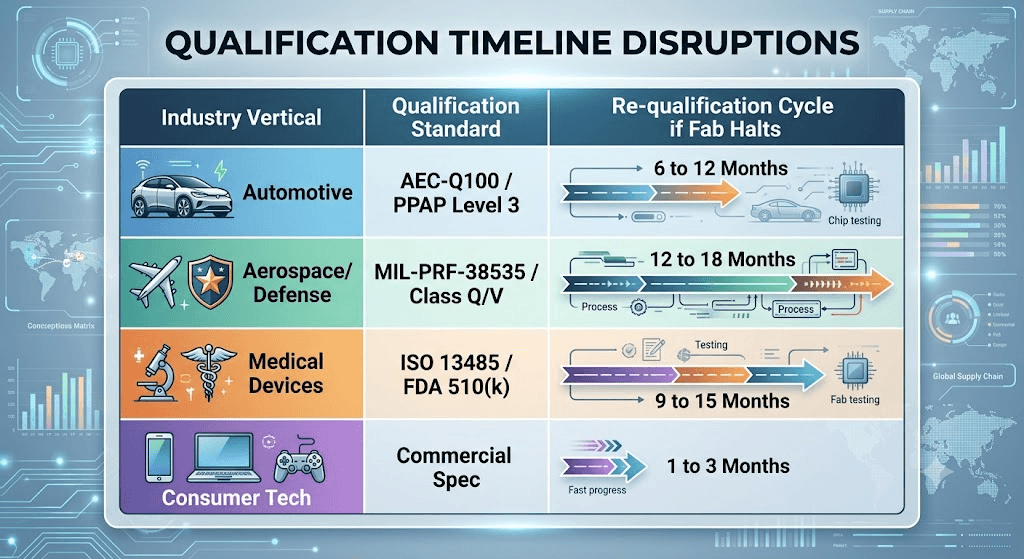
Even if a fab recovers from a cyber attack within two weeks, any loss of process validation requires auto manufacturers to re-qualify component lots, creating disproportionate downstream production halts.
Under-discussed observations in semiconductor cyber risk
1. Observation: Extortion as an Indirect Supply-Chain Weapon |
| Evidence: Exfiltrated vendor lists and IP schematics exposed downstream tier-1 automotive clients to secondary extortion. |
| Why it matters: Threat actors don't need to breach automobile makers if they hold their single-source chip supplier hostage. |
| Security Implication: Supply-chain risk management must include vendor breach notification SLAs under 24 hours. |
2. Observation: MES as the Unchecked IT/OT Bridge |
| Evidence: MES platforms bridge corporate Active Directory for user auth while issuing direct commands to fab equipment. |
| Why it matters: Compromise of an IT domain controller can grant administrative rights over MES lot scheduling. |
| Security Implication: Decouple MES user authentication from enterprise Active Directory; enforce local MFA. |
3. Observation: Yield Attack Vulnerability over Ransomware Shutdown |
| Evidence: Modern steppers allow remote parameter updates via SECS/GEM without cryptographic signature verification. |
| Why it matters: Sabotaging wafer yield by 3% causes greater financial loss over time than a 3-day complete fab shutdown. |
| Security Implication: Implement cryptographic signing for all tool recipe files and configuration updates. |
4. Observation: Facilities OT is the Hidden Critical Single Point of Failure |
| Evidence: Cleanroom HVAC and UPW systems run on legacy PLCs connected to corporate BMS networks. |
| Why it matters: Tripping a single UPW pump PLC dumps cleanroom pressure, ruining all active in-line silicon wafers. |
| Security Implication: Isolate Facilities BMS into a dedicated safety zone with unidirectional gateways. |
5. Observation: Heterogeneity of Legacy Fab Tooling |
| Evidence: Modern 300mm fabs operate 20-year-old legacy tools running unpatched Windows XP/7 embedded systems. |
| Why it matters: Endpoint agents cannot be installed on vendor-certified tool control PCs without voiding warranties. |
| Security Implication: Rely on network-level micro-segmentation and agentless anomaly detection for tool networks. |
6. Observation: Vendor Field Engineer Laptops as Unmonitored Shadow Bridges |
| Evidence: Field engineers bypass perimeter firewalls by plugging laptops directly into tool Ethernet ports inside the cleanroom.|
| Why it matters: A malware-infected vendor laptop bypasses all corporate IT perimeter controls. |
| Security Implication: Enforce physical port security, 802.1X NAC, and inspection stations for all vendor hardware entering fab.|
7. Observation: Recovery Complexity Exceeds Standard IT Restoration Timelines |
| Evidence: Re-imaging an MES server takes hours; recalibrating lithography tools and re-establishing baseline yield takes weeks.|
| Why it matters: IT-centric Disaster Recovery (DR) plans give executives false confidence in recovery speed. |
| Security Implication: DR plans must include "Golden Baseline" equipment configuration validation protocols. |
8. Observation: Photolithography GDSII Data as High-Value Geopolitical Currency |
| Evidence: Rogue nation-states aggressively seek mask layouts to leapfrog decade-long sub-micron lithography R&D gaps. |
| Why it matters: IP exfiltration from semiconductor firms has national security consequences beyond corporate financial loss. |
| Security Implication: Mandate Digital Rights Management (DRM) and HSM-based encryption for all GDSII/OASIS design files. |
9. Observation: Active Directory Dependencies in Fab Automation |
| Evidence: Many fab automation servers rely on corporate Kerberos authentication for internal process transfers. |
| Why it matters: Taking down enterprise Active Directory during a cyber attack accidentally freezes fab automation. |
| Security Implication: Fabs must maintain an isolated, resilient local identity provider (IdP) for internal factory operations. |
10. Observation: Process Drift Masking Cyber Intrusions |
| Evidence: Semiconductor equipment experiences natural mechanical drift, making subtle cyber manipulation look like hardware fatigue.
| Why it matters: Security teams won't investigate a cyber cause for minor yield degradation without explicit OT alerts. |
| Security Implication: Integrate OT security logging with SPC (Statistical Process Control) telemetry. |
Dimensions of impact analysis
Dimension | Current evidence | Potential severity |
Production | No public impact identified | High |
Yield | No evidence of impact | Very high if integrity attack confirmed |
IP | Exfiltration claimed, unverified | High |
Confidentiality | Alleged data theft | High |
Integrity | No evidence | Critical if manufacturing state affected |
Availability | No public fab outage identified | High |
Supply chain | No disruption identified | High if critical-source dependency affected |
Safety | No evidence | Potentially critical |
Financial | Unknown | Potentially high |
Regulatory | Unknown | Potentially high |
Strategic | Victim is strategically important | High potential |
Reference semiconductor OT defensive architecture
Actual architecture unknown. The following architecture is an illustrative semiconductor threat model and should not be interpreted as a representation of onsemi's environment.

Detection engineering use cases for semiconductor OT

KPI and KRI framework for semiconductor fabs

Standards and frameworks matrix

Incident response workflow for semiconductor fabs
Restoring a server from backup is not equivalent to restoring a fab. Fab recovery requires verifying physical process parameters before resuming wafer flow.
1.Threat Isolation & Domain Containment: Isolate IT without tripping fab safety systems.
Sever enterprise IT connections at DMZ Firewalls. Do not execute indiscriminate isolation actions against Level 1/0 equipment or safety systems without an OT-aware containment procedure and process-owner approval, unless immediate safety conditions require emergency action.
2.Verification of Physical Safety Systems: Ensure chemical and toxic gas systems are nominal.
Audit Toxic Gas Monitoring Systems (TGMS), Ultrapure Water (UPW), and cleanroom pressurization controls. Confirm physical safety interlocks are operating on local hardwired logic.
3.Establishment of 'Trusted Production Baseline’: Verify recipes before restarting lot dispatch.
Compare active tool configurations and recipe GDSII files against cryptographically signed offline "Golden Baselines" stored in an isolated vault.
4.Controlled MES & Tool Re-boarding: Sequential restart of manufacturing IT.
Bring MES databases online in read-only mode. Re-connect equipment clusters sequentially, verifying SECS/GEM handshake integrity at each step.
5.Pilot Lot Run & Parametric Yield Audit: Validate product quality prior to full volume restart.
Run controlled engineering/qualification material through affected process steps and compare equipment, metrology and yield indicators against trusted pre-incident baselines before releasing production lots.
Wöchentlich erhalten
Ressourcen & Nachrichten
Erfahren Sie, wie unsere branchenführenden OT-Security-Lösungen kritische Sicherheitsherausforderungen gemäß KRITIS-Anforderungen bewältigen
Dies könnte Ihnen auch gefallen.

How AI Is Changing IEC 62443 Assessments
Team Shieldworkz

Deep investigative threat intelligence report: Alleged SafePay cyberattack on T-Systems
Team Shieldworkz

CEA Compliance Requirements for Power Utilities: What Changes
Team Shieldworkz

OT Media Scan Solution: What to Evaluate Before Securing Removable Media
Team Shieldworkz

G99 cybersecurity evidence pack for UK generators and BESS: What DNOs need to see in the PGMD
Team Shieldworkz

Best IEC 62443 Risk Assessment Platform for Industrial OT Security
Team Shieldworkz