50°C by cyberattack? Inside France’s supermarket refrigeration crisis


Prayukth K V
Date of Analysis: October 13, 2026
Primary Focus: Cyber-Physical Disruption, Operational Technology (OT) / Building Management Systems (BMS) Dependency, Supply Chain Vulnerability
Target Sector: Retail Grocery, Cold-Chain Logistics, Food Distribution (France / Western Europe)
Between the night of 11–12 October 2026, a large-scale cyber incident caused a disruption in refrigeration systems at multiple French supermarket chains. Public reporting at the time of writing indicates that some affected refrigeration units reached temperatures of up to 50°C, resulting in food spoilage and reported fires. Intermarché's parent group reported impacts at around 150 stores. Other reporting described more than 100 affected Coopérative U outlets and disruption involving additional retail chains. These figures are retailer- and source-specific and should not be treated as a verified, deduplicated national total.
The available reporting identifies Danfoss refrigeration-management equipment as a significant technical lead. Danfoss stated that affected systems were running outdated firmware. This is relevant in light of claims about vulnerabilities affecting the Danfoss AK-SM 800A platform, including an authentication-bypass vulnerability. However, the public evidence reviewed for this Shieldworkz report does not establish that a particular CVE was exploited during the incident, which access path was used, or whether all affected retailers shared the same technical exposure.
The incident demonstrates a credible cyber-physical risk to commercial cold-chain operations: unauthorised control of refrigeration functions can produce material losses without requiring the attacker to compromise point-of-sale systems or deploy conventional file-encrypting ransomware. It does not yet establish that the attackers compromised a single central cloud platform, defeated independent physical safety devices, or used a common multi-tenant service to reach every affected store.
Key intelligence judgements
1. Operational impact: high confidence: Public reporting supports significant refrigeration disruption and food losses across multiple French retail chains.
2. Danfoss-related exposure: moderate confidence: Danfoss equipment and outdated firmware are reported as relevant; the exact product versions, configurations, and exploited weaknesses remain to be established.
3. Initial access and propagation: undetermined: A vulnerable controller, exposed management interface, compromised credentials, service-provider access, or another route remain candidate explanations.
4. Direct OT manipulation: plausible, but scope requires precision: The reported use of refrigeration-control functions suggests a cyber-physical dimension. The underlying commands, devices, and control boundaries have not been independently reconstructed in the public evidence reviewed.
5. Cross-border linkage: unconfirmed: The Ahold Delhaize security incident should be assessed separately unless technical indicators or authoritative findings connect it to the French event.
6. Threat actor and motive: unknown: The incident's operational impact does not by itself establish state sponsorship, political intent, extortion, or a broader hybrid campaign.
Central analytical conclusion: The most important question is not simply whether a refrigeration controller was vulnerable. Instead, it is how an attacker could gain sufficient authority to cause unsafe or economically destructive changes, how those changes could propagate across sites, and why local safeguards and monitoring did—or did not—prevent or limit the consequences. Those questions should guide the investigation and the defensive recommendations.
Incident dimensions
· When seen in the larger context of attacks on water utilities and power companies, hackers seem to be operating with a wider motive of carrying out cyberattacks that cause disruption across multiple citizen touchpoints
· There is a flavor of inflation in this attack when seen in the larger context
· While the threat actor behind this attack has not come forward yet, it is possible that this attack was a demonstration of the capabilities of the hacker group involved. The hackers were aware of many operational aspects of the target entity and used that effectively to target the company
· Instead of going behind the upstream parts of supply chains, this attack involved an attack on the downstream part
· Legacy systems are a challenge and need urgent security attention
Incident facts and confidence matrix
The following matrix classifies factual claims from primary, government, and media sources as of October 13, 2026.
Claim | Assessment status | Confidence | Evidence and limitations |
Refrigeration systems at multiple French supermarket chains were disrupted | Reported by multiple credible outlets, with retailer and prosecutor statements cited | High for the broad incident; exact scope remains provisional | Reuters, AFP and other reporting. Store counts vary by retailer and source. |
Some affected refrigerators reached approximately 50°C | Retailer-specific figure reported | High that the figure was publicly reported; independent telemetry not available in this assessment | Attribute to the relevant retailer statement. Do not imply every affected unit reached this temperature. |
Some affected units remained heated for approximately six hours | Reported for Intermarché stores | Moderate to high as a reported claim; technical measurement details unavailable | Do not generalise the duration to all retailers or sites. |
Fires and food losses occurred | Reported by the Paris prosecutor's office and media | High that these consequences were reported | The physical cause of each fire has not been established here. |
Danfoss equipment and outdated firmware are relevant to the incident | Vendor statement and press reporting | Moderate to high | Exact product models, firmware builds, configuration, and exposure at each site require confirmation. |
A central cloud or multi-tenant platform was compromised | Hypothesis | Low to moderate | Could explain multi-site reach if a shared platform and access path are demonstrated. No such architecture should be assumed. |
Local safety interlocks were bypassed | Unknown | Low | Requires controller logic, hardware design, event logs, and engineering investigation. |
No malware was deployed | Unknown | Low | No publicly reported encryption event is not evidence that malware was absent. |
Ahold Delhaize's incident was part of the same operation | Unconfirmed hypothesis | Low | Shieldworkz has kept this outside the French incident scope until common technical evidence emerges. |
A state actor or criminal group was responsible | Unknown | Low | No attribution should be made without corroborated technical or investigative evidence. |
National losses reached tens of millions of euros | Preliminary estimate reported in the media | Moderate as a reported estimate; low as an independently verified total | Attribute the estimate and state that it is not an audited loss calculation. |
Confidence convention: Confidence refers to the assessment of the stated claim, not to the certainty that every underlying technical detail is known. “Reported” identifies the evidence's public status; it is not synonymous with “false” or “confirmed by forensic examination.”
Timeline and source reconciliation
Time | Event | Evidentiary status |
Night of 11–12 October | Refrigeration disruption reportedly affects multiple French supermarket chains. | Reported by retailers and multiple media outlets. Exact first malicious activity is unknown. |
Overnight, 11–12 October | Some affected Intermarché refrigeration units reportedly reach 50°C for approximately six hours. | Retailer-specific claim reported by Reuters and other outlets. Do not generalise to every affected location. |
12 October | Retailers report food losses; the Paris prosecutor's office describes a large-scale attack affecting connected refrigeration systems and reports fires. | Publicly reported incident and consequences. The technical cause of each fire remains unestablished in this report. |
12 October | French authorities announce an investigation involving ANSSI. Danfoss says it is aware of incidents affecting refrigeration management systems and that affected units were running outdated firmware. | Reported statements; technical findings from the investigation remain pending. |
12–13 October | Media report possible effects beyond the initially identified retailers and raise comparisons with a separate US military commissary incident. | Leads for further investigation, not proof of one international campaign. |
As of 13 October | Initial public reporting remains insufficient to establish the complete entry path, affected firmware inventory, command sequence, actor, or motive. | Intelligence gap. Update as primary-source evidence becomes available. |
Evidence-based attack reconstruction
What the evidence supports
Public reporting supports the conclusion that a cyber incident affected connected refrigeration systems at multiple retail organisations and that forced defrosting was reported as the mechanism associated with the food losses. Reporting also identifies Danfoss refrigeration-management equipment and outdated firmware as relevant leads.
The precise attack chain has not been established by the sources reviewed for this report. In particular, the available evidence does not establish whether the attacker compromised an internet-facing controller, abused legitimate credentials, exploited a vulnerability, gained access through a refrigeration maintenance provider, or used a shared remote-management service.
Competing access hypotheses (H)
H1: Direct exploitation of exposed refrigeration controllers
An attacker may have accessed internet-reachable management interfaces on vulnerable controller models and used the resulting privileges to alter refrigeration settings. Prior research makes this a technically credible hypothesis for affected, vulnerable AK-SM 800A devices. It remains unconfirmed for this incident until investigators establish the exact models, firmware versions, exposure, and forensic traces.
H2: Abuse of a legitimate remote-management or maintenance channel
An attacker may have obtained credentials, tokens, or access to a service provider's remote-management environment. This could provide a route to multiple customer sites, but it requires evidence of a common provider, common access infrastructure, or common account activity.
H3: Compromise of a shared supervisory platform
A shared platform or central management service could explain multi-site reach if affected retailers used the same service or a connected management architecture. The report must first establish whether such a shared dependency existed. Similar equipment from the same manufacturer does not, by itself, prove a shared control plane.
H4: Multiple intrusions exploiting a common product weakness
Several sites may have been independently compromised through a common product vulnerability or exposure pattern. This possibility should not be dismissed solely because the events occurred in a narrow time window. It requires evidence of common indicators, exploitation behaviour, affected versions, or a consistent command sequence.
Evidence required to discriminate between the hypotheses
Prioritise controller and supervisory-system audit logs, firmware and configuration inventories, remote-session records, authentication logs, management API records, network-flow data, command histories, alarm histories, service-provider access records, and time-synchronised event logs from affected sites.
Compare the source of each management session, the identity used, the target controller, the command or configuration changed, and the resulting process state. Establish whether the events were issued by one central source, several independent sources, or a shared service account.
Until this evidence is available, present the attack path as a set of testable hypotheses rather than a reconstructed fact pattern.
MITRE ATT&CK Mapping
· T0836: Modify Parameter: a sensible mapping if investigators establish that an adversary changed process parameters. MITRE specifically describes parameters being changed to unexpected or out-of-bounds values.
MITRE ATT&CK®
· T0886: Remote Services: use only if the actual activity involved remote services as defined by ATT&CK for ICS. It is not a generic label for every remote management operation.
MITRE ATT&CK®
· T0859: Valid Accounts: consider if legitimate credentials were used or compromised. It should not be mapped solely because the attack may have used an authenticated interface.
MITRE ATT&CK®
· T1212: Exploitation for Credential Access: remove as a generic mapping for “web/API flaws.” The stated mechanism does not establish that the vulnerability was used to obtain credentials.
· T1195.002: Compromise Software Supply Chain: remove unless there is evidence that software or its distribution mechanism was compromised. Exploiting a vulnerable installed product is not automatically a software supply-chain compromise.
· T0828 / T0827 / T0837: do not assert these as observed techniques until the precise action—such as inhibiting control or disabling protection—is demonstrated. Changing a setpoint does not automatically prove that an interlock or protective function was disabled.
OT and cyber-physical failure assessment
What is known and what remains to be demonstrated
Public reporting associates unauthorized refrigeration-system activity with forced defrosting, elevated temperatures, food losses, and reported fires. These observations justify an investigation into refrigeration control integrity and physical safeguards. They do not independently reveal which control variables were changed, which actuators were energised, whether cooling was disabled, or whether a safety function failed.
The following mechanisms should be investigated rather than assumed:
Defrost control: Determine whether the relevant command initiated a normal defrost cycle, changed its schedule or duration, altered termination parameters, or invoked a different supervisory function.
Cooling response: Establish whether compressors, evaporator fans, expansion valves, and other relevant equipment continued to operate normally, were inhibited, or were affected by separate commands.
Temperature measurement: Identify where the reported temperatures were measured, whether readings came from controller telemetry or independent instruments, and whether sensor readings were corroborated.
Alarm handling: Determine whether high-temperature alarms were generated, delivered, acknowledged, suppressed, reconfigured, or lost because of an independent communications failure.
Protective functions: Establish which software limits, controller-level protections, electrical protection devices, and independent thermal cutoffs existed in the affected configurations. Determine whether any were activated, bypassed, ineffective, or simply not designed to prevent the observed outcome.
Fire causation: Treat reported fires as a separate physical investigation. Do not attribute them to prolonged heater operation without equipment examination, incident records, and a credible causal finding.
The key engineering question
Could an unauthorized change to a supervisory function produce a harmful process state that local controls would accept as valid?
If so, the critical design question is whether the system has independent limits that constrain hazardous operation even when a supervisory controller, management interface, or authorised account is compromised. The answer must be determined for the actual equipment and configuration, not inferred from generic refrigeration practices.
The investigation should reconstruct the relationship between command history, controller state, actuator state, temperature telemetry, alarm history, and the physical condition of affected equipment. That evidence can distinguish a normal but maliciously initiated function from a disabled protective mechanism, a separate equipment failure, or a combination of events.
Defensive implication: Validate that safety-relevant limits cannot be overridden solely through a remotely accessible supervisory interface. Where the risk assessment requires independent protective devices, verify their design, wiring, functional independence, maintenance status, and operation through engineering-approved tests.
Distinctive characteristics and competing hypotheses
Why this incident merits closer analysis
The reported incident is significant because it connects a cyber event to the availability and integrity of refrigeration operations across multiple retail organisations. Unlike an incident whose impact is limited to corporate data or application availability, disruption of cold-chain control can directly affect perishable inventory, store operations, and physical safety.
Three characteristics deserve particular investigation:
Operational impact through a commercially deployed control function
The reported forced-defrost mechanism raises the possibility that an attacker could misuse an existing equipment-management function rather than depend exclusively on a destructive payload. This would be consistent with a broader defensive challenge: legitimate control functionality can become a means of disruption when an attacker obtains sufficient authority. The exact commands and attack method remain unconfirmed.
Potential concentration of risk in remote maintenance and controller exposure
As per sources, research establishes that vulnerabilities existed in the Danfoss AK-SM 800A platform and that internet-exposed management interfaces were observable during its research. This creates a concrete line of inquiry into patch status, remote exposure, and administrative access. It does not establish that all affected stores used the same controller, shared one management platform, or were compromised through the same flaw.
A mismatch between cyber recovery and physical recovery
Even after unauthorised access is contained, an organisation may need to verify controller configuration, restore safe operating conditions, assess food integrity, inspect equipment, and validate alarms before normal operations resume. The length and cost of recovery may therefore depend on operational assurance as well as conventional IT restoration.
Competing hypotheses
The hypotheses should be ranked only against evidence actually available:
H1: Exploitation of vulnerable or exposed refrigeration controllers: technically credible given the prior Danfoss vulnerability research; incident-specific exploitation remains unconfirmed.
H2: Compromised credentials or remote-maintenance access: plausible, but requires access logs, account evidence, or service-provider findings.
H3: Compromise of a shared management service: potentially explains multi-site reach, but requires proof of a shared service or control plane.
H4: Multiple intrusions exploiting a common product or configuration weakness: plausible if affected sites share vulnerable configurations; requires technical correlation.
H5: Deliberate state-linked or politically motivated sabotage: unresolved. Geopolitical context and physical impact alone are not sufficient to establish intent or attribution.
H6: Financially motivated disruption or extortion: unresolved absent verified ransom communications, financial demands, or supporting operational evidence.
At this stage, the most defensible conclusion is that the incident is consistent with a serious cyber-physical disruption involving refrigeration management. The specific entry path, attacker identity, motive, and degree of coordination remain open investigative questions.
Competing hypotheses evaluation
Hypothesis | Supporting Evidence | Counter-Evidence / Gaps | Analytical Verdict |
H1: Centralized SaaS/Vendor Portal Compromise | Multi-chain impact; synchronized execution; Danfoss platform focus. | Technical confirmation of specific compromised portal architecture still pending. | Most Plausible |
H2: State-Sponsored Sabotage / Geopolitical Hybrid Action | Timing during geopolitical tensions; targets critical food supply distribution. | Lack of custom malware, wipers, or political manifestos/claims. | Plausible / Unproven |
H3: Cybercrime Extortion Gone Awry | Extortionists seeking leverage altered parameters to force rapid payment, underestimating thermal damage speed. | No public ransom demands or extortion communications disclosed. | Plausible |
H4: Opportunistic Mass-Scan of Exposed Edge Interfaces | Known CVEs in edge gateways. | Coordination across diverse IP space without prior detection is unlikely. | Less Plausible |
State and non-state threat-pattern comparison
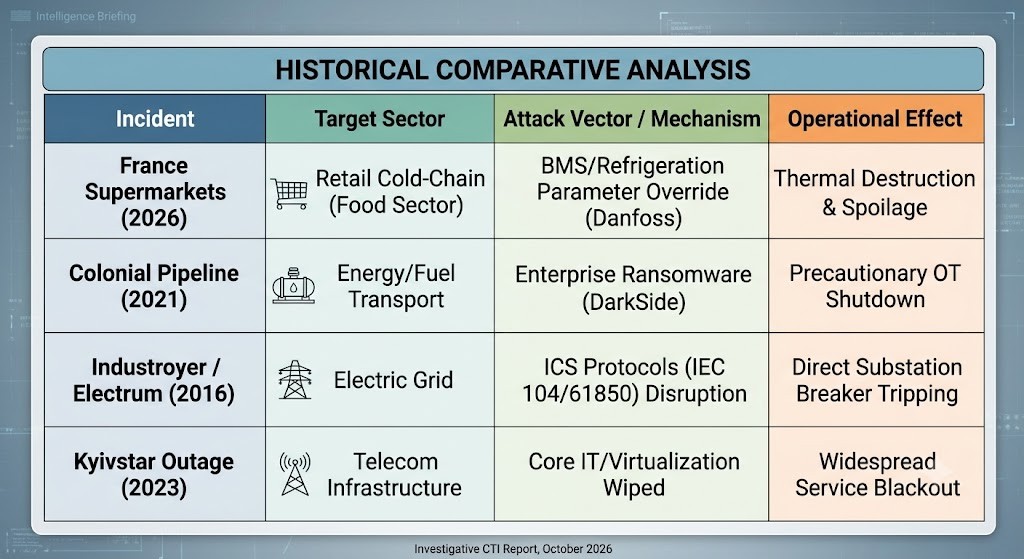
The most useful comparison is not whether previous incidents were labelled “cyber-physical,” but how cyber access translated into operational consequences.
Colonial Pipeline illustrates how loss of corporate systems and confidence in business operations can trigger a precautionary shutdown even without demonstrated direct manipulation of industrial controllers. The Ukraine power-grid incidents demonstrate a different pathway in which adversaries directly affected power-system operations. The French refrigeration incident, as currently reported, appears to sit closer to the second category in terms of its reported operational effect, but its technical path remains incompletely established.
The reported US military commissary refrigeration incident is a particularly relevant lead because the physical process and business consequences appear more comparable. Investigators should compare affected equipment, controller and firmware versions, exposed management interfaces, access patterns, event timing, command sequences, and forensic indicators. A similar outcome is not enough to infer a common actor or operation.
The principal analytical question is whether the French and US events reflect a shared weakness in commercial refrigeration management, a shared technical exposure, or a common adversary. These are distinct propositions and require different evidence. The first can be established through product and architecture research; the second requires evidence of matching vulnerable versions or configurations; the third requires incident-level technical correlation.
Operational, financial, food-safety, and supply-chain implications

Detailed breakdown
Operational Impact: Complete removal of fresh and frozen goods across 300+ stores. Labor-intensive sanitation required before restocking to prevent bacterial contamination.
Financial Exposure: Total damages across affected chains estimated in tens of millions of euros. Complex business interruption and product spoilage insurance claims.
Food Safety and Compliance: Strict regulation requires total disposal of food exposed to temperature excursions above safe thresholds (HACCP principles).
Supply-Chain Shock: Unplanned regional demand spikes on regional distribution centers (DCs) to replace destroyed inventory simultaneously.
Threat scenarios for comparable organisations
Organizations operating centralized, connected physical assets (e.g., cold storage, pharmaceutical storage, data center HVAC, smart buildings) must evaluate three primary risk scenarios:
Scenario 1: Vendor Cloud Multi-Tenant Compromise
Mechanism: Adversary accesses a single multi-tenant vendor management console and pushes destructive configuration changes across all connected customer sites simultaneously.
Scenario 2: Identity System Takeover (Single Sign-On / API Keys)
Mechanism: Adversary steals service account credentials or OAuth tokens with global administrative access to BMS/OT environments, triggering mass parameter modifications.
Scenario 3: Ransomware-Adjacent Physical Sabotage
Mechanism: Extortion groups deploy parameter modifications as a double-extortion tactic to force rapid payment before physical assets are ruined.
Defensive architecture and prioritized remediation plan
The defensive objective is to prevent unauthorized refrigeration changes, constrain the consequences of a compromised management interface, detect abnormal process behaviour, and preserve safe local operation during an incident.
Priority | Control area | Required action | Evidence of effectiveness |
P1 | Product exposure and patching | Identify controller models, firmware versions, exposed management interfaces, vendor support status, and applicable security advisories. Prioritise supported security updates and safe migration from unsupported systems. | Reconciled asset inventory; documented exceptions; verified firmware and exposure status. |
P1 | Remote access | Remove unnecessary internet exposure. Restrict maintenance access to approved, monitored paths using strong authentication, least privilege, and time-limited access where feasible. | Periodic exposure review; remote-access logs; tested revocation procedure. |
P1 | Process integrity | Baseline critical setpoints, schedules, defrost parameters, alarm configuration, and other safety- or availability-relevant settings. Restrict changes to authorised roles and retain auditable change records. | Configuration-drift reports; traceable change records; tested alerts for unauthorised changes. |
P1 | Operational protection | Review the independence and adequacy of local protections for the actual equipment. Validate protective functions through approved engineering procedures. | Signed engineering review; test records; documented remediation of deficiencies. |
P1 | Detection and response | Monitor management sessions, configuration changes, temperature trends, alarms, controller availability, and abnormal command patterns. Integrate alerts into the incident response process. | Detection tests; measured alert latency; documented escalation and containment exercises. |
P2 | Blast-radius reduction | Restrict who can issue changes across multiple sites. Require risk-based approval for high-impact operations and provide a rapid means to revoke compromised management access. | Tested change-control guardrails; evidence that a single account cannot exceed its authorised scope. |
P2 | Resilience | Validate local operating procedures, independent temperature visibility, backup configurations, and safe restoration after suspected compromise. | Site-level exercise results; verified recovery records; documented gaps and owners. |
P2 | Supplier assurance | Obtain product security advisories, support lifecycle information, patch guidance, and relevant incident findings from manufacturers and service providers. | Current supplier contact paths; tracked advisories; risk-based supplier reviews. |
P3 | Continuous improvement | Run controlled exercises simulating unauthorised configuration changes and loss of monitoring. Use non-disruptive tests or isolated environments where live-process risk is unacceptable. | Exercise findings, corrective actions, and retest results. |
All changes to refrigeration and building-management systems should be approved by the responsible engineering authority. The aim is not simply to make systems harder to access; it is to ensure that a compromised digital management layer cannot silently cause unacceptable physical consequences.
KPI/KRI scorecard and resilience tests
Metric Name | Calculation / Formula | Data Source | Proposed Target | Frequency | Owner |
Directly Exposed OT/BMS Interfaces | Count of edge controllers reachable via public IP without VPN. | External Attack Surface Management (EASM) / Shodan scans. | 0 | Daily | Network Security |
MFA Coverage on BMS Portals | Remote BMS Accounts with Active MFA" /"Total Remote BMS Accounts×100 | Identity Provider (IdP) Logs / PAM. | 100% | Weekly | IAM Team |
Hardware Interlock Audit Rate | "Refrigeration Units with Hardwired Thermal Cutouts" /"Total Active Refrigeration Units" ×100 | Physical Engineering Inspections. | 100% | Quarterly | Facilities / OT Engineering |
Mean Time to Detect (MTTD) Thermal Anomalies | "Time of Unauthorized Parameter Change"→"Time of SOC Alert" | BMS Telemetry / SIEM Alerts. | < 15 Mins | Real-Time | SOC Lead |
Degraded-Mode Test Completion | "Stores Tested for Manual Local Refrigeration Override" /"Total Store Locations" ×100 | Operational Resilience Exercises. | 100% | Bi-Annually | Store Operations |
Relevant standards and regulatory considerations
The incident raises questions that can be examined using established OT-security, resilience, and food-safety frameworks. The following are assessment references, not findings that an organisation violated a particular standard or law.
IEC 62443: Use the applicable parts of the series to assess asset-owner security governance, service-provider controls, risk assessment, zones and conduits, system security requirements, and component security. Determine whether remote-management access, change authorisation, configuration integrity, and monitoring meet the requirements applicable to the system in scope.
NIST SP 800-82: Use the OT-security guidance to assess remote access, segmentation, asset visibility, monitoring, recovery, and the safety and availability constraints of operational environments.
NIST Cybersecurity Framework 2.0: Use the Govern, Identify, Protect, Detect, Respond, and Recover functions to structure executive oversight and operational resilience improvements.
ISO/IEC 27001 and ISO 22301: Apply these frameworks where relevant to information-security management, business continuity, and recovery planning.
EU NIS2 and national implementation: Determine whether the relevant legal entity and activity fall within scope, identify the applicable French or other national requirements, and verify incident-reporting and risk-management obligations with authoritative legal sources.
EU food-safety requirements and HACCP: Evaluate temperature records, product disposition, traceability, corrective action, and the evidence required before affected stock or equipment returns to service.
For each framework, document the applicable requirement, the observed evidence, the gap (if established), the operational risk, and the corrective action. Do not infer a compliance violation solely from the fact that an incident occurred.
Intelligence gaps and priority collection requirements
Specific access channel: Was access gained via compromised third-party contractor credentials, an API vulnerability in Danfoss software, or direct edge device exploitation?
Actor artifacts: Are there command-and-control (C2) IP addresses, user-agent strings, or custom scripts recovered from BMS logging servers?
Cross-border Correlation: Did the incident at Ahold Delhaize/Albert Heijn share infrastructure, or was it an unrelated concurrent IT issue?
Lessons for cyber defenders
The October 2026 French supermarket incident is a significant reported example of cyber disruption affecting physical refrigeration operations and perishable inventory. Its importance lies in the operational consequence: when connected management systems can influence physical processes, a compromise can create losses that cannot be resolved through conventional IT restoration alone.
The public evidence reviewed for this report does not yet establish the complete intrusion path, whether one shared platform was compromised, which specific vulnerability was exploited, whether independent safety functions were defeated, or who was responsible. These are central investigative questions—not details that should be filled in by inference.
Three defensive priorities are justified now:
Establish control over remote management. Inventory exposed controllers and management interfaces, validate firmware and support status, restrict access, and audit high-impact configuration changes.
Constrain physical consequences. Review the independence and adequacy of local protective functions, maintain independent temperature visibility where required, and verify that unauthorised supervisory changes cannot silently create unacceptable operating conditions.
Prove operational resilience. Exercise local operating procedures, incident containment, configuration recovery, food-safety assessment, and the evidence required before affected systems return to service.
The wider lesson is not that every refrigeration controller is unsafe or that a state actor has attacked the food supply. It is that organisations must understand how remote access, controller configuration, physical safeguards, monitoring, and operational recovery interact.
As forensic findings emerge, the assessment should be updated to distinguish a product vulnerability from its exploitation, a shared technology exposure from a shared campaign, and a cyber incident with physical consequences from a deliberate attempt to cause strategic disruption.
Key lessons for security leadership
Never allow software logic to outclass physical safety: Software-based supervisory controllers must never be the sole defense against physical hazards. Electro-mechanical thermal cutoffs and hardware interlocks must operate independently of network logic.
Audit Third-Party and SaaS Platforms for OT Control: Centralized management software provides high operational efficiency but introduces catastrophic single points of failure. Apply strict multi-factor authentication, least privilege, and rate-limiting to all remote management systems.
Prepare for Non-Ransomware Sabotage: Incident response playbooks must account for attacks designed purely to destroy assets or disrupt operational capacity without presenting an encryption screen or ransom demand.
Presenting industry's first OT security assessment tool. Get IEC 62443/NIS2/NERC CIP assessment reports in under 24 hours.
Source register and methodology
Methodology
This report was prepared using Shieldworkz and Open Source Intelligence (OSINT) gathered following public reporting on October 12–13, 2026. Our analysis evaluates facts against established industrial control system (ICS) security engineering principles and threat intelligence frameworks (MITRE ATT&CK for ICS).
Key sources
eSecurity Planet (Oct 13, 2026): Hackers Target 300+ French Supermarkets: Refrigeration Attack Exposes Security Risks.
The Guardian (Oct 12, 2026): Hackers force French supermarket fridges to heat up to 50C in cyber-attack.
CBS News / BFM TV Reporting (Oct 12, 2026): Hackers turn up the heat in refrigerators at hundreds of supermarkets in France.
Quartz (Oct 12, 2026): Cyberattack disables refrigeration at French supermarkets.
UA.News / Daily Maverick / AFP (Oct 13, 2026): Cyberattack hits hundreds of supermarkets in France.

Wöchentlich erhalten
Ressourcen & Nachrichten
Erfahren Sie, wie unsere branchenführenden OT-Security-Lösungen kritische Sicherheitsherausforderungen gemäß KRITIS-Anforderungen bewältigen
Dies könnte Ihnen auch gefallen.

Inside the Albert Heijn cyber incident: Investigating the attack, the IT/OT exposure, and the risks to critical operations
Team Shieldworkz

Automating IEC 62443 Compliance Assessments Without Losing Expert Control
Team Shieldworkz

Investigative cyber threat intelligence report: Daiichi Kosho supply-chain data exposure
Prayukth K V

How AI Is Changing IEC 62443 Assessments
Team Shieldworkz

Deep investigative threat intelligence report: Alleged SafePay cyberattack on T-Systems
Team Shieldworkz

CEA Compliance Requirements for Power Utilities: What Changes
Team Shieldworkz