

Team Shieldworkz
On August 14, 2003, a computer worm quietly spread through the control systems of FirstEnergy Corporation in Ohio. Within hours, 55 million people across the northeastern United States and Canada lost power in what became the largest blackout in North American history. The entry point? Unmanaged software on a workstation connected to operational systems, a failure mode that remains alarmingly common in industrial facilities two decades later.
Today, media scan systems serve as one of the most critical last lines of defense for operational technology environments. Every USB drive, every maintenance laptop, every portable diagnostic tool represents a potential threat vector that can bypass perimeter defenses entirely and land directly on your engineering workstations, PLCs, DCS systems, or SCADA networks. Understanding exactly what these systems detect, and why, is not an academic exercise. It is an operational imperative.
Why This Matters for OT Leaders Industrial environments are fundamentally different from corporate IT networks. Air-gapped or semi-isolated by design, OT systems are often unpatched, running legacy operating systems, and vulnerable to threats that would be caught immediately on a modern IT endpoint. Removable media bypasses every network-based defense you have deployed. A single unscanned USB drive can carry ransomware directly to your historian server or HMI, no phishing email required. |
At a Glance: 12 Threats Detected by Media Scan Systems
The table below provides a structured overview of the twelve most commonly identified threat categories in modern media scanning deployments across industrial and critical infrastructure environments.
# | Threat Type | Risk Level for OT/ICS |
01 | Malware Delivered via Removable Media | Critical |
02 | Ransomware Payloads Concealed in Files | Critical |
03 | Zero-Day Exploits in Industrial File Formats | High |
04 | Unauthorized Executable Files | High |
05 | Macro-Based Attacks in Office Documents | High |
06 | Industrial Worms & Self-Replicating Code | Critical |
07 | Data Exfiltration Tools & Hidden Backdoors | High |
08 | Autorun & Script-Based Threats | Medium-High |
09 | Firmware Modification Files | Critical |
10 | Credential Harvesting Utilities | High |
11 | Rogue Software Installation Packages | Medium-High |
12 | Encrypted Archive Smuggling | High |
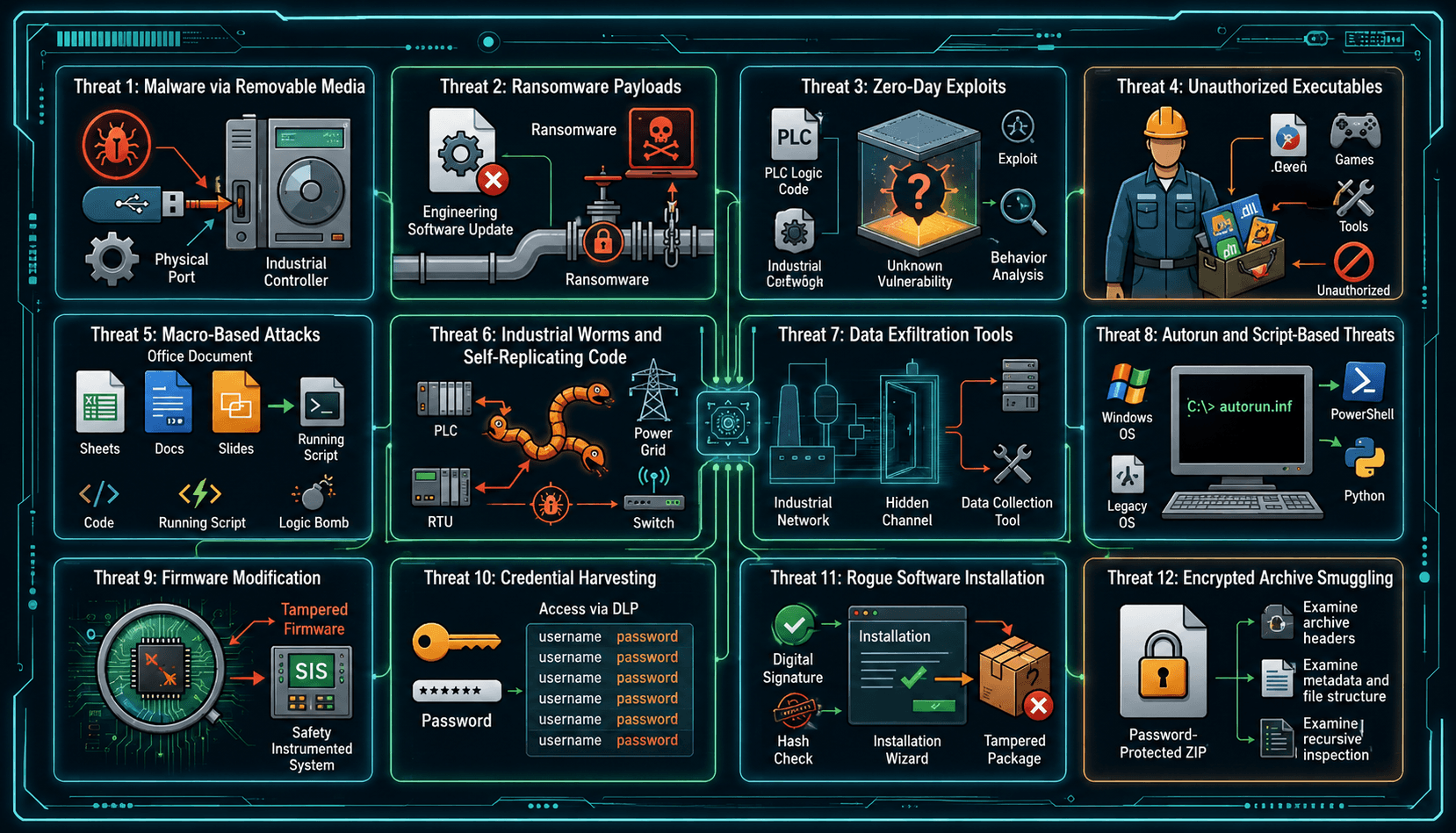
Threat 1: Malware Delivered via Removable Media
This remains the single most prevalent threat vector in OT environments globally. Malware delivered through USB drives, portable hard drives, or memory cards does not require a network connection to execute. It simply needs a willing port.
The Stuxnet worm, the most sophisticated piece of malware ever discovered at the time of its detection in 2010, was delivered to uranium enrichment centrifuges in Natanz, Iran, through infected USB drives carried into a facility with no internet connectivity. The malware caused physical destruction to centrifuges while reporting normal operation to operators. This single incident redefined the global understanding of what removable media threats are capable of achieving in industrial environments.
Modern media scan platforms use multi-engine detection that checks files against thousands of malware signatures, behavioral patterns, and heuristic models. For OT environments, this is non-negotiable.
Threat 2: Ransomware Payloads Concealed in Files
Ransomware has evolved from a nuisance targeting individual consumers to an industrial-scale extortion mechanism capable of shutting down entire manufacturing plants, pipelines, and water treatment facilities. The Colonial Pipeline attack of May 2021 resulted in fuel shortages across the US East Coast, a $4.4 million ransom payment, and a federal emergency declaration, all traced to a single compromised credential and lateral movement across inadequately segmented systems.
What makes ransomware particularly dangerous in OT environments is that it can enter through removable media as an encrypted payload, a disguised installation package, or even embedded within legitimate-looking engineering software updates. Modern media scan systems decompress, analyze, and inspect files recursively , meaning they do not accept the outer container as benign simply because it looks legitimate.
Threat 3: Zero-Day Exploits in Industrial File Formats
Industrial environments commonly exchange data through specialized formats , project files for engineering software, configuration backups, PLC programming files, historian exports, and firmware packages. These formats are trusted by default. Attackers know this, and they exploit it.
Zero-day exploits embedded within trusted industrial file formats represent one of the most difficult threats to detect. Advanced media scan systems use behavioral heuristics and sandboxing techniques that execute suspicious files in isolated environments to observe behavior before allowing them near live systems. This approach has proven effective in catching previously unknown exploits targeting widely-used industrial engineering platforms.
Threat 4: Unauthorized Executable Files
Not every threat is sophisticated. Sometimes the most damaging files are simply ones that should not be there. Unauthorized executables, unlicensed software, pirated utilities, personal applications, games, or tools brought in by contractors, represent a substantial and often underestimated risk in industrial environments.
A contractor arriving with a diagnostic tool not approved by your security team may carry software with unknown vulnerabilities, backdoors, or bundled adware. Media scan systems with file allowlisting capabilities enforce a simple but powerful rule: only pre-approved file types and executables are permitted to transfer. Everything else is blocked, logged, and flagged for review.
Threat 5: Macro-Based Attacks in Office Documents
Engineering teams in industrial facilities routinely work with Excel spreadsheets for equipment tracking, Word documents for maintenance reports, and PowerPoint decks for shift handover. These files travel on USB drives constantly. And they are frequently weaponized.
Macro-based attacks embed malicious Visual Basic scripts within Office documents. When opened, the macro executes silently, potentially downloading additional malware, creating persistence mechanisms, or exfiltrating data. The Emotet banking trojan, responsible for hundreds of millions of dollars in damages globally , frequently used malicious macros as its primary delivery method. Advanced media scan systems specifically analyze Office documents for macro content and flag or strip suspicious code before files enter the OT environment.
Threat 6: Industrial Worms and Self-Replicating Code
Industrial worms are designed specifically to propagate across OT networks by exploiting the trust relationships between devices, the prevalence of legacy unpatched systems, and the flat network architectures common in older industrial facilities. Once inside, they replicate autonomously.
The Industroyer malware , discovered in 2017 and linked to the 2016 power outage in Ukraine that left 230,000 residents without electricity, was specifically designed to target industrial control protocols. It could communicate directly with electrical substation equipment and send commands to open circuit breakers. Media scan systems that identify known worm signatures and behavioral patterns of self-replication serve as a critical choke point before such code can enter an operational environment.
Threat 7: Data Exfiltration Tools and Hidden Backdoors
Not all attacks are immediately destructive. Some of the most damaging intrusions into industrial environments are persistent, quiet, and designed to establish long-term access rather than cause immediate disruption. Attackers install hidden backdoors, remote access tools, or data collection utilities that silently harvest engineering data, process parameters, network topology information, or intellectual property over months or years.
Media scan systems inspect files not only for destructive capabilities but also for known remote access tool signatures, unauthorized communication utilities, and tools associated with advanced persistent threat operations. This layer of inspection is especially critical for managing contractor and vendor access to sensitive OT systems.
Threat 8: Autorun and Script-Based Threats
Autorun exploits were historically one of the most common entry mechanisms for removable media threats. While modern operating systems have reduced automatic execution, script-based threats, PowerShell scripts, batch files, Python utilities, and shell scripts, continue to pose significant risks, particularly on older industrial systems still running Windows XP, Windows 7, or other unsupported operating systems that remain commonplace in OT environments.
Media scan platforms specifically inspect scripting files, flag obfuscated code, and can block execution based on script content analysis. For environments where script execution is necessary for legitimate operations, policy-based controls ensure that only pre-approved scripts can be transferred through managed media channels.
Threat 9: Firmware Modification Files
Few threats are as catastrophically damaging as a malicious firmware update delivered to a PLC, remote terminal unit, or industrial network switch. Firmware-level compromises are exceptionally difficult to detect after the fact, can survive factory resets, and may persist for years without detection while giving attackers persistent, deep access to physical processes.
The Triton/TRISIS malware discovered in 2017, targeting Safety Instrumented Systems at a Middle Eastern petrochemical facility , was specifically designed to disable safety systems that prevent catastrophic industrial accidents. The attack vector required physical access to engineer workstations and targeted firmware-level control. Organizations that inspect all firmware update files through media scan systems before deployment add a critical verification layer that traditional network security cannot provide.
Industry Alert: The Firmware Threat Is Escalating Industrial security researchers have documented a significant increase in threat actor interest targeting programmable industrial devices at the firmware level. Firmware attacks are essentially invisible to endpoint detection tools that operate at the operating system level. The only reliable detection point is at the file transfer stage, precisely what media scan systems are designed to address. |
Threat 10: Credential Harvesting Utilities
Credential theft in OT environments is a precursor to privilege escalation, lateral movement, and eventual control of critical systems. Specialized tools designed to extract stored credentials from Windows systems, engineering software license files, or SCADA historian platforms are regularly discovered concealed within seemingly innocent files transferred via removable media.
Media scan systems with DLP (data loss prevention) capabilities and behavioral analysis can identify known credential harvesting tools, including variations and obfuscated versions , and prevent them from reaching systems where they could be executed. This is especially important in environments where service accounts with broad operational privileges are common.
Threat 11: Rogue Software Installation Packages
Vendor and contractor management represents one of the most persistent challenges in OT security. Third-party personnel regularly bring software installation packages for engineering tools, diagnostic utilities, firmware updaters, and license managers. Not all of these packages are verified, digitally signed, or checked against known-good versions.
Rogue installation packages may be legitimate software that has been tampered with, a supply chain compromise scenario, or entirely unauthorized software attempting to establish a foothold. In 2020, the SolarWinds supply chain compromise demonstrated the scale of damage that can result when trusted software update mechanisms are exploited. Media scan systems that verify digital signatures, hash values, and file integrity provide a verification checkpoint that mitigates supply chain risk at the physical transfer layer.
Threat 12: Encrypted Archive Smuggling
Password-protected archive files, ZIP, RAR, 7z, and similar formats, represent a deliberate attempt to bypass scanning tools that cannot inspect encrypted content. Attackers and malicious insiders use this technique knowing that many security tools will mark encrypted archives as unreadable and pass them through.
Modern media scan platforms address this through several mechanisms: enforcing policies that block all password-protected archives from transfer, requiring archive passwords to be provided for inspection, maintaining threat intelligence on known archive files associated with attack campaigns, and using content analysis on archive metadata that does not require decryption. Organizations that simply allow encrypted archives without inspection are accepting a blind spot that attackers actively exploit.
Building an Effective Removable Media Policy for OT Environments
Threat detection is only as effective as the governance framework surrounding it. A world-class media scan deployment without a supporting removable media policy is like installing a sophisticated alarm system but leaving the front door unlocked. The following control layers are foundational to an industrial-grade media security program:
Control Layer | Policy Requirement | Operational Impact |
Physical Access | Only approved and asset-tagged media permitted on-site | Blocks unknown USB devices at the gate |
Technical Scanning | All media scanned before connecting to OT network | Stops malware before it reaches PLCs or HMIs |
File Allowlisting | Only approved file types and executables permitted | Prevents unauthorized software execution |
Audit & Logging | Every media insertion logged with user, time, location | Full accountability and incident trace |
Incident Response | Quarantine protocols triggered on threat detection | Limits blast radius of any security event |
Effective removable media policies in OT environments must address the full lifecycle of media access: who is permitted to bring media on-site, what scanning requirements apply, how scan results are reviewed, what constitutes an acceptable file type, and how exceptions are managed and documented. These policies should align with established industrial security frameworks and be reviewed at least annually or after any significant change to the operational environment.
The Challenge of Contractor and Vendor Media Access
Third-party access represents the highest-risk category for removable media threats in most industrial facilities. Contractors arrive with laptops and USB drives that have traversed multiple client sites, each representing a potential exposure. Vendors supply firmware updates, software patches, and configuration files that may not have been verified through the same quality controls applied to internally generated content.
Organizations that establish dedicated scanning kiosks at facility entry points , requiring all external media to be scanned and cleared before connecting to any operational system, have consistently reported dramatic reductions in threat incidents attributable to third-party media access. This single control, properly enforced, eliminates one of the most reliable attack vectors available to both targeted adversaries and opportunistic threat actors.
Media Scan Capabilities vs. ICS Threat Vectors
Media Scan Capability | Threat Vector Addressed |
Multi-engine malware detection | Known and variant malware strains |
Behavioral heuristics analysis | Zero-day and obfuscated threats |
File type verification & enforcement | Disguised executables & rogue installers |
Macro & script analysis | Weaponized Office documents |
Encrypted archive inspection | Payload smuggling via ZIP, RAR, 7z |
Firmware integrity checking | Unauthorized firmware update files |
DLP content inspection | Sensitive data exfiltration attempts |
Comprehensive audit logging | Full chain-of-custody for compliance |
What Industrial Security Research Tells Us
Analysis of incidents affecting industrial and critical infrastructure organizations consistently reveals several patterns that underscore the importance of media scanning as a core security control:
Removable media has been identified as the initial access vector in a significant proportion of documented OT security incidents, including multiple incidents affecting nuclear, energy, water, and manufacturing facilities globally.
The gap between initial compromise and detection in OT environments is substantially longer than in IT environments, frequently measured in months rather than days, allowing attackers extended periods of undiscovered access.
Air-gapped and semi-isolated OT networks are specifically targeted through removable media precisely because attackers understand that network-based detection capabilities do not apply to physical media transfer.
Supply chain attacks, where trusted software packages or update mechanisms are compromised, have increased substantially, making file integrity verification at the media scan stage a supply chain security control as much as a malware prevention measure.
Organizations that implement formal removable media governance programs with technical enforcement consistently demonstrate measurably lower incident rates and shorter containment times when incidents do occur.
Real-World Context: Energy Sector Targeting Industrial cybersecurity monitoring organizations have documented sustained campaigns by multiple advanced threat groups specifically targeting energy generation, transmission, and distribution infrastructure through a combination of spear-phishing and removable media delivery mechanisms. These campaigns have been active for extended periods and have demonstrated the capability for pre-positioning malicious tools within operational networks without triggering detection. The energy sector's reliance on contractor access and portable diagnostic equipment makes removable media governance a sector-critical security discipline. |
How Shieldworkz Supports Industrial Organizations
Shieldworkz brings specialized OT and ICS cybersecurity expertise to organizations that cannot afford the operational, safety, or reputational consequences of a security failure. Our approach to media scanning and removable media security is built on deep industrial knowledge , understanding not just the threat landscape but the operational realities of environments where security controls must coexist with production continuity, system availability, and strict change management requirements.
We design and implement media scanning solutions purpose-built for OT environments, including dedicated scanning kiosks for facility entry points, integration with existing OT asset management systems, and deployment configurations that account for air-gapped and semi-isolated network architectures. Industrial-Grade Media Scan Deployment:
We work directly with your security, operations, and procurement teams to develop removable media governance policies that are enforceable, operationally practical, and aligned with applicable industry frameworks and regulatory requirements relevant to your sector. Removable Media Policy Development:
Our scanning configurations incorporate continuously updated threat intelligence specifically curated for industrial threat actors and OT-targeted malware families, ensuring detection capabilities remain current against evolving attack techniques. Threat Intelligence Integration:
We help organizations establish formal third-party media access programs, including scanning requirements, acceptable use policies, audit logging, and exception management processes that reduce the risk surface associated with external personnel access. Contractor and Vendor Access Management:
Our deployments are designed to support compliance with applicable industrial security standards and regulatory frameworks, providing documented evidence of control effectiveness for audit and assessment purposes. Compliance Alignment:
In the event that a media scan system identifies a threat, our team provides rapid incident response support to contain, investigate, and remediate the threat before it can propagate through operational systems. Incident Response Support:
Media security is not a one-time deployment. We provide ongoing program support including policy reviews, detection capability updates, staff awareness training, and periodic program effectiveness assessments. Ongoing Program Management:
Our clients include organizations across energy generation and distribution, oil and gas processing, water treatment, manufacturing, chemical production, and transportation infrastructure , environments where the consequences of a security failure extend well beyond financial impact to encompass operational safety, environmental risk, and national security considerations.
Conclusion: The 12 Threats Your Media Scan System Must Detect
The twelve threat categories detailed in this guide represent the full spectrum of risks that arrive through removable media in industrial environments. From the immediate destructive potential of ransomware and industrial worms to the slow-burning damage of credential theft and persistent backdoors, each category demands detection capability, policy enforcement, and operational governance working in concert.
The facilities that have experienced the most damaging cyber incidents in recent years share a common characteristic: they underestimated the removable media threat vector. They assumed that air gaps, perimeter controls, or organizational trust would be sufficient. In every documented case, those assumptions proved incorrect.
The organizations that have successfully defended against these threats share a different common characteristic: they implemented layered, technically enforced, policy-backed media security programs before they were tested. They understood that in operational technology environments, the cost of prevention is always lower than the cost of response.
The question for every OT security leader, plant manager, and CISO reading this is straightforward: when was the last time every removable media device that entered your operational environment was verified, scanned, and logged? If the answer involves any degree of uncertainty, that uncertainty is your risk.
Is Your OT Environment Protected at Every Entry Point?
Every unscanned USB drive, every unchecked laptop, every bypassed media policy is an open door into your most critical operational systems. The threats are real, they are active, and they do not wait for your next audit cycle.
Book a Free Consultation with Our OT/ICS Security Experts
Our specialists will review your current media scanning posture, identify gaps in your removable media policy, and recommend a tailored protection strategy aligned with your operational environment. No obligations, no generic playbook, just focused, industrial-grade expertise.
Additional resources:
OT Cyber Threat Intelligence Advisory - Middle East here
NIS2 Directive Achieving NIS2 Compliance Through IEC 62443 here
What Is Removable Media? Risks, Policies, and Industrial OT Security Solutions here
Free Removable Media Policy Template for OT and IT Teams here
Remediation Guides here
Get Weekly
Resources & News
See How Our Industry-Leading OT Security Solutions Address Critical Security Challenges
You may also like

Investigative cyber threat research report: Colorado water utilities OT attacks
Prayukth K V

CEA Cyber Incident Response Requirements: How Power Utilities Can Build a Practical Security Plan
Team Shieldworkz

IEC 62443 for Pharmaceutical Manufacturing: Secure Critical Production OT
Team Shieldworkz

Investigative cyber threat research report: Cyberattacks on U.S.-bound energy tankers
Team Shieldworkz

The OT Lull: What a 30-day decline in direct intrusion activity actually tells us
Prayukth K V

Inside the Revolut data disclosure incident
Prayukth K V