Team Shieldworkz
For decades, SCADA systems ran on a simple, comforting assumption: if it's inside the plant network, it's safe. That assumption no longer holds. Remote monitoring, cloud,connected historians, vendor support portals, and IIoT sensors have quietly dissolved the air gap that once separated control systems from the outside world. The convenience is real. So is the exposure.
Industrial leaders don't need another abstract warning about "cyber risk." They need to understand exactly how attackers reach SCADA environments today, why traditional network defenses fall short, and what a Zero Trust approach actually changes on the plant floor. That's what this guide covers ,in plain terms, with real industry context, and without the jargon that usually clutters this conversation.
Why SCADA Security Has Become a Boardroom Issue
SCADA and ICS environments were engineered for reliability and long service life, not for resisting a determined attacker. Many control systems installed fifteen or twenty years ago are still in production, running protocols that were never built with authentication or encryption in mind. That was an acceptable design choice when these systems were isolated. It is a serious liability now that almost every plant has some path ,official or unofficial ,connecting operational technology to the internet.
Security researchers tracking critical infrastructure through 2026 have observed a shift in attacker behavior: rather than simply causing a single disruptive event, some nation,state,linked groups have been found maintaining quiet, persistent access inside industrial networks for months, apparently gathering information or waiting for the right moment to act. That pattern changes the calculus for OT leaders. It's no longer only about preventing a single breach. It's about assuming that determined adversaries may already be probing your environment, and building defenses that limit what they can do even if they get in.
This is precisely the gap Zero Trust was designed to close.
There's also a business dimension that often gets underweighted in purely technical conversations. A cyber incident in an IT environment usually means a data breach ,costly, damaging, but contained to information. A cyber incident in a SCADA environment can mean a halted production line, a safety system behaving unpredictably, contaminated product, or a regulatory reporting obligation triggered within hours. Insurance underwriters, OEM customers, and regulators are all beginning to ask harder questions about OT security posture specifically, which means this is no longer a conversation that stays inside the plant engineering team. It increasingly sits on the desk of the CISO, the COO, and, in regulated industries, the board.
That shift matters because it changes how security investment gets justified. Zero Trust isn't sold internally as a compliance checkbox or a technology refresh ,it's justified as a direct reduction in the likelihood and severity of an operational disruption event. Framed that way, it becomes far easier for OT leaders to secure the budget and organizational support the initiative actually needs.
Recent Industry Examples: Why This Isn't Theoretical
It helps to ground this discussion in what has actually happened, rather than hypothetical risk. A few examples illustrate how SCADA and ICS environments are being targeted right now.
Ongoing PLC exploitation campaign, 2026. Since early 2026, U.S. cybersecurity agencies have warned of a sustained campaign targeting internet,connected programmable logic controllers, including devices from major industrial automation vendors, across water, energy, and government facility sectors. The attackers reportedly manipulated project files and altered what appeared on HMI and SCADA displays, in some cases causing genuine operational disruption and financial loss. The activity has been linked to geopolitical tensions, underscoring that ICS targeting is increasingly tied to broader state,level conflict rather than isolated criminal opportunism.
Ransomware reaching SCADA layers directly. In a separate incident, a ransomware group successfully accessed and encrypted a significant volume of data tied to the SCADA system of a bioenergy facility, disrupting supervisory control of core plant processes. The group's approach reflected a broader trend among ransomware operators: rather than stopping at the IT layer, they are increasingly seeking direct access to operational systems, where the pressure to restore uptime makes victims more likely to pay quickly.
Vendor access as an entry point. One of the most instructive breaches in ICS history didn't start with an attack on control systems at all. Attackers first compromised a third,party HVAC contractor through a phishing email, then used the contractor's stolen credentials to pivot into environmental control systems, and ultimately into far more sensitive systems. It remains one of the clearest illustrations of how vendor and remote access ,not the control system itself ,is often the weakest link.
Purpose,built ICS malware. Threat intelligence researchers have also identified sophisticated malware families designed specifically to interact with multiple industrial protocols, maintain persistence, and resist forensic analysis ,tools built and sold specifically for use against critical infrastructure operators. Their existence confirms that ICS,specific attack tooling is now a mature, commercially available capability, not a rare, custom,built exception.
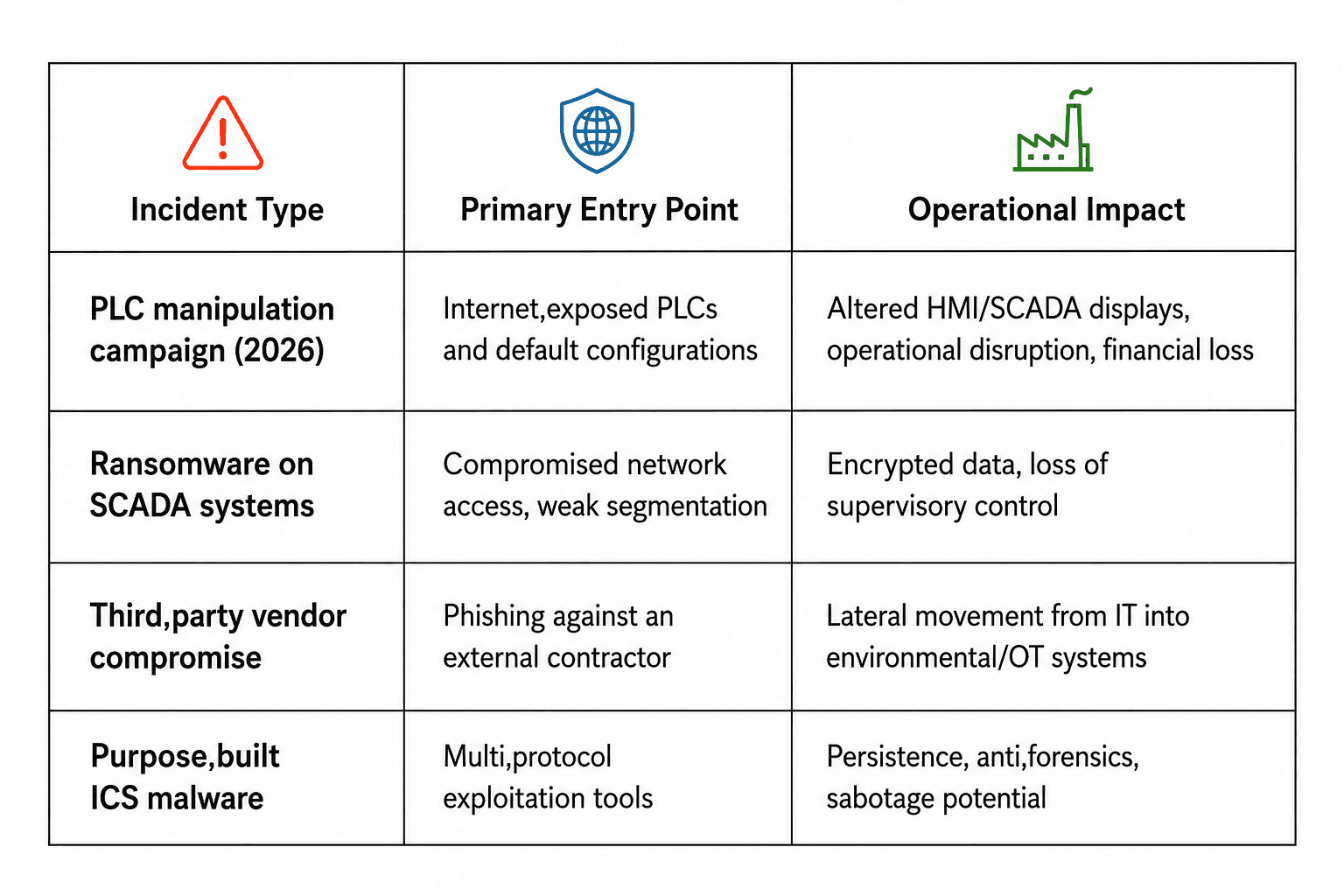
The common thread across all of these cases isn't a single technical flaw ,it's the absence of strict verification at every step. A device, a user, or a vendor connection was trusted simply because it appeared to be on the "inside." Zero Trust exists specifically to remove that assumption.
It's also worth noting how these attack patterns are evolving. Earlier ICS incidents, going back over a decade, tended to involve highly targeted, custom,built tools aimed at a specific facility or a specific type of equipment ,the kind of operation that required significant resources and planning to execute. What's changed more recently is scale and accessibility. Ransomware,as,a,service groups now routinely include OT,aware capabilities in their toolkits. Malware built specifically for industrial protocols is sold and resold on underground forums. Attackers no longer need nation,state resources to attempt to reach a SCADA layer; they need an exposed remote access point, a phishing email that lands, or a default password that was never changed. That combination of lower barriers to entry and higher potential impact is exactly why OT security has become urgent rather than aspirational.
Security professionals surveying the threat landscape heading into 2026 have also pointed to a broadening of targets. Where earlier attention concentrated heavily on energy and utilities, forecasts now point to manufacturing, water treatment, healthcare, food production, and logistics as equally attractive targets ,sectors where legacy control systems, thin security staffing, and high operational dependency combine to make disruption both easier to achieve and more damaging when it happens.
Zero Trust Fundamentals for Industrial Environments
Zero Trust is often described in IT terms first, which can make it feel disconnected from plant,floor reality. Applied correctly to OT, it comes down to a small number of practical principles:
Never trust by default, verify continuously. Being on the plant network is not, by itself, proof that a device or user should have access to a specific control system.
Least,privilege access. Every user, device, and application gets only the access required for its specific role ,nothing broader.
Microsegmentation. The network is divided into small, tightly controlled zones, so that a compromise in one segment cannot spread freely into others.
Continuous monitoring and validation. Access decisions aren't made once at login; they are reassessed continuously based on behavior, device posture, and context.
Assume breach. Defenses are designed on the assumption that an attacker may already have a foothold somewhere in the environment, and the goal becomes limiting what that foothold can reach.
Traditional Perimeter Security | Zero Trust Security |
Trust is based on network location | Trust is based on verified identity and context |
One,time authentication at the perimeter | Continuous verification throughout the session |
Broad access once inside the network | Narrow, role,based access to specific assets |
Flat or loosely segmented OT networks | Granular microsegmentation by zone and function |
Vendor access often standing and shared | Vendor access time,bound, logged, and monitored |
Detection often after lateral movement occurs | Lateral movement is structurally limited from the start |
None of this requires ripping out legacy PLCs or SCADA servers. Zero Trust is architected around the network and access layer ,precisely where most industrial environments have the most room for improvement without touching production systems directly.
Zero Trust Remote Access for Industrial Systems
Remote access is one of the highest,risk, least,controlled paths into most OT environments ,and it's also one of the easiest to fix. Vendors, integrators, and support engineers frequently need to reach PLCs, HMIs, and historians remotely for troubleshooting and maintenance. In many plants, this access still runs through shared credentials, unmonitored remote desktop sessions, or a general,purpose VPN that, once connected, gives far broader network access than the task requires.
A Zero Trust approach to remote access replaces that model with:
Identity,based, time,bound sessions. Access is granted for a specific task and window, then automatically revoked.
Multi,factor authentication for every remote session, applied consistently regardless of vendor or urgency.
Session recording and full audit trails, so every remote action on a control system is logged and reviewable.
Application,level access instead of network,level access. A vendor connecting to troubleshoot one HMI should never gain visibility into the entire OT network by default.
Zero Trust Network Access (ZTNA) in place of flat VPN access, brokering connections to specific assets rather than dropping the user onto the broader network.
This single change ,moving vendor and remote maintenance access to a Zero Trust model ,closes one of the most commonly exploited paths into industrial networks, and it can typically be implemented without disrupting production schedules.
It's worth pausing on why this particular change tends to deliver such a fast return. Most plants already rely on multiple external vendors ,equipment OEMs, systems integrators, calibration technicians, and IT support contractors ,each of whom needs periodic access to specific systems. In the absence of a controlled process, it's common for these relationships to accumulate standing credentials over years, often outliving the original support contract or even the vendor employee who first requested access. Nobody owns the job of reviewing and revoking that access on an ongoing basis, so it simply persists. A Zero Trust remote access model forces that review to happen by design: access is granted per session, tied to a specific person and task, and expires automatically rather than lingering indefinitely.
IoT and IIoT Network Security Under a Zero Trust Model
The rapid growth of industrial IoT has multiplied the number of connected devices on plant networks ,sensors, edge gateways, condition,monitoring equipment, and smart instrumentation ,often faster than security teams can track them. Many of these devices ship with weak default credentials, limited patching support, and minimal built,in security, making them an attractive foothold for attackers looking for a quiet way into the broader OT environment.
Applying Zero Trust to IIoT means treating every device as an individual, verifiable identity rather than an anonymous member of the network:
Every IIoT device is inventoried, fingerprinted, and assigned to a defined segment based on its function and risk level.
Device behavior is baselined, so unusual communication patterns ,a sensor suddenly talking to an unfamiliar external address, for example ,can be flagged quickly.
Device,to,device communication is restricted to only what's operationally necessary, rather than allowed to communicate broadly across the network.
Devices that cannot support modern authentication are isolated behind dedicated gateways that enforce policy on their behalf.
This approach turns IIoT sprawl from an unmanaged risk into a mapped, monitored, and controlled part of the environment.
Zero Trust and Regulatory Compliance
For many industrial organizations, the push toward Zero Trust is arriving at the same time as a wave of new regulatory and contractual pressure. Standards such as IEC 62443 explicitly call for zone,and,conduit segmentation, strict access control, and continuous monitoring ,principles that map directly onto Zero Trust architecture. Regional regulations covering critical infrastructure operators are moving in a similar direction, increasingly requiring documented risk assessments, incident reporting timelines, and evidence of layered technical controls rather than a simple attestation of good intent.
OEM customers are adding their own pressure. It has become increasingly common for original equipment manufacturers and large industrial buyers to require their suppliers to demonstrate a baseline level of OT security maturity ,sometimes as a condition of continued business ,before a new contract or renewal is approved. Organizations that can point to a documented Zero Trust architecture, complete with segmentation diagrams, access logs, and monitoring evidence, are simply better positioned to meet these demands quickly, rather than scrambling to produce evidence after an audit request lands.
This is one of the more underappreciated benefits of a Zero Trust program: the same architecture and monitoring that reduces cyber risk also produces the auditable evidence that compliance and OEM assurance programs increasingly demand. Security and compliance stop being two separate workstreams and become two outputs of the same underlying program.
Common Challenges in Implementing Zero Trust in OT
Zero Trust is a proven model in IT, but industrial environments introduce real constraints that deserve honest acknowledgment:
Availability comes first. In OT, uptime and safety take priority over confidentiality. Any Zero Trust control must be validated to ensure it cannot introduce latency or failure into a live production process.
Legacy protocols lack modern authentication. Many industrial protocols were never designed to support the identity verification that Zero Trust depends on, which means compensating controls ,such as protocol,aware monitoring and segmentation ,are often necessary.
Brownfield complexity. Most plants are working with decades of accumulated equipment, documentation gaps, and undocumented network paths, making a phased, risk,prioritized rollout far more realistic than a single sweeping change.
Cultural resistance. Plant engineering teams are, understandably, cautious about anything that could affect a running process. Zero Trust initiatives succeed when they are planned around maintenance windows and validated with operations teams, not imposed on them.
Acknowledging these constraints upfront ,rather than treating Zero Trust as a plug,and,play IT project ,is what separates successful OT security programs from stalled ones.
Measuring Progress the Right Way
Because Zero Trust in OT is necessarily a phased effort, it helps to define success in measurable terms rather than treating it as a single finish line. Organizations that manage this well typically track a handful of concrete indicators over time: the percentage of OT assets with a verified identity and owner, the number of standing or shared credentials that have been eliminated from vendor access, the average time to detect an anomaly on the plant network, and the proportion of network traffic that has been mapped and baselined versus traffic that remains unaccounted for. None of these metrics require exotic tooling to capture, but together they give plant leadership and the board a clear, honest picture of how exposure is decreasing quarter over quarter ,which makes it far easier to sustain support for the program beyond its first year.
Practical Recommendations and Best Practices
Organizations that successfully adopt Zero Trust in OT environments tend to follow a similar sequence:
Build a verified asset inventory first. You cannot apply access policy to devices you don't know exist. Passive discovery tools that don't interfere with production are the safest starting point.
Map the network into logical zones, aligned with recognized segmentation models, separating IT, OT, and safety,critical systems from one another.
Bring vendor and remote access under identity,based control before tackling broader network changes ,this is usually the highest,risk, lowest,disruption fix available.
Apply least,privilege policies zone by zone, starting with the segments carrying the highest operational or safety risk.
Deploy continuous, protocol,aware monitoring so that anomalies are caught in near real time, not discovered after the fact.
Test the plan with operations, not just security. A Zero Trust control that operations teams don't trust will eventually be worked around.
Review and adjust continuously. Zero Trust is a maturing program, not a one,time deployment ,access needs, device inventories, and threats all shift over time.
Focus Area | Recommended Action | Business Outcome |
Asset visibility | Deploy passive discovery across OT zones | Verified inventory, reduced blind spots |
Remote access | Replace VPN/shared credentials with ZTNA | Eliminated standing,access risk |
Segmentation | Zone networks by function and criticality | Contained lateral movement |
Monitoring | Continuous, protocol,aware anomaly detection | Faster detection and response |
IIoT devices | Individual identity and behavior baselining | Reduced unmanaged attack surface |
Governance | Ongoing policy review and compliance mapping | Sustained, auditable security posture |
How Shieldworkz Supports Organizations
Shieldworkz works alongside industrial security leaders to build Zero Trust into real, running plant environments ,without disrupting production. Our support typically includes:
Passive, non,intrusive OT asset discovery to build a verified inventory of PLCs, HMIs, SCADA servers, and IIoT devices
Network segmentation design and implementation, planned around maintenance windows and validated against production workflows
Zero Trust remote access architecture, replacing standing vendor credentials with time,bound, logged, and monitored sessions
Continuous, protocol,aware threat detection tuned to real plant traffic rather than generic signatures
OT,specific vulnerability management and risk assessments prioritized by actual operational exposure
IEC 62443 and related compliance readiness, with audit,ready documentation for regulators and OEM partners
Managed detection and response (MDR) support for OT environments, with monitoring that continues well beyond initial deployment
Incident response planning and tabletop exercises that bring plant and IT teams together before an incident occurs
Every engagement is led by engineers who understand industrial protocols and plant operations ,not just conventional IT security ,so that the resulting architecture protects the environment without slowing it down.
Frequently Asked Questions
Does Zero Trust require replacing existing SCADA and PLC hardware? No. Zero Trust is primarily an architectural and access,control model applied at the network and identity layer. It works around existing control systems rather than requiring their replacement, which is one of the reasons it's practical for brownfield industrial environments with decades,old equipment still in service.
Will Zero Trust slow down operations or introduce latency into control processes? When implemented correctly, no. Zero Trust controls are designed and validated specifically to avoid interfering with time,sensitive control loops. The access,control and monitoring layers operate alongside production traffic rather than sitting inline in a way that could introduce delay into safety,critical processes. This validation step is exactly why a phased, operations,informed rollout matters.
How is Zero Trust different from a traditional OT firewall? A firewall enforces rules at a network boundary ,it decides what traffic is allowed to pass between zones. Zero Trust goes further, verifying the identity and context of every user, device, and application continuously, not just at the boundary. A well,segmented network with firewalls is a component of Zero Trust, not a replacement for it.
Where should a manufacturing plant start if it has no formal segmentation today? Start with visibility. Passive asset discovery to build a verified inventory almost always comes first, because segmentation and access policy decisions are only as good as the asset data behind them. From there, most organizations find that securing vendor and remote access delivers the fastest risk reduction relative to the effort involved.
Is Zero Trust only relevant to large enterprises with mature security teams? No. Mid,sized manufacturers and plant operators are increasingly the primary targets discussed in current threat intelligence, precisely because they often have fewer internal security resources than large enterprises while running equally critical operations. A phased Zero Trust program, supported by an experienced OT security partner, is achievable at almost any organizational scale.
Conclusion
SCADA and ICS security has moved well past the point where perimeter defenses and implicit trust are enough. The environments in front of us ,flatter than they should be, more connected than they were ever designed to be, and increasingly targeted by both criminal and state,linked actors ,demand a model built on continuous verification, least privilege, and contained blast radius. Zero Trust delivers exactly that, and it can be adopted in phases that respect the realities of a live production environment.
The organizations that begin this work now, deliberately and in partnership with people who understand both security and operations, will be the ones that keep running when the next incident targets their industry. The organizations that wait usually don't get to choose the timing.
Ready to Assess Your OT Environment?
To understand how a Zero Trust approach could reduce your exposure to the kind of SCADA and PLC targeting seen across manufacturing, energy, and critical infrastructure in 2026, book a free consultation with our OT security experts today.
Book a Free Consultation with Our Experts →
Additional resources
Comprehensive Guide to Network Detection and Response NDR in 2026 here
OT Security Risk Exposure Calculator Workbook here
A downloadable report on the Stryker cyber incident here
Remediation Guides here
OT Security Best Practices and Risk Assessment Guidance here
IEC 62443-based OT/ICS risk assessment checklist for the food and beverage manufacturing sector here
Get Weekly
Resources & News
See How Our Industry-Leading OT Security Solutions Address Critical Security Challenges
You may also like

Preventing USB-Based Cyberattacks in OT: From Malware Detection to Secure File Approval
Team Shieldworkz

OpenPLC Runtime v3 Security Advisory: Potential Risks for Industrial Deployments
Team Shieldworkz

Yggdrasil, Russia-linked cyber operations, and emerging risks to global enterprises and governments
Prayukth K V

Cybersecurity Week in Review: Major Data Breaches, Critical Vulnerabilities and Supply-Chain Attacks (October 17–23, 2026)
Team Shieldworkz

NERC CIP Asset Inventory Management: Closing Visibility Gaps Across OT Networks
Team Shieldworkz

SBI data exposure: Evidence, attack scenarios and downstream fraud risk
Prayukth K V