Team Shieldworkz
Choosing OT Security Services for Manufacturers: A Decision-Maker's Guide
There was a time when the plant floor lived in its own world. Programmable logic controllers, SCADA servers, and control networks operated behind closed doors, physically and digitally separated from the rest of the business. That world is gone. Today's manufacturing environment is stitched together by remote access tools, cloud-connected historians, third-party maintenance contracts, and IT networks that touch operational systems at dozens of points. That connectivity has delivered real efficiency gains. It has also handed attackers a far larger door into the systems that keep production running.
Manufacturing has now held the position of most targeted industry worldwide for five consecutive years, according to recent global threat intelligence research, accounting for roughly 27.7 percent of all documented cyberattacks in 2025. Ransomware activity against the sector climbed 56 percent year over year, with the median financial impact of a single incident reaching approximately $500,000. These are not abstract figures. They represent halted production lines, missed shipments, safety exposure, and long recovery timelines that ripple through supplier and customer relationships.
Before we begin, don’t forget to check out our previous post on “Third-party supply chain compromise and extortion analysis of Stadler Rail” here.
For plant managers, CISOs, and OT security leaders, the question is no longer whether to invest in operational technology security. It is how to choose a security partner that understands industrial environments well enough to protect them without slowing them down. This guide is built to help you make that decision with clarity and confidence.
What makes this decision harder than a typical IT vendor selection is the stakes involved. A misconfigured security tool on a corporate laptop is an inconvenience. A poorly planned security intervention on a live control system can trigger a safety event or an unplanned shutdown. That asymmetry is exactly why so many manufacturers delay OT security investment, even when they know the risk is real. This guide is written to remove that hesitation by giving you a clear, practical framework for evaluating providers, understanding the risks specific to your operations, and building a program that strengthens resilience rather than adding friction to production.
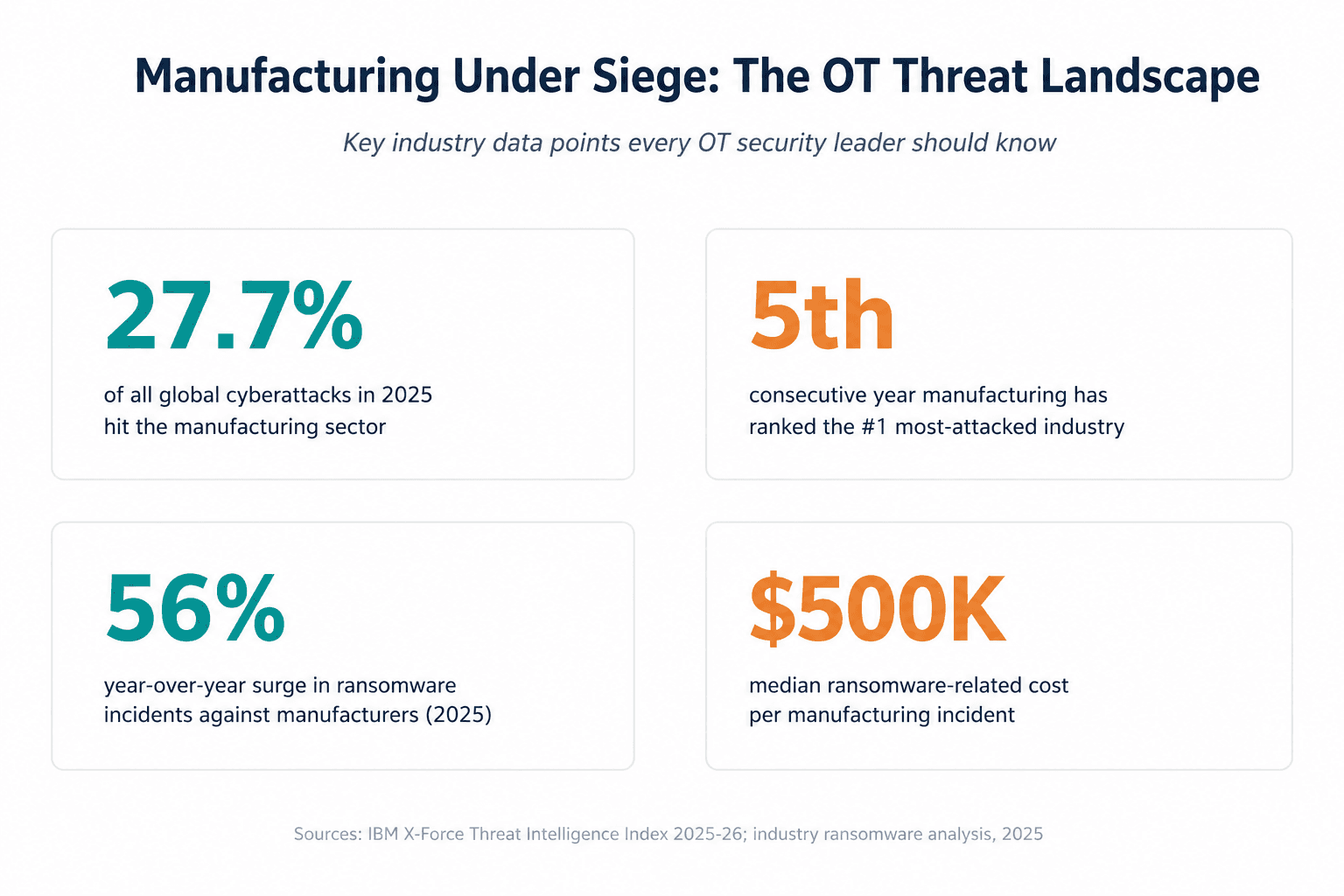
Figure 1: scale of cyber risk The facing manufacturers today.
Why OT Security Has Become a Boardroom Priority
Operational technology security used to be treated as an engineering concern, handled quietly by control systems teams and rarely discussed outside the plant. That has changed. Cyber incidents affecting industrial environments now carry consequences that reach the boardroom directly: extended production stoppages, regulatory scrutiny, insurance complications, safety investigations, and reputational damage with customers who depend on reliable delivery schedules.
Three forces are driving this shift. First, IT and OT networks have converged, meaning a compromise that begins in a corporate email inbox can, within hours, reach the control systems on the plant floor. Second, the Industrial Internet of Things has added thousands of new connected sensors and devices to environments that were never designed with cybersecurity in mind. Third, remote access, expanded significantly since 2020 to support vendors, integrators, and distributed engineering teams, has created access paths that are convenient for operations and equally convenient for attackers.
Executives are now asking sharper questions: How exposed are we? How quickly would we know if something went wrong? What would a two-week production stoppage cost us, and are we protected against it? Answering those questions credibly requires an OT security program built for the realities of industrial operations, not a repurposed IT security checklist.
Insurance underwriters have added their own pressure to this shift. Cyber insurance policies increasingly require evidence of network segmentation, monitored access controls, and documented incident response capability before they will extend or renew coverage for industrial operations. Boards that once viewed OT security as a discretionary line item now see it tied directly to insurability, lending terms, and in some sectors, the ability to retain key customer contracts that require proof of a mature security posture. This is one of the clearest signals that OT security has moved from a technical concern to a core business requirement.
Real-World Incidents That Changed How Manufacturers Think About OT Risk
Abstract risk becomes concrete very quickly when you look at what has actually happened across the sector in the past few years. The following examples illustrate the range of consequences manufacturers now face.
When a Vehicle Manufacturer's Production Line Went Silent
In 2025, a major global automotive manufacturer experienced a cyber incident that forced a shutdown of its production systems for roughly six weeks. The disruption halted vehicle assembly across multiple facilities, delayed shipments to dealers, and created financial exposure estimated at several hundred million pounds. The impact extended well beyond the manufacturer itself, disrupting suppliers and logistics partners who depended on a predictable production schedule. The incident is a reminder that OT risk is also supply chain risk: a single organization's exposure can cascade through an entire network of partners.
A Steel Producer Halts Operations After Unauthorized Access
In mid-2025, a large North American steel producer detected unauthorized access to its systems and made the decision to halt production as a precaution. The response, while disruptive in the short term, reflects a growing recognition among industrial operators that containing an intrusion quickly is far less costly than allowing it to spread into control systems undetected.
Ransomware in a Regulated Manufacturing Environment
Around the same period, a medical device manufacturer experienced a network disruption, with ransomware suspected as the cause, that delayed both manufacturing and shipments. In regulated industries, an OT security incident does not stay contained to operations. It can trigger compliance reviews, delay product availability for healthcare providers, and invite scrutiny from regulators who expect resilient supply chains for critical goods.
The Lesson Behind Every Headline
Looked at together, these incidents share common threads. Legacy systems that were never designed to be internet-facing became exposed as networks converged. Segmentation between IT and OT was either incomplete or poorly enforced. Detection came late, often after production impact had already begun. And in many cases, the organization lacked a response plan built specifically for operational environments, where isolating a system safely requires a different playbook than simply taking a server offline. Every one of these gaps is addressable with the right combination of visibility, monitoring, and planning.
It is also worth noting what these incidents have in common with attacks from years past, such as the well documented compromise of an aluminum producer's operations that forced a temporary return to manual processes across multiple facilities, or the disruption of a major fuel pipeline operator that led to regional fuel shortages. Years apart and across different industries, the pattern repeats: an initial foothold in IT systems, insufficient separation from OT, slow detection, and a costly, manual recovery process. The organizations that recovered fastest from these events were, without exception, the ones that had already invested in visibility and a rehearsed response plan before the incident occurred.
Understanding Why Manufacturers Are Prime Targets
Manufacturing did not become the most targeted sector by accident. Several structural factors make it a consistently attractive target for financially motivated and, increasingly, state-linked threat actors. Understanding these factors matters because they shape what an effective defense actually needs to look like. A security program built for a bank or a retailer, where the priority is protecting customer data, will not adequately address a threat model centered on process availability, physical safety, and supply chain continuity.
High tolerance for ransom payments: Downtime is extraordinarily expensive in manufacturing, which creates pressure to pay quickly rather than investigate thoroughly.
Deep supply chain interdependence: A single manufacturer's disruption can affect dozens of downstream customers, amplifying the pressure to restore operations fast.
Long-lived legacy infrastructure: Control systems installed fifteen or twenty years ago are still running critical processes, often without modern security controls.
Valuable intellectual property: Proprietary designs, formulas, and process data make manufacturers attractive targets for espionage as well as extortion.
Constrained OT-specific security budgets: Security investment has historically followed IT priorities, leaving operational environments comparatively under-resourced.
Fragmented ownership of risk: Responsibility for OT security is often split between engineering, IT, and operations teams, which can leave gaps that no single group is accountable for closing.
None of these factors are going to change on their own. Supply chains will keep getting more interconnected, not less. Legacy equipment will continue running well past its originally intended service life because replacing a functioning production line is expensive and disruptive in its own right. That is precisely why the security approach has to adapt to these realities rather than waiting for the environment to become easier to defend.
The IT/OT Security Gap
A significant part of the challenge comes down to a simple mismatch: security programs designed for IT environments do not translate cleanly to OT environments. The two domains prioritize different outcomes, operate on different timelines, and tolerate different types of intervention. The table below outlines some of the most important distinctions.
Focus Area | Traditional IT Security | OT / ICS Security |
Top priority | Confidentiality of data | Availability and safety of the process |
Patching approach | Regular, automated update cycles | Scheduled around planned maintenance windows |
Asset lifespan | 3 to 5 years | 15 to 25 years, often longer |
Response to an incident | Isolate and rebuild the endpoint | Contain without disrupting the physical process |
Protocols in use | TCP/IP, HTTPS, standard enterprise protocols | Modbus, DNP3, OPC-UA, PROFINET and vendor-specific protocols |
Consequence of failure | Data loss, service disruption | Production stoppage, safety incidents, environmental impact |
Table 1: How OT security priorities differ from traditional IT security.
This is not a minor technical distinction. It is the reason a well-intentioned IT security initiative can sometimes create new risk on the plant floor rather than reducing it. A vulnerability scan that behaves perfectly on an office network can overwhelm a fragile PLC and take a production line offline. An endpoint agent that works reliably on a laptop may not be supported, or may not even be installable, on a decades-old engineering workstation. Effective OT security requires tools and expertise built specifically for these constraints, not IT security retrofitted for an industrial setting.
The Cost of Waiting: Why Delayed Investment Rarely Pays Off
One of the most common reasons OT security programs stall inside manufacturing organizations is not a lack of awareness. It is the difficulty of building a business case for a risk that has not yet materialized. Security budgets compete with production upgrades, capacity expansion, and workforce investment, all of which have more immediately visible returns. The way to break this stalemate is to translate cyber risk into the same operational and financial language used to evaluate every other capital decision on the plant floor.
Start with a simple calculation: what does one hour of unplanned downtime cost your facility, accounting for lost production, idle labor, contractual penalties for late delivery, and the cost of a controlled restart? Multiply that by the average recovery timeline reported across recent manufacturing incidents, which has frequently stretched into days or weeks rather than hours. For most mid-sized manufacturers, that figure alone exceeds the annual cost of a properly scoped OT security program many times over. Add in the less visible costs, including regulatory response, customer notification, insurance premium increases, and the engineering hours diverted from planned projects to incident recovery, and the business case becomes difficult to ignore.
The organizations that treat OT security as an operational resilience investment, rather than a compliance expense, are consistently the ones that recover fastest when an incident does occur. They are also, in many cases, the ones that never make headlines in the first place, because early detection stopped the incident before it reached the production floor.
What Great OT Security Services Actually Look Like
Not every security provider is equipped to work in industrial environments. Choosing the right partner means looking past marketing language and evaluating specific operational capabilities. Here is what should be present in any credible OT security services engagement.
Continuous, OT-Aware Monitoring
Attacks against control systems rarely happen during convenient hours, and the early signs of compromise, such as unusual command sequences on a PLC or unexpected traffic on an OT network segment, require analysts trained to recognize them. Round-the-clock monitoring staffed by people who understand industrial protocols, not just conventional network traffic, is the foundation of an effective program.
Asset Visibility and Risk Assessment Before Anything Else
You cannot protect what you cannot see. Many manufacturers are surprised, once a proper asset inventory is completed, by how many devices are connected to their operational network that nobody was actively tracking. A credible engagement starts with passive discovery of every asset, its firmware, its communication patterns, and its known vulnerabilities, followed by a risk assessment that prioritizes issues by actual operational impact rather than generic severity scores.
Compliance Alignment Without Compliance Theater
Frameworks such as IEC 62443, the NIST Cybersecurity Framework, and sector-specific regulations exist for good reason, but compliance should be a byproduct of good security practice, not a separate checkbox exercise. The right partner maps monitoring, assessments, and response planning directly to the framework your organization needs to satisfy, so audits become a natural output of ongoing work rather than a scramble.
Deployment That Doesn't Interrupt Production
Nothing damages trust in a security program faster than the security program itself causing an outage. Passive monitoring techniques, careful scheduling of any active testing around maintenance windows, and close coordination with plant engineering teams are non-negotiable. Ask any prospective partner directly how they guarantee zero disruption to live control systems, and ask for specifics rather than a general assurance. A credible provider will be able to walk through exactly how sensors are installed, how traffic is captured without interfering with production networks, and how they coordinate with your engineering team before any change is made.
Cost-Effective, Right-Sized Partnership Models
Mid-sized manufacturers and process plants often assume enterprise-grade OT security is out of reach financially. It doesn't have to be. Scalable engagement models, ranging from focused risk assessments to fully managed 24x7 monitoring, allow organizations to build maturity in phases, aligning investment with the risks that matter most right now rather than committing to an all-or-nothing program. This phased approach also makes it easier to demonstrate return on investment to leadership, since each stage delivers a measurable improvement in visibility or response capability before the next stage of spending is committed.
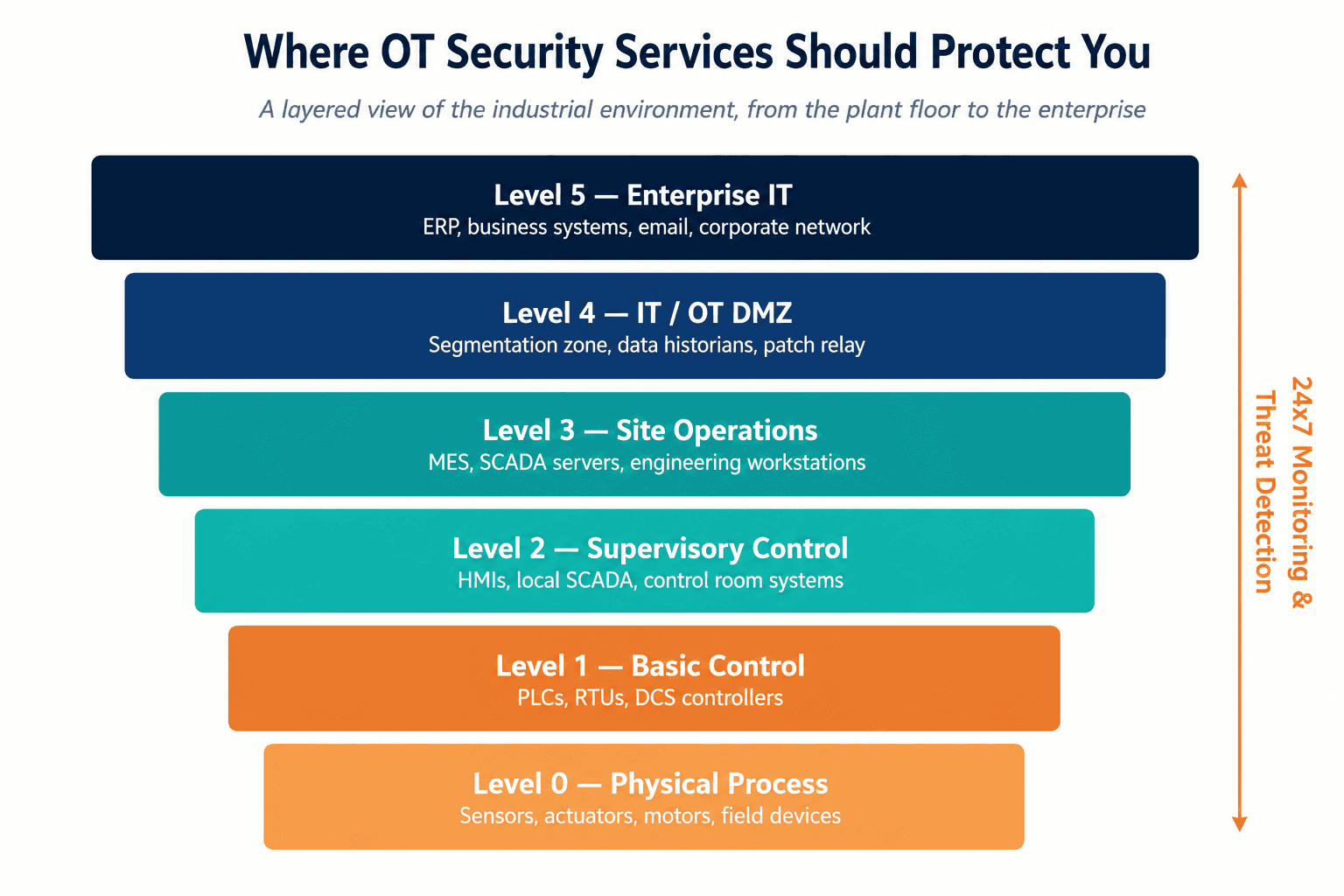
Figure 2: OT security services should provide visibility and monitoring across every layer, from the enterprise network down to the physical process.
Use the checklist below as a working reference during vendor conversations. It is designed to surface the answers that actually predict whether an engagement will succeed.
Evaluation Area | Question to Ask the Provider | Why It Matters |
OT-specific expertise | Do your analysts understand PLCs, SCADA, and industrial protocols, not just IT networks? | Generic IT alerts create noise and miss real OT threats |
Monitoring model | Is monitoring truly 24x7, with defined escalation paths and response times? | Attacks and failures do not wait for business hours |
Deployment method | Can visibility be established passively, without touching live control systems? | Active scanning can destabilize sensitive legacy equipment |
Compliance mapping | How is the engagement mapped to IEC 62443, NIST CSF, or relevant regulatory frameworks? | Clear mapping simplifies audits and board reporting |
Commercial model | Is pricing structured for a mid-sized plant, or built for large enterprise budgets only? | Cost-effectiveness determines long-term sustainability of the program |
Incident response | Is there a documented OT-specific incident response and recovery plan? | Recovery speed directly determines downtime cost |
Table 2: Questions to ask before choosing an OT security services partner.
Pay close attention not just to what a prospective partner says in response to these questions, but how specifically they answer them. Vague reassurances about experience or capability are a warning sign. A provider that has genuinely worked inside manufacturing environments will be able to describe, in concrete terms, how they have handled a segmentation challenge, a legacy PLC with no available patch, or a plant that could not tolerate any scanning traffic on its production network. That level of specificity is difficult to fake and is usually the clearest indicator of real operational maturity.
Practical Recommendations and Best Practices for Manufacturers
Beyond selecting the right partner, there are foundational steps every manufacturing organization should take to strengthen its security posture. These practices apply whether you are just starting an OT security program or refining an existing one.
Build a complete, living asset inventory: Know every device on your operational network, its firmware version, and its communication behavior, and keep that inventory current as equipment changes.
Segment IT and OT networks properly: Enforce clear boundaries and monitored gateways between business systems and control systems, so a compromise on one side cannot move freely to the other.
Apply least-privilege remote access: Every vendor and engineer connection should be time-bound, logged, and limited to exactly what the task requires.
Develop an OT-specific incident response plan: Response procedures for control systems must account for safety, physical process continuity, and safe shutdown sequences, not just data recovery.
Run tabletop exercises regularly: Practicing a response scenario with plant, IT, and leadership teams together exposes gaps long before a real incident does.
Formalize third-party and vendor risk management: Suppliers and integrators with system access should meet defined security requirements, with access reviewed periodically.
Plan patching around maintenance windows: A realistic patch management program respects production schedules while still closing known vulnerabilities on a defined cadence.
Invest in plant-floor security awareness: Operators and technicians are often the first to notice something unusual; equip them to recognize and report it.
Review and test backup and recovery procedures: Confirm that backups of critical control system configurations exist, are stored securely offline, and can actually be restored under time pressure.
Establish clear governance for OT security ownership: Assign accountability across engineering, IT, and operations leadership so that no gap in responsibility goes unnoticed.
None of these steps require a complete overhaul on day one. The most successful programs are built in phases, starting with visibility, moving to monitoring, and maturing into a fully tested response capability over twelve to eighteen months. What matters most is starting with an honest assessment of where you stand today.
How Shieldworkz Supports Organizations
Shieldworkz works exclusively with organizations that run industrial and critical infrastructure environments, which means every recommendation, tool, and process is built around the realities of OT, not adapted from generic IT security. Here is how that translates into practical support for manufacturers:
OT-native 24x7 monitoring: A security operations capability staffed by analysts trained in industrial protocols, control system behavior, and manufacturing operations, not just conventional IT traffic.
Passive asset discovery and risk assessment: Complete visibility into connected devices, firmware, and vulnerabilities, gathered without touching or destabilizing live control systems.
Compliance mapping to recognized frameworks: Ongoing work is aligned to IEC 62443, NIST CSF, and other relevant regulatory requirements, so audit readiness is continuous rather than reactive.
Zero-disruption deployment: Every engagement is planned around your production schedule and maintenance windows, with no impact to live operations.
Right-sized, scalable engagement models: Programs are structured to fit mid-sized manufacturers and process plants, allowing security maturity to grow in phases without enterprise-level overhead.
OT-specific incident response planning: Response plans account for the safety, availability, and physical-process considerations unique to control system environments.
Vendor-agnostic architecture guidance: Recommendations are based on what fits your existing infrastructure and vendor relationships, not tied to any single equipment ecosystem.
Ongoing threat intelligence relevant to your sector: Insights are tailored to the specific risks facing manufacturing, process industries, and energy and utility operations.
Every engagement begins with listening. Before recommending any tool, process, or timeline, our team takes the time to understand your production environment, your existing systems, and the specific pressures your organization is navigating. The goal is never to sell a standard package. It is to build a security program that fits the plant you actually operate, strengthens resilience over time, and holds up when it is tested.
Conclusion
The manufacturing sector's position at the top of global attack statistics is not a temporary trend. It reflects a structural reality: industrial environments are more connected, more valuable to attackers, and more consequential to disrupt than ever before. The organizations managing this risk most effectively are not necessarily the ones spending the most. They are the ones who have chosen an OT security partner that understands industrial operations, provides genuine round-the-clock visibility, and can prove its approach will not interrupt the very production it is meant to protect.
Choosing that partner is one of the most consequential decisions an OT security leader will make this year. Take the time to ask the right questions, use the checklist in this guide as a starting point, and prioritize partners who speak the language of the plant floor as fluently as they speak the language of cybersecurity.
The manufacturers who will navigate the next few years most successfully are not the ones who eliminate risk entirely, since that is not realistic in any connected environment. They are the ones who can detect an issue early, contain it before it reaches the production floor, and recover quickly with minimal disruption to customers and operations. That capability is built deliberately, one informed decision at a time, starting with the choice of who you trust to protect the systems your business depends on every single day.
Book a Free Consultation with Our Experts
If you're evaluating OT security services for your plant or facility, our team is glad to walk through your environment, your current gaps, and what a right-sized program could look like, with no obligation. Reach out to Shieldworkz to schedule a free, no-pressure consultation with an OT security specialist.
Additional resources
Comprehensive Guide to Network Detection and Response NDR in 2026 here
OT Security Risk Exposure Calculator Workbook here
A downloadable report on the Stryker cyber incident here
Remediation Guides here
OT Security Best Practices and Risk Assessment Guidance here
IEC 62443-based OT/ICS risk assessment checklist for the food and beverage manufacturing sector here
Get Weekly
Resources & News
See How Our Industry-Leading OT Security Solutions Address Critical Security Challenges
You may also like

PHP2Shell Update: First Confirmed Exploitation, OT Vendor Fallout and the CISO Response Plan
Team Shieldworkz

PLC Penetration Testing: A Safe Methodology That Works
Team Shieldworkz

Investigative report on Lamashtu extortion operations: German brewery incident analysis
Prayukth K V

Passive OT Asset Discovery Techniques: The Complete Guide for Industrial Environments
Team Shieldworkz

Modbus TCP Security: Firewall Rules and Best Practices
Team Shieldworkz

IEC 62443 Zones and Conduits: Practical Industrial Examples
Team Shieldworkz