What Is Removable Media? Risks, Policies, and Industrial OT Security Solutions
What Is Removable Media? Risks, Policies, and Industrial OT Security Solutions
What Is Removable Media? Risks, Policies, and Industrial OT Security Solutions
Removable Media Security for OT, ICS & IoT Environments
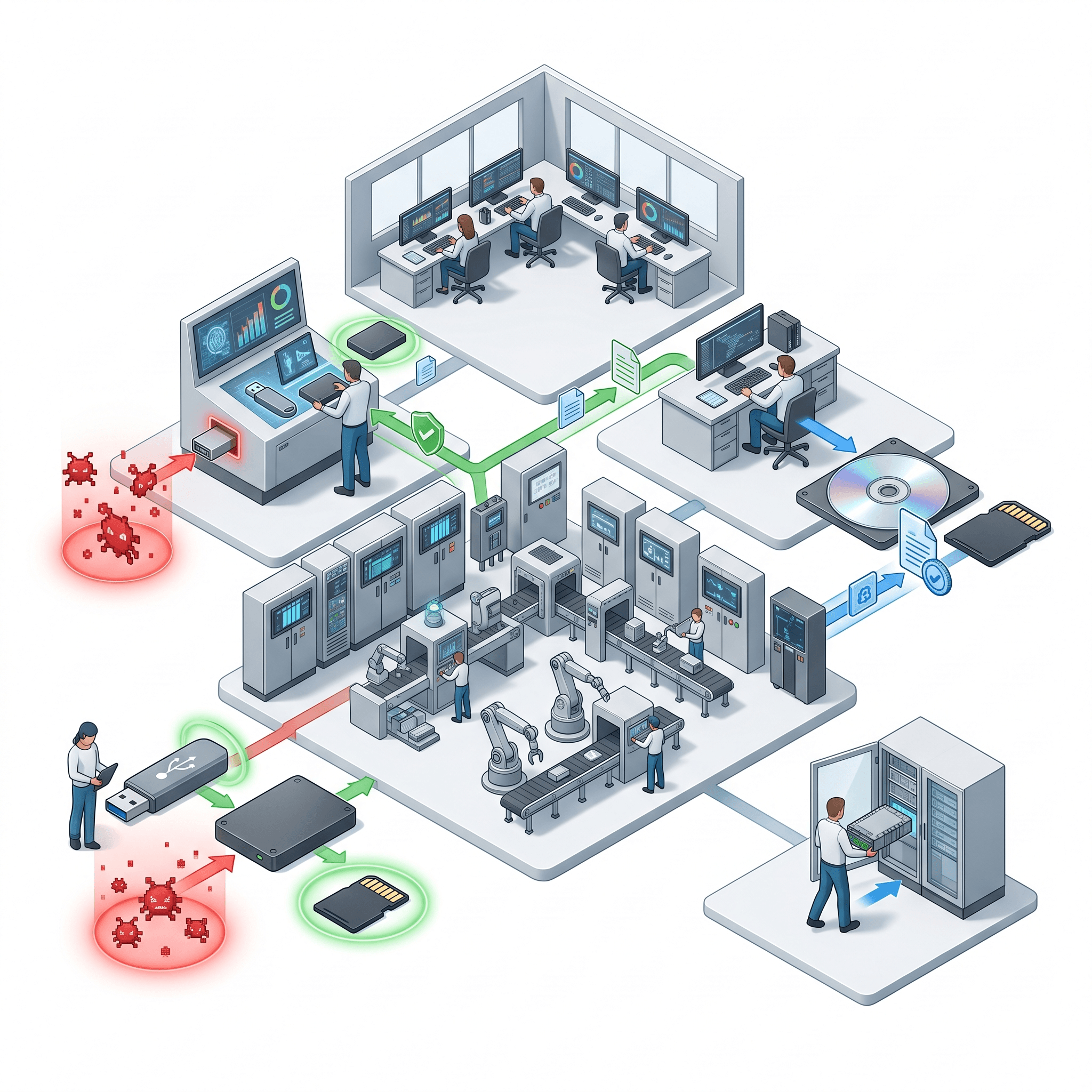
Removable media still plays an important role in industrial operations. In plants, utilities, manufacturing lines, and critical infrastructure environments, teams often need a reliable way to move files when the network path is unavailable, restricted, or intentionally separated. That is why USB drives, memory cards, external hard drives, and other portable storage devices continue to show up in OT, ICS, and IoT workflows.
The problem is not the media itself. The problem is how easily it can bypass the protections organizations build around their networks. A single drive can introduce malware, carry sensitive files out of the environment, or create an audit problem that is difficult to explain later. NIST SP 800-82r3 treats removable media as a media-protection issue in OT, CISA’s Cybersecurity Performance Goals 2.0 call out limiting USB devices and removable media where feasible, and IEC 62443-2-1:2024 includes portable-media security requirements for industrial automation and control system asset owners. For security teams, this is no longer a “basic USB policy” issue. It is a business continuity issue, a compliance issue, and in many cases, a safety issue.
OT Security, or operational technology security, is the practice of protecting critical infrastructure and industrial systems from cyber threats. These systems, which include everything from power grids and water treatment facilities to manufacturing plants and transportation networks, are the backbone of modern society. Unlike traditional IT systems, OT systems are designed to control physical processes and often operate in real-time, making them both unique and highly vulnerable to cyberattacks.
What Is Removable Media?
A Straightforward Definition
Removable media refers to any portable storage device that can be inserted into and removed from a computing system while it is operational. Common examples include:
USB flash drives - the most widely used and misused form
External hard drives and SSDs - high-capacity storage used for backups and data transfers
SD cards and memory cards - prevalent in embedded systems, cameras, and industrial equipment
Optical media - CDs, DVDs, and Blu-ray discs, still used in long-term archiving and legacy OT environments
Industrial-grade memory devices - compact flash cards and proprietary storage modules found in PLCs, HMIs, and DCS systems
In IT environments, cloud sync and enterprise file-sharing have reduced reliance on physical media. In OT environments, that shift has barely happened. Industrial controllers, safety instrumented systems, and legacy SCADA platforms are often deliberately disconnected from internet-facing networks - a practice known as air-gapping. The very design that protects these systems from remote intrusion creates a dependency on physical media for software updates, configuration changes, and diagnostic data transfers. That dependency is the vulnerability.

What Is Removable Media?
A Straightforward Definition
Removable media refers to any portable storage device that can be inserted into and removed from a computing system while it is operational. Common examples include:
USB flash drives - the most widely used and misused form
External hard drives and SSDs - high-capacity storage used for backups and data transfers
SD cards and memory cards - prevalent in embedded systems, cameras, and industrial equipment
Optical media - CDs, DVDs, and Blu-ray discs, still used in long-term archiving and legacy OT environments
Industrial-grade memory devices - compact flash cards and proprietary storage modules found in PLCs, HMIs, and DCS systems
In IT environments, cloud sync and enterprise file-sharing have reduced reliance on physical media. In OT environments, that shift has barely happened. Industrial controllers, safety instrumented systems, and legacy SCADA platforms are often deliberately disconnected from internet-facing networks - a practice known as air-gapping. The very design that protects these systems from remote intrusion creates a dependency on physical media for software updates, configuration changes, and diagnostic data transfers. That dependency is the vulnerability.
Why Removable Media Is a Serious Threat to OT and ICS Environments
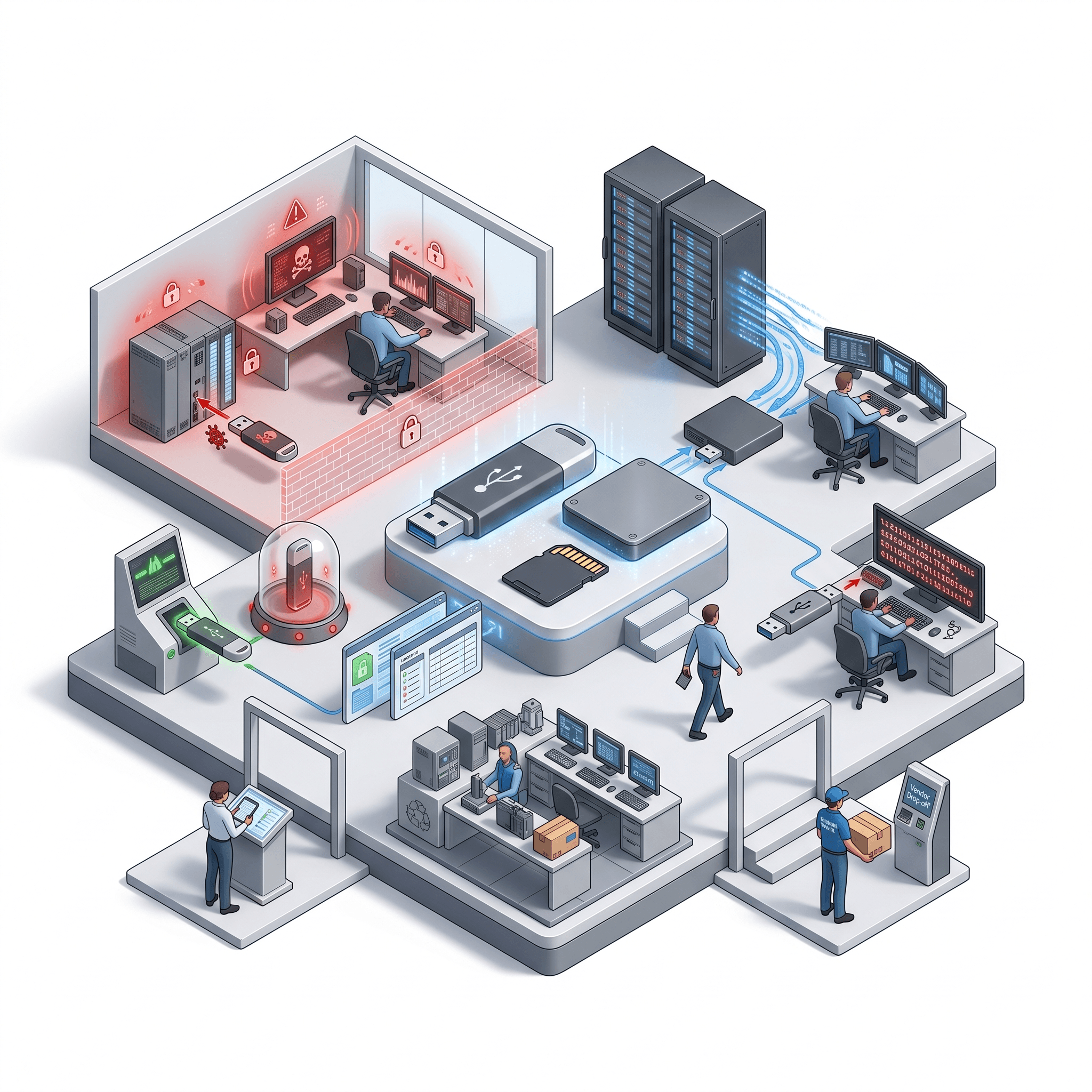
Industrial control systems were designed for reliability and uptime, not cybersecurity. Many of these systems are decades old, running on operating systems that are no longer patched, and connected to equipment that cannot simply be rebooted after a malware infection. A single compromised USB drive inserted into a historian server or engineering workstation can cascade into a full plant shutdown.
Malware Introduction Into Air-Gapped Systems: The most dangerous misconception in OT security is that air-gapping a system makes it immune to cyberattacks. The 2010 Stuxnet attack permanently disproved this. That attack - which targeted uranium enrichment centrifuges - was delivered entirely via USB drives and caused physical destruction to industrial equipment. More than a decade later, threat actors continue to use the same vector with updated techniques. In 2024 and into 2025, threat intelligence has documented multiple incidents where industrial environments were compromised through infected removable media brought in by third-party contractors, maintenance vendors, and even employees who unknowingly transferred files from personal devices.
Data Exfiltration Without a Network Trace: Unlike network-based exfiltration, data theft via removable media leaves minimal forensic evidence in standard IT security logs. A 128 GB USB drive can quietly carry out engineering drawings, process parameters, SCADA configurations, or proprietary production formulas - data that took years to develop and carries significant competitive and operational value. The challenge is not just detecting it after the fact; it's preventing it before any harm occurs.
BadUSB and Hardware-Level Firmware Attacks: Not all USB threats are software-based. BadUSB attacks exploit the firmware of USB devices, reprogramming them to impersonate keyboards, network adapters, or other trusted hardware. Once inserted, the device can execute commands silently, harvest credentials, or establish a persistent backdoor - all without triggering conventional antivirus or endpoint detection tools. Hardware-level attacks of this nature are particularly dangerous in OT environments where endpoint security coverage is inconsistent or absent.
Social Engineering and Supply Chain Exposure: Threat actors understand that the weakest point in most OT security programs is the humans who operate the systems, not the systems themselves. USB drives left in parking lots, branded flash drives distributed at industry events, or seemingly routine vendor-supplied configuration media have all been used to compromise industrial networks. Supply chain integrity is a growing concern, particularly as organizations receive media from third-party contractors, original equipment manufacturers (OEMs), and systems integrators with varying security standards.
Compliance Violations With Real Financial Consequences: Regulatory frameworks governing critical infrastructure and industrial operations - including NERC CIP, IEC 62443, NIST SP 800-82, and sector-specific guidelines - increasingly include explicit requirements around removable media control. Beyond regulatory frameworks, broader data protection laws such as HIPAA, GDPR, and state-level privacy regulations impose financial penalties for incidents involving uncontrolled portable media. In 2024, a healthcare organization faced a $3.8 million regulatory fine after an unencrypted external drive containing patient records was lost - a preventable incident with the right controls in place.
Why Removable Media Is a Serious Threat to OT and ICS Environments
Industrial control systems were designed for reliability and uptime, not cybersecurity. Many of these systems are decades old, running on operating systems that are no longer patched, and connected to equipment that cannot simply be rebooted after a malware infection. A single compromised USB drive inserted into a historian server or engineering workstation can cascade into a full plant shutdown.
Malware Introduction Into Air-Gapped Systems: The most dangerous misconception in OT security is that air-gapping a system makes it immune to cyberattacks. The 2010 Stuxnet attack permanently disproved this. That attack - which targeted uranium enrichment centrifuges - was delivered entirely via USB drives and caused physical destruction to industrial equipment. More than a decade later, threat actors continue to use the same vector with updated techniques. In 2024 and into 2025, threat intelligence has documented multiple incidents where industrial environments were compromised through infected removable media brought in by third-party contractors, maintenance vendors, and even employees who unknowingly transferred files from personal devices.
Data Exfiltration Without a Network Trace: Unlike network-based exfiltration, data theft via removable media leaves minimal forensic evidence in standard IT security logs. A 128 GB USB drive can quietly carry out engineering drawings, process parameters, SCADA configurations, or proprietary production formulas - data that took years to develop and carries significant competitive and operational value. The challenge is not just detecting it after the fact; it's preventing it before any harm occurs.
BadUSB and Hardware-Level Firmware Attacks: Not all USB threats are software-based. BadUSB attacks exploit the firmware of USB devices, reprogramming them to impersonate keyboards, network adapters, or other trusted hardware. Once inserted, the device can execute commands silently, harvest credentials, or establish a persistent backdoor - all without triggering conventional antivirus or endpoint detection tools. Hardware-level attacks of this nature are particularly dangerous in OT environments where endpoint security coverage is inconsistent or absent.
Social Engineering and Supply Chain Exposure: Threat actors understand that the weakest point in most OT security programs is the humans who operate the systems, not the systems themselves. USB drives left in parking lots, branded flash drives distributed at industry events, or seemingly routine vendor-supplied configuration media have all been used to compromise industrial networks. Supply chain integrity is a growing concern, particularly as organizations receive media from third-party contractors, original equipment manufacturers (OEMs), and systems integrators with varying security standards.
Compliance Violations With Real Financial Consequences: Regulatory frameworks governing critical infrastructure and industrial operations - including NERC CIP, IEC 62443, NIST SP 800-82, and sector-specific guidelines - increasingly include explicit requirements around removable media control. Beyond regulatory frameworks, broader data protection laws such as HIPAA, GDPR, and state-level privacy regulations impose financial penalties for incidents involving uncontrolled portable media. In 2024, a healthcare organization faced a $3.8 million regulatory fine after an unencrypted external drive containing patient records was lost - a preventable incident with the right controls in place.
Removable Media Policy for OT/ICS Environments
Policy is where most industrial organizations underinvest. Technical tools get budget. Policy work gets deferred. The result is an organization with security products deployed but no governance structure to make them effective.
A removable media policy for an OT environment is not the same as a general IT acceptable use policy. It needs to reflect the operational realities of industrial settings - including the fact that USB ports cannot always be blocked, that external technicians routinely bring their own media, and that some legacy systems have no alternative to physical media transfer.
What a Strong OT Removable Media Policy Covers
Device Registration and Approval All removable media authorized for use in OT environments should be formally registered, inventoried, and assigned to specific personnel or use cases. Approved devices should be distinguishable - through labeling, asset tags, or cryptographic identity - from unauthorized media brought in from outside.
Third-Party and Vendor Media Protocols Any removable media brought into the facility by a contractor, OEM technician, or systems integrator should be subject to mandatory pre-screening before it contacts any operational system. This protocol should be formalized in vendor contracts and consistently enforced - not left to the discretion of the technician on-site.
Scanning Requirements Before Connection Policy should mandate that all removable media - including devices from trusted internal sources - is scanned at a designated secure transfer station before being connected to any OT asset. This requirement removes the human judgment element from the equation. The policy does not ask people to evaluate risk. It creates a mandatory process.
Data Classification and Transfer Rules Policy should define what categories of data may be transferred to removable media, from which systems, and under what authorization. This is particularly important for preventing insider-driven data exfiltration, where the technical capability to copy files exists but the policy boundary provides the control.
Encryption Requirements Any sensitive data written to removable media should be encrypted by policy. This ensures that the physical loss or theft of a device does not automatically constitute a data breach. Encryption requirements should specify approved methods and key management procedures.
Incident Reporting and Handling Policy should define what constitutes a removable media security incident, how it should be reported, and what immediate steps should be taken. Employees who discover or suspect a compromised device should have a clear, low-friction reporting path.
Enforcement, Exceptions, and Accountability A policy that cannot be enforced provides false assurance. Enforcement mechanisms - technical controls that back up policy requirements, audit processes, and defined consequences for violations - are essential. An exception management process should allow for legitimate deviations with appropriate authorization and documentation, preventing the workarounds that undermine unenforced policies.

Removable Media Policy for OT/ICS Environments
Policy is where most industrial organizations underinvest. Technical tools get budget. Policy work gets deferred. The result is an organization with security products deployed but no governance structure to make them effective.
A removable media policy for an OT environment is not the same as a general IT acceptable use policy. It needs to reflect the operational realities of industrial settings - including the fact that USB ports cannot always be blocked, that external technicians routinely bring their own media, and that some legacy systems have no alternative to physical media transfer.
What a Strong OT Removable Media Policy Covers
Device Registration and Approval All removable media authorized for use in OT environments should be formally registered, inventoried, and assigned to specific personnel or use cases. Approved devices should be distinguishable - through labeling, asset tags, or cryptographic identity - from unauthorized media brought in from outside.
Third-Party and Vendor Media Protocols Any removable media brought into the facility by a contractor, OEM technician, or systems integrator should be subject to mandatory pre-screening before it contacts any operational system. This protocol should be formalized in vendor contracts and consistently enforced - not left to the discretion of the technician on-site.
Scanning Requirements Before Connection Policy should mandate that all removable media - including devices from trusted internal sources - is scanned at a designated secure transfer station before being connected to any OT asset. This requirement removes the human judgment element from the equation. The policy does not ask people to evaluate risk. It creates a mandatory process.
Data Classification and Transfer Rules Policy should define what categories of data may be transferred to removable media, from which systems, and under what authorization. This is particularly important for preventing insider-driven data exfiltration, where the technical capability to copy files exists but the policy boundary provides the control.
Encryption Requirements Any sensitive data written to removable media should be encrypted by policy. This ensures that the physical loss or theft of a device does not automatically constitute a data breach. Encryption requirements should specify approved methods and key management procedures.
Incident Reporting and Handling Policy should define what constitutes a removable media security incident, how it should be reported, and what immediate steps should be taken. Employees who discover or suspect a compromised device should have a clear, low-friction reporting path.
Enforcement, Exceptions, and Accountability A policy that cannot be enforced provides false assurance. Enforcement mechanisms - technical controls that back up policy requirements, audit processes, and defined consequences for violations - are essential. An exception management process should allow for legitimate deviations with appropriate authorization and documentation, preventing the workarounds that undermine unenforced policies.
Industrial OT Security Solutions for Removable Media
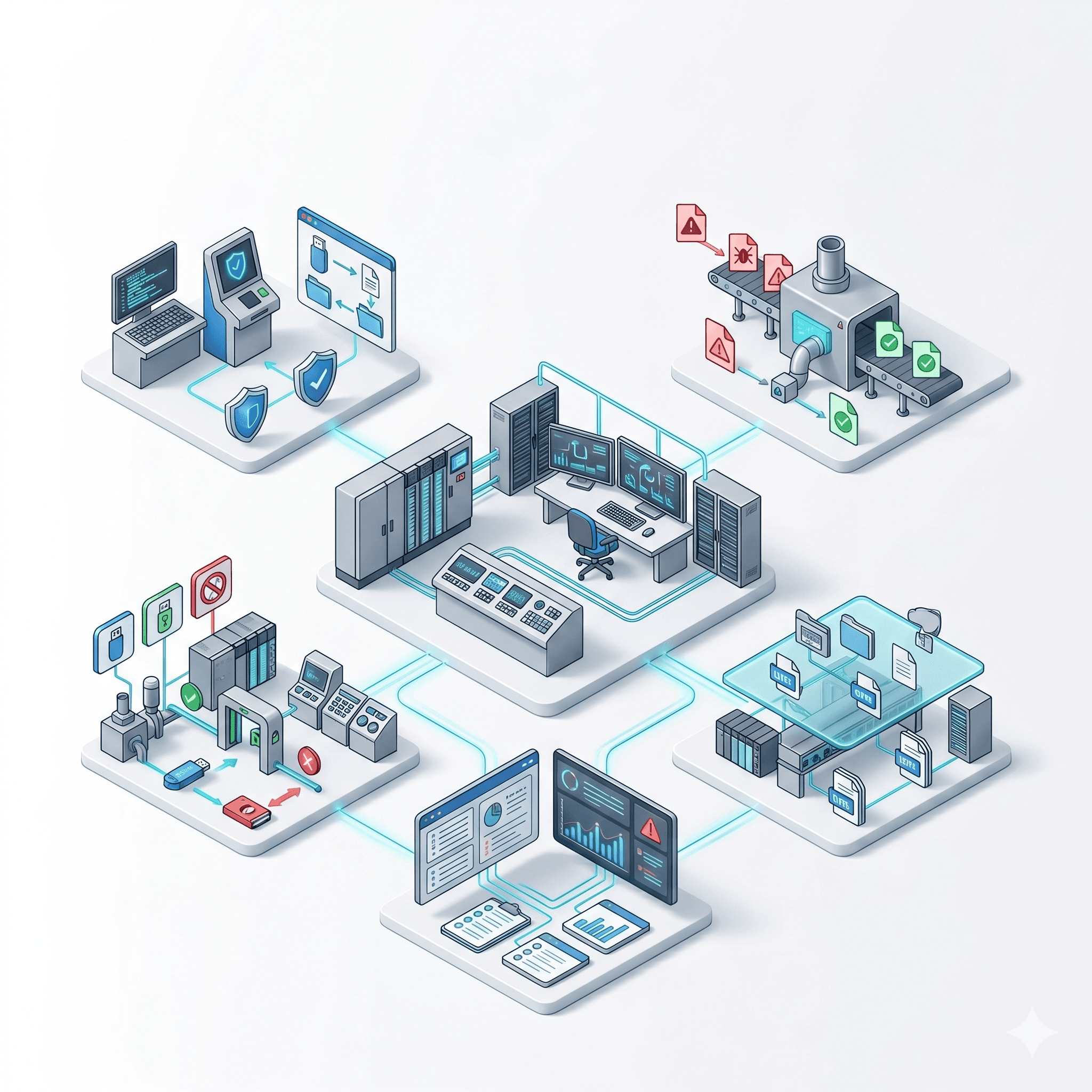
Policy defines the rules. Technology enforces them - consistently, at scale, and without relying on individual judgment in the field. The following are the core security solutions relevant to removable media risk management in OT and ICS environments.
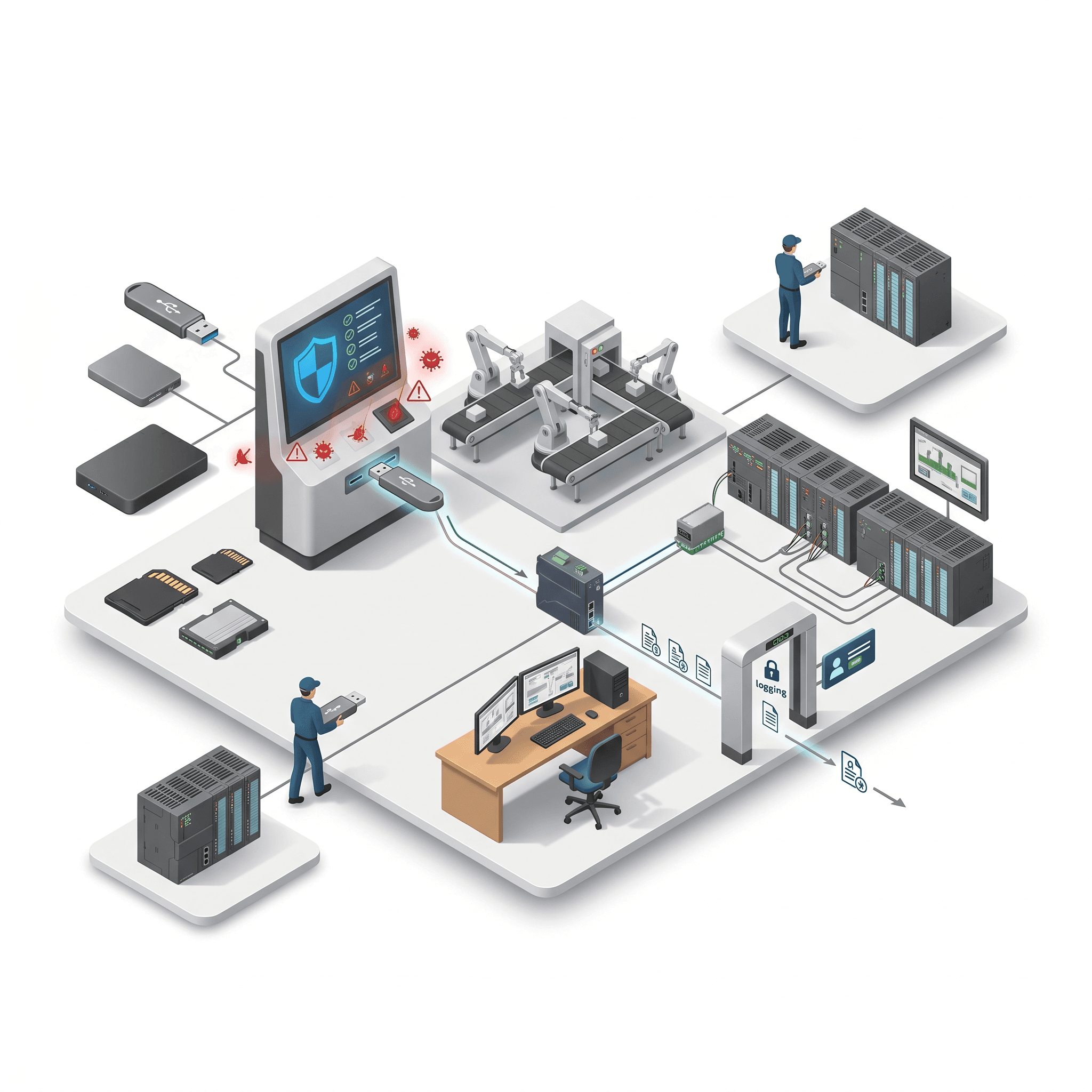
Secure Media Transfer Kiosks: A secure transfer kiosk creates a controlled checkpoint for every USB or portable device before it reaches OT assets. It combines scanning, file handling controls, and activity logging in one isolated workflow, which is a practical way to operationalize current guidance on screening removable media, maintaining logs, and enforcing policy without adding tools to every legacy workstation.
Content Disarm and Reconstruction (CDR): CDR strengthens removable media security by rebuilding files into a safer version instead of only looking for known malware. That matters in OT because current guidance stresses scanning, disabling autorun, and controlling risky content, while threat reality still includes unknown payloads and file-based exploits. CDR helps preserve usability while reducing exposure from macros, scripts, and embedded objects.
Endpoint Device Control and Whitelisting: Endpoint device control restricts removable media to preapproved devices and blocks everything else at the hardware level. In OT, that is especially important because NIST and CISA both emphasize limiting unauthorized media and using policy-backed controls rather than trust-by-default access. A tiered whitelist approach is often best, with stricter rules for critical systems and more flexibility where business risk is lower.
Data Loss Prevention (DLP) for OT: DLP solutions monitor and control what data can be written from OT systems to removable media. They can enforce rules based on data classification, user role, file type, destination device, and other parameters - preventing unauthorized copies of sensitive engineering files, configuration backups, or operational data from leaving the controlled environment.
Centralized Monitoring, Logging, and Audit: All removable media activity - what devices connected, when, to which systems, and what data was transferred - should generate log records that feed into a central monitoring environment. This provides the visibility needed for both security operations (detecting anomalies and investigating incidents) and compliance reporting (demonstrating control effectiveness to auditors and regulators).
Industrial OT Security Solutions for Removable Media
Policy defines the rules. Technology enforces them - consistently, at scale, and without relying on individual judgment in the field. The following are the core security solutions relevant to removable media risk management in OT and ICS environments.
Secure Media Transfer Kiosks: A secure transfer kiosk creates a controlled checkpoint for every USB or portable device before it reaches OT assets. It combines scanning, file handling controls, and activity logging in one isolated workflow, which is a practical way to operationalize current guidance on screening removable media, maintaining logs, and enforcing policy without adding tools to every legacy workstation.
Content Disarm and Reconstruction (CDR): CDR strengthens removable media security by rebuilding files into a safer version instead of only looking for known malware. That matters in OT because current guidance stresses scanning, disabling autorun, and controlling risky content, while threat reality still includes unknown payloads and file-based exploits. CDR helps preserve usability while reducing exposure from macros, scripts, and embedded objects.
Endpoint Device Control and Whitelisting: Endpoint device control restricts removable media to preapproved devices and blocks everything else at the hardware level. In OT, that is especially important because NIST and CISA both emphasize limiting unauthorized media and using policy-backed controls rather than trust-by-default access. A tiered whitelist approach is often best, with stricter rules for critical systems and more flexibility where business risk is lower.
Data Loss Prevention (DLP) for OT: DLP solutions monitor and control what data can be written from OT systems to removable media. They can enforce rules based on data classification, user role, file type, destination device, and other parameters - preventing unauthorized copies of sensitive engineering files, configuration backups, or operational data from leaving the controlled environment.
Centralized Monitoring, Logging, and Audit: All removable media activity - what devices connected, when, to which systems, and what data was transferred - should generate log records that feed into a central monitoring environment. This provides the visibility needed for both security operations (detecting anomalies and investigating incidents) and compliance reporting (demonstrating control effectiveness to auditors and regulators).
How Shieldworkz Supports Removable Media Security in Industrial Environments
Shieldworkz brings deep expertise in OT/ICS and industrial cybersecurity to organizations that cannot afford to treat physical media security as an afterthought. Our approach is built around the operational realities of industrial environments - not adapted from enterprise IT frameworks.
OT-Specific Risk Assessments - We evaluate your current removable media exposure across your entire facility footprint, identifying high-risk systems, uncontrolled media touchpoints, and gaps in existing policy or monitoring
Media Inspection and Kiosk Solutions - We design and deploy centralized media inspection infrastructure purpose-built for industrial environments, including facilities with air-gapped networks, legacy controllers, and strict operational uptime requirements
Removable Media Policy Development - We develop practical, enforceable removable media policies that align with NERC CIP, NIST 800-82, IEC 62443, and other applicable standards - policies that operations teams can actually follow without bypassing them
Vendor and Contractor Media Controls - We implement processes and technical controls governing the devices that third-party personnel bring into your facilities, one of the most commonly overlooked and highest-risk removable media vectors
Incident Detection and Response Integration - We integrate removable media event logging into your broader OT security monitoring program so that unauthorized device use triggers alerts, not just audit entries discovered weeks later
Security Awareness Training for OT Personnel - We deliver targeted training for the engineers, operators, and maintenance teams who work directly with industrial systems, covering specific tactics and scenarios relevant to their environment
Compliance Alignment and Documentation - We help your organization demonstrate compliance with removable media controls under applicable regulatory frameworks, including support for audit preparation and evidence collection
Book a free consultation with our experts today!
Benefits of Secure Removable Media Management in OT & ICS Environments
When implemented correctly and tuned for your specific OT/ICS environment, NIDS delivers measurable security outcomes that justify the investment:
Reduced Malware Exposure: Prevent malware, ransomware, and unauthorized code from entering industrial environments through controlled USB usage, advanced scanning, and policy-driven removable media security workflows.
Stronger OT Network Protection: Protect critical ICS and OT assets from unauthorized access by controlling how external devices interact with production systems, engineering workstations, and industrial endpoints.
Improved Regulatory Compliance: Support compliance initiatives with centralized logging, audit trails, device accountability, and controlled media handling processes aligned with industrial cybersecurity requirements and governance standards.
Safer Vendor and Contractor Access: Enable secure file transfers for third-party vendors, contractors, and maintenance teams without exposing critical operational technology environments to unnecessary cyber risks.
Enhanced Operational Continuity: Reduce the likelihood of operational disruptions, malware-related downtime, and production outages caused by infected or unauthorized removable media entering industrial networks.
Centralized Visibility and Control: Gain enterprise-wide visibility into removable media activity, including device usage, file transfers, user actions, and policy violations across multiple industrial locations.
Secure Data Transfer Across Air-Gapped Systems: Maintain safe and controlled file movement between segmented or air-gapped OT environments while minimizing exposure to cyber threats and unauthorized data access.
Simplified Security Management: Streamline removable media governance with standardized policies, centralized administration, automated scanning, and consistent enforcement across complex industrial infrastructures.
Benefits of Secure Removable Media Management in OT & ICS Environments
When implemented correctly and tuned for your specific OT/ICS environment, NIDS delivers measurable security outcomes that justify the investment:
Reduced Malware Exposure: Prevent malware, ransomware, and unauthorized code from entering industrial environments through controlled USB usage, advanced scanning, and policy-driven removable media security workflows.
Stronger OT Network Protection: Protect critical ICS and OT assets from unauthorized access by controlling how external devices interact with production systems, engineering workstations, and industrial endpoints.
Improved Regulatory Compliance: Support compliance initiatives with centralized logging, audit trails, device accountability, and controlled media handling processes aligned with industrial cybersecurity requirements and governance standards.
Safer Vendor and Contractor Access: Enable secure file transfers for third-party vendors, contractors, and maintenance teams without exposing critical operational technology environments to unnecessary cyber risks.
Enhanced Operational Continuity: Reduce the likelihood of operational disruptions, malware-related downtime, and production outages caused by infected or unauthorized removable media entering industrial networks.
Centralized Visibility and Control: Gain enterprise-wide visibility into removable media activity, including device usage, file transfers, user actions, and policy violations across multiple industrial locations.
Secure Data Transfer Across Air-Gapped Systems: Maintain safe and controlled file movement between segmented or air-gapped OT environments while minimizing exposure to cyber threats and unauthorized data access.
Simplified Security Management: Streamline removable media governance with standardized policies, centralized administration, automated scanning, and consistent enforcement across complex industrial infrastructures.
The Cost of a Single Unscreened Device
A ransomware attack introduced through a contractor's unauthorized USB drive in October 2024 resulted in $4.2 million in operational losses for one industrial organization. An earlier defense contractor compromise - delivered through modified external hard drive firmware - maintained persistent access for eight months before detection. These outcomes are not the result of sophisticated, unstoppable attacks. They are the predictable result of inadequate controls around ordinary portable storage devices.
In industrial environments, the consequences of a successful OT compromise extend beyond financial loss. Process disruptions, safety incidents, regulatory investigations, and reputational damage can follow a single unscreened USB drive.
OT Security, or operational technology security, is the practice of protecting critical infrastructure and industrial systems from cyber threats. These systems, which include everything from power grids and water treatment facilities to manufacturing plants and transportation networks, are the backbone of modern society. Unlike traditional IT systems, OT systems are designed to control physical processes and often operate in real-time, making them both unique and highly vulnerable to cyberattacks.
Book Your Free Consultation With Our OT Security Experts
If you are responsible for the security of an OT, ICS, or industrial IoT environment, the removable media risk landscape requires your attention now - not after an incident.
Shieldworkz offers a complimentary consultation to help you understand your current exposure, evaluate your existing controls, and identify the most impactful next steps for your specific environment. There is no obligation and no sales pressure - just a focused, expert conversation about your security posture.
Book your free consultation with our OT/ICS cybersecurity experts today. Let us help you build a removable media security program that protects your operations without disrupting them.
Request a demo
Book Your Free Consultation With Our OT Security Experts
If you are responsible for the security of an OT, ICS, or industrial IoT environment, the removable media risk landscape requires your attention now - not after an incident.
Shieldworkz offers a complimentary consultation to help you understand your current exposure, evaluate your existing controls, and identify the most impactful next steps for your specific environment. There is no obligation and no sales pressure - just a focused, expert conversation about your security posture.
Book your free consultation with our OT/ICS cybersecurity experts today. Let us help you build a removable media security program that protects your operations without disrupting them.
Request a demo