
Equipo Shieldworkz
La remediación de un sistema de control industrial (ICS) después de una evaluación de brechas es donde la "seguridad en el papel" se encuentra con el "acero y los cables". Como consultores de IEC 62443 con décadas de experiencia en campo, sabemos que el objetivo no es solo cerrar una brecha, sino garantizar que la seguridad nunca comprometa la Seguridad Operacional ni la Disponibilidad. En la publicación de hoy, profundizamos en la remediación de observaciones y brechas de seguridad identificadas durante una evaluación de riesgos y brechas basada en IEC 62443.
Antes de continuar, no olvides revisar nuestra publicación anterior del blog sobre lo que podría significar una toma de control del IRGC para el actor de amenazas iraní Handala aquí.
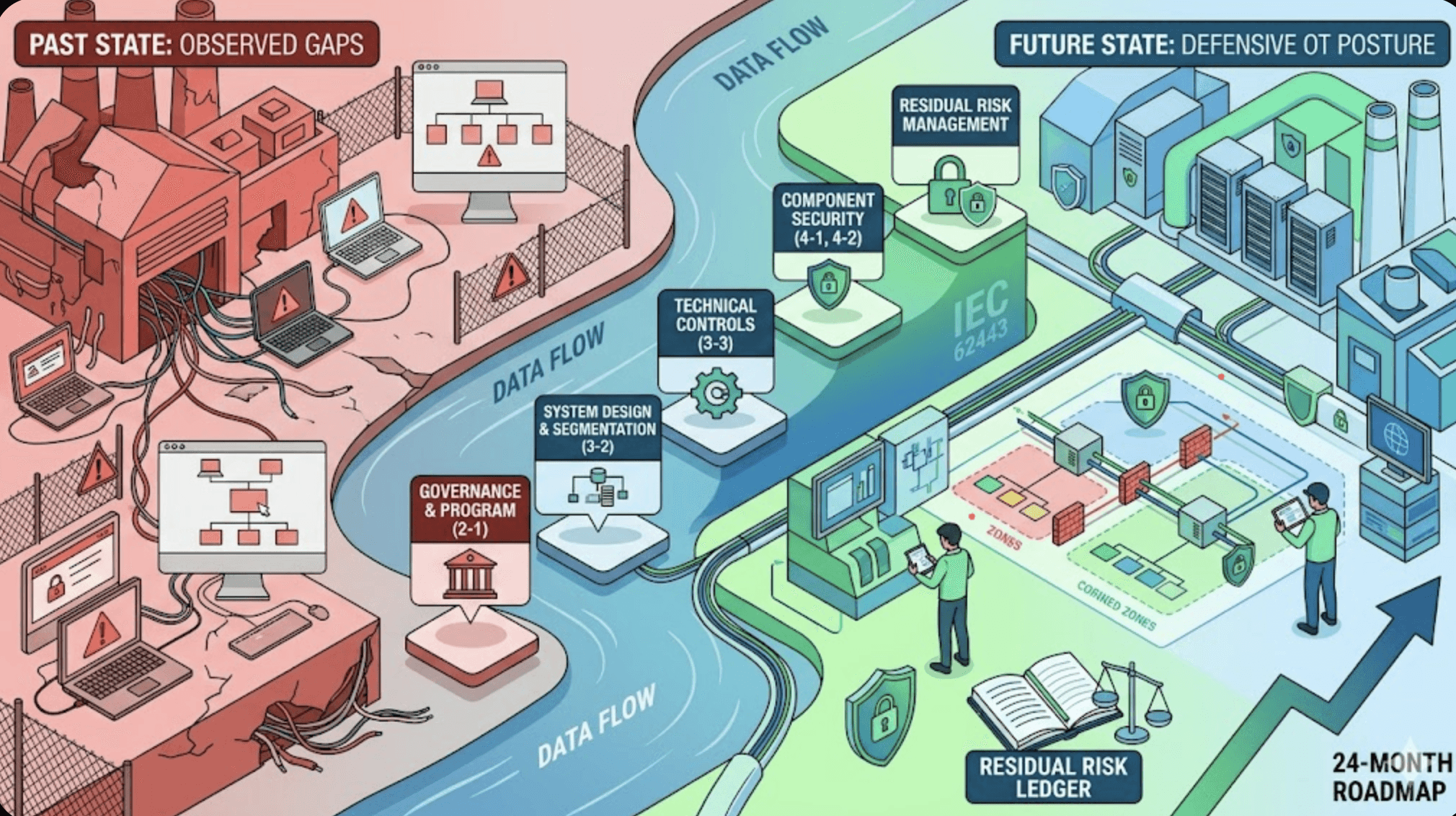
1. Brechas de gobernanza y del programa (IEC 62443-2-1)
La base: establecer un programa de seguridad de IACS
La mayoría de las evaluaciones encuentran que, aunque existen controles técnicos, el sistema de gestión está fragmentado. La remediación aquí se centra en el elemento "Personas y Procesos".
Estrategia de remediación: * La única fuente de verdad del inventario de activos: No puedes proteger lo que no puedes ver. Remedia las brechas de 2-1 implementando una herramienta automatizada de descubrimiento de activos que clasifique los dispositivos por versión de hardware, nivel de firmware y patrones de comunicación.
La política de seguridad de IACS: Redacta un manual dedicado de seguridad OT. No solo copies y pegues políticas de TI. Tu política de OT debe definir explícitamente los procedimientos de "Acceso de Emergencia", donde la seguridad de la vida humana prevalece sobre la autenticación.
Ciclo de vida de la evaluación de riesgos: Pasa de una evaluación única a un modelo de "Gestión Continua de Riesgos". Esto implica actualizar el registro de riesgos cada vez que se agregue una nueva estación de trabajo de ingeniería o se actualice el firmware de un PLC.
2. Arquitectura y segmentación del sistema (IEC 62443-3-2)
El plano: evaluación de riesgos de seguridad y diseño del sistema
Las brechas en 3-2 normalmente implican "redes planas" donde una laptop comprometida en la oficina puede alcanzar un controlador en el piso de planta.
Estrategia de remediación:
Modelado de Zonas y Conductos: Agrupa física o lógicamente los activos en "Zonas de Seguridad" con base en su similitud funcional y perfil de riesgo.
Definición de conductos: Cada ruta de comunicación entre zonas debe ser un "Conducto". Remedia implementando firewalls con inspección con estado que solo permitan los protocolos industriales necesarios (p. ej., EtherNet/IP, OPC UA).
Implementación de IDMZ: Crea una Zona Desmilitarizada Industrial. El tráfico nunca debe fluir directamente desde la Empresa (Nivel 4/5) hacia la Zona de Control (Nivel 0-2). Todo intercambio de datos debe terminar en la IDMZ.
3. Requisitos técnicos del sistema (IEC 62443-3-3)
El escudo: implementación de seguridad funcional
Aquí es donde abordamos los "Siete Requisitos Fundamentales" (FR). Las brechas comunes incluyen contraseñas compartidas y tráfico de ingeniería sin cifrar.
Estrategia de remediación:
FR 1: Identificación y autenticación: Reemplaza los inicios de sesión compartidos de "Operador" por IDs únicos. Si la HMI no admite inicios de sesión individuales, implementa un jump-host en la IDMZ que requiera MFA antes de otorgar acceso a la HMI.
FR 5: Flujo de datos restringido: Implementa Inspección Profunda de Paquetes (DPI). Si existe una brecha en la seguridad del protocolo, DPI puede evitar comandos de "Escritura" desde direcciones IP no autorizadas, incluso si el protocolo en sí no está autenticado.
FR 6: Respuesta oportuna a eventos: Centraliza los registros de OT en un OT-SIEM dedicado. Asegúrate de que tu SOC (Centro de Operaciones de Seguridad) entienda la diferencia entre un "Escaneo" y una "Tormenta de Broadcast".
La siguiente tabla ofrece una lista de acciones por dominio para el cumplimiento de IEC 62443
Dominio | Acción | Referencia IEC 62443-3-3 |
Identificación | Eliminar cuentas compartidas en HMIs; implementar RBAC (Control de Acceso Basado en Roles). | SR 1.1, SR 1.2 |
Integridad de datos | Habilitar firmas digitales para actualizaciones de firmware cuando sean compatibles con el proveedor. | SR 3.1 |
Confidencialidad de datos | Cifrar "Datos en Reposo" para servidores historiadores y "Datos en Tránsito" para tráfico de ingeniería sensible. | SR 4.1 |
Flujo restringido | Implementar inspección profunda de paquetes (DPI) para monitorear paquetes industriales malformados. | SR 5.2 |
Respuesta oportuna | Implementar una herramienta NDR (Network Detection and Response) con conocimiento de ICS para monitoreo continuo. | SR 6.1 |
Disponibilidad de recursos | Validar que los modos "Fail-Safe" no abran inadvertidamente puertas traseras de seguridad. | SR 7.1 |
4. Requisitos de componentes (IEC 62443-4-1 y 4-2)
Los bloques de construcción: desarrollo de producto y componentes técnicos
Estas brechas suelen involucrar equipos heredados que eran "seguros por oscuridad", pero que ahora son vulnerables.
Estrategia de remediación (4-1: ciclo de vida):
Adquisición segura: Actualiza tus plantillas de RFP (Solicitud de Propuesta). Exige que los proveedores entreguen una Lista de Materiales de Software (SBOM) y evidencia de prácticas de codificación segura (SDLC).
Estrategia de remediación (4-2: componentes):
Endurecimiento de endpoints: Deshabilita puertos físicos no utilizados (USB, RJ45) en PLCs y switches.
Controles compensatorios para legado: Si una máquina heredada con Windows XP no puede ser parchada (violación 4-2), remedia mediante "Parcheo Virtual" a través de un IPS a nivel de conducto y listas blancas estrictas de aplicaciones para evitar cualquier ejecución binaria no autorizada.
Abordar el riesgo residual: el libro de cuentas del CISO
Incluso después de una remediación completa, el Riesgo Residual permanece. En OT, esto suele ser el riesgo de un exploit "Zero-Day" contra un protocolo propietario o la vulneración física de una unidad terminal remota (RTU).
Cuantificación: Usa una matriz de $Riesgo = Probabilidad \times Impacto$ para mostrar al Consejo cómo la remediación ha reducido la "Pérdida Esperada".
Aceptación: Las brechas que no pueden cerrarse debido a "Anulaciones de Seguridad" deben ser aceptadas formalmente por el Director de Operaciones.
Seguro: Para el "Riesgo No Mitigable" restante, asegúrate de que el Seguro Cibernético de la organización cubra específicamente "Daño a Propiedad Física" e "Interrupción del Negocio" causados por incidentes de OT.
La hoja de ruta de 24 meses
Fase 1 (0-6 meses): Descubrimiento de activos, segmentación por zonas y parchado crítico.
Fase 2 (6-12 meses): Gestión de identidades (MFA), configuración de IDMZ e integración de OT-SIEM.
Fase 3 (12-24 meses): Endurecimiento completo 4-2, integración de adquisiciones con SBOM y ejercicios de Red Team en el entorno OT.
Reflexión final: El cumplimiento de IEC 62443 debe considerarse como un maratón, no un sprint. Cada PLC que blindas y cada conducto que cierras eleva el "Costo de Ataque" para el adversario. Impulsa el cambio mediante principios de ingeniería primero.
Habla con un especialista en IEC 62443 aquí.
Prueba la solución NDR de seguridad OT de Shieldworkz aquí.
¿Te interesan estrategias de remediación para tu infraestructura OT? Descarga nuestras guías gratuitas de remediación aquí.
Todo lo que querías saber sobre la implementación de controles IEC 62443 aquí.
Recibe semanalmente
Recursos y Noticias
Vea cómo nuestras soluciones de seguridad de OT líderes en la industria abordan los desafíos de seguridad críticos
También te puede interesar

What the French supermarket cyberattack reveals about OT security
Prayukth K V

Inside the Albert Heijn cyber incident: Investigating the attack, the IT/OT exposure, and the risks to critical operations
Team Shieldworkz

50°C by cyberattack? Inside France’s supermarket refrigeration crisis
Prayukth K V

Automating IEC 62443 Compliance Assessments Without Losing Expert Control
Team Shieldworkz

Investigative cyber threat intelligence report: Daiichi Kosho supply-chain data exposure
Prayukth K V

How AI Is Changing IEC 62443 Assessments
Team Shieldworkz