
Prayukth K V
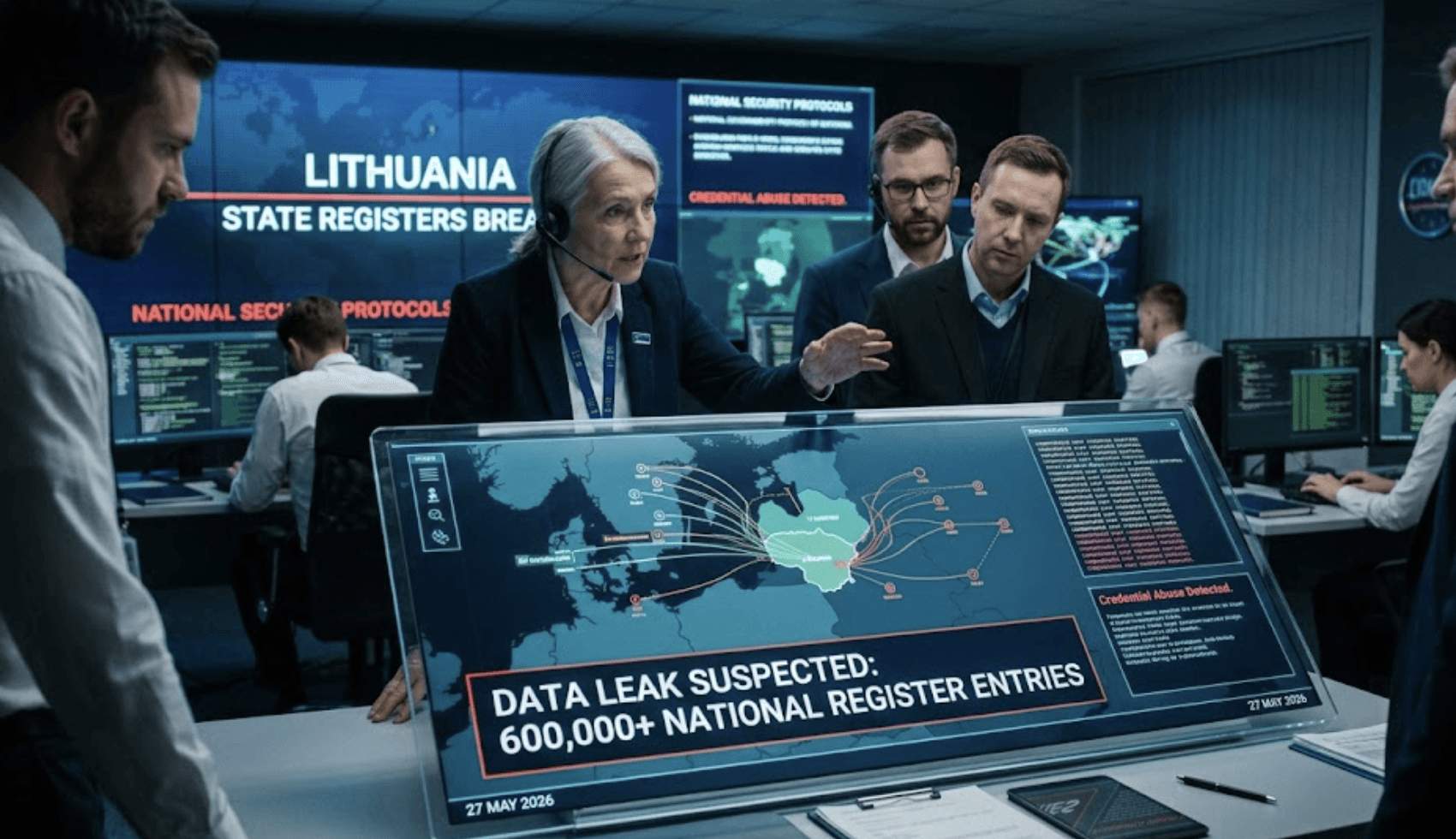
The recent breach of Lithuania’s State Enterprise Centre of Registers, exposing over 600,000 national data entries, represents a significant escalation in state-sponsored cyber operations. While most analysts and media entities have framed this as a standard database leak, a deeper analysis reveals a sophisticated, highly targeted intelligence gathering operation.
This was anything but a brute-force attack or a ransomware exploit. Instead, it was an insidious abuse of trusted citizen and corporate facing infrastructure designed to map out the human and physical topography of a frontline NATO state. When one places this attack in a wider timeline covering Russian cyberattacks on Baltic states, a more sinister pattern of persistence emerges. While initial attacks by Russian state actors were designed to convey a message, attacks now-a-days are to exfiltrate data and use information for secondary attacks and to keep tabs on citizens.
The stolen data could include:
· Corporations,
· Property records,
· Duplicate linked records,
· Historical data,
· Legal entities,
· Metadata objects.
Today’s blogpost is an analytical breakdown of this incident. I have made an attempt to highlight the tactical realities and geopolitical undercurrents that standard analyst and media reporting often overlooks while placing this attack among a series of attacks orchestrated by Russian threat actors over the last decade.
Before we move forward, don’t forget to check out our previous blog post on continuous threat exposure management in industrial environments here.
The operational mechanics: Credential harvest vs. system exploitation
In my opinion, the most telling detail released by the Lithuanian General Prosecutor’s Office is that the perpetrators bypassed the state's security perimeter by using the legitimate login credentials of authorized institutions. This is a trend that must worry cyber defenders everywhere.
The so called "low and slow" collection: This indicates the attackers did not exploit a zero-day software vulnerability. Instead, they likely spent months conducting upstream phishing, session hijacking and purchasing harvested credentials belonging to municipal workers, notary publics, or institutional users who legally access the register daily. They were building a mesh of information on the target over the years. Such levels of patience indicate the level of interest that these state-backed actors had in breaching Lithuania’s State Enterprise Centre of Registers.
The stealth aspect: By masquerading as authorized institutional entities, the attackers minimized anomalous traffic alerts and kept their operations under the radar. Over a period of time, this permitted a massive data harvesting operation impacting 600,000 entries which equates roughly to nearly 20 percent of Lithuania’s total population of 2.9 million to execute quietly before detection. The volume of accessed records suggests large-scale enumeration activity with potentially nationwide intelligence value. This also underscores the level of impact this hack has had on Lithuania.
Strategic targeting: The intersection of corporate and real estate data
Standard data breaches usually target financial data (credit cards), corporate IP, employee data or personally identifiable information (PII) for identity theft. This attack targeted two specific state databases: Real estate and legal entities. We need to pay more attention to this part of this breach.
When one maps this breach against a hostile intelligence service's requirements, this specific combination yields powerful operational results for the hacker:
Operational reconnaissance
As mentioned by opposition politician Laurynas Kasčiūnas, cross-referencing real estate registries allows an adversary to uncover the physical residential addresses of:
Intelligence officers
Military personnel and border guards
Diplomats and key political figures
Land use information
Validation of additional stolen information
By tracking ownership trails, a foreign state actor can construct a precise physical map of Lithuania’s entire state defense apparatus. This information can then be used to build a map of targets that the rogue state can use during times of conflict or even to identify and target a citizen of interest.
There are several dots that such a data can provide. An intelligence agency can then connect the dots and use that information to meet varied objectives.
Corporate and supply chain mapping
By querying the Legal Entities database, the threat actor gains complete a very high level of visibility into beneficial ownership, corporate structures, inter-corporate relationships and domestic logistics networks. Such data sits at the very core of Lithuania’s economic ecosystem.
In a crisis scenario, this data can be used to identify single points of failure in national supply chains, critical infrastructure vendors, and dual-use technology firms. These points can then be targeted to generate economic stress.
Human intelligence (HUMINT) targeting
Knowing what a high-value individual owns, who they are co-signed with, their corporate assets, and their financial liens provides a baseline for blackmail, coercion, and recruitment operations.
The geopolitical crucible: Hybrid warfare on the Baltic frontline
The timing and geographic focus of this incident cannot be separated from the broader kinetic and non-kinetic friction occurring across Europe, specifically the Baltic region.
[Traditional Cybersecurity Breach]
│ (Evolves via geopolitical tension)
▼
[Hybrid Warfare Catalyst] ───► Sabotage, Espionage, & Physical Intimidation
Lithuania has positioned itself as one of the most vocal critics of eastern revisionist powers, making it a primary laboratory for modern hybrid warfare. This leak bridges the gap between the digital and physical domains in three distinct ways:
Synergy with physical sabotage: The Baltic region has recently seen a surge in state-sponsored physical hybrid operations ranging from mysterious GPS jamming and drone provocations near the Belarus border, to orchestrated arson and vandalism across EU capitals. Weaponized registry data turns digital records into physical vulnerabilities, feeding exact location data to kinetic saboteurs on the ground.
The threshold of "gray-zone" aggression: Cyber actions that do not destroy critical infrastructure (like a power grid wipe) fall strictly within the "gray zone." They are designed to degrade national security over time while remaining below the threshold that would trigger a unified NATO Article 5 collective defense response.
Decapitation of trust: The rapid resignation of Adrijus Jusas, head of the State Enterprise Centre of Registers, demonstrates that the attackers achieved a major strategic objective before ever deploying the stolen data: the erosion of institutional trust. Forcing leadership shakeups in key government bodies during a period of high regional tension weakens domestic command stability.
The Russian shadow
While no public attribution has so far conclusively linked the Lithuania registry breach to Moscow, the operation aligns with several strategic patterns historically associated with Russian cyber and hybrid activities across the Baltic region. Over the past two decades, the Baltic states have repeatedly faced cyber-enabled pressure campaigns designed not only to collect intelligence, but also to test political resilience, steal data, undermine institutional trust, and signal strategic reach.
From the distributed denial-of-service attacks against Estonia in 2007 following the Bronze Soldier dispute, to persistent espionage campaigns targeting government, defense, logistics, and energy sectors across Lithuania, Latvia, and Estonia, Russian-linked operations have consistently emphasized long-term intelligence gathering over any immediate disruption. In that context, access to real estate and legal entity registries could support broader objectives such as mapping political and military networks, identifying strategic economic dependencies, enabling influence or recruitment operations, and enhancing situational awareness for future cyber, informational, or physical hybrid activities. The value of such datasets lies not merely in the stolen records themselves, but in their ability to transform fragmented public and institutional information into actionable state intelligence.
The defensive fallout and next steps
The immediate response from Vilnius involved blocking compromised accounts and enforcing mandatory credential resets. This is a necessary stopgap but it only addresses the symptoms.
For a state functioning under constant threat of hybrid warfare, the long-term remediation must shift from passive parameter defense to aggressive, zero-trust infrastructure architecture. Authorized institutional users can no longer be trusted based on valid credentials alone; continuous behaviour monitoring, hardware-bound authentication, and localized data-rate limiting (to prevent bulk scraping) are now mandatory components of frontline national defense.
Additional resources
IEC 62443 - Practical guide for OT/ICS & IIoT security here
Remediation Guides here
Guide to OT Asset Inventory and Device Management for Improved Security here
ICS Security Awareness Training Kit for Operators here
Cyber Risk Management Checklist here
Get Weekly
Resources & News
See How Our Industry-Leading OT Security Solutions Address Critical Security Challenges
You may also like

What the French supermarket cyberattack reveals about OT security
Prayukth K V

Inside the Albert Heijn cyber incident: Investigating the attack, the IT/OT exposure, and the risks to critical operations
Team Shieldworkz

50°C by cyberattack? Inside France’s supermarket refrigeration crisis
Prayukth K V

Automating IEC 62443 Compliance Assessments Without Losing Expert Control
Team Shieldworkz

Investigative cyber threat intelligence report: Daiichi Kosho supply-chain data exposure
Prayukth K V

How AI Is Changing IEC 62443 Assessments
Team Shieldworkz