Team Shieldworkz
Every industrial organization eventually reaches the same realization: the plant floor is no longer isolated. Programmable logic controllers, human-machine interfaces, and supervisory control systems that were once air-gapped from the outside world are now connected, monitored, and, increasingly, targeted. That shift has made operational technology security one of the most urgent conversations happening in boardrooms across manufacturing, energy, utilities, and critical infrastructure sectors.
Amid a landscape crowded with frameworks, checklists, and vendor-specific guidance, one standard has consistently risen above the noise: IEC 62443. It was not designed by a single company or written for a single industry. It was built collaboratively, refined over more than a decade, and shaped by the practical realities of keeping physical processes safe while defending against digital threats.
Before we move forward, don’t forget to read our previous blog post onPreliminary Investigation Report: Data Extortion targeting Kudankulam Nuclear Plant engineering documents here
This Blog breaks down what IEC 62443 actually is, why it has earned its position as the reference standard for industrial cybersecurity, and what practical steps your organization can take to put it to work. Whether you are a plant manager evaluating a new vendor, a CISO building an OT security roadmap, or an engineer trying to make sense of security levels and zones, this is the plain-language explanation you have been looking for.
What makes this particular standard worth your attention is not just its technical depth, but the fact that it was shaped by people who understand what happens when a control system goes down at two in the morning. It treats safety and continuity as first-class priorities rather than an afterthought bolted onto a data-protection checklist, which is precisely why it resonates so strongly with the people responsible for keeping physical operations running.
What Is IEC 62443?
IEC 62443 is a series of international standards developed to secure industrial automation and control systems, commonly referred to as IACS. It was created through a joint effort between the International Society of Automation and the International Electrotechnical Commission, bringing together input from asset owners, system integrators, and equipment manufacturers rather than a single interest group.
Unlike traditional IT security frameworks, which were designed around protecting data confidentiality, IEC 62443 was built specifically around the priorities that matter most on a plant floor: safety, availability, and process integrity. A control system that goes offline unexpectedly does not just create an inconvenience. It can halt production, damage equipment, or in the worst cases, create genuine safety hazards for people working near industrial processes.
Who the Standard Is Written For
One of the reasons IEC 62443 has gained such wide adoption is that it does not speak to just one audience. It defines distinct responsibilities for three groups that must work together to secure an industrial environment:
Asset owners: Organizations that own and operate industrial facilities, responsible for building and maintaining a security management program.
System integrators: Companies that design and deploy control system architecture, responsible for implementing zones, conduits, and technical safeguards during system design.
Product suppliers: Manufacturers of PLCs, HMIs, sensors, and network equipment, responsible for building security into products through a secure development lifecycle.
This shared structure is deliberate. Industrial cybersecurity fails most often at the seams, where an operator assumes a vendor handled something, or a vendor assumes the integrator configured a device correctly. IEC 62443 closes those gaps by giving every party a defined role and a common vocabulary.
Key Terminology Every OT Security Leader Should Know
Before going further, it helps to establish a shared vocabulary. Conversations about IEC 62443 often stall simply because teams are using the same words to mean different things. The definitions below reflect how these terms are used within the standard itself.
Zone: A grouping of assets that share similar security requirements and risk levels, treated as a single unit for security purposes.
Conduit: A pathway that connects two zones, through which all traffic must pass and can therefore be inspected, restricted, or blocked.
IACS: The industrial automation and control systems that make up a facility's operational environment, including PLCs, HMIs, sensors, and supervisory systems.
Security Level (SL): A rating from SL 0 to SL 4 describing the degree of protection a zone, system, or component provides against a defined class of adversary.
Secure Development Lifecycle (SDLC): A structured process for designing, developing, and maintaining products with security considerations built in from the start rather than added afterward.
With these terms in place, the rest of the standard becomes far easier to navigate, whether you are reading a vendor's compliance documentation or briefing your leadership team on a proposed security investment.
The Structure of the IEC 62443 Framework
The standard is organized into four main parts, each addressing a different layer of responsibility. Understanding this structure makes it much easier to know which sections are relevant to your role and where to focus your time.
Series | Focus Area | What It Covers |
62443-1 | General | Common terminology, concepts, and the overall security model used across the standard |
62443-2 | Policies & Procedures | Requirements for building and running a security management program at the asset-owner level |
62443-3 | System | Requirements for designing secure systems, including zone and conduit segmentation and target security levels |
62443-4 | Component | Secure development lifecycle and technical requirements for products built by automation vendors |
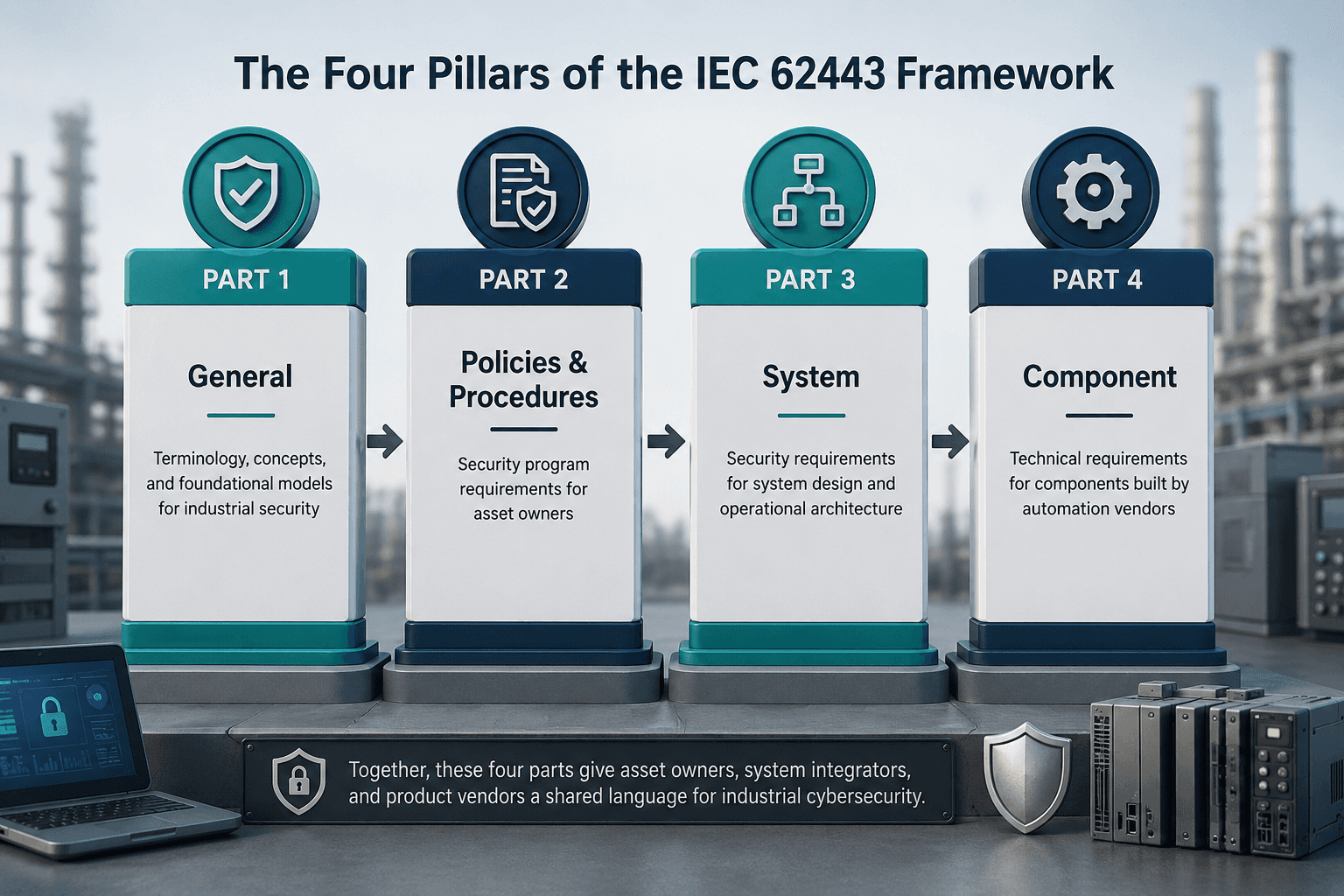
The four parts of IEC 62443 work together across governance, system design, and product security.
This layered approach means an organization does not have to tackle everything at once. A plant manager might start with the policy and procedure requirements to establish governance, while a system integrator focuses on the system-level requirements during a network redesign, and a supplier works through the component requirements as part of product certification.
Zones and Conduits: The Segmentation Model That Sets IEC 62443 Apart
If there is one concept from IEC 62443 that has changed how industrial networks are architected, it is the zone and conduit model. Rather than treating a facility's network as one flat, trusted environment, the standard requires assets to be grouped into zones based on shared risk and function, with every connection between zones treated as a conduit that must be actively controlled.
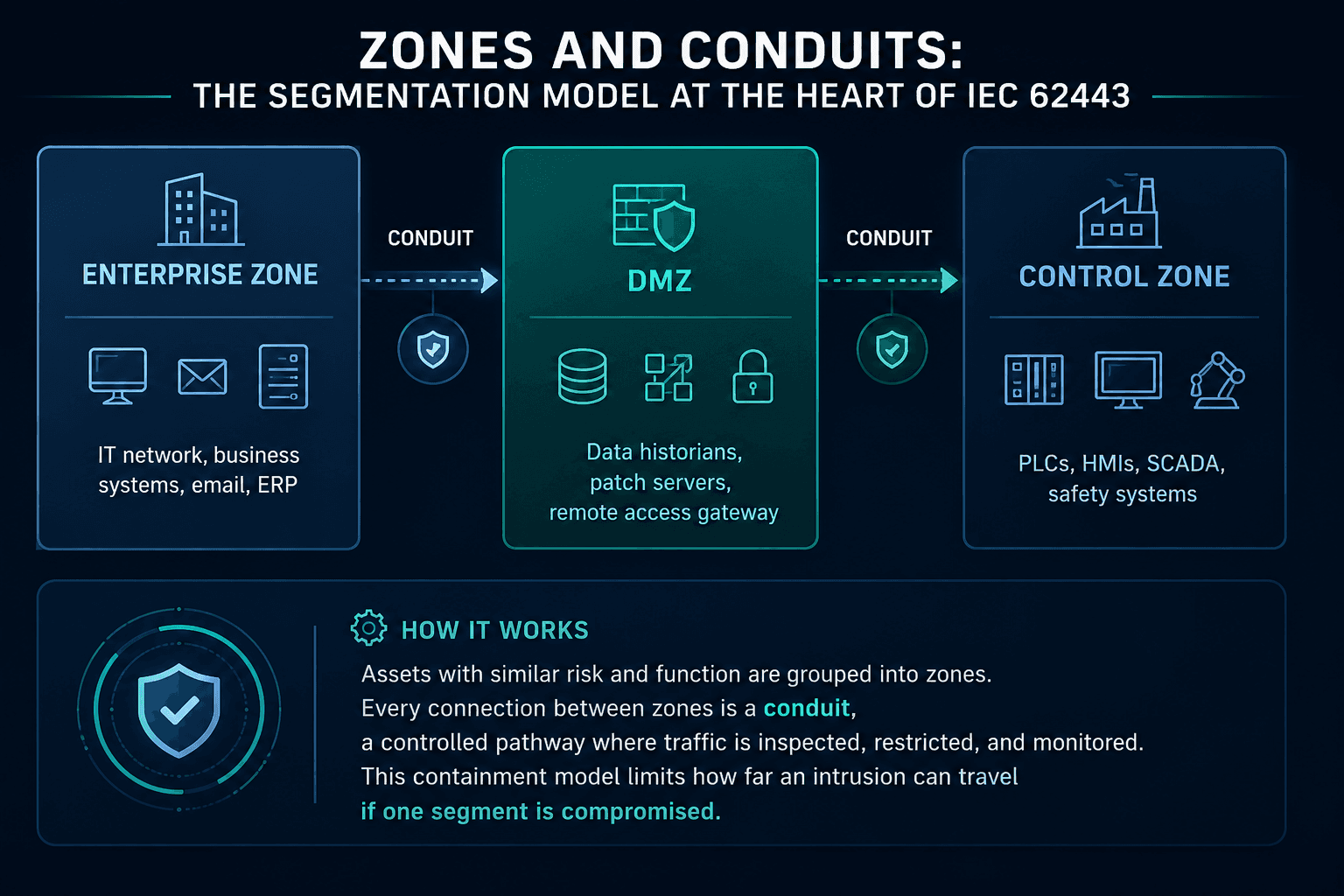
A simplified view of how enterprise, DMZ, and control zones are separated and connected through monitored conduits.
This model mirrors how many serious industrial incidents actually unfold. An attacker rarely breaches a control system directly. Far more often, the initial entry point is a business network, a remote access tool, or a vendor connection, and the intrusion moves laterally until it reaches something critical. Zones and conduits are designed to interrupt exactly that kind of lateral movement, containing an incident to a small segment instead of allowing it to spread across an entire facility.
The goal of segmentation is not to make a facility impenetrable. It is to make sure that if something does get in, it cannot get everywhere.
Security Levels: Matching Protection to Real-World Risk
Not every asset in a facility carries the same level of risk, and IEC 62443 recognizes that by defining five security levels, from SL 0 to SL 4. Each level corresponds to the sophistication and motivation of the adversary a zone is expected to withstand, which allows organizations to apply stronger protection where it is genuinely needed instead of spreading resources evenly across systems that do not carry equal risk.

Security levels scale from no specific protection at SL 0 to defense against highly resourced, motivated adversaries at SL 4.
A useful way to think about security levels is in three categories: the target level an organization wants to achieve for a given zone, the capability level a product or system was designed to support, and the achieved level that reflects what has actually been implemented and verified. Gaps between these three numbers are often where real vulnerabilities hide, and closing them is one of the most valuable exercises a security team can undertake.
Why IEC 62443 Has Become the Global Benchmark
Industrial organizations have no shortage of frameworks to choose from, yet IEC 62443 has become the reference point that others are frequently measured against. Part of that credibility comes from how the standard was built: through years of iterative input from the people who actually operate, integrate, and manufacture industrial systems, rather than a top-down mandate written without frontline experience. A few specific reasons explain why it continues to pull ahead of alternative approaches.
It Was Built for Operational Reality, Not Adapted From IT
Many early attempts at industrial security simply borrowed IT frameworks and applied them to the plant floor. The problem is that OT environments operate under different constraints. A control system may need to run continuously for years without a reboot, use legacy protocols with no built-in encryption, and prioritize uptime above all else. IEC 62443 was written with those realities in mind from the start, rather than retrofitted onto them.
It Creates a Common Language Across the Supply Chain
Before a shared standard existed, asset owners had no consistent way to evaluate whether a vendor's equipment was secure by design. Every supplier described their own security posture differently, making comparisons nearly impossible. IEC 62443 gives procurement teams concrete, testable requirements to reference in contracts and requests for proposals, which shifts security from a vague promise to a measurable expectation.
It Is Internationally Recognized and Sector-Neutral
Because it was developed through an international standards body rather than a single national regulator or industry association, IEC 62443 applies cleanly across manufacturing, energy, water, transportation, and other critical infrastructure sectors. Multinational organizations in particular benefit from having one framework that translates across facilities in different countries, rather than juggling a patchwork of regional requirements.
It Is Increasingly Referenced by Regulators and Insurers
Across multiple regions, regulatory guidance and cybersecurity insurance underwriting have begun pointing directly to IEC 62443 as an accepted baseline for demonstrating due diligence. That trend is likely to accelerate as critical infrastructure protection becomes a higher priority for governments worldwide, making early alignment a strategic advantage rather than a compliance afterthought.
Real-World Incidents That Show Why the Standard Matters
Abstract frameworks can be easy to dismiss until they are placed next to what has actually happened inside industrial environments. The past fifteen years have produced several incidents that illustrate exactly the failure points IEC 62443 was designed to address.
Malware Designed to Manipulate Physical Processes
In 2010, security researchers uncovered a piece of malware that had been engineered specifically to target industrial control equipment used in uranium enrichment, subtly altering the speed of centrifuges while reporting normal readings to operators. It was one of the first widely documented cases of malicious code built to manipulate a physical process rather than simply steal or corrupt data, and it fundamentally changed how the industry thought about OT-specific threats.
Coordinated Attacks on Power Grid Infrastructure
In the mid-2010s, attackers successfully caused power outages affecting hundreds of thousands of customers by compromising the control systems of regional power distribution companies. The attackers had spent months inside the network before taking action, using remote access tools and stolen credentials to eventually seize control of substation breakers. The incident underscored how a lack of network segmentation and monitored remote access can allow an intrusion to sit undetected until it results in real, physical consequences.
Malware Targeting Safety Instrumented Systems
In 2017, researchers identified malware that had specifically targeted the safety instrumented systems at a petrochemical facility, the very systems designed as a last line of defense to prevent catastrophic equipment failure. The malware attempted to reprogram safety controllers, and while the attack was ultimately detected before causing physical harm, it demonstrated that adversaries were willing and able to target the systems responsible for protecting human life, not just production output.
Ransomware Reaching Beyond IT Into Operations
More recently, ransomware attacks against a major fuel pipeline operator and a global aluminum producer forced both organizations to shut down operational systems as a precaution, even though the initial infection occurred on the IT side of the business. These events made clear that OT does not need to be directly breached to be affected. Weak separation between IT and OT networks means an IT-focused attack can still force an operational shutdown out of caution alone, causing significant financial and reputational damage.
Each of these incidents traces back to a gap that IEC 62443 was specifically designed to close: unsegmented networks, unmanaged remote access, unverified vendor equipment, or an absent security governance program.
The Business Impact of Ignoring Industrial Cybersecurity Standards
For many executives, the case for IEC 62443 becomes clearest when framed in terms of business consequences rather than technical detail. The table below outlines how alignment with the standard changes outcomes across several areas that matter directly to leadership.
Risk Area | Without IEC 62443 Alignment | With IEC 62443 Alignment |
Production continuity | Unplanned shutdowns from unsegmented networks and unmanaged access | Contained incidents, faster isolation, minimal downtime |
Vendor accountability | No consistent baseline to evaluate supplier security posture | Clear, measurable requirements built into procurement |
Insurance & compliance | Difficulty demonstrating due diligence to insurers and regulators | Documented, auditable evidence of a structured security program |
Incident response | Ad hoc response, unclear ownership between IT and OT | Defined roles, tested procedures, faster recovery |
M&A and investment | Security gaps surface late and reduce deal value | Security posture becomes a demonstrable asset |
The financial impact of an OT security incident is rarely limited to the direct cost of remediation. Production downtime, contractual penalties for missed deliveries, regulatory scrutiny, and long-term reputational damage with customers and partners often outweigh the cost of the incident itself. Organizations that can point to a structured, standards-based security program are consistently better positioned to manage all of these downstream consequences.
Practical Recommendations for Implementing IEC 62443
Adopting IEC 62443 does not need to happen all at once, and attempting a full-scale implementation without a plan is one of the most common reasons initiatives stall. The following approach reflects how successful organizations typically sequence their work.
1. Start With an Honest Asset Inventory
It is impossible to secure what has not been identified. Many facilities are surprised to discover forgotten devices, undocumented remote access points, or legacy systems still running on the network during their first comprehensive inventory. This step alone often surfaces the most urgent risks.
2. Conduct a Risk Assessment Before Defining Target Security Levels
Rather than applying the highest security level everywhere, assess which assets would cause the most operational, safety, or financial harm if compromised. This informs realistic target security levels for each zone and prevents resources from being spread too thin across low-risk areas.
3. Design Zones and Conduits Around Actual Operations
Segmentation should reflect how the facility actually functions, not a generic template. Involve engineers who understand the process, not just the network, when designing zone boundaries, since a poorly placed conduit can disrupt legitimate operations as easily as it blocks an attacker.
4. Build Vendor Requirements Into Procurement
Reference specific component-level requirements in requests for proposals and contracts. This shifts security conversations with suppliers from informal assurances to documented, verifiable commitments before equipment ever reaches the plant floor.
5. Establish Governance Before Adding More Technology
Policies, roles, and incident response procedures often deliver more risk reduction per dollar spent than additional security tools. A clearly defined governance structure ensures that technology investments are actually used effectively rather than left misconfigured or unmonitored.
6. Treat Implementation as Continuous, Not a One-Time Project
Threats, assets, and business priorities all change over time. Organizations that treat IEC 62443 alignment as an ongoing program, with periodic reassessment and updates, consistently maintain stronger security postures than those that treat it as a single project with a defined end date.
Common Challenges Organizations Face Along the Way
Even with a clear roadmap, most organizations encounter a similar set of obstacles during implementation. Recognizing these challenges early makes it far easier to plan around them instead of being caught off guard midway through a project.
Legacy equipment constraints: Facilities often run equipment with limited processing power and outdated protocols that were never designed to support modern security controls, requiring compensating measures rather than direct upgrades.
Misalignment between IT and OT teams: Security, engineering, and operations teams often use different terminology and have different priorities, which can slow decision-making if not addressed early with a shared framework.
Underestimating the scope of change: Full implementation is rarely completed in a single budget cycle, and organizations that try to do everything at once frequently lose momentum partway through.
Limited internal OT security expertise: Skilled OT security professionals remain in short supply relative to demand, making external expertise valuable for organizations building their programs from the ground up.
None of these challenges are reasons to delay getting started. They are simply factors to plan around, and organizations that anticipate them from the outset tend to move through implementation with far fewer setbacks than those that discover them midway through a project.
How Shieldworkz Supports Organizations
Navigating IEC 62443 alignment on your own can feel overwhelming, particularly for teams balancing security priorities against daily operational demands. Shieldworkz works alongside industrial organizations to translate the standard into a practical, achievable roadmap tailored to each facility's specific environment.
OT security assessments: Comprehensive evaluations of existing OT and ICS environments to identify gaps against IEC 62443 requirements and prioritize the risks that matter most.
Zone and conduit architecture design: Practical guidance on grouping assets, defining zone boundaries, and implementing conduits that reflect real operational workflows rather than generic templates.
Security level planning: Support in determining realistic target security levels for each zone based on genuine risk, and a clear path toward achieving them.
Governance and policy development: Development of security policies, procedures, and incident response plans aligned with the governance requirements outlined in the standard.
Ongoing monitoring and threat detection: Continuous visibility into industrial networks to detect anomalies, unauthorized devices, and emerging threats before they escalate.
Vendor and supply chain risk support: Guidance for evaluating vendor and supplier security postures against component-level requirements before procurement decisions are finalized.
Every facility's path to alignment looks different, and Shieldworkz builds each engagement around the operational realities, budget constraints, and risk priorities that matter most to your organization, not a one-size-fits-all checklist.
Frequently Asked Questions About IEC 62443
1.Is IEC 62443 mandatory, or is it voluntary guidance?
In most regions, IEC 62443 itself is a voluntary, consensus-based standard rather than a legal mandate. However, an increasing number of national regulations, sector-specific directives, and insurance underwriting requirements now reference it directly or expect organizations to demonstrate an equivalent level of security maturity. Even where it is not explicitly required, it has effectively become the default expectation across many industrial sectors.
2.How long does it typically take to align with the standard?
There is no fixed timeline, since it depends heavily on the size of the facility, the age of existing infrastructure, and how mature the current security program already is. Most organizations approach it as a multi-phase journey spanning one to three years rather than a single project, starting with governance and high-risk zones before expanding coverage across the full environment.
3.Do we need to achieve the highest security level everywhere?
No, and attempting to do so is usually not a practical use of resources. The standard is explicitly designed around risk-based differentiation, meaning a low-risk business zone might only need SL 1, while a zone containing safety instrumented systems might warrant SL 3 or SL 4. The goal is proportionate protection, not uniform maximum protection.
4.Can existing legacy equipment still be secured under this framework?
Yes. IEC 62443 does not assume every facility will replace its legacy equipment. Where devices cannot support modern security controls directly, the standard supports compensating measures, such as network segmentation, monitoring, and restricted access, that reduce risk around the asset even when the asset itself cannot be modified.
5.How does this standard relate to broader IT security frameworks?
IEC 62443 is designed to complement, not replace, enterprise IT security practices. Many organizations map it alongside their existing IT governance frameworks, using IEC 62443 specifically for the operational technology environment where safety, availability, and real-time process control take priority over the confidentiality-first approach common in traditional IT security.
Conclusion
IEC 62443 did not become the leading OT cybersecurity standard by accident. It earned that position by addressing the specific realities of industrial environments, creating a shared language across asset owners, integrators, and vendors, and offering a structured, scalable path toward genuine risk reduction rather than a generic checklist borrowed from IT.
For organizations operating critical infrastructure, manufacturing plants, or any environment where digital systems control physical processes, alignment with this standard is no longer a forward-looking initiative. It is becoming an operational and business necessity, one that regulators, insurers, and business partners increasingly expect to see in place.
The path there does not have to be complicated, and it does not have to happen overnight. It starts with an honest look at where your organization stands today and a clear plan for closing the gaps that matter most.
Ready to Strengthen Your OT Security Posture?
Every industrial environment carries its own risks, priorities, and constraints. Our team can help you understand exactly where your organization stands against IEC 62443 and what a realistic path forward looks like.
Book a Free Consultation with Our Experts
Additional resources
IEC 62443 - Practical guide for OT/ICS & IIoT security here
Remediation Guides here
Guide to OT Asset Inventory and Device Management for Improved Security here
ICS Security Awareness Training Kit for Operators here
Cyber Risk Management Checklist here
Get Weekly
Resources & News
See How Our Industry-Leading OT Security Solutions Address Critical Security Challenges
You may also like

What the French supermarket cyberattack reveals about OT security
Prayukth K V

Inside the Albert Heijn cyber incident: Investigating the attack, the IT/OT exposure, and the risks to critical operations
Team Shieldworkz

50°C by cyberattack? Inside France’s supermarket refrigeration crisis
Prayukth K V

Automating IEC 62443 Compliance Assessments Without Losing Expert Control
Team Shieldworkz

Investigative cyber threat intelligence report: Daiichi Kosho supply-chain data exposure
Prayukth K V

How AI Is Changing IEC 62443 Assessments
Team Shieldworkz