
Team Shieldworkz
For decades, the electric power industry built its cybersecurity programs around a simple idea: keep the perimeter strong, and the inside stays safe. Firewalls, demilitarized zones, and access control lists formed the backbone of that strategy. It worked reasonably well when operational technology networks were isolated and communication paths were predictable.
That assumption no longer holds. Attackers who breach a single remote access point, a vendor connection, or a compromised engineering laptop can now move quietly inside a network that was never designed to watch itself. This is precisely the gap that NERC CIP-015-1 was created to close, and it marks one of the most consequential shifts in critical infrastructure cybersecurity regulation in recent years.
For OT security leaders, plant managers, and CISOs across the energy and utilities sector, CIP-015-1 is not simply another compliance checkbox. It represents a fundamental change in how internal network activity must be observed, evaluated, and acted upon. This guide breaks down what the standard requires, why it exists, and how organizations can build a vulnerability management strategy that satisfies both the letter of the regulation and the operational realities of running industrial systems.
Understanding NERC CIP-015-1: What Changed and Why It Matters
CIP-015-1, formally titled Cyber Security, Internal Network Security Monitoring, was adopted by the NERC Board of Trustees after the Federal Energy Regulatory Commission directed the development of new requirements for monitoring activity inside trusted network zones. The Federal Energy Regulatory Commission formally approved the standard in mid-2025, and it became effective on September 2, 2025, setting in motion a phased compliance timeline that continues through the end of the decade.
At its core, the standard requires responsible entities to implement internal network security monitoring, commonly referred to as INSM, for high-impact bulk electric system cyber systems and medium-impact systems with external routable connectivity. Unlike earlier CIP standards that concentrated heavily on perimeter defense, electronic security perimeters, and access control, CIP-015-1 focuses on what happens after a boundary has already been crossed, whether through a compromised credential, a supply chain foothold, or an insider mistake.
From Perimeter Defense to Internal Visibility
The logic behind this shift is straightforward once you consider how modern intrusions actually unfold. Sophisticated threat actors rarely announce themselves at the firewall. They land quietly, study the environment, escalate privileges, and move laterally toward systems that control physical processes. Traditional perimeter tools have very limited visibility into that internal movement because they were never built to monitor traffic between trusted systems inside an electronic security perimeter.
CIP-015-1 addresses this blind spot directly. It requires organizations to deploy monitoring capabilities that can observe communication between systems inside the protected zone, establish a baseline of what normal activity looks like, and flag deviations that could indicate compromise. This is a meaningful operational shift for teams that have historically treated the inside of the network as a trusted, low-scrutiny zone.
Who Must Comply and By When
The compliance timeline for CIP-015-1 is phased, giving entities time to plan, budget, and deploy monitoring infrastructure without disrupting operational continuity. The table below summarizes the key milestones every OT security leader in the electric sector should track closely.
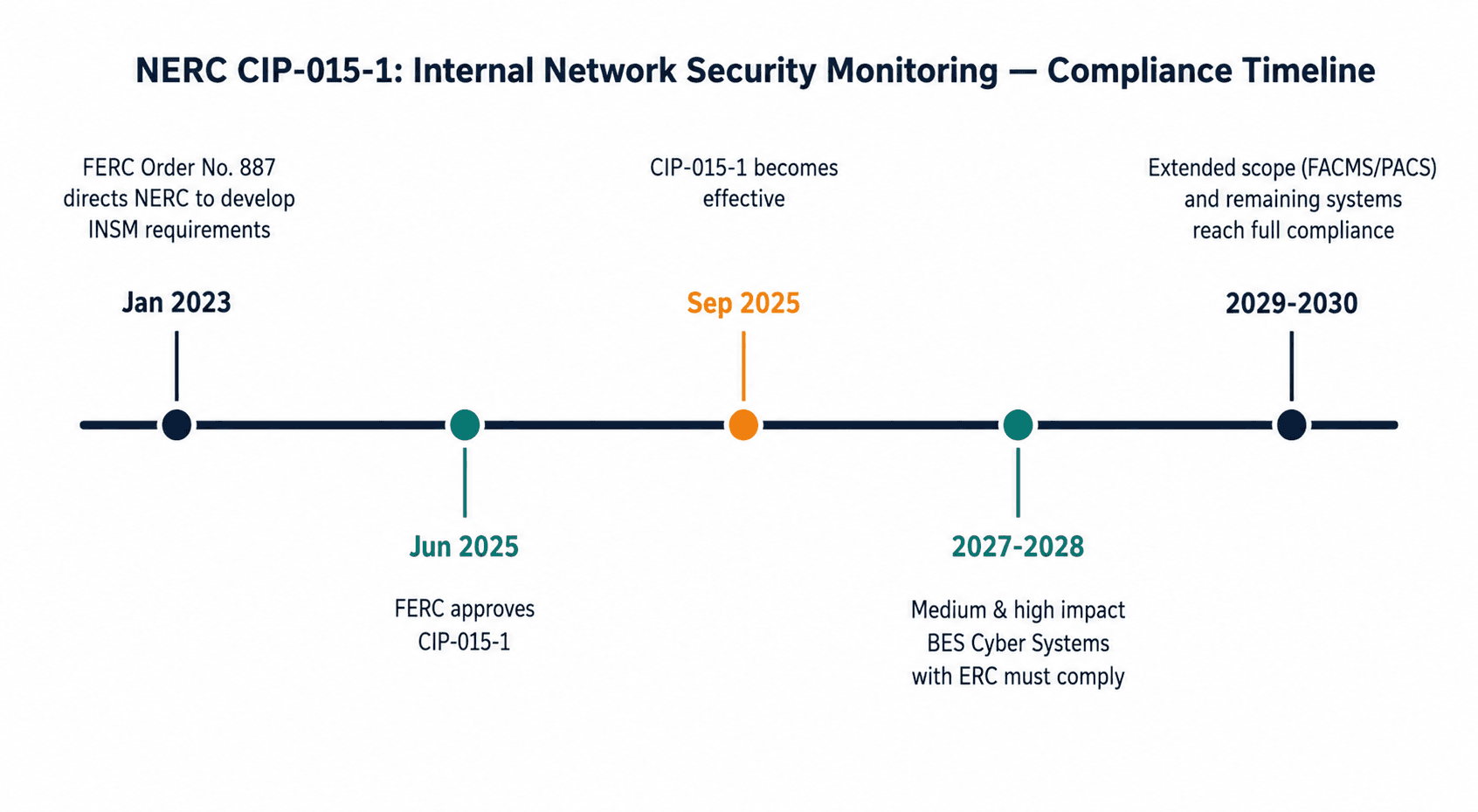
Figure 1: NERC CIP-015-1 phased compliance timeline, from FERC's original directive through full implementation.
Milestone | Date | What It Means for Your Organization |
FERC directive issued | January 2023 | Regulatory groundwork laid for internal network monitoring requirements |
CIP-015-1 approved | Mid-2025 | Standard formally adopted, giving entities a defined roadmap |
Standard becomes effective | September 2, 2025 | Compliance clock begins; planning and budgeting should already be underway |
Medium and high-impact systems with external routable connectivity | 2027–2028 | First wave of mandatory INSM deployment for the highest-risk systems |
Extended scope and remaining systems | 2029–2030 | Full compliance, including anticipated expansion to access control and monitoring systems |
Even though some deadlines appear several years out, the scale of work involved, ranging from asset inventory gaps to sensor placement decisions to staffing considerations, means that organizations waiting until the deadline approaches will likely find themselves compressed for time. Early movers gain a meaningful advantage, both in avoiding compliance penalties and in genuinely reducing risk sooner.
The Real-World Risk Landscape Driving CIP-015-1
Regulations rarely emerge in a vacuum, and CIP-015-1 is no exception. It reflects lessons learned from a string of incidents that exposed just how vulnerable internal OT networks can be once an attacker gains a foothold.
Consider the attacks on Ukraine's power grid in 2015 and again in 2016. In both cases, attackers did not need to breach hardened perimeter defenses through brute force. They gained access through spear-phishing and stolen credentials, then spent weeks moving quietly through internal systems, learning how the grid operators worked before executing a coordinated shutdown that cut power to hundreds of thousands of customers. The attackers succeeded not because perimeter security failed outright, but because nothing inside the network was watching for their lateral movement.
A different but equally instructive example is the 2021 ransomware event that forced a major fuel pipeline operator to shut down operations across the eastern United States. While the initial compromise involved a single exposed credential on a remote access system, the business impact rippled far beyond the point of entry, disrupting fuel supply for millions of people and demonstrating how quickly a contained IT issue can cascade into a real-world operational crisis when segmentation and internal visibility are insufficient.
More recently, threat intelligence disclosures from national cybersecurity agencies have detailed the activity of state-linked actors, publicly referred to under names such as Volt Typhoon, pre-positioning themselves inside critical infrastructure networks in the United States. Investigators found that these actors prioritized staying hidden, using legitimate system tools rather than obvious malware, specifically to avoid detection by traditional monitoring. Their goal appeared to be establishing persistent access that could be activated during a future geopolitical crisis, rather than causing immediate disruption.
These examples share a common thread: the most damaging intrusions rarely happen in a single dramatic moment. They unfold gradually, inside networks that lacked the visibility to notice something was wrong until the consequences were already unfolding.
The business impact of this blind spot extends well beyond the immediate cost of incident response. When a control system outage forces a manufacturing line to halt, the losses compound quickly: idle labor, missed delivery commitments, contractual penalties, and in some cases, safety incidents that trigger regulatory investigations of their own. For utilities specifically, extended outages carry the added weight of public trust, regulatory scrutiny, and in severe cases, congressional attention. Insurance carriers have also grown more discerning, increasingly asking pointed questions about internal network visibility before underwriting cyber liability coverage for industrial operators. In that sense, CIP-015-1 compliance is quietly becoming a factor in conversations that have nothing to do with NERC audits at all.
It is also worth noting that OT-targeted threats are not limited to headline-grabbing nation-state campaigns. Ransomware groups have increasingly built OT-aware capabilities into their toolkits, understanding that the operational pressure to restore production quickly makes industrial victims more likely to pay. A monitoring gap that might only expose an IT organization to data theft can expose an OT organization to safety risk, environmental consequences, and physical damage to equipment that takes months to replace.
Why Perimeter-Only Security Fails in OT Environments
Operational technology environments carry unique characteristics that make perimeter-only defense particularly risky.
Long equipment lifecycles. Programmable logic controllers, human-machine interfaces, and SCADA systems often remain in service for fifteen to twenty-five years, frequently running on outdated operating systems that cannot be patched without risking process disruption.
Limited tolerance for downtime. Unlike IT systems, OT assets often control physical processes such as turbines, valves, and switchgear. Taking a system offline for a security update can carry safety and production consequences that IT teams rarely face.
Flat network architectures. Many industrial networks were designed decades ago, before segmentation best practices matured, meaning a single compromised device can often communicate freely with critical control systems.
Vendor and third-party access. Maintenance contractors, equipment vendors, and remote support providers frequently require access to OT systems, each connection representing a potential entry point that perimeter tools may not fully account for.
Convergence with IT networks. As enterprises increasingly connect OT systems to IT networks for efficiency and data analytics, the attack surface expands, and traditional boundaries blur.
The Vulnerability Management Gap in Legacy ICS Networks
Vulnerability management in traditional IT environments typically follows a well-established rhythm: scan, identify, patch, verify. OT environments break that rhythm at nearly every step.
Many industrial control systems cannot tolerate active scanning, since older PLCs and RTUs may crash or behave unpredictably when probed with standard IT vulnerability scanners. Patching windows are often limited to scheduled maintenance periods that occur only a few times a year. Asset inventories in many plants are incomplete, undocumented, or exist only in the institutional memory of long-tenured engineers. When you combine these constraints with the internal monitoring requirements introduced by CIP-015-1, it becomes clear why so many organizations are re-evaluating their entire approach to OT vulnerability management rather than simply adding a new tool.
Core Components of a NERC CIP-015-1 Vulnerability Management Strategy
Meeting the intent of CIP-015-1, not just the letter of it, requires organizations to build a strategy around several interconnected pillars.
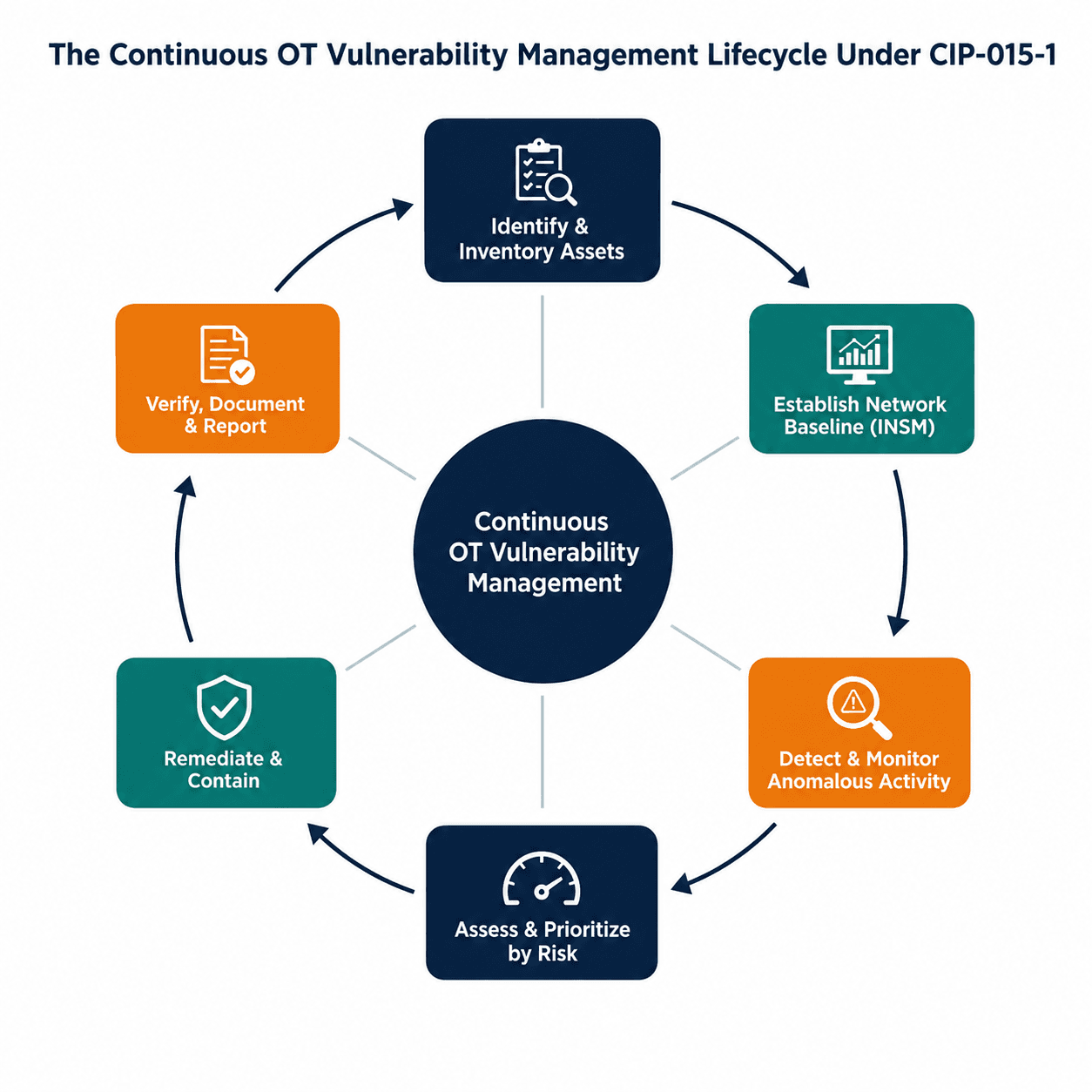
Figure 2: The continuous OT vulnerability management lifecycle underpinning a CIP-015-1-aligned program.
Asset Visibility and Network Baselining
You cannot monitor what you cannot see, and you cannot detect anomalies without first understanding what normal looks like. A comprehensive, continuously updated asset inventory forms the foundation of any credible vulnerability management program. This includes not only PLCs, RTUs, and HMIs, but also the switches, firewalls, and communication links connecting them.
Once assets are catalogued, establishing a network communication baseline becomes the next critical step. This means understanding which systems normally talk to each other, what protocols they use, what times of day traffic patterns shift, and what constitutes an unusual connection attempt. Without this baseline, internal monitoring tools generate noise rather than actionable intelligence.
Continuous Internal Monitoring (INSM)
Internal network security monitoring is the operational heart of CIP-015-1. Rather than relying solely on signature-based detection, effective INSM programs use behavioral analysis to flag deviations from established baselines, such as a device communicating with a system it has never interacted with before, or a spike in traffic volume during off-hours.
The goal is not to generate an alert for every anomaly, since that quickly leads to fatigue and disengagement from security teams. The goal is to build a monitoring capability that distinguishes between benign changes, such as a scheduled maintenance activity, and genuinely suspicious behavior that warrants investigation.
Risk-Based Vulnerability Prioritization
Not every vulnerability deserves the same level of urgency, and OT environments in particular demand a risk-based approach rather than a purely severity-score-driven one. A vulnerability affecting a non-critical historian server carries a different risk profile than one affecting a safety instrumented system controlling a pressure relief valve.
Effective prioritization weighs several factors together: the criticality of the affected asset to safety and production, the exploitability of the vulnerability in the specific OT context, the presence of compensating controls such as segmentation or monitoring, and the realistic remediation timeline given maintenance windows. This approach ensures limited engineering and security resources are directed where they matter most.
Evidence and Documentation for Audit Readiness
CIP-015-1 places significant emphasis on documented processes, meaning organizations must be able to demonstrate, with evidence, how they identify anomalous activity, how they retain monitoring data, and how they protect that data from tampering or unauthorized access. Building documentation practices into daily operations, rather than treating them as a pre-audit scramble, saves considerable time and reduces compliance risk when NERC audits occur.
NERC CIP-015-1 Incident Response Planning: Bridging Detection and Action
Detection without a clear response plan creates a false sense of security. Once internal monitoring identifies anomalous activity, organizations need a defined path from alert to resolution, one that accounts for the operational sensitivities unique to industrial environments.
Building an OT-Specific Incident Response Playbook
A generic IT incident response plan rarely translates well to OT environments. Effective playbooks for industrial settings need to address questions that IT-focused plans typically overlook: Can the affected system be isolated without disrupting a physical process? Who has the authority to make that call at two in the morning? What is the safe shutdown procedure if isolation is necessary?
A strong OT incident response plan clearly defines escalation paths, designates decision-making authority for both cybersecurity and operational leadership, and includes pre-approved containment actions that plant personnel can execute without waiting for lengthy approval chains during a live event.
Coordinating IT and OT Response Teams
One of the most consistent challenges organizations face is the cultural and procedural gap between IT security teams and OT engineering teams. IT teams are trained to prioritize confidentiality and rapid isolation. OT teams are trained to prioritize safety and continuity of physical processes. Neither instinct is wrong, but without deliberate coordination, they can work against each other during an actual incident.
Regular joint tabletop exercises, shared terminology, and clearly documented roles help bridge this gap before a real event forces teams to figure it out under pressure. Organizations that invest in this coordination well ahead of an incident consistently respond faster and with fewer costly missteps than those relying on improvised coordination in the moment.
Practical Recommendations and Best Practices
Building a CIP-015-1-aligned vulnerability management strategy does not need to feel overwhelming if approached methodically. The following practices reflect what has consistently worked across industrial environments preparing for this standard.
Best Practice | Why It Matters |
Start with a full, verified asset inventory | Every subsequent monitoring and prioritization decision depends on knowing exactly what exists on the network |
Deploy passive monitoring before active scanning | Reduces the risk of disrupting sensitive legacy equipment while still building visibility |
Establish baselines during a representative operating period | Baselines built during unusual conditions, such as planned outages, can distort what counts as normal |
Align monitoring data retention with audit requirements | Prevents gaps in evidence that could create compliance exposure during a NERC audit |
Integrate OT monitoring with existing SOC workflows | Avoids creating a disconnected monitoring silo that nobody consistently reviews |
Conduct joint IT and OT tabletop exercises quarterly | Builds response muscle memory and clarifies decision authority before a real incident occurs |
Prioritize vulnerabilities by operational impact, not just CVSS score | Ensures limited remediation resources address the risks that matter most to safety and reliability |
Document every monitoring and response process as it is built | Reduces last-minute compliance scrambling and strengthens audit readiness continuously |
Beyond these specific practices, a few broader principles consistently separate organizations that manage this transition smoothly from those that struggle:
Treat CIP-015-1 compliance as an opportunity to mature your overall security posture, not merely a regulatory obligation to satisfy at minimum cost.
Involve plant operations leadership early in monitoring deployment decisions, since their buy-in determines whether new tools are embraced or quietly worked around.
Budget for the ongoing analyst time required to review monitoring alerts, since deploying sensors without adequate staffing to interpret their output undermines the entire program.
Revisit and refine baselines periodically, since OT environments evolve as equipment is upgraded, replaced, or reconfigured.
The Role of Threat Intelligence in Strengthening CIP-015-1 Programs
Internal monitoring becomes exponentially more valuable when it is informed by relevant threat intelligence. Knowing that a particular malware family targets specific PLC firmware, or that a threat actor group has recently shifted tactics toward exploiting remote access software common in the energy sector, allows security teams to tune their monitoring and prioritize their vulnerability remediation with far greater precision.
Turning Generic Intelligence Into Operational Value
Many organizations subscribe to threat intelligence feeds but struggle to translate that information into action. A report describing a new attack technique is only useful if someone maps it against your specific asset inventory and determines whether your environment is actually exposed. This mapping exercise, connecting external intelligence to internal asset and network context, is where many vulnerability management programs fall short.
Contextualize, don't just collect. Raw intelligence feeds generate volume without value unless someone actively correlates them against your specific OT asset inventory and network baseline.
Prioritize sector-specific sources. Intelligence focused on energy, utilities, and manufacturing threat actors will consistently deliver more relevant signal than broad, industry-agnostic feeds.
Feed intelligence back into monitoring rules. When a new indicator of compromise or tactic emerges, your internal monitoring baseline and alert logic should be updated to reflect it, rather than treating intelligence and monitoring as separate workstreams.
Share findings across the sector where appropriate. Information-sharing organizations dedicated to the electricity sector exist precisely because coordinated awareness benefits every participant, not just the organization that first identifies a threat.
When threat intelligence, internal monitoring, and vulnerability prioritization work together as a connected system rather than three separate initiatives, organizations gain the ability to anticipate risk rather than simply react to it after detection.
Common Challenges Organizations Face During Implementation
Even well-resourced organizations encounter friction when implementing internal network monitoring across OT environments. Recognizing these challenges early allows leaders to plan around them rather than being caught off guard.
Legacy protocol diversity is often the first hurdle. Many industrial networks run a mix of proprietary and open protocols developed decades ago, some of which were never designed with security monitoring in mind. Selecting monitoring capabilities that can interpret this protocol diversity without requiring wholesale equipment replacement is essential to a realistic implementation timeline.
Staffing and expertise represent a second consistent challenge. Skilled OT security professionals who understand both industrial processes and cybersecurity principles remain in short supply across the industry. Many organizations find that the fastest path forward involves partnering with experienced specialists who can supplement internal teams during the initial deployment and tuning phase, rather than attempting to build every capability from scratch internally.
Finally, alert fatigue deserves particular attention. Deploying monitoring is only half the equation; interpreting its output in a way that highlights genuine risk without overwhelming security teams with noise requires careful tuning, contextual awareness of plant operations, and often, iterative refinement over the first several months of deployment.
Budget justification presents a fourth, less technical but equally real challenge. Internal network monitoring requires capital investment in sensors, software, and often, network infrastructure upgrades to support data collection at the necessary points. Security leaders frequently need to translate compliance requirements into business language that resonates with finance and operations leadership, framing the investment not as a regulatory cost but as protection against the kind of extended outage or safety incident that would carry far greater financial consequences.
A fifth consideration involves organizational change management. Introducing continuous monitoring into an environment where plant personnel have long operated with a certain degree of autonomy can create friction if not handled thoughtfully. Clear communication about what is being monitored, why it matters, and how it protects both the organization and individual employees from being unfairly blamed during an incident goes a long way toward building the internal support that any successful program ultimately depends on.
How Shieldworkz Supports Organizations
Navigating NERC CIP-015-1 compliance while strengthening genuine operational resilience requires more than a checklist. Shieldworkz partners with energy, utility, and industrial organizations to build vulnerability management and internal monitoring programs that satisfy regulatory requirements while meaningfully reducing real-world risk.
OT-specific asset discovery and inventory services that map every connected device, protocol, and communication path across your industrial environment, forming a reliable foundation for monitoring and compliance.
Passive internal network monitoring deployment designed to respect the operational sensitivities of legacy ICS equipment, avoiding the disruption risks associated with active scanning.
Behavioral baselining and anomaly detection tuning that reduces alert fatigue while ensuring genuine threats are surfaced quickly to your security team.
Risk-based vulnerability prioritization frameworks tailored to your specific plant criticality, safety systems, and operational constraints.
NERC CIP-015-1 documentation and audit-readiness support, helping your team build evidence trails as part of daily operations rather than a pre-audit scramble.
Joint IT and OT incident response planning and tabletop exercises that close the coordination gap before a real event tests it.
Ongoing advisory support from specialists who understand both the regulatory landscape and the operational realities of running critical infrastructure, so your team never has to navigate this alone.
Every engagement begins with understanding your specific environment, your existing tools, and your compliance timeline, ensuring the guidance you receive is practical rather than generic.
Conclusion
NERC CIP-015-1 represents a meaningful evolution in how the energy and utilities sector approaches cybersecurity, shifting attention from the perimeter to the internal networks where modern threats increasingly operate undetected. The organizations that treat this standard as a catalyst for genuine visibility and resilience, rather than a compliance formality, will find themselves better positioned against threats that have nothing to do with regulatory deadlines and everything to do with protecting the physical systems millions of people depend on every day.
Building this capability takes deliberate planning: a clear asset inventory, thoughtfully deployed internal monitoring, risk-based vulnerability prioritization, and a tested incident response plan that bridges the gap between IT and OT teams. None of this needs to happen overnight, but it does need to start now, well ahead of the deadlines that will otherwise arrive faster than expected.
Book a Free Consultation with Our Experts
If your organization is working through what NERC CIP-015-1 means for your specific network, assets, and compliance timeline, a conversation with an experienced OT security specialist can help clarify the path forward. Shieldworkz offers a free consultation to assess your current posture, identify practical next steps, and outline a monitoring and vulnerability management strategy suited to your environment.
There is no better time to start than before the deadline pressure sets in. Reach out to Shieldworkz today to schedule your free consultation and take the next step toward a more resilient, audit-ready OT security program.
Additional resources:
NERC CIP Security Gap Diagnosis Checklist here
NIS2 Directive Cybersecurity Gap Assessment and Control Checklist here
NERC CIP Remediation Checklist Using OT Security NDR here
Remediation Guides here
Get Weekly
Resources & News
See How Our Industry-Leading OT Security Solutions Address Critical Security Challenges
You may also like

What the French supermarket cyberattack reveals about OT security
Prayukth K V

Inside the Albert Heijn cyber incident: Investigating the attack, the IT/OT exposure, and the risks to critical operations
Team Shieldworkz

50°C by cyberattack? Inside France’s supermarket refrigeration crisis
Prayukth K V

Automating IEC 62443 Compliance Assessments Without Losing Expert Control
Team Shieldworkz

Investigative cyber threat intelligence report: Daiichi Kosho supply-chain data exposure
Prayukth K V

How AI Is Changing IEC 62443 Assessments
Team Shieldworkz