Team Shieldworkz
Every plant manager, control engineer, and CISO overseeing an industrial environment eventually faces the same uncomfortable realization: the network running the physical process was never designed with cybersecurity in mind. Programmable logic controllers, remote terminal units, human-machine interfaces, and supervisory control systems were built for reliability and uptime, not for resisting a determined attacker sitting on the same segment. As industrial environments connect more deeply with enterprise IT, cloud platforms, and remote access tools, that gap has become one of the most consequential blind spots in operational risk management today.
This is exactly the gap that Network Detection and Response, or NDR, is designed to close inside operational technology environments. Unlike traditional IT security tools that were retrofitted for industrial use, purpose-built OT NDR understands the language of control systems: Modbus, DNP3, OPC-UA, PROFINET, EtherNet/IP, and dozens of other protocols that carry the instructions keeping turbines spinning, valves open, and production lines running.
This Blog walks through what OT Network Detection and Response actually means, how it works under the hood, the real incidents that prove why it matters, and the practical steps industrial organizations can take to deploy it successfully.
What Is Network Detection and Response (NDR) in OT Environments?
Network Detection and Response is a security approach built around continuous, passive monitoring of network traffic to detect malicious activity, policy violations, and anomalous behavior, and then support a coordinated response before damage occurs. In an OT context, this means monitoring the traffic between PLCs, RTUs, HMIs, engineering workstations, and SCADA servers rather than the office network.
At its core, OT NDR answers three questions that most industrial organizations struggle to answer with confidence:
What devices are actually on our OT network right now?
What is "normal" communication for our specific process, and what falls outside it?
If something unusual happens, how quickly can we detect it, understand it, and respond without shutting down the plant?
Because OT networks are far more predictable and repetitive than IT networks, a PLC talking to the same HMI, in the same pattern, thousands of times a day, behavioral baselining becomes an extremely powerful detection method. A single unauthorized command sent to a controller, or an unexpected connection from an unfamiliar engineering laptop, stands out clearly against that steady rhythm.
Unlike intrusion prevention systems that sit inline and can introduce latency or break fragile control protocols, most OT NDR platforms are deployed passively, typically through a network tap or a mirrored switch port. This means the technology observes traffic without ever touching or altering it, eliminating the risk of disrupting time-sensitive process communications.
Why Traditional IT Security Tools Fall Short in OT Networks
Many organizations initially try to extend their existing IT security stack into the plant floor. In nearly every case, this creates more risk than it resolves. The reasons are structural, not just a matter of technical preference.
Availability outranks confidentiality. In IT, protecting data confidentiality is usually the top priority. In OT, keeping the physical process running safely and continuously is what matters most. A security control that pauses traffic for inspection, even for milliseconds, can be unacceptable on a network controlling a turbine or a chemical reactor.
Legacy devices can't defend themselves. Many PLCs and RTUs in active use today were installed ten, fifteen, even twenty-five years ago. They often cannot run an endpoint agent, receive a patch without a planned outage, or tolerate an active vulnerability scan without crashing.
Protocols are proprietary and undocumented in generic tools. Standard IT security tools were built to parse HTTP, DNS, and TLS. They were never built to interpret Modbus function codes or DNP3 object groups, which means they cannot tell the difference between a routine command and a dangerous one.
Uptime requirements are absolute. A false positive in IT security might mean an annoying alert. A false positive that triggers an automatic block on an OT network can halt a production line, and in critical infrastructure, that can mean a hospital losing power or a water utility losing treatment capability.
This is precisely why purpose-built OT NDR, designed from the ground up around industrial protocols, asset behavior, and safety constraints, has become a foundational layer of industrial cybersecurity strategy rather than an optional add-on.
How OT NDR Works: Core Components and Detection Workflow
A mature OT NDR deployment generally moves through five connected stages. Understanding this workflow helps security leaders evaluate whether a given approach will actually work inside their environment, rather than just on paper.
Passive Network Monitoring
Sensors are connected to mirrored switch ports (SPAN) or physical network taps at strategic points across the OT network, typically at the industrial DMZ, within Level 2 supervisory zones, and at Level 1 control zones. Because this monitoring is entirely passive, it introduces no latency and carries no risk of disrupting control traffic.
Asset Discovery and Inventory
As traffic flows past the sensors, the system builds a live, continuously updated inventory of every device communicating on the network, including make, model, firmware version, and communication behavior. For most industrial organizations, this single capability delivers immediate value, since many plants genuinely do not have an accurate asset inventory before deploying NDR. Undocumented "shadow" devices are commonly found on industrial networks, often introduced during commissioning, maintenance, or vendor support visits and never removed from tracking.
Behavioral Baselining
Once assets are identified, the platform learns what "normal" looks like for that specific facility: which devices talk to which, over what protocols, at what frequency, and with what command patterns. This baseline is unique to each plant, which is one of the reasons generic, signature-based tools underperform in OT: there is no universal "normal" across industrial sites the way there often is in IT environments.
Threat Detection and Alerting
With a baseline established, the system can flag deviations in real time: an engineering workstation issuing a firmware update command outside a planned maintenance window, a controller receiving programming changes from an unrecognized source, or lateral movement attempting to cross from the IT network into the industrial DMZ. Detections are prioritized and enriched with context so security analysts are not left guessing what a raw alert actually means for the physical process.
Response and Containment
Finally, the platform supports a coordinated response: alerting the security operations center, integrating with existing SIEM and SOAR platforms, and in some deployments, triggering automated segmentation or containment actions defined by the organization's own playbooks. Critically, response actions in OT are almost always designed to be reviewed by a human before anything that could affect the physical process is executed.

Figure 1: The five-stage OT Network Detection and Response lifecycle, from passive monitoring to coordinated response.
Real-World Incidents That Highlight the Need for OT NDR
Industrial cybersecurity is not a theoretical discipline. The past decade has produced a string of incidents that illustrate exactly what happens when visibility into OT networks is missing.
The Ukraine power grid attacks (2015 and 2016). Attackers gained access to the networks of Ukrainian electricity distribution companies and used legitimate remote access tools to open circuit breakers, cutting power to hundreds of thousands of customers. A second attack a year later deployed malware specifically engineered to speak the language of grid control protocols. In both cases, the absence of granular visibility into what was happening on the operational network allowed attackers to move and act for an extended period before anyone understood the scale of what was occurring.
Norsk Hydro (2019). A ransomware attack forced one of the world's largest aluminum producers to switch parts of its operations to manual control across multiple sites. The financial impact ran into tens of millions of dollars, though the company was widely praised for its transparent public response. The incident remains one of the clearest examples of how an IT-originated attack can cascade directly into physical production consequences when segmentation and monitoring between the two environments are incomplete.
The Oldsmar water treatment incident (2021). An operator at a Florida water treatment facility noticed a cursor moving on its own across a control screen, briefly adjusting sodium hydroxide levels to a potentially dangerous concentration before the change was caught and reversed. The access came through a remote support tool. The incident became a widely cited case study for the water and wastewater sector specifically because a human happened to be watching the screen at the exact moment the change occurred, a level of visibility that continuous automated monitoring is designed to guarantee rather than leave to chance.
Colonial Pipeline (2021). While the initial compromise occurred on IT systems, the operational decision to shut down the pipeline itself came from the operator's own uncertainty about whether the attack had reached OT systems and billing infrastructure tied to metering. The fuel supply disruption across the U.S. East Coast demonstrated how an IT security event, even without direct OT compromise, can force a shutdown of physical operations purely because organizations lack the visibility to confirm OT integrity quickly and confidently.
Each of these incidents shares a common thread: the organizations involved lacked real-time, protocol-aware visibility into what their operational networks were actually doing at the moment it mattered most. That is the exact gap OT NDR is built to close.
Risks and Challenges in Industrial Network Security
Industrial organizations face a distinct set of risks that make OT network visibility a genuine business priority rather than a compliance checkbox.
Converging IT/OT networks. Digital transformation initiatives, remote monitoring, and predictive maintenance programs have connected previously isolated OT networks to corporate IT and, in many cases, to the internet. Every new connection point is a potential entry path.
Aging infrastructure with long lifecycles. Industrial equipment can remain in service for two to three decades. Security was rarely a design consideration when much of it was built, and replacing it wholesale is neither realistic nor affordable for most operators.
Limited maintenance windows. Many facilities can only patch, reboot, or take systems offline during scheduled outages that may occur once or twice a year, leaving known vulnerabilities exposed for extended periods.
Third-party and remote access. Vendors, integrators, and remote support personnel routinely require access to OT systems for maintenance and troubleshooting, creating access paths that are difficult to monitor consistently without dedicated visibility tools.
Safety implications, not just data loss. A compromised OT environment can result in equipment damage, environmental release, or physical harm to personnel, consequences that go well beyond the data breach costs typically associated with IT security incidents.
Regulatory and insurance pressure. Frameworks such as IEC 62443 and NERC CIP, along with various national critical infrastructure directives, increasingly expect demonstrable network visibility and monitoring, and cyber insurers are asking harder questions about OT security posture before underwriting policies.
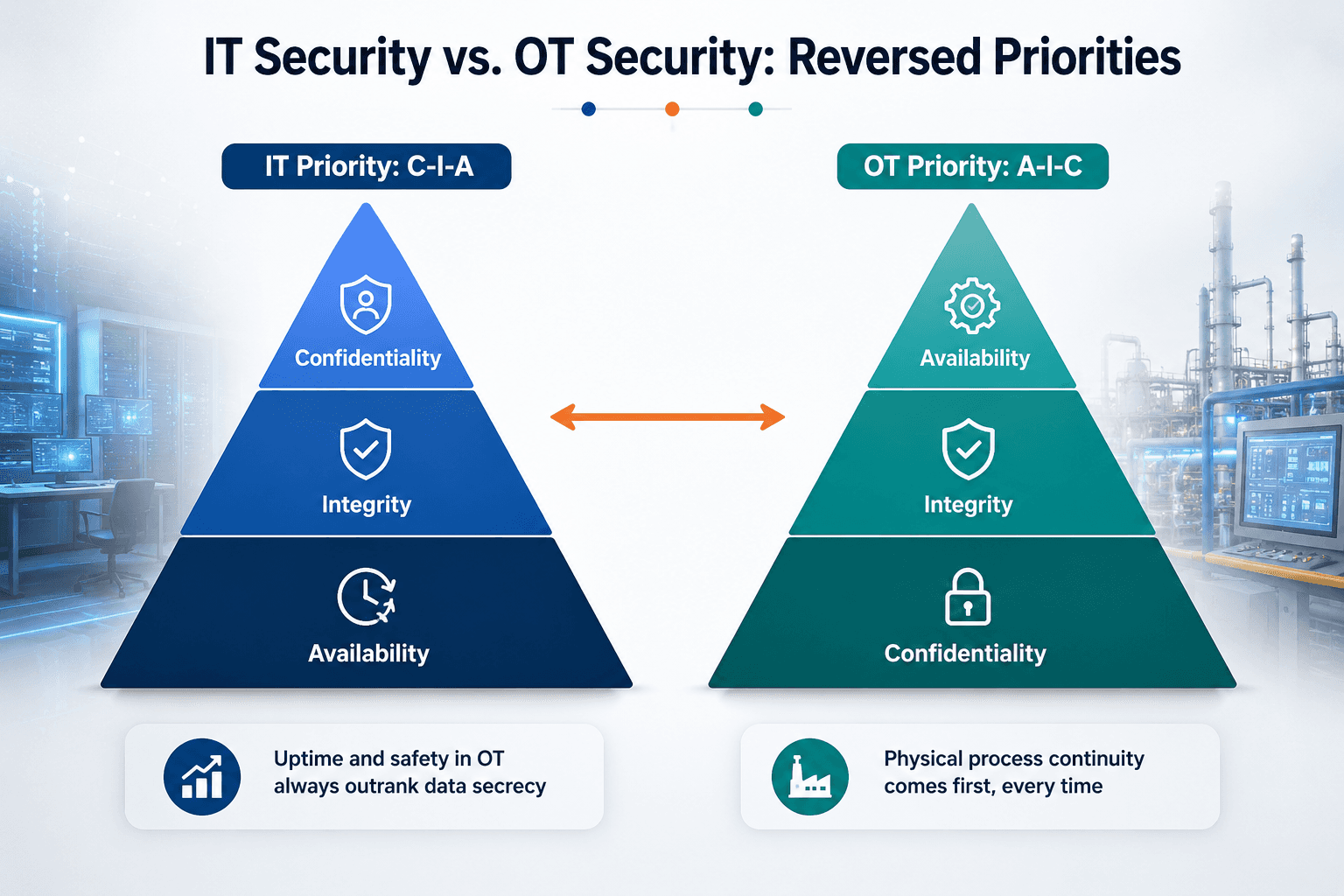
Figure 2: OT security reverses the classic IT priority order, placing availability and safety ahead of confidentiality.
The Business Case: What OT NDR Means for the Bottom Line
Security leaders rarely struggle to justify a firewall or an antivirus budget line. OT NDR is a newer category, and boards understandably want to understand the return before approving spend. The honest answer is that the return shows up primarily as avoided cost, a category that is easy to underestimate until an organization has lived through an unplanned shutdown.
Unplanned downtime in manufacturing and process industries is consistently one of the most expensive line items an operations budget can carry, often running into tens of thousands of dollars per hour once lost production, restart costs, and missed delivery commitments are combined. A single incident that forces even a partial shutdown for a day can therefore cost far more than several years of a monitoring program. Beyond direct downtime, organizations face regulatory penalties, insurance premium increases, customer trust erosion, and in the case of critical infrastructure, potential public safety consequences that carry their own long-tail costs.
Cost Category | Without OT Visibility | With OT NDR in Place |
Incident detection time | Often weeks or months, discovered indirectly | Real time to near real time |
Root cause analysis | Manual, reconstructed after the fact | Immediate, based on recorded traffic and behavior |
Unplanned downtime risk | High, anomalies often surface as a process failure | Reduced, anomalies caught before affecting the process |
Regulatory readiness | Reactive, difficult to demonstrate | Continuous evidence of monitoring and controls |
Insurance underwriting position | Limited visibility weakens the case | Documented monitoring strengthens the case |
The most persuasive argument for OT NDR is rarely a single number. It's the combination of faster detection, clearer evidence during an incident, and the ability to demonstrate, to a board, a regulator, or an insurer, that the organization has genuine control over its operational risk rather than an assumption of safety based on the network having "worked fine so far."
Common Myths About OT Network Monitoring
Several misconceptions continue to slow down OT security investment across industrial sectors. It's worth addressing them directly.
"Our OT network is air-gapped, so we're not exposed." True air gaps are rare today. Vendor remote access, USB media, engineering laptops that move between networks, and wireless sensors all create paths that a network diagram often doesn't reflect.
"Monitoring will slow down our control systems." This concern made sense with older, inline security appliances. Passive OT NDR sensors observe traffic through a mirrored port or tap, meaning they never sit in the path of control communications.
"We already have an IT security team monitoring everything." IT security tools are built to interpret IT protocols and IT risk priorities, and typically cannot distinguish a legitimate PLC programming change from a malicious one.
"Our plant is too small to be a target." Threat actors increasingly use automated scanning to find any internet-exposed industrial device, regardless of the size of the organization behind it.
"We'll deal with this during our next major upgrade cycle." Given that industrial equipment lifecycles often span decades, waiting for a full modernization cycle can mean leaving a known visibility gap in place for years.
Key Use Cases for NDR Across Industries
Different sectors face distinct operational risks, but the underlying need, reliable, protocol-aware visibility into what the network is actually doing, remains consistent across all of them.
Industry | Primary OT NDR Use Case | Business Impact |
Manufacturing | Detecting unauthorized PLC programming changes and rogue devices on the plant floor | Protects production uptime and product quality consistency |
Energy & Utilities | Monitoring substation and grid control communications for unauthorized commands | Reduces risk of service disruption and regulatory exposure |
Oil & Gas | Visibility across pipeline SCADA and remote terminal unit communications | Prevents costly shutdowns and supports safety-critical operations |
Water & Wastewater | Detecting anomalous changes to chemical dosing and treatment control systems | Protects public health and safety outcomes |
Pharmaceuticals | Monitoring batch control systems for deviations from validated processes | Maintains product quality and regulatory compliance |
Transportation & Logistics | Securing rail signaling, port automation, and logistics control networks | Prevents operational delays and safety incidents |
Practical Recommendations and Best Practices
Deploying OT NDR successfully requires more than purchasing a platform. Organizations that get the most value follow a consistent set of practices.
Start with a passive asset inventory before anything else. You cannot secure what you cannot see. An accurate, living inventory of every device, protocol, and communication path is the foundation everything else builds on.
Deploy sensors at logical segmentation points. Prioritize the industrial DMZ, boundaries between supervisory and control zones, and any point where remote access enters the OT network.
Involve OT engineers from day one. Security teams that design monitoring strategies without control engineers risk misreading normal operational behavior as a threat, or missing genuinely dangerous activity because it looks routine to an IT-trained eye.
Tune baselines around actual operations, not assumptions. Every plant is different. A baseline copied from another facility, or built too quickly, will generate noise that erodes trust in the system.
Integrate with existing IT security operations, don't replace them. OT NDR should feed into the same SOC, SIEM, and incident response processes already in place, with clear escalation paths that account for OT-specific safety considerations.
Establish a response process before an incident, not during one. Define in advance who has authority to isolate a segment, who needs to be consulted before any action affecting physical operations, and how that decision gets made under time pressure.
Revisit and refine continuously. Networks change as equipment is added, vendors rotate, and processes are upgraded. Treat the baseline as a living model, not a one-time project.
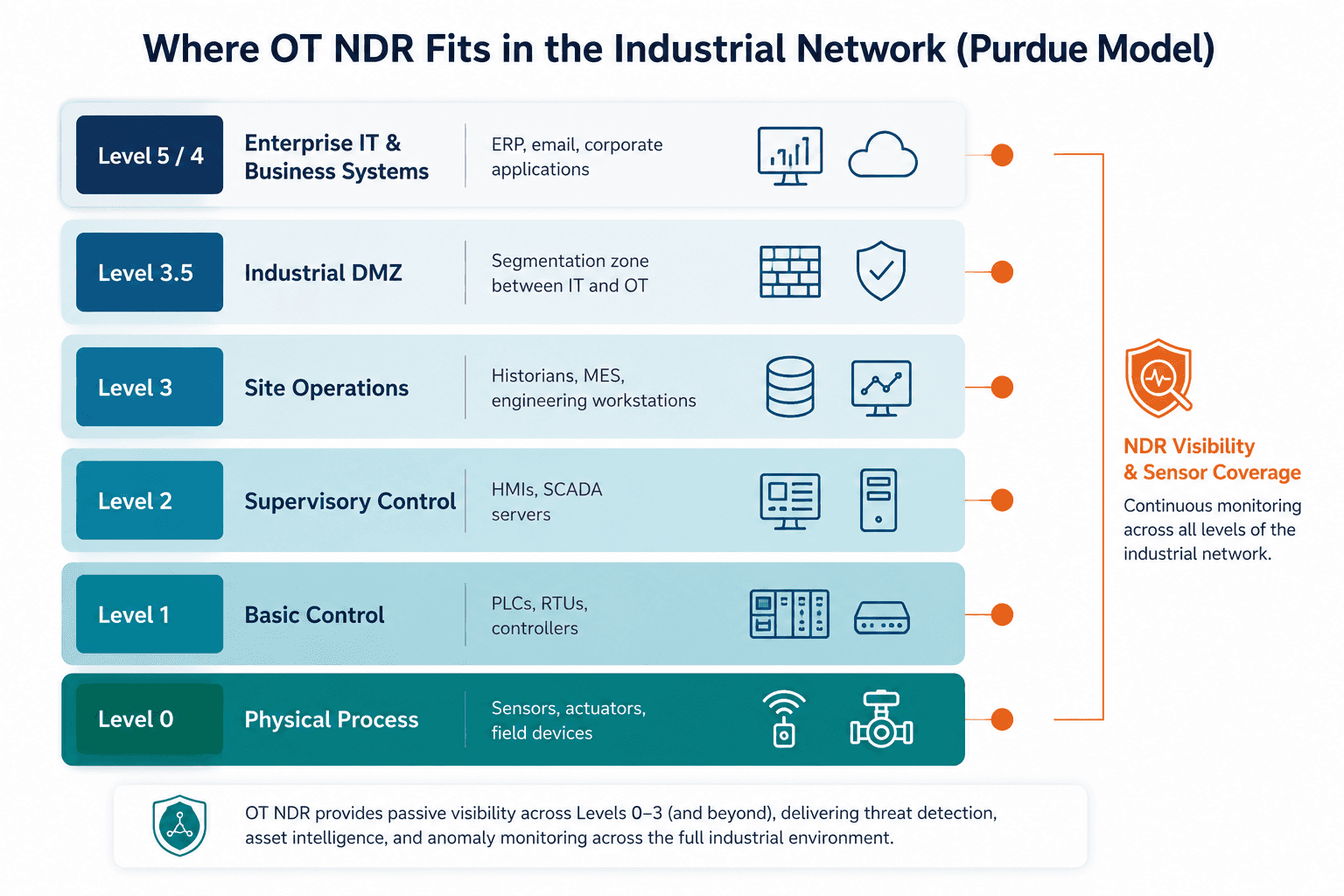
Figure 3: OT NDR sensor coverage mapped against the Purdue reference architecture, from the industrial DMZ down to the physical process layer.
Frequently Asked Questions
What is network detection and response in simple terms? Network detection and response is a monitoring approach that continuously watches network traffic to spot unusual or unauthorized activity, then supports a fast, informed response. In OT environments, this means watching the specific communications between industrial devices rather than general office network traffic.
How is OT NDR different from a traditional intrusion detection system? Traditional intrusion detection systems typically rely on known attack signatures and were built around IT protocols. OT NDR platforms are built specifically to parse industrial protocols and establish behavioral baselines unique to a given facility, allowing them to catch novel or process-specific anomalies that a signature-based tool would miss entirely.
Will deploying OT NDR require any downtime? In most cases, no. Because sensors connect through a mirrored switch port or a passive network tap, deployment typically does not require interrupting live control system traffic.
How long does it take to establish a useful behavioral baseline? This varies by facility, but many organizations begin seeing meaningful asset visibility within the first days of deployment, with a stable behavioral baseline typically maturing over several weeks.
Does OT NDR replace the need for firewalls and network segmentation? No. OT NDR is a visibility and detection layer that works alongside segmentation, firewalls, and access controls rather than replacing them.
Is OT NDR only relevant for large enterprises? No. While large critical infrastructure operators were early adopters, mid-sized manufacturers and utilities increasingly recognize that a single unplanned outage or safety incident can be just as damaging, proportionally, to a smaller organization.
How Shieldworkz Supports Organizations
Shieldworkz works alongside industrial organizations to build practical, sustainable OT security programs rather than one-off technology deployments. Our approach is grounded in the operational realities plant teams face every day.
Comprehensive OT asset discovery and continuous network visibility tailored to each facility's actual protocols and devices
Protocol-aware threat detection built around industrial communication standards, not adapted IT signatures
Deployment strategies designed around safety and uptime requirements, with zero disruption to live control systems
Collaborative baselining conducted alongside plant engineers and control system operators, not imposed from outside
Clear, actionable alerting that gives security and operations teams shared context instead of conflicting priorities
Guidance aligned with recognized frameworks including IEC 62443, helping organizations meet regulatory and insurance expectations
Ongoing advisory support as networks evolve, new equipment is added, and threat patterns shift over time
Our goal is straightforward: help industrial organizations gain confident, continuous visibility into their operational networks so that security decisions are based on real evidence rather than guesswork.
Conclusion
Industrial networks were built to run physical processes reliably, not to withstand modern cyber threats. As IT and OT environments continue converging, the organizations that will manage this risk successfully are the ones that invest in visibility first. Network Detection and Response, purpose-built for operational technology, gives security leaders and plant operators a clear, real-time understanding of what is actually happening on their networks, and the ability to act before a routine anomaly becomes a costly incident.
The incidents outlined in this guide didn't happen because organizations lacked good intentions. They happened because visibility gaps went unaddressed until it was too late. Closing that gap is one of the most consequential decisions an industrial organization can make this year.
Book a Free Consultation with Our Experts
If you're evaluating how OT Network Detection and Response fits into your organization's security roadmap, our team is glad to walk through your specific environment, answer technical questions, and help you think through what a practical first step could look like. There's no pressure and no sales script, just a straightforward conversation with people who understand industrial networks.
Additional resources:
Comprehensive Guide to Network Detection and Response NDR in 2026 here
NERC CIP-015 Internal Network Security Monitoring Readiness Checklist for Electric Utilities here
OT SOC Foundational Guide here
Managed SOC Service here
OT Cyber Threat Intelligence Advisory - Middle East here
NIS2 Directive Achieving NIS2 Compliance Through IEC 62443 here
What Is Removable Media? Risks, Policies, and Industrial OT Security Solutions here
Free Removable Media Policy Template for OT and IT Teams here
Get Weekly
Resources & News
See How Our Industry-Leading OT Security Solutions Address Critical Security Challenges
You may also like

What the French supermarket cyberattack reveals about OT security
Prayukth K V

Inside the Albert Heijn cyber incident: Investigating the attack, the IT/OT exposure, and the risks to critical operations
Team Shieldworkz

50°C by cyberattack? Inside France’s supermarket refrigeration crisis
Prayukth K V

Automating IEC 62443 Compliance Assessments Without Losing Expert Control
Team Shieldworkz

Investigative cyber threat intelligence report: Daiichi Kosho supply-chain data exposure
Prayukth K V

How AI Is Changing IEC 62443 Assessments
Team Shieldworkz