Team Shieldworkz
Every utility that touches the bulk electric system eventually reaches the same realization: passing a NERC CIP audit and actually being secure are not automatically the same thing. A control can be documented, evidenced, and technically compliant on paper, yet still fail to stop a determined intrusion into a control network.
Before we begin, don’t forget to check out our previous post on “Manchester Airport data breach: Attack path, impact, and cybersecurity lessons” here.
The organizations that get the most value out of NERC CIP are the ones that stop treating it as a list of individual requirements to satisfy and start treating it as a compliance program: a coordinated, living system of people, processes, and technology that protects Bulk Electric System (BES) Cyber Systems while generating the evidence auditors expect.
This Blog walks through what that program looks like in practice in 2026, including the newest CIP-015 internal monitoring obligations, the risks that trip up experienced OT security teams, a step-by-step implementation roadmap, and the operating habits that separate mature programs from those that scramble every audit cycle.
Why NERC CIP Implementation Is More Than a Checklist
The North American Electric Reliability Corporation's Critical Infrastructure Protection standards exist because the bulk power system is one of the few pieces of national infrastructure where a cyber or physical security incident can cascade into a regional or even continental event. Unlike many IT security frameworks that are voluntary, NERC CIP is mandatory for Registered Entities in the United States and Canada, and it carries enforceable financial penalties through FERC oversight.
That enforcement weight is exactly why many organizations fall into a compliance-first mindset: satisfy the letter of each requirement, gather the minimum acceptable evidence, and move to the next audit cycle. The problem is that this approach tends to produce fragmented programs. One team owns access management, another owns patching, a third owns physical security, and nobody owns the overall security posture of the environment those controls are supposed to protect. Gaps appear at the seams, which is exactly where real-world attackers and, at times, physical intruders look first.
The Real Cost of Getting It Wrong
NERC CIP penalties are calculated per violation, per day, and the cap is adjusted for inflation over time. What began as a $1 million-per-day maximum has risen to roughly $1.54 million per violation per day as of 2025. In practice, the largest exposure rarely comes from a single sharp violation. It comes from sustained, systemic gaps that accumulate over years and surface all at once during a formal audit.
The largest publicly reported CIP enforcement action to date illustrates this well. In January 2019, NERC issued a record $10 million penalty against a US utility for 127 separate CIP violations that had built up over several years. NERC's own filing kept the company's identity redacted for security reasons, but the Wall Street Journal, E&E News, and Utility Dive independently reported the entity as Duke Energy. NERC's findings pointed to a lack of management engagement, disassociation between compliance and security functions, and organizational silos between business units , the same structural issues that show up repeatedly in less severe cases across the industry.
The financial penalty is only part of the cost. The larger cost is usually operational: emergency remediation projects under audit pressure, strained relationships between OT and compliance teams, and, in the worst cases, an actual security event in an environment that was assumed to be protected because it was labeled compliant.
Impact Area | Compliance-Only Approach | Coordinated Program Approach |
Audit outcome | Reactive evidence gathering, last-minute scrambles | Continuous evidence collection built into daily operations |
Security posture | Controls exist but operate in isolation | Controls are integrated and monitored as a system |
Cost over time | Recurring remediation spend after each audit cycle | Predictable, planned investment with fewer surprises |
Staff impact | Compliance seen as a burden by OT engineers | Compliance and security work reinforce each other |
Incident readiness | Documentation exists, but response is untested | Programs include tested detection and response workflows |
Table 1: Compliance-only execution versus a coordinated NERC CIP program
Understanding the NERC CIP Standards Landscape in 2026
A working NERC CIP program starts with a clear-eyed understanding of what the standards actually require, not in isolation, but as an interconnected set of obligations that build on each other. As of 2026, the active CIP framework runs from CIP-002 through CIP-014, plus the newer CIP-015 standard covering Internal Network Security Monitoring (INSM). Several changes have reshaped the framework over the past two years, and organizations that have not revisited their program since 2024 are very likely working from an outdated picture.
Core Standard Families at a Glance
Standard | Primary Focus | Why It Matters Operationally |
CIP-002 | BES Cyber System identification and categorization | Sets the scope for every other standard; errors here ripple through the entire program |
CIP-003 | Security management controls | Governance, policy, and , since CIP-003-9 , expanded vendor remote access rules for low-impact assets |
CIP-004 | Personnel and training | Background checks, awareness training, and timely access revocation |
CIP-005 | Electronic Security Perimeters | Defines and protects the boundary between OT and untrusted networks |
CIP-006 | Physical security of BES Cyber Systems | Controls physical access to control centers and substations |
CIP-007 | System security management | Ports, services, patch management, malicious code prevention, logging |
CIP-008 | Incident reporting and response planning | Requires a tested plan and defined reporting timelines |
CIP-009 | Recovery plans for BES Cyber Systems | Backup, restoration, and testing of recovery procedures |
CIP-010 | Configuration change management and vulnerability assessments | Baseline configurations and controlled change processes |
CIP-011 | Information protection | Handling and disposal of BES Cyber System Information |
CIP-012 | Communications between Control Centers | CIP-012-2 (effective July 1, 2026) protects real-time operational data in transit |
CIP-013 | Supply chain risk management | Vendor risk assessment for procurement of BES Cyber Systems |
CIP-014 | Physical security of critical substations | Risk assessment and protection of the most critical facilities |
CIP-015 | Internal Network Security Monitoring | New INSM requirement inside the electronic security perimeter for high- and medium-impact systems |
Table 2: Core NERC CIP standard families and their operational relevance
What Changed Recently , and What's Coming
Three developments matter most for teams building or refreshing a program in 2026:
CIP-015-1 (Internal Network Security Monitoring): Approved by FERC in Order No. 907 on June 26, 2025, and effective September 2, 2025. It requires monitoring inside the electronic security perimeter for high-impact systems and medium-impact systems with external routable connectivity. Compliance is phased: Control Centers and backup Control Centers must comply by September 2, 2028, with all other applicable medium-impact systems following by September 2, 2030. FERC has also directed NERC to extend INSM to cover electronic access control and physical access control systems located outside the perimeter, so a further revision (CIP-015-2) is expected.
CIP-003-9: Became enforceable April 1, 2026, expanding governance and vendor remote-access requirements for assets with low-impact BES Cyber Systems , a category that historically received lighter oversight.
CIP-012-2: Effective July 1, 2026, strengthening protection of real-time operational data exchanged between Control Centers against unauthorized disclosure, modification, and loss of availability.
Note: FERC has also approved a package of virtualization-related CIP revisions (covering CIP-002 through CIP-013) with a later mandatory compliance date. Because implementation timelines shift as NERC files updates with FERC, confirm current effective and enforcement dates directly with your Regional Entity before finalizing a project timeline.
Risks, Challenges, and Industry Insights
OT environments were largely designed for reliability and safety, not cybersecurity. Retrofitting compliance and security controls onto systems that may be fifteen or twenty years old, running legacy protocols, and tied to safety-critical processes creates a distinct set of challenges that IT-centric compliance frameworks rarely anticipate.
Common Implementation Challenges
Asset visibility gaps: many utilities still rely on spreadsheets or outdated inventories, making accurate CIP-002 categorization difficult from day one.
Legacy technology constraints: older relays, RTUs, and HMIs often cannot support modern authentication, patch cadences, or endpoint agents without engineering validation.
Organizational silos: compliance, OT engineering, and IT security frequently operate with different priorities, vocabularies, and reporting lines , the exact pattern regulators cited in the largest CIP enforcement action on record.
Evidence fatigue: manually gathering screenshots, logs, and change records for every audit cycle consumes enormous staff time and is prone to gaps.
Change management friction: any modification to a BES Cyber System, even a routine patch, must be evaluated against safety, reliability, and compliance impact simultaneously.
New monitoring scope: CIP-015 requires internal network visibility that many OT environments have never had, since perimeter-focused defenses were historically considered sufficient.
Vendor and supply chain complexity: CIP-013 and the expanded CIP-003-9 vendor provisions require visibility into third-party risk that many procurement processes were never built to capture.
Talent scarcity: professionals who understand both electrical operations and cybersecurity remain difficult to hire and retain.
What Real-World Incidents Teach Us
The risks NERC CIP is designed to address are not theoretical. Well-documented incidents over the past decade show how vulnerabilities in industrial environments translate into real operational and physical consequences, spanning both cyber and physical attack vectors.
The December 2022 gunfire attack on two Duke Energy distribution substations in Moore County, North Carolina, is a useful example on the physical security side. Attackers used firearms to disable equipment at the Carthage and West End substations, cutting power to roughly 40,000 to 45,000 customers for several days and contributing to one death. The case remains unsolved, and it prompted new North Carolina legislation increasing penalties for attacks on energy infrastructure. For any organization operating critical substations, it is a direct, real-world illustration of why CIP-014 risk assessments and physical hardening are not a formality.
On the cyber side, the 2015 and 2016 attacks on Ukraine's power grid, involving malware publicly documented as Industroyer (also called CrashOverride), demonstrated that a coordinated intrusion combining credential theft and manipulation of grid control software could remotely trip breakers and cause real outages affecting hundreds of thousands of customers.
The May 2021 ransomware incident that forced a major US pipeline operator to shut down fuel delivery across the East Coast illustrated a different but equally important lesson: an attack that only reached IT systems still triggered a precautionary shutdown of OT operations, showing how tightly interconnected, and how fragile, the boundary between business and operational networks can be.
Each of these events reinforces the same conclusion: documentation alone does not stop an intrusion or a physical attack. Only an operating program , one that actively monitors, detects, and responds , closes the gap between paper compliance and real protection.
Building a NERC CIP Compliance Program: A Practical Roadmap
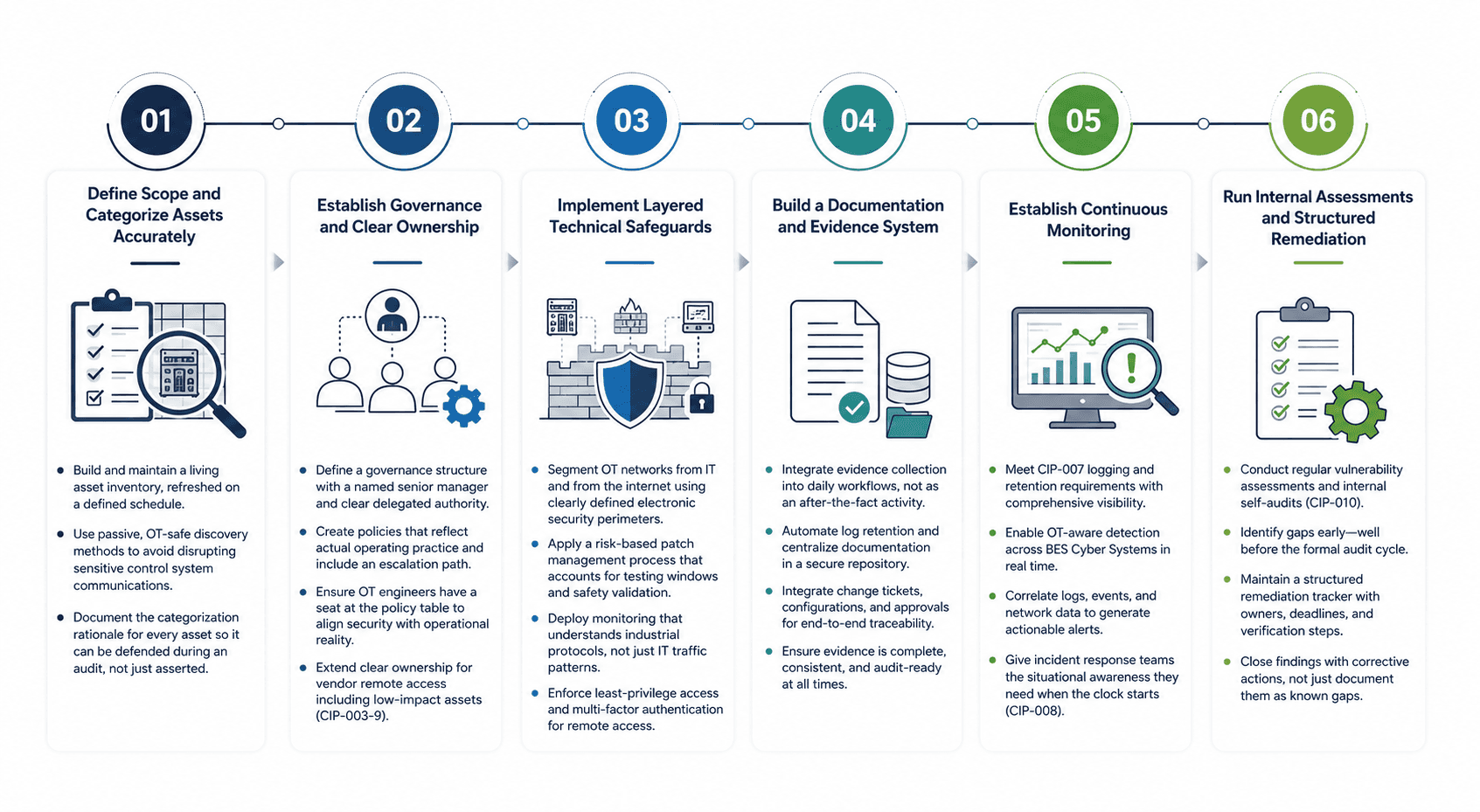
Moving from scattered controls to a genuine program happens in stages. Skipping stages, or trying to run them all in parallel without sequencing, is one of the most common reasons implementation projects stall or produce inconsistent evidence. The roadmap below reflects the order in which mature OT security programs typically build capability.
Step 1: Define Scope and Categorize Assets Accurately
Everything begins with an accurate, current inventory of BES Cyber Systems, associated Cyber Assets, and their categorization as High, Medium, or Low impact under CIP-002. This is not a one-time exercise. Substations get upgraded, new field devices are commissioned, and network segments change, so asset inventories need a defined update cadence, ideally supported by passive network discovery tools that do not disrupt sensitive control processes.
Build and maintain a living asset inventory, refreshed on a defined schedule rather than only before audits.
Use passive, OT-safe discovery methods to avoid disrupting sensitive control system communications.
Document the categorization rationale for every asset so it can be defended during an audit, not just asserted.
Step 2: Establish Governance and Clear Ownership
A CIP-003 governance structure needs a named senior manager with clearly delegated authority, documented policies that reflect actual operating practice, and a defined escalation path when compliance and operational priorities conflict. With CIP-003-9 now in force, low-impact assets need the same kind of clear ownership for vendor remote access that high- and medium-impact systems have long required. Programs that succeed give OT engineers a seat at the policy table, because a policy that ignores operational reality gets worked around, not followed.
Step 3: Implement Layered Technical Safeguards
Technical controls under CIP-005 and CIP-007 form the backbone of day-to-day protection: electronic security perimeters, interactive remote access controls, port and service hardening, patch management, and malicious code prevention. CIP-015 now adds a layer on top of this: visibility inside the perimeter, so that lateral movement by an attacker who gets past the edge does not go undetected. In OT environments, these controls need to be implemented with an understanding of process safety and uptime requirements, since a firewall rule change or an unplanned reboot carries very different consequences on a substation network than on a corporate email server.
Segment OT networks from IT and from the internet using clearly defined electronic security perimeters.
Apply a risk-based patch management process that accounts for testing windows and safety validation.
Deploy monitoring that understands industrial protocols, not just IT traffic patterns, in preparation for CIP-015 deadlines.
Enforce least-privilege access and multi-factor authentication for interactive remote access wherever technically feasible.
Step 4: Build a Documentation and Evidence System
Evidence collection is where many programs quietly fail, not because controls are missing, but because proof that the control operated consistently over time is missing. The strongest programs build evidence collection into daily workflows rather than treating it as a separate, after-the-fact exercise. Automated log retention, change-ticket integration, and centralized documentation repositories dramatically reduce the burden compared to manual, spreadsheet-based tracking.
Step 5: Establish Continuous Monitoring
CIP-007 logging requirements, CIP-008 incident response obligations, and the new CIP-015 internal monitoring standard all depend on genuine visibility into what is happening across BES Cyber Systems in real time, not a quarterly review of logs nobody has looked at since the last audit. A security operations function with OT-aware detection capability turns raw log and network data into actionable alerts, and gives incident response teams the situational awareness they need when CIP-008's reporting clock starts running.
Step 6: Run Internal Assessments and Structured Remediation
CIP-010 vulnerability assessments and internal self-audits should happen well before the formal audit cycle, with enough lead time to remediate findings rather than simply document them as known gaps. A structured remediation tracker, with owners, deadlines, and verification steps, turns assessment findings into closed issues instead of a growing backlog that resurfaces every year.
Program Phase | Typical Focus | Key Outcome |
Foundation (Months 1–3) | Asset inventory, scoping, governance structure | Accurate CIP-002 categorization and defined ownership |
Build (Months 3–8) | Technical safeguards, ESP design, access controls | Layered protection aligned to CIP-005 / CIP-007 |
Operationalize (Months 6–12) | Monitoring, logging, evidence automation, INSM planning | Continuous compliance evidence and a CIP-015 roadmap |
Mature (Ongoing) | Internal assessments, remediation tracking, drills | Audit readiness maintained year-round, not seasonally |
Table 3: A phased view of NERC CIP program maturity
Practical Recommendations and Best Practices
Beyond the step-by-step roadmap, a handful of operating habits consistently separate programs that hold up under audit and under attack from those that don't.
Treat asset inventory as a living system with an owner, not a one-time project , schedule recurring reconciliation reviews.
Involve OT engineers early in every control design decision; controls that ignore process constraints get bypassed.
Automate evidence capture wherever possible so audit preparation becomes a report, not a project.
Run tabletop exercises for CIP-008 incident response at least annually, using scenarios based on real industry incidents.
Start CIP-015 planning now, even though full compliance dates run through 2028 and 2030 , sensor procurement and network design typically take twelve to eighteen months.
Build supply chain risk questions into procurement contracts up front, rather than retrofitting CIP-013 and CIP-003-9 requirements after a purchase is signed.
Track remediation items with the same discipline used for safety findings: assigned owner, due date, and verification.
Align internal risk assessments with recognized OT security frameworks so findings translate cleanly into both security and compliance language.
Moving From Individual Controls to a Coordinated Program
The organizations that consistently perform well on NERC CIP audits share a common trait: they stopped asking whether a control satisfies a requirement in isolation and started asking whether the program, as a whole, reduces risk and produces defensible evidence. That shift changes how teams are structured, how budgets are justified, and how success is measured, moving from a pass/fail audit outcome to an ongoing operational capability.
This is also where the difference between compliance and security narrows the most. A coordinated program treats CIP-002 categorization, CIP-005 perimeter design, CIP-007 hardening, CIP-008 response planning, CIP-010 change control, CIP-013/CIP-003-9 supply chain review, and CIP-015 internal monitoring as interlocking parts of the same protective system, because that is exactly what they are. When one part changes, the others need to reflect it. That interdependency is precisely why a fragmented, siloed approach eventually breaks down, usually at the worst possible moment: during an audit, or during an actual incident.
How Shieldworkz Supports Organizations
Shieldworkz works alongside utilities, generation operators, and industrial organizations to turn NERC CIP obligations into a functioning, defensible security program, not just a stack of audit binders.
OT-safe asset discovery and inventory services that accurately support CIP-002 categorization without disrupting live control processes.
Electronic security perimeter design and network segmentation guidance built around real industrial protocols and process constraints.
CIP-015 readiness assessments covering sensor placement, data sources, and internal network monitoring architecture ahead of the 2028 and 2030 compliance dates.
Continuous, OT-aware monitoring that gives security and compliance teams shared visibility into BES Cyber System activity.
Evidence and documentation frameworks that integrate with daily operations, reducing manual audit preparation.
Incident response planning and tabletop exercises tailored to CIP-008 reporting obligations and real-world OT attack scenarios.
Supply chain risk assessment support aligned with CIP-013 and CIP-003-9 vendor requirements.
Internal assessment and remediation planning that identifies gaps early and tracks them to closure well ahead of formal audits.
The goal is not simply to help an organization pass its next audit. It is to build a compliance program that stands on its own as a genuine security capability, one that protects critical infrastructure whether or not an auditor happens to be reviewing it that quarter.
Frequently Asked Questions
1.What is NERC CIP implementation, in plain terms?
It is the process of building the people, processes, and technology needed to meet NERC's Critical Infrastructure Protection standards for Bulk Electric System Cyber Systems, and then operating that program continuously rather than treating it as a one-time project.
2.How many NERC CIP standards are currently active?
As of 2026, the active framework spans CIP-002 through CIP-014, plus CIP-015 for Internal Network Security Monitoring. Several standards, including CIP-003, CIP-012, and CIP-015, have recently been updated or added, so it's worth confirming the current version numbers with your Regional Entity before an audit.
3.What is CIP-015 and when do organizations need to comply?
CIP-015-1 is the Internal Network Security Monitoring standard, approved by FERC on June 26, 2025 and effective September 2, 2025. It requires monitoring inside the electronic security perimeter for high-impact systems and medium-impact systems with external routable connectivity. Control Centers must comply by September 2, 2028, with other applicable medium-impact systems following by September 2, 2030.
4.How much can NERC CIP violations cost?
Penalties are assessed per violation, per day, with a maximum that has risen to roughly $1.54 million per day as of 2025. The largest publicly known case, a $10 million penalty for 127 violations issued in 2019, shows how quickly accumulated, unaddressed gaps can add up over several years.
5.What is the difference between NERC CIP and frameworks like IEC 62443?
NERC CIP is a mandatory regulatory requirement enforced by FERC for entities that own or operate portions of the North American bulk electric system, with the compliance burden placed on the asset owner. IEC 62443 is a voluntary international framework applicable across industrial sectors, with responsibility distributed across asset owners, integrators, and suppliers. Many energy organizations use both together: NERC CIP for regulatory compliance, IEC 62443 for broader technical guidance.
6.How long does it take to build a NERC CIP compliance program from scratch?
Most organizations move through foundational asset inventory and governance work in the first one to three months, build core technical safeguards over the following several months, and reach a genuinely operationalized program, with monitoring and automated evidence collection, within about a year. CIP-015 monitoring architecture typically needs a longer runway given equipment procurement lead times.
7.Does low-impact classification mean an asset can be ignored?
No. CIP-003-9, enforceable since April 1, 2026, introduced specific vendor remote access and governance requirements for assets containing low-impact BES Cyber Systems. Low-impact no longer means minimal oversight.
Conclusion
NERC CIP implementation is not a project with an end date. It is an operating discipline that has to keep pace with changing assets, changing threats, and changing regulatory expectations, including the newest internal monitoring, vendor access, and control-center data protection requirements taking effect through 2026. Organizations that treat it as a coordinated program, with accurate asset visibility, layered technical safeguards, integrated evidence collection, continuous monitoring, and disciplined remediation, consistently find that audits become easier precisely because security got better. The two goals were never actually in tension; they simply require a program built to serve both at once.
If your organization is working through NERC CIP scoping, CIP-015 readiness, or preparing for an upcoming audit cycle, a focused conversation with people who work in this space every day can save months of trial and error.
Book a Free Consultation with Our Experts
Talk to the Shieldworkz OT security team about where your NERC CIP program stands today, including CIP-015 readiness, and what a coordinated, audit-ready compliance program would look like for your environment. No pressure, just a practical conversation about your next steps.
Additional resources:
Comprehensive Guide to Network Detection and Response NDR in 2026 here
NERC CIP-015 Internal Network Security Monitoring Readiness Checklist for Electric Utilities here
OT SOC Foundational Guide here
Managed SOC Service here
OT Cyber Threat Intelligence Advisory - Middle East here
NIS2 Directive Achieving NIS2 Compliance Through IEC 62443 here
What Is Removable Media? Risks, Policies, and Industrial OT Security Solutions here
Free Removable Media Policy Template for OT and IT Teams here
Get Weekly
Resources & News
See How Our Industry-Leading OT Security Solutions Address Critical Security Challenges
You may also like

What the French supermarket cyberattack reveals about OT security
Prayukth K V

Inside the Albert Heijn cyber incident: Investigating the attack, the IT/OT exposure, and the risks to critical operations
Team Shieldworkz

50°C by cyberattack? Inside France’s supermarket refrigeration crisis
Prayukth K V

Automating IEC 62443 Compliance Assessments Without Losing Expert Control
Team Shieldworkz

Investigative cyber threat intelligence report: Daiichi Kosho supply-chain data exposure
Prayukth K V

How AI Is Changing IEC 62443 Assessments
Team Shieldworkz