Team Shieldworkz
A ransomware infection rarely announces itself the moment it lands. It moves quietly first, through a compromised credential, a misconfigured remote access session, or a single unpatched workstation sitting closer to the plant floor than anyone realized. By the time encryption actually hits, the attacker has often spent days or weeks studying the network, mapping out engineering workstations, historians, and control system assets. This is precisely why Network Detection and Response, commonly known as NDR, has become one of the most important capabilities for industrial organizations trying to stay ahead of ransomware rather than simply reacting to it.
For OT security leaders, plant managers, and CISOs responsible for critical infrastructure, the conversation has shifted. It is no longer just about preventing the initial breach, modern security programs assume that some level of compromise is inevitable given how interconnected IT and OT networks have become. The real differentiator is how quickly abnormal behavior is spotted and contained before it reaches production systems, safety instrumented systems, or physical processes. This guide walks through exactly how NDR identifies ransomware activity early, how it fits into hybrid IT/OT environments, and what a strong network visibility strategy actually looks like in practice.
What makes this topic especially urgent right now is the pace at which industrial digitalization is expanding the attack surface. Remote monitoring platforms, predictive maintenance sensors, cloud-connected historians, and third-party vendor access have all been added to plant networks over the past several years, often faster than security teams have been able to fully map and secure them. Each of these additions creates a new potential pathway into the environment. Understanding how NDR works, and how to deploy it thoughtfully, has become a practical necessity rather than an optional upgrade for any organization serious about protecting uptime, safety, and operational continuity.
This is also why so many boards and executive teams now ask a very direct question after every major industry incident: could this happen to us, and would we know quickly enough to stop it? Answering that question honestly usually exposes a gap. Most industrial networks were built for reliability and uptime, not for visibility into every conversation happening between devices. Firewalls sit at the perimeter. Antivirus, where it exists at all on OT assets, catches only what it already recognizes. The vast, quiet space in between, the actual traffic moving between a historian and an engineering laptop, or between a remote access gateway and a PLC, is where ransomware spends most of its time before anyone notices anything is wrong. NDR exists specifically to illuminate that space.
Why Ransomware Has Become the Defining Operational Risk for Industrial Organizations
Ransomware targeting industrial and critical infrastructure organizations is no longer a hypothetical risk discussed in conference rooms , it has repeatedly translated into real production shutdowns, safety concerns, and multi-week recovery efforts.
Several converging trends explain why this risk has accelerated so sharply over the past few years. IT and OT networks that were once physically and logically separate are now connected through remote access tools, cloud-based analytics platforms, and vendor support links that did not exist a decade ago. Ransomware groups have also become more organized, often operating as structured businesses with affiliate programs, dedicated negotiation teams, and a clear understanding that industrial victims are more likely to pay quickly because downtime carries such a high daily cost. Add to this the reality that many industrial environments still run legacy operating systems and unpatched software , not due to negligence, but because patching a system tied to a live production process carries its own operational risk , and the result is a threat landscape where attackers have both motive and opportunity.
In 2021, a ransomware attack against a major U.S. fuel pipeline operator forced the shutdown of a pipeline supplying nearly half of the East Coast's fuel supply, even though the ransomware itself only infected the IT network. The operator chose to halt OT operations out of caution because visibility into how far the infection had spread was limited. In 2019, a global aluminum producer was hit by ransomware that spread across dozens of sites, forcing a temporary shift to manual operations at several plants and resulting in losses estimated in the tens of millions of dollars. In 2021, one of the world's largest meat processing companies had to halt operations at multiple facilities across North America and Australia after a ransomware incident disrupted its production scheduling and IT-dependent processes.
These incidents share a common thread: in each case, the attackers did not need to directly breach a PLC or SCADA server to cause massive operational disruption. Simply compromising IT systems that OT depends on, or creating enough uncertainty about the blast radius of an infection, was sufficient to force a shutdown. This is exactly the blind spot that network detection and response is designed to close.
What Is Network Detection and Response, and Why OT Environments Need It
Network Detection and Response is a security approach that continuously monitors traffic moving across a network, including traffic between IT and OT zones, between plant floors, and even east-west between individual devices, to identify behavior that deviates from what is normal for that environment. Rather than relying solely on known malware signatures, NDR builds a behavioral understanding of the network and flags activity that looks suspicious, even if it has never been seen before.
This matters enormously in OT environments for a simple reason: many industrial devices cannot run traditional endpoint agents. Programmable logic controllers, remote terminal units, and legacy Windows-based HMIs often cannot support the same endpoint detection tools deployed across a corporate IT fleet. Passive network monitoring solves this problem by observing traffic without touching the device itself, which means NDR can extend visibility into parts of the network that were previously invisible to the security team.
NDR platforms typically combine several techniques to build this picture, including deep packet inspection of industrial protocols, asset discovery and communication mapping, statistical baselining of normal traffic patterns, and machine-learning-driven anomaly detection. Together, these capabilities allow a security team to see not just that traffic is flowing, but whether that traffic makes sense given the asset, the time of day, the protocol being used, and the historical pattern of communication.
How NDR Complements Existing Security Investments
It is worth being clear that NDR is not meant to replace firewalls, endpoint protection, or existing segmentation efforts, it is meant to fill the visibility gap those tools were never designed to cover. A firewall enforces policy at defined boundaries but has little insight into what happens once traffic is allowed through. Endpoint tools depend on an agent being installed, which simply is not possible on the majority of field-level OT devices. NDR sits quietly in the middle, observing everything that moves across the wire regardless of whether an agent could ever be installed on the device generating that traffic. For organizations that have already invested heavily in perimeter defenses and asset inventories, NDR is often the missing layer that turns those existing investments into a genuinely complete detection strategy rather than a partial one.
How NDR Detects Ransomware Before It Spreads
Behavioral Baselines and Anomaly Detection
Industrial networks are, in many ways, easier to baseline than typical IT environments because OT traffic tends to be repetitive and predictable. A historian polling a PLC every few seconds, an engineering workstation pushing a program update once a quarter, or an HMI querying a SCADA server on a fixed cycle , these patterns rarely change. NDR platforms take advantage of this predictability by learning what normal communication looks like across assets, protocols, ports, and time windows. When a device suddenly initiates a connection it has never made before, transfers an unusual volume of data, or communicates outside its normal operating hours, that deviation is flagged immediately, often long before any file is encrypted.
East-West Traffic Visibility and Lateral Movement Detection
Ransomware operators rarely stay in one place. After gaining initial access, they typically move laterally, hopping from one system to another while searching for higher-value targets such as domain controllers, backup servers, or engineering workstations with access to control systems. Traditional perimeter security tools, such as firewalls positioned only at the network edge, have very limited visibility into this internal, east-west movement. NDR is specifically designed to monitor traffic between internal segments, which is where lateral movement almost always occurs. By watching for unusual internal scanning, credential reuse across unrelated systems, or connections between zones that should never talk to each other, NDR can catch an attacker mid-movement, well before they reach anything capable of encrypting production systems.
Identifying Command-and-Control and Data Staging Activity
Before deploying ransomware, most attackers first establish a foothold that allows them to communicate with external infrastructure and stage stolen data for extortion purposes. This command-and-control traffic often uses techniques designed to blend in with legitimate outbound connections, such as low-and-slow beaconing or encrypted channels disguised as normal web traffic. NDR platforms analyze the timing, frequency, size, and destination reputation of outbound connections to detect these subtle patterns. Unusual data staging , large internal transfers to a single system shortly before an external upload, is another strong early indicator that ransomware operators are preparing for both encryption and double-extortion data theft.
Encryption Behavior and Protocol Anomalies
Even in the final stages, right before or during actual file encryption, network behavior changes in detectable ways. A sudden spike in file-sharing protocol activity, rapid sequential connections to multiple internal hosts, or SMB traffic patterns consistent with mass file renaming can all be picked up by NDR in near real time. In OT-specific contexts, NDR can also flag anomalies in industrial protocols themselves , for example, unexpected write commands to a controller, unusual engineering software activity, or protocol traffic arriving from a device that has no legitimate reason to speak that protocol at all.
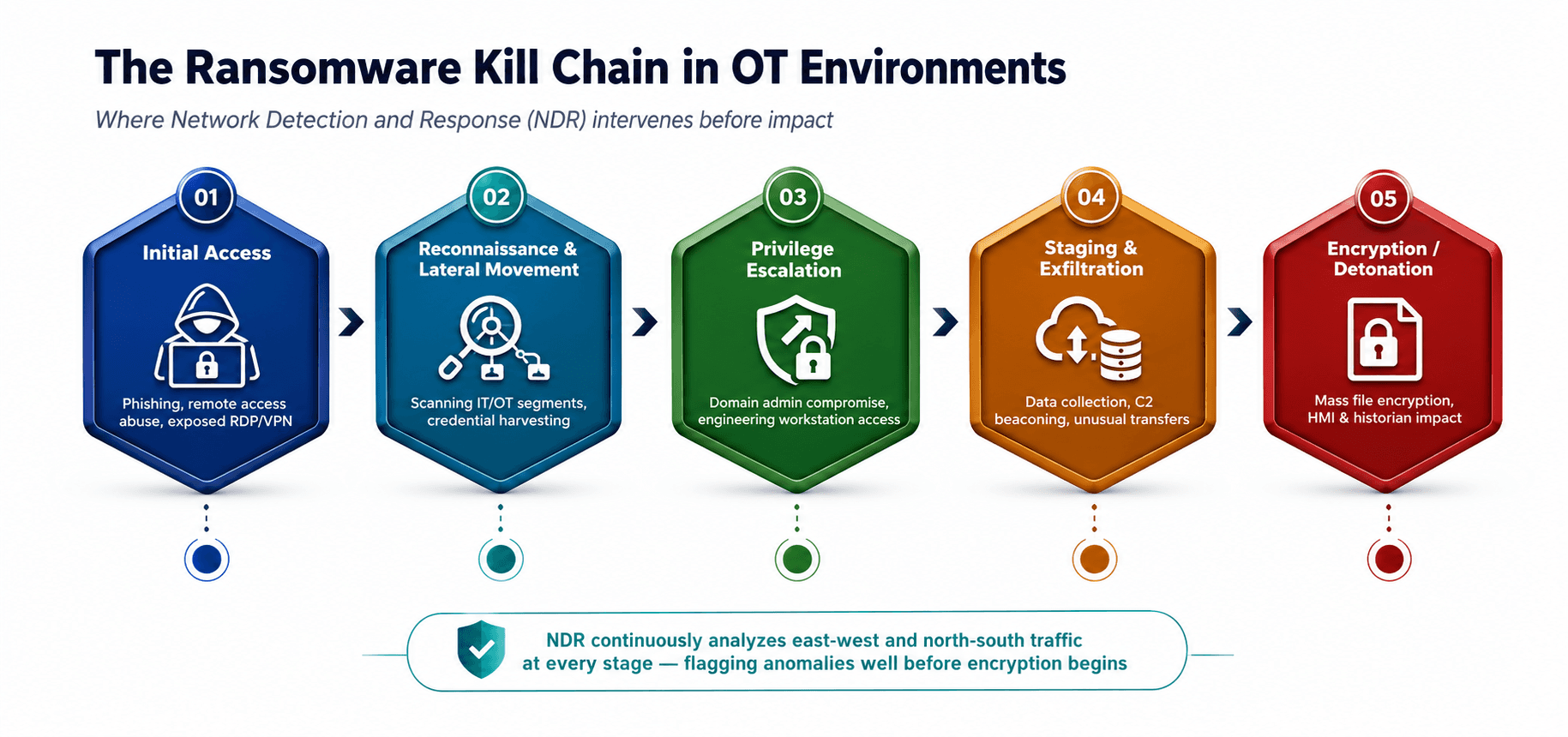
Figure 1: The ransomware kill chain in OT environments, and where NDR intervenes at each stage before impact.
Ransomware Stage vs. NDR Detection Focus
Attack Stage | What Typically Happens | How NDR Detects It |
Initial Access | Phishing, exposed remote access, or exploited internet-facing systems | Flags unusual authentication patterns and first-time external connections |
Reconnaissance | Internal scanning to map network segments and assets | Detects abnormal scanning behavior and new device-to-device communication |
Lateral Movement | Credential reuse to move between IT and OT segments | Identifies traffic crossing zones that historically never communicated |
Staging & Exfiltration | Data collected and moved to a single point before upload | Flags large internal transfers and unusual outbound data volume |
Encryption | Mass file changes and rapid internal connections | Detects abnormal protocol activity and simultaneous multi-host connections |
NDR Deployment in Hybrid IT/OT Environments
Deploying NDR across a hybrid environment that spans corporate IT networks, DMZs, and multiple OT zones is a fundamentally different exercise than deploying it purely within an IT data center. OT networks carry protocols that many general-purpose security tools were never built to parse, uptime requirements are far less forgiving, and the physical topology often includes remote sites, substations, or plants with limited bandwidth back to a central monitoring location.
Common Deployment Challenges
Legacy protocols and proprietary industrial communications that require specialized parsing to interpret correctly, rather than generic network analysis built for standard IT traffic.
Bandwidth and latency constraints at remote plants or substations, which limit how much raw traffic can realistically be forwarded to a central analysis point.
Concerns from operations teams about any monitoring approach that could introduce latency or risk to live control system traffic, even when the approach is entirely passive.
Fragmented ownership between IT and OT teams, which can slow down decisions about where sensors should be placed and who is responsible for reviewing alerts.
Inconsistent asset inventories, making it difficult to know in advance exactly what devices and protocols a deployment needs to account for.
Deployment Best Practices
The organizations that deploy NDR most successfully in hybrid environments tend to follow a similar sequence. They start with passive, out-of-band monitoring using network taps or switch port mirroring rather than inline deployment, which eliminates any risk of the monitoring solution itself impacting live traffic. They prioritize the IT/OT boundary and DMZ first, since this is where the highest volume of meaningful cross-zone traffic occurs and where early detection has the greatest impact on preventing spread. From there, visibility is extended deeper into Level 2 and Level 1 zones in a phased approach, often site by site, allowing operations teams to build confidence in the technology before broader rollout.
Bandwidth-constrained sites deserve special attention in any deployment plan. Rather than trying to backhaul every packet of raw traffic to a central collection point, many successful deployments perform initial analysis closer to the edge, sending only relevant metadata and alerts back to the central monitoring platform. This keeps remote-site connectivity requirements realistic while still preserving full visibility into what matters. Equally important is building a shared understanding between IT and OT stakeholders before deployment begins , clarifying who owns sensor placement decisions, who reviews alerts day to day, and how an OT-relevant alert gets escalated differently than a routine IT finding. Skipping this alignment step is one of the most common reasons NDR programs stall after an initial pilot phase.
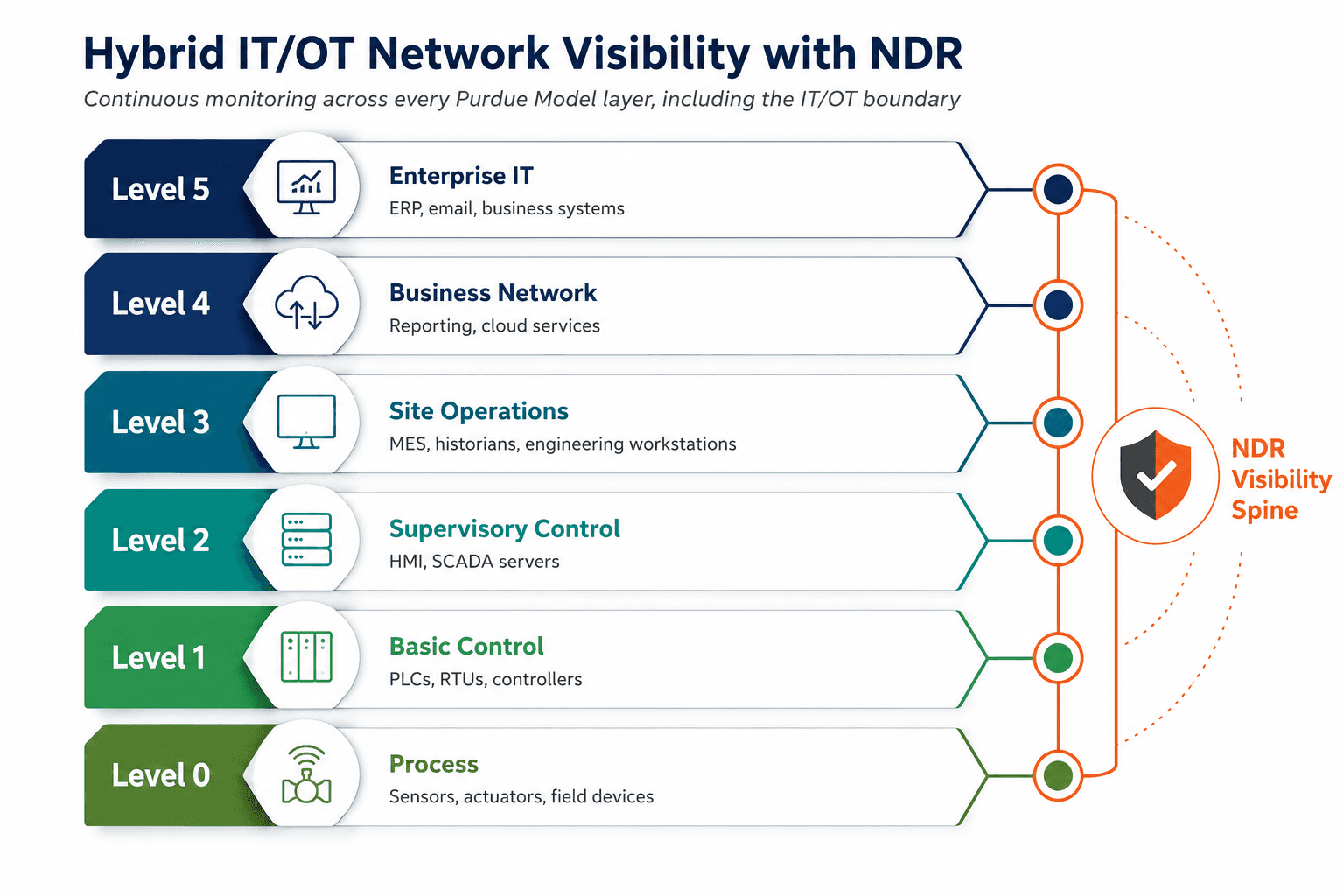
Figure 2: Continuous NDR visibility layered across every level of a hybrid IT/OT network, from enterprise systems down to the process floor.
Building a Network Visibility Strategy for OT Security
NDR is only as effective as the visibility strategy behind it. Buying a platform without first understanding what needs to be seen, where the highest-risk communication paths exist, and how alerts will actually be reviewed and acted on tends to produce a lot of noise and very little protection. A deliberate, staged visibility strategy consistently outperforms a rushed, all-at-once rollout.
Mapping Assets and Communication Flows
The foundation of any visibility strategy is an accurate picture of what exists on the network and how it communicates. This means going beyond a spreadsheet-based asset list and building a living map of which devices talk to which other devices, over which protocols, and how often. Passive network monitoring is typically the fastest and least disruptive way to build this map, since it can be done without touching a single control system device directly.
This mapping exercise frequently uncovers surprises, even at well-run sites. It is common to discover devices that were never formally documented, communication paths left over from a long-completed project, or a vendor connection that was supposed to be temporary but was never closed out. None of these discoveries necessarily indicate an active compromise, but each one represents an undocumented pathway that could be exploited, and each one is a gap that a determined attacker would be delighted to find before your security team does.
Segmenting Without Disrupting Operations
Once communication patterns are understood, segmentation decisions become far more informed. Rather than segmenting based on assumptions about how the network should work, teams can segment based on how it actually works, reducing the risk of breaking legitimate operational traffic. NDR plays a continuing role here by validating that segmentation boundaries are actually holding over time, rather than assuming a one-time network diagram remains accurate indefinitely.
Continuous Monitoring vs. Point-in-Time Assessments
Many industrial organizations still rely primarily on periodic vulnerability assessments or annual network audits. While valuable, these point-in-time exercises only capture a snapshot of the network at one moment. Ransomware and other threats do not wait for the next audit cycle. Continuous monitoring closes this gap by providing an always-on view of the network, which is particularly important given how frequently new devices, vendor connections, and temporary remote access sessions appear in modern industrial environments.
Network Visibility Maturity in Industrial Environments
Maturity Level | Typical Characteristics | Ransomware Detection Capability |
Minimal | Little to no OT-specific monitoring; visibility limited to IT firewalls | Very low, spread is usually discovered only after operational impact |
Basic | Asset inventory exists but is manually maintained and often outdated | Low, detection typically relies on outages or manual reports |
Developing | Passive monitoring in place at the IT/OT boundary only | Moderate, cross-zone movement is visible but deeper OT traffic is not |
Mature | Continuous NDR coverage across IT/OT boundary and key OT zones | High, lateral movement and staging activity are typically caught early |
Optimized | Full-stack visibility with behavioral analytics and integrated response workflows | Very high, anomalies are detected and investigated in near real time |
Risks and Challenges of Operating Without Full Network Visibility
Organizations that delay investment in network visibility often underestimate what is actually at stake. The risks extend well beyond a single incident and can affect the business for years afterward.
Perhaps the most underappreciated cost is the decision paralysis that follows an incident when visibility is limited. Without a clear picture of which segments were affected, incident response teams are forced to treat the entire environment as suspect, which often means shutting down far more of the operation than the actual infection ever reached. This overly broad containment response, born entirely out of uncertainty rather than actual compromise, is frequently what turns a contained IT incident into a full-scale operational shutdown lasting days or weeks longer than necessary.
Extended production downtime, since teams without clear visibility often have no choice but to shut down entire sites out of caution when they cannot confirm how far an infection has spread.
Safety exposure, particularly when ransomware forces a rushed or uncontrolled shutdown of processes that normally require careful, sequenced procedures.
Higher recovery costs, as incident response teams are forced to rebuild trust in systems from scratch rather than confirming which segments were never touched.
Regulatory and insurance complications, as cyber insurance providers and regulators increasingly expect documented evidence of continuous monitoring capabilities.
Reputational and customer trust damage, especially for organizations supplying critical goods, energy, or infrastructure services where disruption has downstream effects on partners and communities.
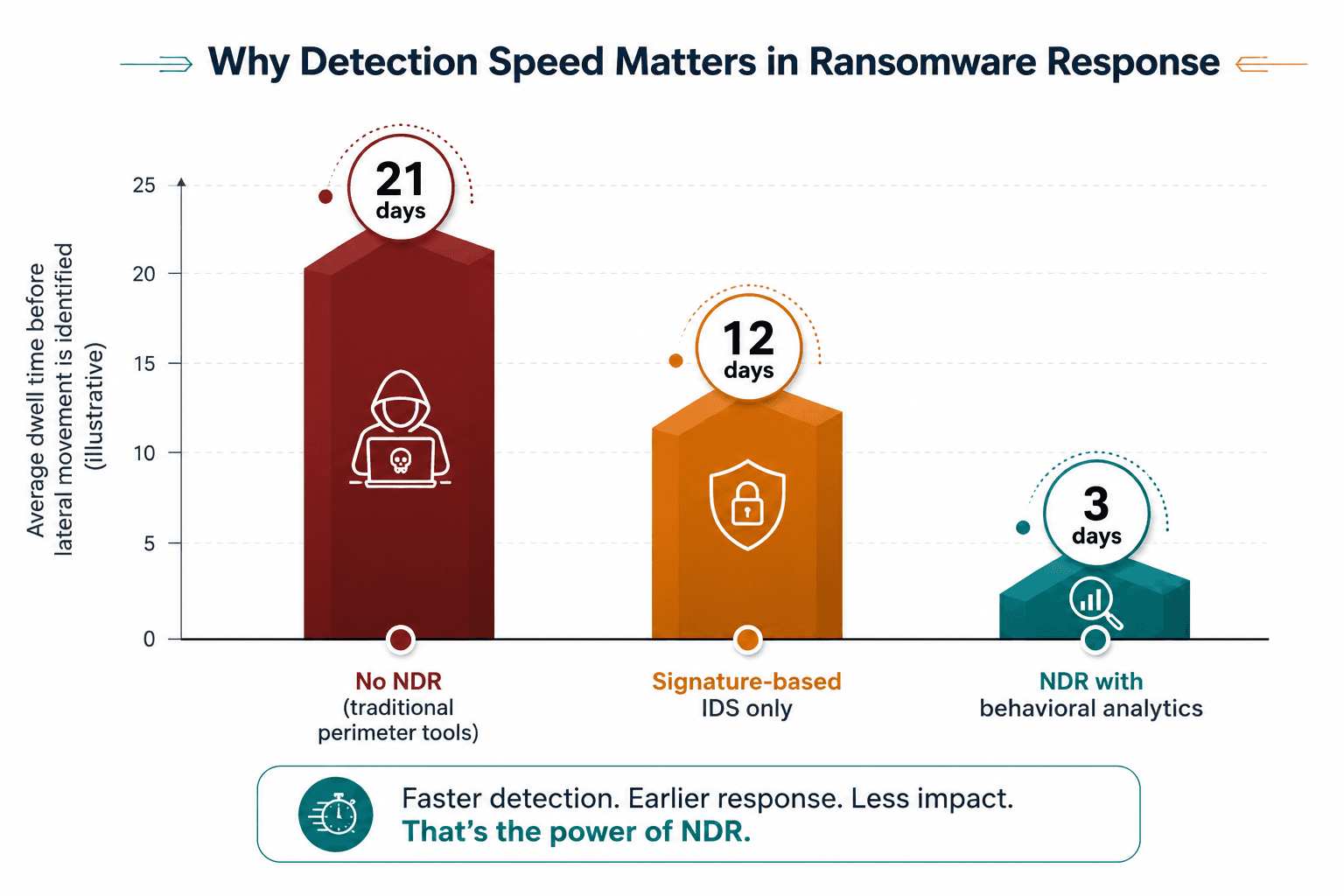
Figure 3: Illustrative comparison of how monitoring approach affects the time needed to identify lateral movement inside a network.
Practical Recommendations and Best Practices for OT Security Leaders
Building ransomware resilience through network visibility does not require a complete overhaul of existing security programs. It requires a clear, prioritized set of actions that most organizations can begin immediately, without waiting for a multi-year budget cycle or a complete network redesign.
Start with an accurate, living asset inventory rather than relying on outdated documentation from previous projects.
Deploy passive monitoring at the IT/OT boundary first, since this is where the earliest signs of lateral movement typically appear.
Establish behavioral baselines for critical zones before assuming any anomaly detection is tuned correctly.
Align IT and OT teams on a shared alerting and escalation process so that suspicious activity is investigated quickly by the right people.
Test incident response plans specifically for ransomware scenarios, including decisions about when and how to isolate OT segments.
Review remote access pathways regularly, since third-party and vendor connections remain one of the most common entry points into industrial networks.
Treat network visibility as an ongoing program rather than a one-time project, with regular reassessment as the network evolves.
None of these steps require ripping out existing infrastructure or pausing production to complete. They are best approached as a rolling program, prioritized by risk and site criticality, with measurable milestones that give leadership visibility into progress along the way. Organizations that treat this as an evolving capability, rather than a single project with a defined end date, tend to stay ahead of an attack surface that itself never stops evolving.
How Shieldworkz Supports Organizations
Shieldworkz works exclusively with industrial and critical infrastructure organizations to build practical, operationally-aware security programs , never generic IT security applied to OT environments as an afterthought. Our approach is grounded in understanding how your plant actually runs before recommending any technology or process change.
Comprehensive OT/ICS asset discovery and communication mapping, built through passive methods that never risk disrupting live operations.
Network visibility and NDR deployment strategy tailored to hybrid IT/OT environments, including phased rollouts that respect operational constraints and bandwidth realities.
Behavioral baselining and anomaly detection tuning specific to your industry, protocols, and site-by-site operating patterns.
Ransomware readiness assessments that evaluate segmentation, backup integrity, remote access exposure, and incident response maturity.
Ongoing monitoring support and alert triage guidance, helping lean security teams focus on the anomalies that matter most.
Executive-level reporting that translates technical findings into business risk language for boards, insurers, and regulators.
Conclusion
Ransomware will continue to target industrial organizations for a simple reason: the operational and reputational cost of downtime makes these targets attractive. The organizations that fare best are not necessarily the ones that prevent every single intrusion attempt , that standard is unrealistic in any modern, connected environment. The organizations that fare best are the ones that see the attacker moving early, understand exactly how far an incident has spread, and can make confident, fast decisions about containment rather than defaulting to a full shutdown out of uncertainty.
Network Detection and Response gives OT and ICS security leaders exactly that capability. By continuously observing behavior across IT, OT, and everything in between, NDR turns network traffic from a blind spot into one of the most valuable early-warning systems available to industrial organizations today. The question worth asking is not whether your organization can afford to invest in this level of visibility, it is whether your organization can afford the alternative.
Every industrial organization is at a different point on this journey. Some are still working through basic asset inventories, while others already have partial monitoring in place and are looking to close specific gaps at the IT/OT boundary or at remote sites. Wherever your organization currently stands, the most productive next step is usually a candid, informed conversation about what your network actually looks like today, and where the highest-priority blind spots remain.
Book a Free Consultation with Our Experts Talk to a Shieldworkz OT security specialist about your current network visibility, ransomware readiness, and NDR deployment options. No pressure, no sales script , just a candid conversation about where your industrial network stands today and what a stronger defense could look like. |
Additional resources:
Comprehensive Guide to Network Detection and Response NDR in 2026 here
NERC CIP-015 Internal Network Security Monitoring Readiness Checklist for Electric Utilities here
OT SOC Foundational Guide here
Managed SOC Service here
OT Cyber Threat Intelligence Advisory - Middle East here
NIS2 Directive Achieving NIS2 Compliance Through IEC 62443 here
What Is Removable Media? Risks, Policies, and Industrial OT Security Solutions here
Free Removable Media Policy Template for OT and IT Teams here
Get Weekly
Resources & News
See How Our Industry-Leading OT Security Solutions Address Critical Security Challenges
You may also like

IEC 62443 for Pharmaceutical Manufacturing: Secure Critical Production OT
Team Shieldworkz

Investigative cyber threat research report: Cyberattacks on U.S.-bound energy tankers
Team Shieldworkz

The OT Lull: What a 30-day decline in direct intrusion activity actually tells us
Prayukth K V

Inside the Revolut data disclosure incident
Prayukth K V

NERC CIP Compliance Software: 9 Capabilities Utilities Should Compare
Team Shieldworkz

Investigative Cyber Threat Research Report: Alleged Cyberattack and U.S. Investigation of VLCC VL Prosperity
Prayukth K V