
Team Shieldworkz
The Invisible Entry Point in Industrial Cybersecurity
In the world of operational technology, the greatest security vulnerabilities are often the most overlooked. While industrial organizations invest heavily in network segmentation, firewalls, and remote access controls, a persistent and growing threat slips past these defenses through a channel that bypasses almost every digital security layer: removable media.
USB drives, engineering laptops, portable hard drives, SD cards, and even optical discs continue to serve as essential operational tools across manufacturing floors, power generation facilities, water treatment plants, and oil and gas installations. They carry firmware updates, configuration files, diagnostic tools, and maintenance software. They are, by design, trusted. And that trust is precisely what sophisticated threat actors exploit.
What makes media-borne threats particularly dangerous in OT environments is the combination of air-gap assumptions and legacy infrastructure. Many plant operators still believe that physical separation from the internet is sufficient protection. The documented history of industrial attacks tells a very different story.
A single infected USB drive costs a nuclear enrichment facility years of recovery time. In today's industrial world, the same threat can walk through your plant's front door every single day, undetected.
Why OT Environments Cannot Simply Adopt IT Security Tools
The security community has spent decades refining endpoint protection for information technology environments. Enterprise antivirus platforms, email gateways, and intrusion detection systems are mature, well-tested, and broadly effective in IT environments. The operational technology world operates under fundamentally different constraints.
Industrial control systems often run on legacy operating systems that have reached end-of-support status. Real-time control requirements mean that even a momentary system pause for a security scan can cause production shutdowns, process disruptions, or in the worst cases, unsafe physical conditions. Update cycles for OT software are measured in years or decades, not months. The availability and integrity of systems take absolute precedence over confidentiality, the exact opposite of the IT security priority model.
Deploying a standard enterprise security scanner on an engineering workstation connected to a PLC may cause more operational harm than the malware it is trying to detect. This is why purpose-built media scan technology specifically designed for OT environments is not optional; it is essential.
The Most Dangerous Removable Media Entry Points in OT/ICS Environments
Understanding where malware enters is the first step toward building an effective media scanning strategy. The following table documents the most prevalent removable media types used in industrial environments, their associated risk levels, and the real-world threats they have enabled.
Media Type | Common Use in OT/ICS | Associated Risk Level | Real-World Threat Example |
USB Flash Drives | Firmware updates, config file transfers to PLCs/HMIs | Critical | Stuxnet (2010),spread via USB to Siemens PLCs in Iran nuclear facility |
Engineering Laptops | Field maintenance, SCADA diagnostics, software uploads | Critical | Ukraine Power Grid Attack (2015),malware deployed via engineering workstation |
CD/DVD Media | Legacy software installations, historian backups | High | Air-gapped facility compromises using optical media in classified environments |
SD Cards / Memory Cards | HMI display updates, historian data collection | High | Industrial espionage campaigns targeting energy and water utilities |
External Hard Drives | Bulk data transfers, asset backups | High | Ransomware introductions in manufacturing plants via portable drives |
Contractor/Vendor Devices | On-site maintenance tools brought by third parties | Critical | Multiple documented ICS breaches via third-party maintenance laptops |
How Modern Media Scan Technology Works in Industrial Environments
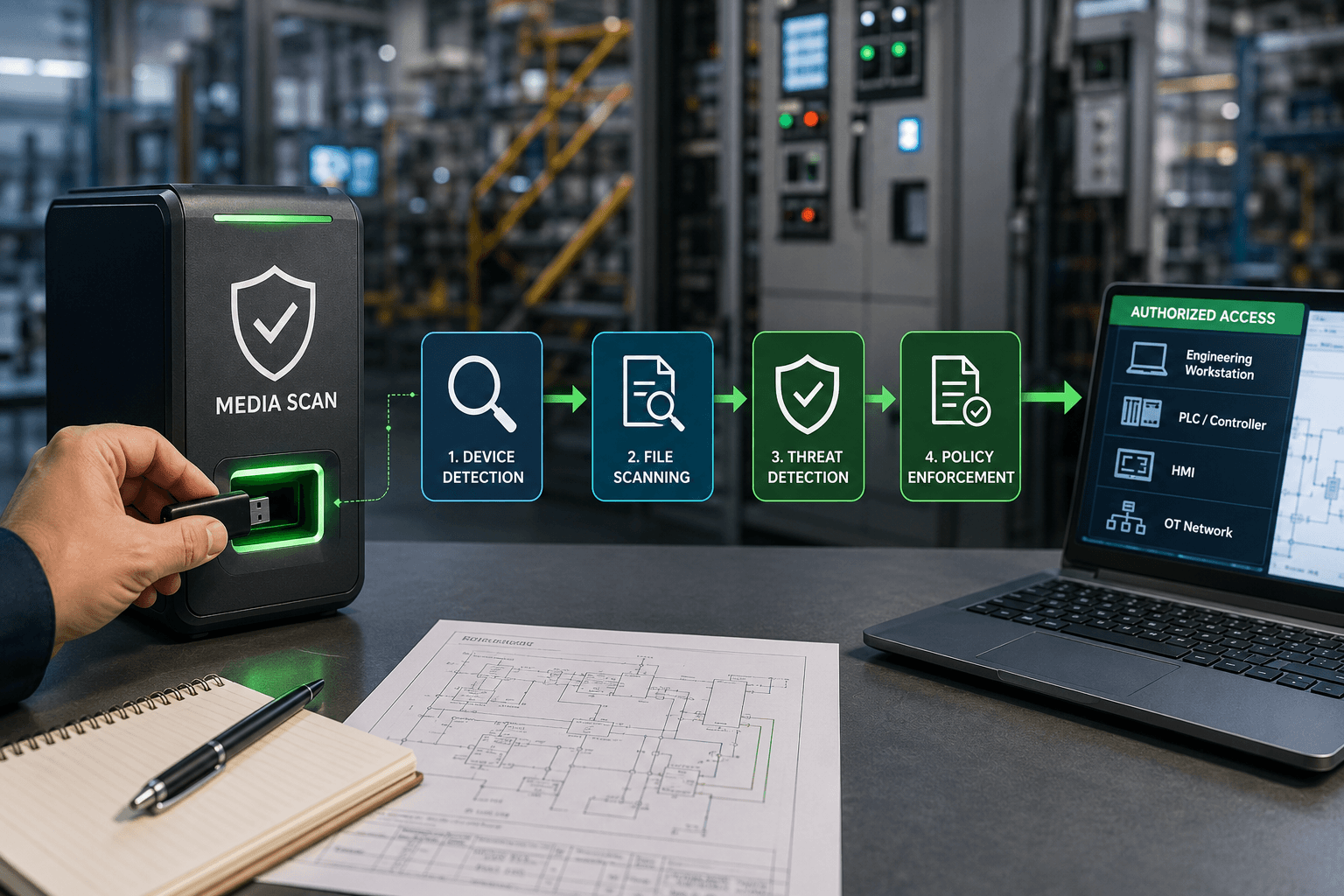
Effective media scanning for OT environments goes far beyond a simple virus check. Industrial-grade solutions employ multiple complementary detection layers designed to identify both well-documented threats and previously unknown attack tools.
Layer 1: Signature-Based Detection
The foundation of any scanning solution, signature-based detection compares file hashes, byte sequences, and behavioral patterns against a continuously updated database of known malware. For industrial environments, effective solutions maintain OT-specific threat libraries that include known PLC logic manipulation tools, HMI tampering code, and SCADA-targeting malware families, not just general-purpose IT malware.
Against known threats, this approach is highly effective and computationally efficient. Its limitation is inherent: it cannot detect threats that have not yet been catalogued. Against sophisticated, targeted attacks, the kind most dangerous to industrial infrastructure,signature-based detection alone is insufficient.
Layer 2: Heuristic and Behavioral Analysis
Heuristic analysis evaluates files based on behavioral characteristics rather than known fingerprints. A file that attempts to enumerate industrial network devices, reads PLC project files, or modifies automation software configuration registers is flagged as suspicious even without a matching signature.
This approach significantly extends detection capability to modified malware variants, existing attack tools that have been altered enough to evade signature detection. In the OT threat landscape, where attackers frequently modify proven tools for new campaigns, heuristic detection provides critical coverage.
Layer 3: Dynamic Sandboxing
The most powerful component of advanced media scanning is dynamic analysis, executing suspicious files in an isolated, controlled environment that simulates an OT system. The sandbox observes actual behavior: Does the file attempt to communicate with external IP addresses? Does it try to modify PLC firmware? Does it disable system logging or alter process values?
Sandboxing is the primary defense against zero-day threats, malware designed specifically to evade signature and heuristic detection. For industrial environments facing sophisticated, targeted attacks like Triton or next-generation variants, dynamic analysis is not a luxury feature. It is a necessary capability.
Layer 4: OT Protocol and File Integrity Analysis
Industrial-specific scanning goes beyond executable files. It examines engineering project files, PLC configuration packages, firmware update binaries, and historian data files for signs of tampering. It analyzes whether files contain embedded industrial protocol commands, Modbus, DNP3, EtherNet/IP, PROFINET, that are anomalous for the file type being examined.
This layer is specifically designed to detect the supply chain attacks and insider threat scenarios that general-purpose scanners entirely miss. A firmware update file from a vendor that has been modified in transit, a documented attack technique, will not trigger standard antivirus detection. Protocol-aware scanning can identify these modifications.
Media Scan Detection Method Comparison for OT/ICS Environments
Detection Category | What It Scans For | Threat Type Addressed | Effectiveness in OT |
Signature-Based Detection | Known malware fingerprints, hash matches | Stuxnet, Industroyer, BlackEnergy variants | High for known threats |
Heuristic Analysis | Unusual file behaviors, code anomalies | Modified or repackaged malware | Moderate-to-High |
Sandboxing / Dynamic Analysis | File execution behavior in an isolated environment | Zero-day exploits, ransomware droppers | Very High for unknown threats |
Protocol Anomaly Detection | Irregular industrial protocol commands in file payloads | Triton/TRISIS-style attacks, PLC logic bombs | High for targeted OT attacks |
File Integrity Verification | Unauthorized changes to firmware and config files | Supply chain tampering, insider threats | High for configuration security |
Multi-Engine Scanning | Parallel analysis by multiple detection engines | Full-spectrum malware, advanced persistent threats | Highest overall coverage |
Deployment Best Practices for Industrial Media Scanning
The Scanning Kiosk Model
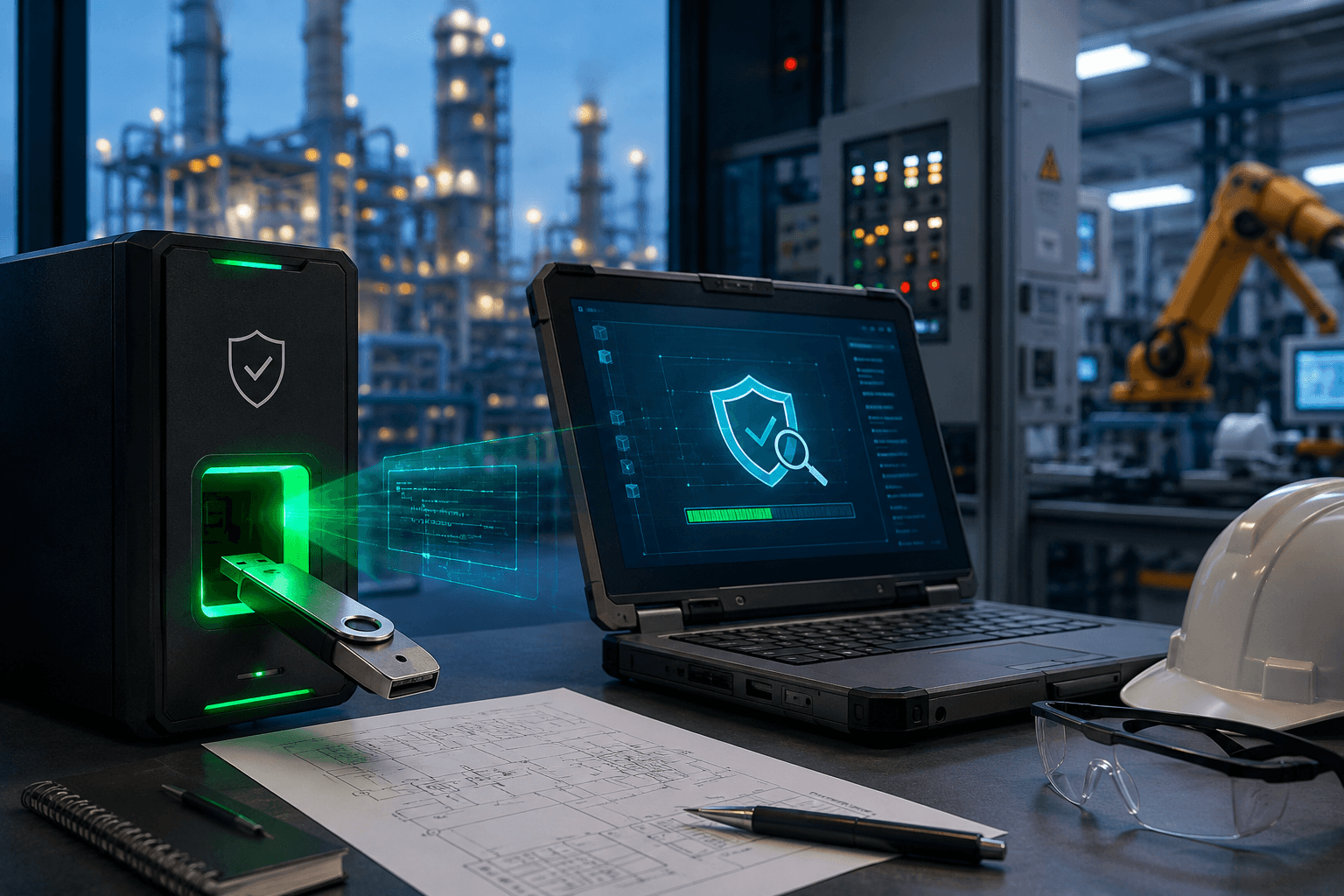
The most effective deployment architecture for OT media scanning is the dedicated scanning kiosk, a purpose-built hardware station installed at facility entry points, typically at the security gate, the IT/OT network boundary, or the engineering workstation staging area.
Every removable media device is scanned before it physically enters the facility or connects to any OT system. This creates an enforceable policy checkpoint that is operationally simple for plant staff, vendors, and contractors to understand and follow: if it has not been scanned, it does not enter. The kiosk model enforces discipline through process rather than relying on individual judgment.
Engineering Workstation Scanning Protocols
Engineering workstations present a unique challenge. They are frequently used both in office environments and directly on the plant floor, connecting to PLCs, HMIs, and SCADA systems. An engineering laptop that downloads a software update from a vendor portal and then connects to a PLC without scanning represents a critical exposure window.
Effective protocols require that engineering workstations undergo media scanning after any exposure to external networks or media and before connection to any OT system component. This scan-before-connect discipline should be enforced through policy and, where possible, through technical controls that prevent OT system connections from unscanned devices.
Third-Party and Contractor Management
Some of the most significant documented OT security breaches have originated from third-party contractor devices. Maintenance vendors, system integrators, and equipment suppliers bring their own laptops and portable storage devices into industrial facilities with legitimate business purposes, and sometimes with unintentional or deliberate malware aboard.
Scanning protocols must explicitly cover all contractor and vendor devices as a non-negotiable entry requirement. Organizations that allow exceptions to scanning policies for trusted vendors create the exact vulnerability that sophisticated attackers specifically target through supply chain compromise techniques.
Frequency and Update Management
Threat signature databases should be updated on a defined schedule, with critical OT-specific threat intelligence incorporated as new campaigns are identified
Scanning logs should be reviewed regularly and fed into the broader security monitoring framework
Results from dynamic sandboxing should be analyzed not just for immediate threats but for indicators of reconnaissance activity or targeted pre-positioning
Periodic testing of the scanning solution using controlled test files should verify that detection capabilities remain effective
Policies should be reviewed annually or after any significant change to the industrial environment or threat landscape
How Shieldworkz Supports Industrial Organizations with OT-Native Media Scanning
Shieldworkz was built by industrial cybersecurity specialists who understand that protecting OT environments requires more than applying IT security concepts to industrial settings. Our media scanning capabilities are purpose-designed for the operational realities, legacy constraints, and threat profiles of industrial control system environments.
Capability | Description | Business Benefit |
OT-Native Media Scanning Kiosks | Dedicated scanning stations deployed at facility entry points, not IT-adapted tools | Eliminates malware before it enters the OT network perimeter |
Multi-Engine Threat Analysis | Parallel scanning using multiple detection engines simultaneously for maximum coverage | Dramatically reduces false negatives on novel and targeted threats |
Zero-Day & Behavioral Detection | Dynamic sandbox analysis that executes suspicious files in an isolated OT-simulated environment | Identifies threats that have no existing signature or patch |
Engineering Workstation Hardening | Dedicated scanning workflow tailored to laptops and portable devices used by OT engineers | Secures the most common path for malware entering industrial environments |
Compliance & Audit Reporting | Automated scan reports aligned with IEC 62443, NERC CIP, and NIST SP 800-82 requirements | Reduces compliance burden and prepares organizations for regulatory audits |
Incident Forensics Support | Detailed file-level logs and threat attribution to support post-incident investigation | Enables faster root cause analysis and improves future defenses |
On-Site Deployment Expertise | Shieldworkz engineers work directly with your OT/ICS team for seamless integration | Avoids operational disruption during deployment in live industrial environments |
Beyond technology deployment, Shieldworkz works alongside your OT and security teams to build the policies, procedures, and training programs that make media scanning effective in practice,not just on paper. Technical controls are only as strong as the operational discipline that supports them.
Purpose-built OT media scanning solutions,not IT products adapted for industrial use
Multi-engine scanning with OT-specific threat intelligence libraries
Zero-day detection through dynamic behavioral analysis in isolated environments
Engineering workstation security workflows tailored to field maintenance realities
Compliance reporting aligned with IEC 62443, NERC CIP, and NIST SP 800-82
On-site deployment support from certified OT cybersecurity engineers
Ongoing threat intelligence updates focused exclusively on industrial threats
Incident response support and forensic analysis capabilities
Conclusion: The Gate You Cannot Afford to Leave Open
The evidence is unambiguous. From the uranium enrichment halls of Natanz to the power distribution infrastructure of Ukraine, and from petrochemical safety systems in the Middle East to manufacturing facilities across every industrialized nation, removable media remains the most consistently exploited entry point for malware targeting operational technology.
What makes this threat particularly urgent is that it is entirely addressable. Media scan technology designed for industrial environments exists. The detection methods are proven. The deployment models are practical and operationally compatible with real industrial workflows. The gap between the threat environment and adequate protection is not technical; it is organizational.
OT security leaders who have secured network perimeters, implemented segmentation strategies, and deployed monitoring solutions but have not addressed the removable media exposure have left a reliable, well-documented attack path wide open. Modern adversaries know this, and they use it.
The question is not whether your organization will encounter malware on removable media. The question is whether your industrial environment has the capability to detect and stop it before it reaches your PLCs, HMIs, or safety instrumented systems.
Every day without OT-native media scanning is a day that threat actors have an open invitation into your industrial control systems.
Book a Free Consultation with Our Experts Are you confident in the security of the transient cyber assets and removable media entering your facility? Protect your critical infrastructure from targeted malware. Contact Shieldworkz today to book a free, comprehensive consultation with our OT cybersecurity experts and learn how to implement zero-trust media scanning in your environment.
Additional resources:
What Is Removable Media? Risks, Policies, and Industrial OT Security Solutions here
Free Removable Media Policy Template for OT and IT Teams here
Remediation Guides here
Get Weekly
Resources & News
See How Our Industry-Leading OT Security Solutions Address Critical Security Challenges
You may also like

PHP2Shell Update: First Confirmed Exploitation, OT Vendor Fallout and the CISO Response Plan
Team Shieldworkz

PLC Penetration Testing: A Safe Methodology That Works
Team Shieldworkz

Investigative report on Lamashtu extortion operations: German brewery incident analysis
Prayukth K V

Passive OT Asset Discovery Techniques: The Complete Guide for Industrial Environments
Team Shieldworkz

Modbus TCP Security: Firewall Rules and Best Practices
Team Shieldworkz

IEC 62443 Zones and Conduits: Practical Industrial Examples
Team Shieldworkz