
Team Shieldworkz
A ransomware alert on a corporate laptop and a stalled blast furnace should never feel like the same emergency, but in most industrial environments today, they trigger the same slow, manual scramble. Security teams still spend precious hours pulling logs by hand, calling plant engineers to confirm what a device actually does, and manually isolating switches while production keeps running blind. That gap between detection and containment is exactly where attackers live, and it is exactly what modern Network Detection and Response, layered on top of disciplined network segmentation and zero trust architecture, is built to close.
This is not a theoretical concern for OT security leaders, ICS engineers, plant managers, and CISOs overseeing manufacturing, energy, and critical infrastructure environments. It is the operational reality driving budget conversations, board-level risk reviews, and insurance renewals across the industrial sector. Understanding how automated incident response actually works, and why it depends entirely on the segmentation and trust model underneath it, is now a core competency for anyone responsible for keeping industrial operations safe, available, and resilient.
The Attack Surface Has Moved Onto the Plant Floor
For decades, industrial control systems were protected by a simple assumption: they were isolated. Air-gapped networks, proprietary protocols, and specialized hardware created a natural moat around programmable logic controllers, remote terminal units, and supervisory control systems. That moat has largely disappeared. IT and OT networks are converged for efficiency, remote vendors need access for maintenance, cloud-based historian and analytics platforms pull data directly from the plant floor, and the same ransomware crews that target hospitals and banks have learned that industrial operators pay quickly to avoid production downtime.
Several publicly documented incidents illustrate how quickly this shift happened. The 2015 and 2016 attacks on Ukraine's power grid used malware that directly manipulated circuit breakers and substation equipment, cutting electricity to hundreds of thousands of customers and demonstrating that attackers could reach deep into operational technology, not just IT systems. In 2017, malware known as Triton, or Trisis, was discovered targeting the safety instrumented systems of a petrochemical facility in Saudi Arabia, the very controllers designed to prevent explosions and protect human life. That incident remains one of the clearest warnings the industrial sector has received: attackers are no longer just after data, they are probing the systems that keep people safe.
Closer to home for many manufacturers, the 2019 ransomware attack on Norsk Hydro forced the aluminum producer to switch large parts of its operations to manual processes for weeks, at a cost that ran into tens of millions of dollars. And the 2021 Colonial Pipeline incident showed how an attack that technically stayed within IT systems could still force operators to shut down an entire fuel pipeline out of caution, because they lacked confidence in the boundary between their business network and their operational network. None of these organizations were careless. They simply lacked the segmentation, visibility, and automated response capability needed to contain an incident before it forced a shutdown.
Why Manual Incident Response No Longer Works in Industrial Environments
The traditional incident response model was built for IT: an analyst reviews an alert, checks a few systems, and decides whether to isolate a laptop or reset a credential. Applied to OT, that model breaks down in three specific ways.
Dwell time is longer and more dangerous. Industrial intrusions have historically gone undetected for extended periods because OT traffic is rarely monitored with the same rigor as IT traffic, giving attackers time to map the network and identify high-value targets such as safety systems.
Alert fatigue hits harder. Legacy intrusion detection tools built for enterprise IT generate enormous volumes of noise when pointed at OT protocols they were never designed to understand, burying the handful of genuinely dangerous alerts.
Containment decisions carry physical consequences. An analyst cannot simply cut power to a segment the way they would isolate a compromised laptop; doing so incorrectly can trigger a safety event, damage equipment, or halt a process that takes hours to safely restart.
The result is a response cycle measured in hours or days rather than minutes, precisely the window attackers need to move from initial access to real operational impact. Closing that window requires two things working together: automation that understands OT context, and a segmented network architecture that makes fast, safe containment possible in the first place.
The Business Cost of Delayed Containment
Security leaders often win budget for new tooling by talking about breach probability. In industrial environments, the more persuasive number is usually simpler: the cost of every hour a line, unit, or facility sits idle while a team manually investigates what happened. Unplanned downtime in continuous-process industries such as chemicals, energy, and heavy manufacturing routinely runs into tens of thousands of dollars per hour once lost production, spoiled materials, contractual penalties, and restart costs are combined, and a full precautionary shutdown across multiple lines multiplies that figure quickly.
Delayed containment compounds this cost in three distinct ways. First, the direct production loss grows for every hour an incident remains unresolved. Second, the scope of a manual investigation tends to expand as more systems are pulled offline out of caution simply because nobody can say with confidence which ones are affected. Third, recovery itself takes longer, because restarting complex industrial processes safely after an unplanned stop is rarely as simple as flipping a switch back on, it often requires re-validating safety interlocks and process parameters before production can resume.
Response Model | Typical Detect-to-Contain Window | Scope of Precautionary Shutdown |
Manual, log-driven investigation | Hours to several days | Often plant-wide or multi-line, out of caution |
NDR alerts without automated response | Under an hour to detect, hours to act | Reduced, but still dependent on manual execution |
Automated NDR + SOAR with segmentation | Minutes from detection to first containment action | Limited to the specific segmented zone affected |
Table 3: How response maturity directly shapes the operational cost of an incident.
Framed this way, automated incident response and segmentation stop looking like a pure security expense and start looking like operational risk management, the same category of investment as backup generators or redundant safety systems, justified by avoided downtime rather than avoided breach alone.
What Modern NDR Actually Means for OT Networks
Network Detection and Response designed for industrial environments is a fundamentally different discipline than the intrusion detection tools most IT teams already run. Generic IT-focused tools inspect packet headers and flag known signatures; they were never built to parse Modbus, DNP3, EtherNet/IP, or proprietary vendor protocols, and they cannot tell the difference between a scheduled maintenance command and a malicious one. Purpose-built OT NDR platforms instead build a behavioral baseline of every asset on the network, what it talks to, what commands it normally issues, and what a safe operating pattern looks like, and flag deviations from that baseline in real time, without requiring intrusive scanning that could disrupt sensitive control systems.
Capability | Traditional IT-Centric Monitoring | Purpose-Built OT Network Detection & Response |
Protocol awareness | Understands common IT protocols only | Parses industrial protocols (Modbus, DNP3, EtherNet/IP, OPC-UA and others) |
Discovery method | Active scanning, often disruptive | Passive, non-intrusive traffic monitoring safe for legacy devices |
Detection logic | Signature and CVE matching | Behavioral baselining of assets, commands, and process logic |
Asset visibility | Limited to networked IT endpoints | Full inventory of PLCs, RTUs, HMIs, sensors, and engineering workstations |
Response speed | Manual triage, hours to days | Automated triage and orchestrated containment in minutes |
Safety alignment | Not designed with process safety in mind | Response actions calibrated against operational and safety impact |
Table 1: How purpose-built OT network detection differs from generic IT monitoring tools.
This behavioral, protocol-aware foundation is what makes automation trustworthy in an OT context. An automated system can only take safe action when it truly understands what "normal" looks like on that specific network, which is why bolting a generic IT tool onto a production line so often does more harm than good.
Automating the Incident Response Lifecycle
Automation in OT incident response is not about removing humans from the loop, it is about removing the delay between detection and the first safe containment action, so that human experts spend their time making judgment calls instead of chasing raw data. A mature automated workflow generally moves through six stages, each one feeding the next without waiting for a person to manually trigger it.
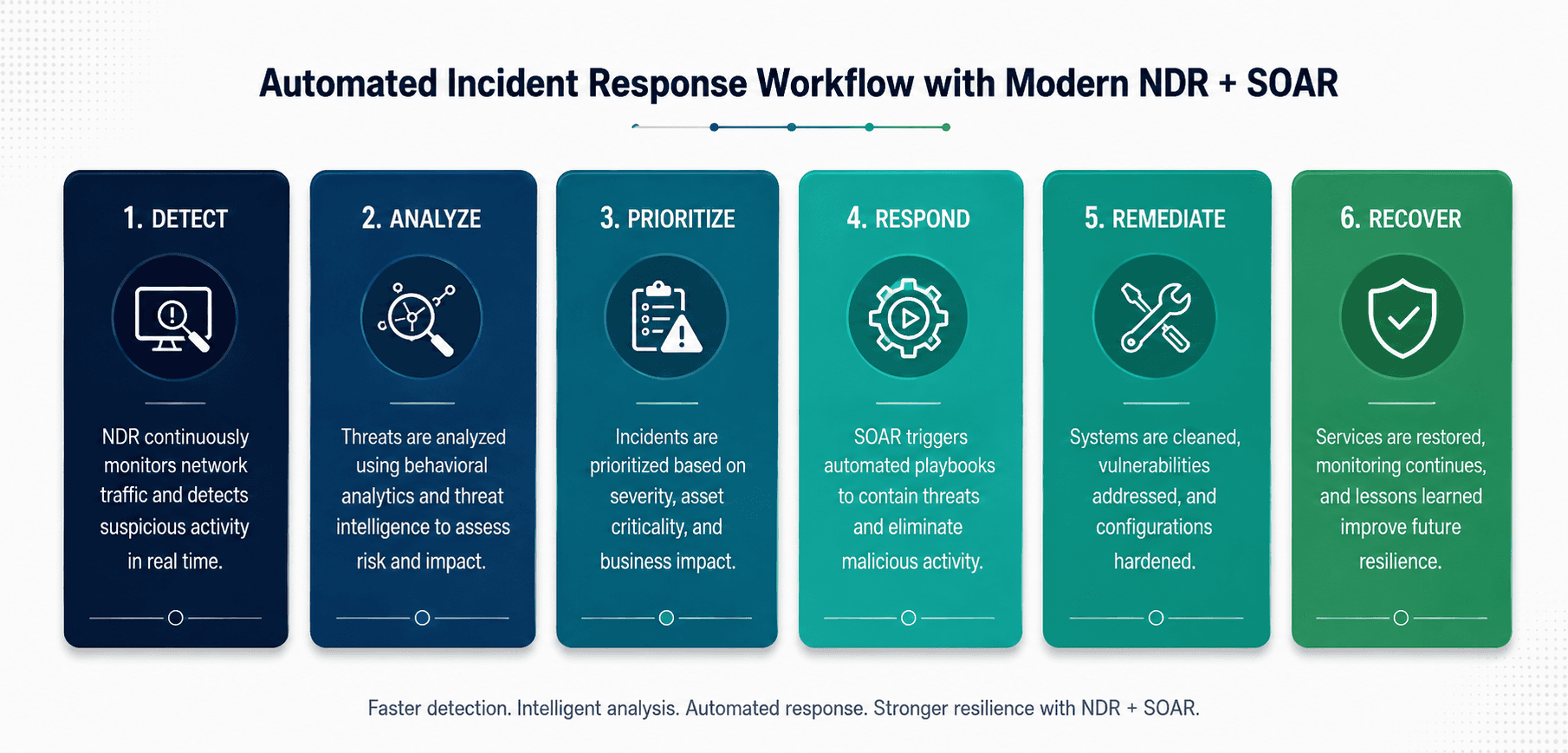
Figure 1: A modern automated incident response pipeline connecting OT-aware NDR sensors with SOAR-driven orchestration.
1. Detect
Sensors positioned at key network junctions continuously compare live traffic against the established behavioral baseline, flagging anomalies such as an engineering workstation suddenly issuing write commands to a controller it has never communicated with before.
2. Enrich
Raw alerts are automatically layered with asset context, device type, firmware version, criticality, physical location, and cross-referenced against current threat intelligence, turning a bare network event into a fully contextualized incident.
3. Triage
Automated scoring weighs the enriched alert against business and safety impact, separating a routine maintenance anomaly from a credible threat to a safety instrumented system, so analysts focus only on what genuinely matters.
4. Orchestrate
For alerts that cross a defined risk threshold, pre-approved playbooks execute automatically, tightening firewall rules, revoking a suspicious remote session, or moving a device into a restricted VLAN, without waiting on a human to type the first command.
5. Contain
Containment actions are scoped precisely to the affected segment, so a compromised HMI can be isolated without interrupting the safety controllers or production lines operating around it, preserving uptime while eliminating the threat's reach.
6. Report
Every action, timestamp, and decision point is logged automatically into a forensic timeline, ready for the SOC, regulators, insurers, and executive leadership, turning what used to be days of after-action reconstruction into an instantly available record.
Network Segmentation: The Foundation That Makes Automation Safe
None of the automation described above is safe to deploy without a deliberately segmented network underneath it. Segmentation is what allows an automated playbook to isolate one compromised zone with surgical precision instead of triggering a plant-wide shutdown out of caution. Most industrial environments still map loosely to the Purdue Enterprise Reference Architecture, and each layer of that model represents both a functional boundary and a security boundary that should be enforced, not just documented.
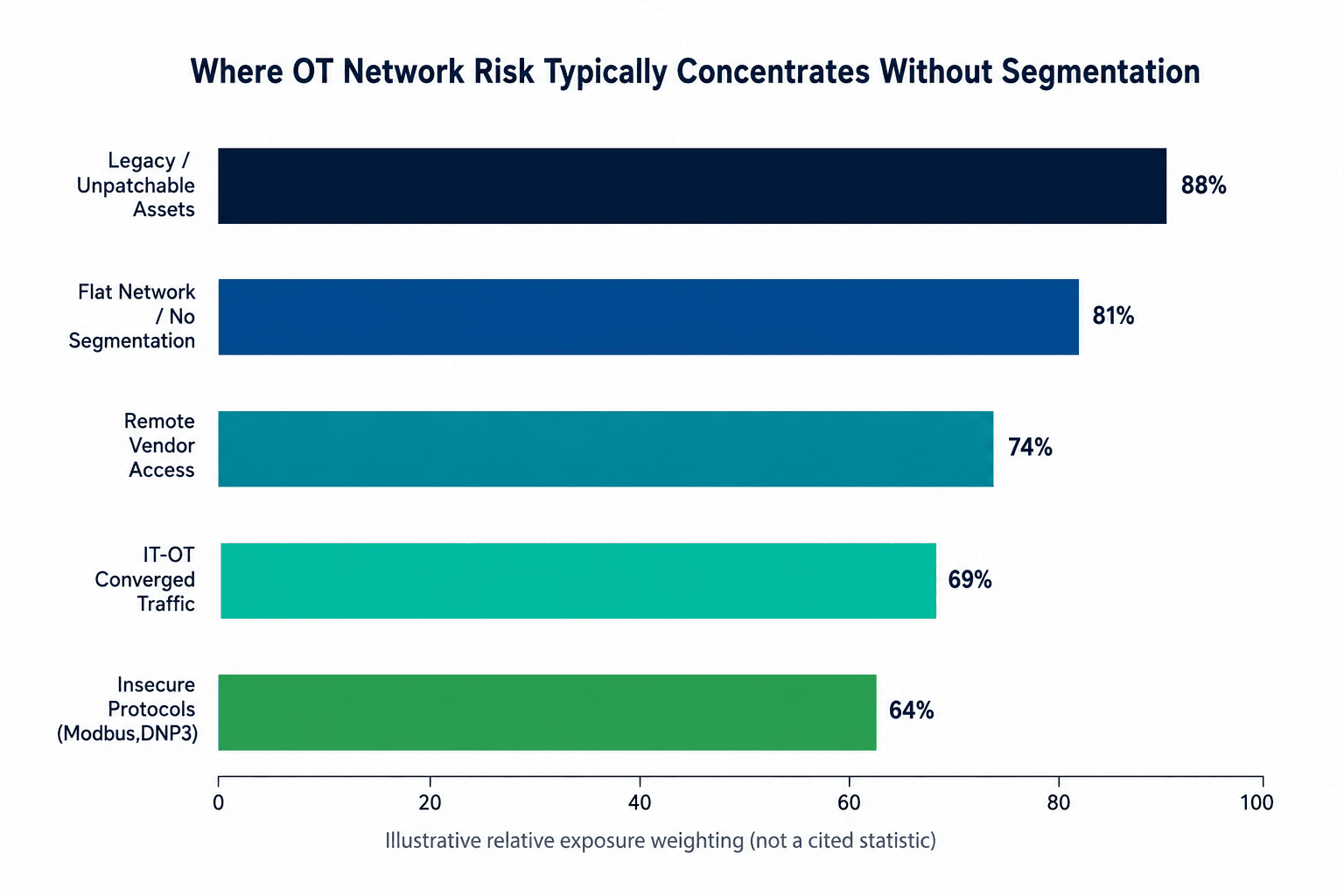
Figure 2: Applying zero trust verification at every boundary of the Purdue model, from enterprise IT down to field devices.
Purdue Level | What Lives There | Segmentation Priority |
Level 5, Enterprise IT | Corporate applications, email, cloud services | Strict boundary from OT; no direct control-plane access |
Level 4, Business Planning | ERP, business logistics, reporting systems | Data flows one-directional where possible into OT |
Level 3, Operations & MES | Manufacturing execution, historians, patch servers | Broker all traffic through a monitored DMZ |
DMZ | Jump servers, replicated historians, remote access gateways | Zero trust enforcement point; every session verified |
Level 2, Supervisory Control | SCADA, HMI, engineering workstations | Micro-segmented by production line or cell |
Level 0-1, Field Devices | PLCs, RTUs, sensors, actuators | Isolated device groups with tightly scoped east-west access |
Table 2: Segmentation priorities mapped to each layer of the Purdue reference model.
The organizations that recover fastest from an OT security incident are almost never the ones that avoided every attack, they are the ones whose network architecture physically limited how far an attacker could move once inside. Segmentation converts a potential plant-wide emergency into a contained, single-cell event that automated tools can neutralize in minutes.
Applying Zero Trust Principles Inside OT Environments
Zero trust is often discussed as an IT concept, but its three core principles translate directly into the industrial world, with a few important adaptations for the realities of legacy equipment and continuous operations.
Verify explicitly: every session, whether from a vendor's remote access tool, an engineering laptop, or a historian pulling data, is authenticated and authorized based on identity and context, not simply because it originates from inside the plant network.
Enforce least privilege: an operator, engineer, or third-party integrator receives access scoped to exactly the systems and functions their role requires, nothing more, which dramatically limits what a compromised credential can actually do.
Assume breach: architecture and monitoring are designed on the assumption that an attacker will eventually gain a foothold somewhere, so the priority shifts from preventing every intrusion to limiting blast radius and detecting lateral movement immediately.
Applied correctly, zero trust does not mean adding friction to every operator action on the plant floor. It means removing the implicit trust that flat, legacy OT networks have relied on for decades, the assumption that anything already inside the perimeter is safe, and replacing it with continuous, contextual verification at the points that matter most: the DMZ, remote access gateways, and the boundaries between production cells.
Risks, Challenges, and Industry Insights
Even organizations that recognize the need for automated response and segmentation run into predictable obstacles when they try to implement it. Understanding these challenges upfront is what separates a rollout that strengthens operations from one that disrupts them.
Legacy and unpatchable assets: many field devices run software that cannot be updated without vendor involvement or a full outage window, so segmentation and monitoring often have to compensate for vulnerabilities that cannot be directly patched.
Flat, undocumented networks: plants built or expanded over decades frequently have far more east-west connectivity than anyone realizes, and a full asset and traffic discovery exercise is usually the first step before segmentation can even be designed.
Third-party and vendor remote access: maintenance contracts often require external engineers to reach specific controllers, and without scoped, time-boxed, monitored access, that pathway becomes one of the most common routes attackers use to enter an OT network.
Converged IT-OT traffic: the same connectivity that enables predictive maintenance and real-time analytics also creates a bridge attackers can use to pivot from a compromised office laptop into the plant floor.
Insecure-by-design protocols: many industrial protocols were built decades ago with no authentication or encryption in mind, so monitoring and segmentation have to carry the security burden the protocol itself cannot.
Skills and staffing gaps: security teams trained on IT tools often lack the OT process knowledge needed to judge whether a containment action is safe, which is exactly the gap that well-designed automation and playbooks are meant to close.
None of these challenges are reasons to delay. They are the specific problems that a phased segmentation and automation program is designed to solve, one production zone at a time, without demanding a disruptive, all-at-once network overhaul.
Regulatory Momentum Is Making This Non-Negotiable
Beyond operational risk, the regulatory landscape around industrial cybersecurity has shifted decisively toward requiring exactly the capabilities described in this article. Standards such as IEC 62443 explicitly call for network segmentation into security zones and conduits as a foundational control for industrial automation systems. In North America, NERC CIP requirements place specific obligations on bulk electric system operators around electronic security perimeters and incident response planning. Pipeline and transportation operators have faced new directives requiring documented network segmentation and continuous monitoring following high-profile incidents. And a growing number of jurisdictions now expect timely breach disclosure for incidents affecting critical infrastructure, which is far easier to meet when automated tooling already produces a complete forensic timeline.
None of these frameworks mandate a specific vendor or product, but nearly all of them converge on the same underlying expectations: know your assets, segment your network, monitor continuously, and be able to demonstrate a tested incident response capability. Organizations that build toward these principles proactively find compliance audits far less disruptive than those trying to retrofit documentation onto a network nobody has ever fully mapped.
Practical Recommendations and Best Practices
Organizations that successfully modernize their incident response capability tend to follow a similar sequence, prioritizing visibility before automation and segmentation before enforcement.
Start with a full asset and traffic inventory: you cannot segment, baseline, or automate a response for a device your team does not know exists.
Establish passive monitoring before anything else: non-intrusive OT-aware NDR should be running and building a behavioral baseline well before any automated containment action is enabled.
Segment incrementally, by production zone: rather than attempting a plant-wide redesign, isolate the highest-risk or highest-value cells first and expand outward as confidence grows.
Build a DMZ that actually enforces zero trust: every data flow between IT and OT, including historian replication and remote access, should route through a monitored broker rather than a direct connection.
Define playbooks with operations, not just security: containment actions should be reviewed and approved by plant engineers who understand the safety and process implications before they are automated.
Time-box and monitor all third-party access: vendor and integrator sessions should be scoped to specific systems, logged in full, and automatically expired when the maintenance window ends.
Test response playbooks regularly: tabletop exercises and simulated incidents keep both the automation and the human team ready for a real event, and surface gaps before an attacker does.
Report metrics that matter to leadership: mean time to detect, mean time to contain, and segmentation coverage give executives a clear, board-ready view of improving resilience over time.
Most successful programs unfold in three deliberate phases rather than a single disruptive project, which keeps operational risk low while still delivering measurable progress within the first few months.
Phase | Primary Focus | Typical Outcome |
Phase 1, Visibility | Asset discovery, passive traffic monitoring, baseline behavior | A complete, accurate map of what is actually on the network |
Phase 2, Segmentation | DMZ enforcement, zone and conduit design, remote access controls | Contained blast radius and enforced least-privilege boundaries |
Phase 3, Automation | SOAR playbooks, orchestrated containment, continuous testing | Minutes-level detect-to-contain time with minimal manual effort |
Table 4: A phased approach that builds automation on a foundation of visibility and segmentation.
Frequently Asked Questions
Is network segmentation possible without disrupting live production?
Yes, when it is planned as a phased rollout starting with passive discovery. Segmentation projects that fail are almost always the ones that skip straight to enforcement without first understanding real traffic patterns; a careful, zone-by-zone approach avoids unplanned interruptions.
Can automated response accidentally shut down a safety-critical process?
Only if the playbooks are poorly designed. Well-built automation is scoped precisely to network-layer containment actions, isolating a switch port or restricting a VLAN, for example, and is developed jointly with process engineers so it never touches safety instrumented systems directly.
How is OT-focused NDR different from an IT firewall or antivirus tool?
Firewalls and antivirus tools control access and catch known malicious files; they do not understand industrial protocols or behavioral context. OT NDR is purpose-built to watch how devices actually communicate and flag deviations from that pattern, which is where most real ICS intrusions eventually reveal themselves.
What should a plant manager expect from an initial assessment?
A credible assessment begins with passive network discovery, not intrusive scanning, and should produce a clear asset inventory, a segmentation gap analysis, and a prioritized set of recommendations tied to actual operational risk, not a generic checklist.
How Shieldworkz Supports Organizations
Shieldworkz works alongside industrial operators, plant engineering teams, and security leaders to build incident response and network architecture that fits the realities of live production environments, not a generic template borrowed from enterprise IT.
Comprehensive OT asset discovery and network mapping, delivered through passive, non-intrusive methods that never risk disrupting sensitive control systems.
Purpose-built network detection tuned to industrial protocols, giving security teams a behavioral baseline instead of a flood of irrelevant IT-style alerts.
Zero trust segmentation design aligned to the Purdue model and tailored to each facility's specific production zones, vendors, and safety requirements.
Automated incident response playbooks co-developed with plant and process engineers, so every containment action respects operational and safety constraints.
Ongoing monitoring, threat intelligence, and incident response support from a team fluent in both cybersecurity and industrial operations.
Executive and board-level reporting that translates technical risk into clear operational and financial terms for informed decision-making.
The goal is straightforward: reduce the time between the first sign of compromise and full containment, without adding operational risk or unnecessary complexity to environments where uptime and safety come first.
Conclusion
The organizations best positioned to withstand the next major industrial cyber incident will not be the ones that never get targeted, every connected industrial environment eventually will be. They will be the ones that detect an intrusion in minutes instead of months, contain it within a single segmented zone instead of an entire plant, and do it all without a single unplanned production stoppage. That outcome is not the product of any single tool. It is the result of purpose-built network detection, disciplined zero trust segmentation, and automated response working together as one coordinated system.
Building that system takes deliberate planning, deep OT process knowledge, and a partner who understands that a control room is not a data center. The sooner that foundation is in place, the smaller the window an attacker has to work with, and the more confidently an operations team can keep running.
Ready to See Where Your OT Network Actually Stands?
Book a free, no-obligation consultation with the Shieldworkz industrial cybersecurity team. We'll walk through your current network architecture, discuss practical first steps toward segmentation and automated response, and answer the questions your board is already asking.
Book a Free Consultation with Our Experts
Additional resources:
Comprehensive Guide to Network Detection and Response NDR in 2026 here
NERC CIP-015 Internal Network Security Monitoring Readiness Checklist for Electric Utilities here
OT SOC Foundational Guide here
Managed SOC Service here
OT Cyber Threat Intelligence Advisory - Middle East here
NIS2 Directive Achieving NIS2 Compliance Through IEC 62443 here
What Is Removable Media? Risks, Policies, and Industrial OT Security Solutions here
Free Removable Media Policy Template for OT and IT Teams here
Get Weekly
Resources & News
See How Our Industry-Leading OT Security Solutions Address Critical Security Challenges
You may also like

What the French supermarket cyberattack reveals about OT security
Prayukth K V

Inside the Albert Heijn cyber incident: Investigating the attack, the IT/OT exposure, and the risks to critical operations
Team Shieldworkz

50°C by cyberattack? Inside France’s supermarket refrigeration crisis
Prayukth K V

Automating IEC 62443 Compliance Assessments Without Losing Expert Control
Team Shieldworkz

Investigative cyber threat intelligence report: Daiichi Kosho supply-chain data exposure
Prayukth K V

How AI Is Changing IEC 62443 Assessments
Team Shieldworkz