The Canva breach and the hidden risk of third-party trust

Prayukth K V
Contemporary third-party risk programs usually assess the security posture of a supplier without adequately measuring the technical trust paths that supplier creates into the enterprise.
A vendor carrying a modest level of inherent risk can rapidly turn into a high-consequence cyber incicent when its integration possessing privileged access to identity systems, SaaS applications, sensitive datasets, administrative consoles, or downstream service providers is misused.
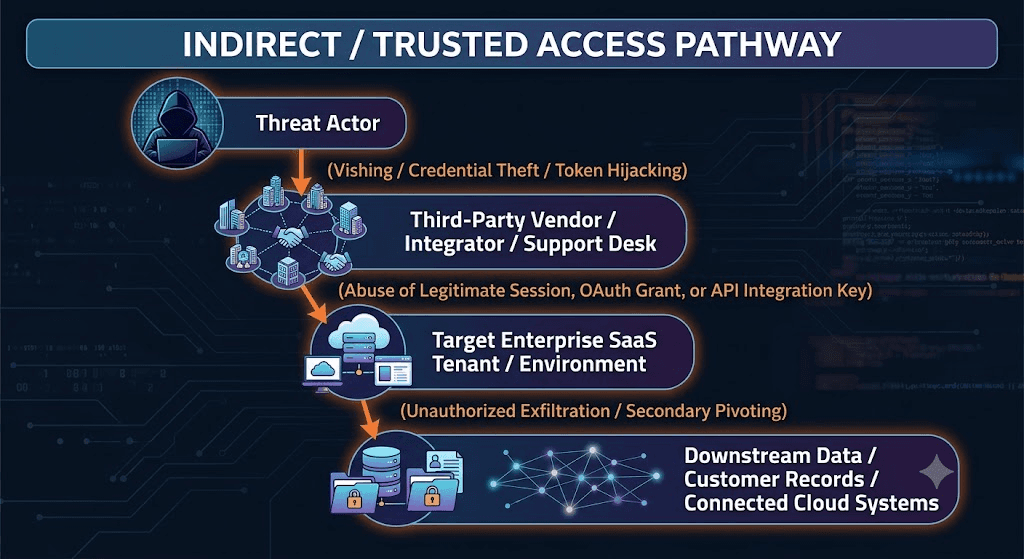
Recent SaaS ecosystem incidents illustrate this distinction. In several cases, the critical security question was not whether the victim organization had an exploitable vulnerability, instead whether an attacker who compromised a trusted intermediary could inherit legitimate access to downstream systems and data.
In light of the above, this report proposes a shift from Vendor Risk to Access-Path Risk: assessing not only who the supplier is, but what technical trust relationships it creates, what privileges those relationships confer, and how quickly they can be revoked.
Strategic takeaways
Perimeter Dissolution: The enterprise security perimeter no longer stops at the firewall or identity provider (IdP). It extends into every SaaS platform, cloud-to-cloud connector, and managed service provider (MSP) possessing delegated administrative or read/write permissions.
Failure of Legacy TPRM: Certifications, assurance reports and periodic questionnaires remain useful components of supplier due diligence, but they do not by themselves provide a continuously updated inventory of production access paths, privilege scopes, tokens, service accounts and downstream dependencies.
The Need for a Third-Party "Kill Switch": Organizations require technical, automated capabilities to instantaneously sever OAuth tokens, API keys, service accounts, and federated trust relationships with a compromised vendor without disrupting unimpacted business services.
Evidence and confidence assessment
To adhere to strict intelligence standards, the analytical findings in this report are categorized using the standard CTI Confidence Model (High, Moderate, Low) paired with source reliability ratings.
Finding | Evidence status | Confidence |
Vendor/support personnel were socially engineered in documented incidents | Confirmed | High |
Compromised credentials/tokens were subsequently used to access downstream resources | Confirmed where supported by incident evidence | High |
Similar architectures create transitive access risk | Analytical assessment | High |
All SaaS integrations inherently create equivalent risk | Hypothesis / unsupported generalization | Low |
Note: Detailed allegations regarding exact numbers of exposed records or specific extortion amounts published solely on threat-actor leak portals must be treated as threat-actor claims until verified by independent forensic auditors, regulatory disclosures, or law enforcement.
Incident anatomy: Timeline of a trusted-access compromise
The following composite timeline illustrates the typical lifecycle of a third-party trusted-access breach within interconnected SaaS ecosystems.
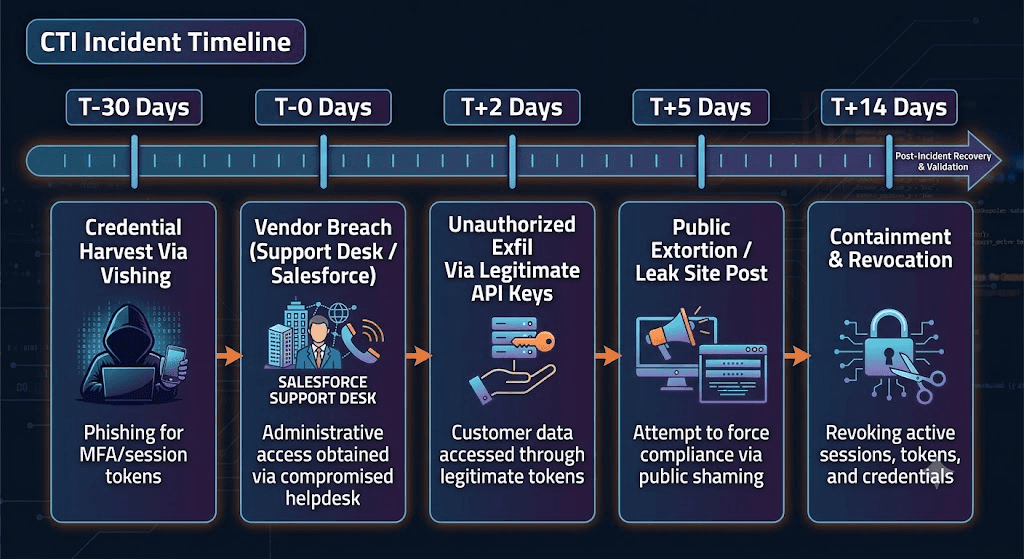
Initial Compromise Phase: Social Engineering and Credential Theft
T-30 Days to T-7 Days
Threat actors conduct targeted voice phishing (vishing) or helpdesk social engineering campaigns against vendor IT/support personnel. Attackers obtain valid multi-factor authentication (MFA) session tokens or administrative credentials.
Vendor Instance Compromise & API Key Harvesting
T-0 Days
The attacker accesses the vendor's internal management tenant (e.g., customer management platform, CRM, or support instance). Instead of deploying malware, the attacker extracts active cross-tenant API keys, OAuth access tokens, and integration secrets stored within the vendor environment.
Indirect Customer Data Exfiltration
T+2 Days
Using stolen, legitimate API credentials, the threat actor connects directly to customer SaaS environments or connected databases. Requests originate from legitimate endpoints or cloud proxies, evading traditional perimeter anomaly detection.
Extortion & Public Disclosure
T+5 Days
The threat actor contacts the vendor or affected enterprise customers with extortion demands, publishing sample data on dark web forums or breach repositories to force compliance.
Incident Discovery, Scope Isolation & Remediation
T+14 Days
Incident response (IR) teams trace anomalous API call volumes to vendor-linked integration keys. Organizations initiate emergency credential rotation, invalidate active OAuth grants, and sever federated trust paths.
The enterprise attack surface: Vulnerability of connected SaaS ecosystems
The SaaS Interconnection Web
Modern cloud infrastructure is no longer composed of isolated siloes. It is an intricate, highly interconnected web where SaaS applications communicate continuously via background REST APIs, webhooks, and federated SSO authentication pathways.
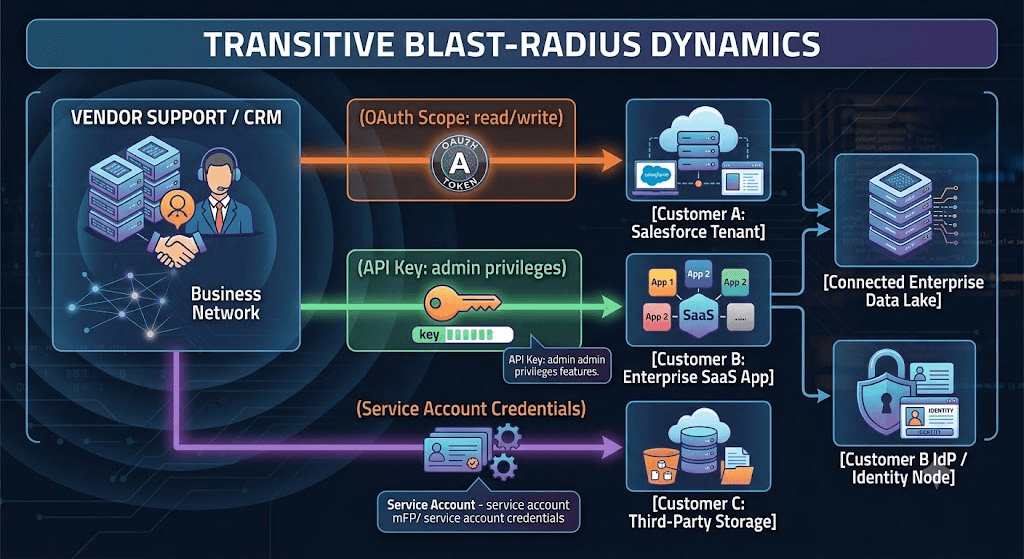
When an enterprise integrates a third-party vendor—such as connecting a marketing automation engine, design platform, analytics tool, or customer success platform to a core CRM—it creates transitive trust paths.
Key Vectors of Indirect Access
OAuth Application Authorizations: Users or IT admins grant third-party OAuth apps long-lived access tokens (refresh_tokens) with broad permission scopes (data:read, user:write).
Hardcoded API Secrets: Vendor software integrated into customer environments frequently relies on static API keys stored in client configuration files or shared key vaults.
Cross-Tenant Service Accounts: Managed service providers (MSPs) and SaaS vendors utilize single service accounts or master management keys capable of querying across thousands of distinct customer tenants.
Identity Federation & SSO Delegations: Trust relationships created between identity providers (IdPs) via SAML/OIDC allow compromised vendor accounts to seamlessly authenticate into customer environments.
Legitimate access vs. vulnerability exploitation
Security operations historically focus on patch management and vulnerability mitigation (e.g., CVE exploitation). However, Abuse of Legitimate Access bypasses almost all traditional detection controls.
Vector Dimension | Software Vulnerability Exploitation (e.g., RCE, SQLi) | Abuse of Legitimate Third-Party Access |
Mechanism | Exploits flawed code logic to execute unauthorized commands. | Uses valid keys, OAuth tokens, or login credentials. |
Detection Profile | Triggers IDS/IPS signatures, Web Application Firewall (WAF) alerts, memory protection faults. | Appears in logs as normal, authorized API/user traffic. |
Authentication State | Unauthenticated or privilege escalation required. | Authenticated with pre-granted privileges. |
Mitigation Path | Deploy software patch, virtual patching, disable vulnerable service. | Token revocation, session termination, API key rotation, access control tightening. |
Access-path criticality
At Shieldworkz, we have worked out a comprehensive method to understand and articulate the implications of access/privilege. This will help enterprises move well beyond simply talking about Vendor Inherent Risk in vague terms to actually measuring the Access-Path Risk. Access-Path Risk can be expressed as:
Access-Path Criticality = Privilege × Data Sensitivity × Reach × Persistence × Detectability × Revocability
And here are the dimensions.
· Privilege
o What can the integration do?
· Reach
o How many systems/tenants can it access?
· Data sensitivity
o What information can it reach?
· Persistence
o How long can access survive credential rotation or account changes?
· Detectability
o Can abnormal activity be reliably identified?
· Revocability
o How quickly can all access be terminated?
Determining the blast radius
These questions will help determine the blast radius with more accuracy:
· How many tenants?
· How many systems?
· What privilege?
· What data?
· What geographic jurisdictions?
· What downstream dependencies?
· How long could credentials remain valid?
· How quickly can access be revoked?
MITRE ATT&CK mapping: Trusted-access tactics
Threat actors leveraging third-party trust paths operate primarily within the following MITRE ATT&CK framework vectors:
Technique | Relevance |
T1199 – Trusted Relationship | Exploitation of trusted relationships between organizations/systems |
T1078 – Valid Accounts | Use of compromised legitimate accounts/credentials |
T1567 – Exfiltration Over Web Service | Exfiltration through legitimate web/cloud services where applicable |
T1556.007 – Hybrid Identity | Relevant where adversaries manipulate hybrid identity mechanisms |
T1556.009 – Conditional Access Policies | Relevant where attackers modify CA policies to preserve or expand access |
ATT&CK mapping is technique-dependent and should be established from observed attacker behavior rather than inferred from the mere presence of an OAuth or SaaS integration.
Flaws in Traditional Third-Party Risk Management (TPRM)
Conventional TPRM programs can leave an important visibility gap when supplier assessments are not connected to the technical access relationships established in production.
What Traditional TPRM Asks vs. What Cyber Risk Requires
Traditional TPRM Questionnaires (Static)
├── "Do you have an ISO 27001 certificate?"
├── "Do you encrypt data at rest using AES-256?"
└── "Do you perform annual penetration testing?"
Cyber Risk and Access Path Analysis (Dynamic & Technical)
├── "What exact API scopes have been granted to this vendor's integration?"
├── "Is the integration's service account limited by IP whitelisting or conditional access?"
├── "Can this vendor's API key perform bulk data exfiltration without triggering rate limits?"
└── "How quickly can security operations programmatically revoke all keys linked to this vendor?"
The Concept of "Access-Path Risk"
Organizations must shift from evaluating Vendor Inherent Risk to analyzing Access-Path Risk. A minor vendor processing non-sensitive data becomes a Critical Strategic Risk if its integration possesses write access to an enterprise Identity Provider or core customer database.
Tactical response: The first 24 hours of third-party compromise
When a critical vendor or SaaS partner suffers a security compromise, security teams must execute a rapid containment sequence.
1.1. Integration Discovery & Inventory Mapping:
Immediately identify all active technical touchpoints associated with the compromised vendor. Query the enterprise Identity Provider (IdP), Cloud Access Security Broker (CASB), SaaS Management Platform (SMP), and API Gateways to compile an exhaustive list of associated client IDs, API keys, and service accounts.
2.2. Token Invalidation & OAuth Revocation:
Programmatically revoke all active OAuth access and refresh tokens assigned to the vendor's application integrations. Invalidate all active user and service sessions tied to the vendor's administrative accounts across enterprise tenants.
3.3. Credential & Secret Rotation:
Rotate all API secrets, Webhook signing keys, client certificates, and database connections shared with or accessible by the vendor. Ensure newly issued secrets are restricted by minimal functional permissions.
4.4. Threat Hunting & API Log Forensic Analysis:
Examine API logs (e.g., Salesforce Event Monitoring, AWS CloudTrail, Microsoft Entra Audit Logs) for anomalous behavior originating from vendor-linked credentials over the preceding 30–90 days. Search specifically for uncharacteristic bulk exports, privilege escalations, or new user creation events.
5.5. Enforcement of Conditional Access & IP Isolation:
If the integration cannot be completely severed due to business-critical continuity requirements, restrict vendor access via strict Conditional Access policies—enforcing strict IP whitelisting, mandatory phishing-resistant MFA (FIDO2), and reduced scope permissions.
Strategic governance: The third-party "Kill Switch" architecture
To achieve true resilience against indirect SaaS compromises, enterprises must build a technical and operational Third-Party Kill Switch.
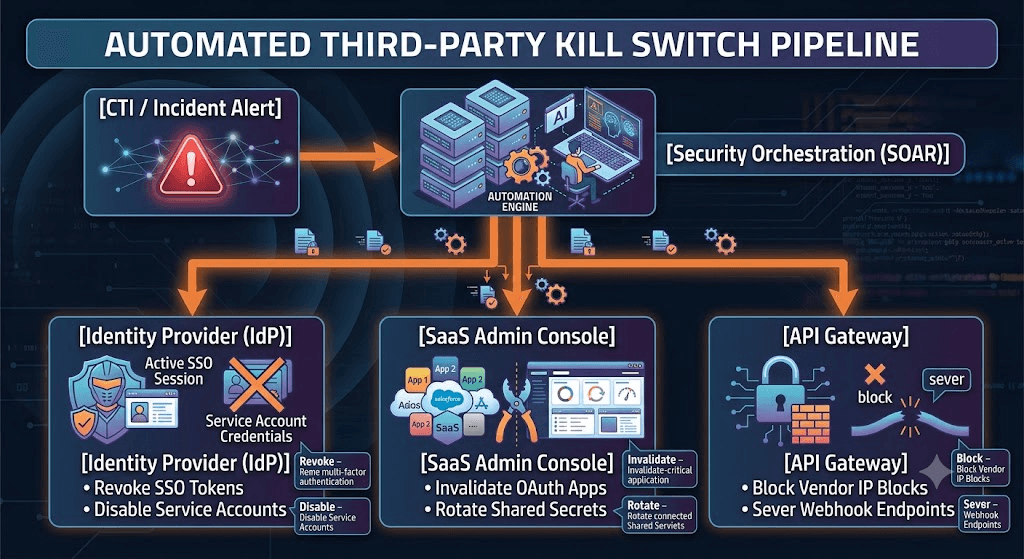
Architectural Blueprint for an Automated Third-Party Kill Switch
A Kill Switch is an automated execution playbook backed by centralized identity governance that can sever all access paths belonging to a compromised supplier within minutes.
Essential technical capabilities required
Centralized Integration Inventory: A single, continuously updated registry mapping every third-party vendor to its technical identifiers (OAuth App IDs, Service Account GUIDs, API Key hashes, SAML entity IDs).
Automated Revocation Playbooks: Security Orchestration, Automation, and Response (SOAR) playbooks capable of triggering API calls to IdPs and SaaS platforms to disable connected applications in bulk.
Just-In-Time (JIT) & Time-Bound Access Controls: Eliminating permanent standing access for third-party support and integration accounts, forcing time-bounded, explicit access approvals for vendor sessions.
Telemetry Centralization: Forwarding third-party API logs into a central Security Information and Event Management (SIEM) or Security Data Lake for real-time behavioral baselining.
The "kill switch" is not necessarily a single technical control. It is an orchestrated capability that can identify and revoke the relevant trust relationships across identity, SaaS, API, cloud and network control planes.
Third-party breach containment framework
This framework provides an operational blueprint for Incident Response (IR), SOC, and Third-Party Risk teams when responding to third-party supply chain and SaaS ecosystem security incidents.
Stage | Operational Objective | Key Analytical Questions | Primary Responsible Team |
1. DISCOVER | Identify vendor incident and determine potential impact on enterprise environments. | Is the vendor directly connected to our cloud instances or IdP? What integrations exist? | CTI / Threat Intelligence |
2. MAP | Construct an inventory of all active tokens, service accounts, and API paths assigned to the vendor. | Which systems, databases, and OAuth scopes does the vendor access? | Cloud Security / Identity Team |
3. CONTAIN | Sever or severely restrict all access paths to prevent lateral movement or data exfiltration. | Have all OAuth refresh tokens, API keys, and service sessions been revoked? | SOC / SecOps / IR |
4. HUNT | Query historical telemetry for indicators of unauthorized data access or credential abuse. | Were there unusual bulk data exports or permission modifications over the past 90 days? | Threat Hunting / DFIR |
5. ASSESS | Quantify the blast radius and determine regulatory or contractual data breach impact. | Was sensitive customer data, PII, or internal IP exposed or exfiltrated? | Risk & Legal / Privacy Office |
6. NOTIFY | Execute required regulatory, board, and customer disclosures in compliance with legal obligations. | What are our reporting timelines under local regulations (e.g., GDPR, SEC rules)? | Legal / Communications / CISO |
7. RECOVER | Re-establish vendor connections under strict least-privilege zero-trust parameters. | Has the vendor provided verified evidence of containment and forensic remediation? | Enterprise Architecture / SecOps |
8. VALIDATE | Audit re-established connections and continuously monitor for secondary exploitation. | Are new security controls, IP restrictions, and shortened token lifespans functioning correctly? | Internal Audit / Red Team |
The secondary attack problem: Follow-on threats
A third-party SaaS breach is rarely a single isolated event. Once a threat actor extracts data or metadata from a vendor, they frequently launch secondary campaigns aimed directly at downstream enterprise customers.
[ Initial Vendor Data Exfiltration ]
│
├──► Targeted Business Email Compromise (BEC) & Invoice Fraud
├──► Hyper-Targeted Spear Phishing (Leveraging Internal Terminology)
├──► MFA Fatigue & Helpdesk Vishing Campaigns
└──► Credential Stuffing & Password Reset Exploitation
Hyper-Targeted Spear Phishing: Attackers utilize stolen internal support tickets, project files, or organizational rosters to craft convincing phishing lures targeting internal staff.
Business Email Compromise (BEC) & Vendor Impersonation: Armed with knowledge of active contracts and invoice formats, threat actors impersonate vendor finance teams to divert payments.
MFA Fatigue & Vishing Re-engagement: Attackers use stolen employee contact lists to initiate voice phishing or MFA push-flooding attacks, attempting to gain direct internal corporate network access.
Key analytical judgments
· AJ-01 — High confidence
Third-party compromise can create downstream exposure even where the customer environment itself has not been directly exploited.
· AJ-02 — High confidence
The security significance of a supplier relationship depends substantially on the privileges and technical pathways granted to that supplier.
· AJ-03 — Moderate confidence
Many conventional TPRM processes are poorly suited to continuously measuring the technical state of SaaS integrations and delegated access.
· AJ-04 — Moderate confidence
Organizations that cannot rapidly identify and revoke supplier-associated credentials may experience materially longer containment windows following a third-party compromise.
· AJ-05 — Analytical assessment
Access-path inventory should become a distinct control layer alongside conventional supplier due diligence.
Executive checklist: 15 Questions CISOs must ask their vendors
Following a reported compromise of a connected SaaS vendor or partner, CISOs and security leadership should require answers to the following 15 technical questions:
What specific API endpoints, OAuth integrations, or service accounts connect your infrastructure to our tenant?
What exact permission scopes (read, write, admin) are assigned to those integrations?
Were any credentials, API keys, or access tokens associated with our account stored within the compromised environment?
Have all shared secrets, API keys, and tokens been invalidated and rotated? What is the exact timestamp of revocation?
What evidence supports your determination that our specific tenant data was or was not accessed?
Were administrative sessions or support portal accounts exposed to unauthorized actors?
Does your architecture utilize shared cross-tenant database environments or isolated single-tenant databases?
Are vendor support and engineering personnel required to authenticate using phishing-resistant hardware MFA (e.g., FIDO2 / WebAuthn)?
Did the threat actors deploy any persistence mechanisms (e.g., newly created service accounts, rogue OAuth applications, modified webhooks) within your environment?
Have you conducted proactive threat hunting across all system and API logs for the preceding 90 days?
What third-party subprocessors or software components were involved in the breach path?
Can you provide complete, unedited forensic audit logs covering all API calls and session activity directed toward our tenant during the incident window?
Is your remote support and maintenance access governed by Just-In-Time (JIT) conditional access controls?
What technical controls prevent an attacker inside your network from pivoting into client environments via your management console?
Will you provide independent third-party forensic validation confirming full remediation prior to integration re-activation?
The access path register
By maintaining an access path register that is updated every week, operational and security teams can keep a tab on access and privileges available to every role within and outside the organisation.
Supplier | System | Integration | Identity | Privilege | Data | Expiry | Revocation | Owner |
Vendor A | CRM | OAuth | App ID | Read/Write | Customer | 90d | Automated | IT |
Vendor B | IdP | SAML | Service account | Admin | Identity | Permanent | Manual | IAM |
Vendor C | Data lake | API | API key | Read | Analytics | Permanent | Manual | Data |
The traditional distinction between internal enterprise risk and external vendor risk is now almost obsolete.
Modern organizations operate within an interdependent, cloud-native ecosystem where SaaS providers, technology partners, and integrations sit inside the logical security boundary. When a third-party vendor receives delegated read/write permissions to internal communications, CRMs, or cloud storage platforms, that vendor becomes an extension of the enterprise internal network.
Key takeaway for executive leadership:
Managing third-party risk can no longer be treated as a legal or compliance-driven questionnaire exercise. Cyber resilience requires controlling trust relationships and access paths. Security leadership must build zero-trust architectures that continuously authenticate, monitor, and rate-limit third-party access—supported by automated capabilities to sever trusted connections instantly when a vendor's security boundary is breached.
Sources and further reading
DataBreaches.net: Canva Hacked Via Vendor's Salesforce Instance, Other Customers Affected As Well. (September 23, 2026).
Cloudskope Incident Analysis: Canvas Breach 2026: Threat Actor Exploitation of EdTech and SaaS Infrastructure.
Reed Smith LLP Legal & Regulatory Advisory: Canvas/Instructure Cyberattack – Key Developments and Action Items for Enterprise Institutions.
CISA & NCSC Joint Guidance: Securing the Software Supply Chain: Recommended Practices for Managing Third-Party SaaS and API Risks.
NIST Special Publication 800-161 Rev. 1: Cybersecurity Supply Chain Risk Management Practices for Systems and Organizations.
Shieldworkz investigates the cyberattacks on Colorado Water Utilities
احصل على تحديثات أسبوعية
الموارد والأخبار
تعرف على كيفية معالجة حلولنا الرائدة في مجال أمن تكنولوجيا التشغيل (OT) للتحديات الأمنية الحيوية
قد تود أيضًا

Fresenius medical care cyber incident: Investigating trusted access, third-party exposure and enterprise blast radius
Team Shieldworkz

OT Removable Media Security: Close the USB Risk Gap Before It Reaches Production
Team Shieldworkz

NERC CIP Compliance Assessment: Find Gaps Before Auditors Do
Team Shieldworkz

Beyond substitution: Strategic takeaways from India’s SCADA indigenisation
Team Shieldworkz

Investigative cyber threat research report: Colorado water utilities OT attacks
Prayukth K V

CEA Cyber Incident Response Requirements: How Power Utilities Can Build a Practical Security Plan
Team Shieldworkz