site-logo
site-logo
site-logo

How Zero Trust and Network Segmentation Strengthen NDR in Industrial Environments

How Zero Trust and Network Segmentation Strengthen NDR in Industrial Environments

How Zero Trust and Network Segmentation Strengthen NDR in Industrial Environments

How Zero Trust and Network Segmentation Strengthen NDR in Industrial Environments
Shieldworkz

Team Shieldworkz

A control engineer at a mid-sized water treatment facility once described their network the way most industrial operators still do: "flat, fast, and forgiving." Every PLC could talk to every historian. Every engineering workstation could reach every remote terminal unit. It worked, until the day a contractor's laptop, infected during a routine vendor visit, was able to reach the safety instrumented system with nothing standing in its way. Nothing detected it early enough to matter, because nothing was watching the internal conversations between assets that were never supposed to be having them in the first place.

This scenario repeats itself across manufacturing plants, utilities, water systems, and energy operators every year. It is rarely a failure of a single tool. It is a failure of architecture. Network Detection and Response, or NDR, has become the backbone of OT visibility, but even the most capable NDR platform is only as effective as the network it is watching. When that network is flat, unsegmented, and built on implicit trust, detection becomes noisy, response becomes slow, and the blast radius of any single compromise grows far larger than it needs to be.

This guide walks through how Zero Trust principles and disciplined network segmentation transform NDR from a passive alerting tool into a genuinely strategic defense layer for industrial environments. It covers what makes OT detection fundamentally different from IT security, how segmentation and Zero Trust reinforce each other, the real operational risks of getting this wrong, and a practical, field-tested path for OT security leaders who need to strengthen detection without disrupting production.

For OT security leaders, plant managers, and CISOs overseeing industrial operations, this topic deserves attention now rather than later. Regulatory bodies, insurers, and boards are all asking sharper questions about how well an organization can detect and contain a compromise before it reaches physical processes. NDR investment continues to grow across manufacturing, energy, water, and critical infrastructure sectors, yet many organizations discover, often during an incident or an audit, that their detection tools are working exactly as designed but simply cannot see clearly through a network with no internal structure. Understanding why segmentation and Zero Trust matter to detection outcomes, not just compliance checklists, is the difference between a security program that reacts to headlines and one that genuinely reduces risk to production and safety.

The sections that follow are organized to move from foundational concepts through to a concrete action plan, so that whether the goal is evaluating a new NDR platform, strengthening an existing deployment, or building the business case for a segmentation project, there is a clear, usable framework to work from.

Understanding NDR Fundamentals in OT/ICS Environments

Network Detection and Response is the practice of continuously monitoring network traffic to identify malicious, anomalous, or policy-violating behavior, and then supporting a coordinated response. In IT environments, NDR has matured around endpoint agents, cloud telemetry, and behavioral analytics tuned to office and enterprise traffic patterns. Industrial environments demand a different discipline entirely.

What Makes OT Network Detection Different from IT NDR

Operational technology networks carry protocols that IT security tools were never designed to parse correctly, including Modbus, DNP3, OPC UA, EtherNet/IP, and proprietary vendor protocols running across PLCs, RTUs, HMIs, and safety systems. These networks cannot tolerate active scanning, aggressive agents, or anything that risks interrupting a control loop. A single dropped packet on a safety instrumented system is a very different problem than a dropped packet on an email server.

  • OT NDR must operate passively, using traffic mirroring or network taps rather than intrusive scanning that could destabilize live control processes.

  • It must understand industrial protocols at the command level, distinguishing a legitimate engineering change from a malicious write command to a PLC register.

  • It must account for extremely long asset lifecycles, since many field devices run for fifteen to twenty-five years without a security patch.

  • It must correlate physical process context with network behavior, because a network anomaly that also corresponds to an unusual valve or turbine command carries very different weight.

  • It must respect the operational calendar, since a maintenance window, a firmware update, or a seasonal production change can all look like anomalies to a model that lacks context, and flagging every one of them erodes trust in the system fast.

These differences are not academic. An IT-focused detection tool dropped into an OT network without protocol awareness will either miss malicious commands hidden inside legitimate-looking industrial traffic, or generate so many false positives from normal engineering activity that operators eventually stop trusting the alerts altogether. Both outcomes leave the organization exposed, which is why NDR platforms purpose-built for industrial environments, and the architecture supporting them, matter so much more than headline detection accuracy claims.

Why Traditional Perimeter Security No Longer Works

For decades, industrial security strategy leaned heavily on the idea of an air gap, a physical or logical separation between the OT network and the outside world. That assumption has quietly eroded. Remote access for vendors, cloud-connected historians, IT/OT convergence projects, and even simple USB-based firmware updates have created dozens of informal bridges into environments that were designed with the expectation of isolation.

Once an attacker crosses that perimeter, whether through a phishing email that lands in the IT environment or a compromised remote access session, a flat network offers almost no internal resistance. This is precisely where segmentation and Zero Trust become essential, not as compliance checkboxes, but as the architecture that determines whether NDR can actually see and stop what happens next.

It is worth being direct about the business stakes here. A production line stoppage caused by a security incident is measured in lost output, contractual penalties, and, in regulated sectors, mandatory reporting obligations. A safety system compromise carries consequences that go beyond financial loss entirely. Framing segmentation and Zero Trust purely as technical projects understates their role: they are risk-reduction investments that directly protect uptime, safety, and the organization's ability to operate.

The Case for Zero Trust in Industrial Control Systems

Zero Trust is often misunderstood as a product category. It is better understood as an operating principle: never assume trust based on network location alone, and continuously verify every user, device, and communication attempting to access a resource, regardless of whether that request originates inside or outside the traditional perimeter.

Core Principles of Zero Trust for OT

  • Verify explicitly. Every access request is authenticated and authorized based on identity, device posture, and context, not simply because the request came from inside the plant network.

  • Enforce least-privilege access. An engineering workstation should only reach the specific controllers it manages, not the entire fleet of devices on a production line.

  • Assume breach. Design the environment as though an attacker is already inside, and build monitoring and segmentation that limit what that attacker can reach and how far they can move.

  • Inspect and log continuously. Every session, especially remote and third-party vendor access, should be visible, recorded, and available for retrospective analysis.

It is important to address a common misconception directly: Zero Trust does not mean removing trust from operators, engineers, or the people who keep production running. It means removing blind trust from the network itself. A control engineer with legitimate reasons to access a specific set of controllers should be able to do so quickly and reliably. What Zero Trust removes is the assumption that because a device sits on the internal network, it automatically deserves access to everything else on that network. That distinction matters enormously when communicating this shift to plant staff who may associate the term with added friction rather than added protection.

Applied thoughtfully, Zero Trust in an OT context tends to reduce operational friction over time rather than increase it, because access becomes predictable, auditable, and tied to actual job function rather than to whatever the network happens to allow. Incident investigations also become dramatically faster, since identity-aware logging shows precisely who or what accessed a given system and when, rather than requiring teams to reconstruct activity from raw packet captures alone.

Zero Trust vs Legacy Trust Models in Industrial Networks

Dimension

Legacy Perimeter Model

Zero Trust Model

Trust basis

Network location (inside = trusted)

Continuous verification of identity and device

Lateral movement

Largely unrestricted once inside

Constrained by policy at every boundary

Vendor & remote access

Broad VPN access to the whole network

Scoped, time-bound access to specific assets

Visibility

Concentrated at the perimeter

Distributed across every internal zone

Breach containment

Reactive, after wide compromise

Proactive, blast radius limited by design

Table 1: How Zero Trust reshapes trust assumptions compared to legacy perimeter-based OT security.

None of this requires ripping out legacy equipment. Zero Trust in industrial environments is applied predominantly at the network and access layer, through segmentation, identity-aware gateways, and scoped remote access, precisely because so many field devices cannot support modern authentication themselves. The strategy works around legacy constraints rather than against them, which is what makes it achievable for organizations running equipment that will remain in service for another decade or more.

Network Segmentation as the Foundation of Defense

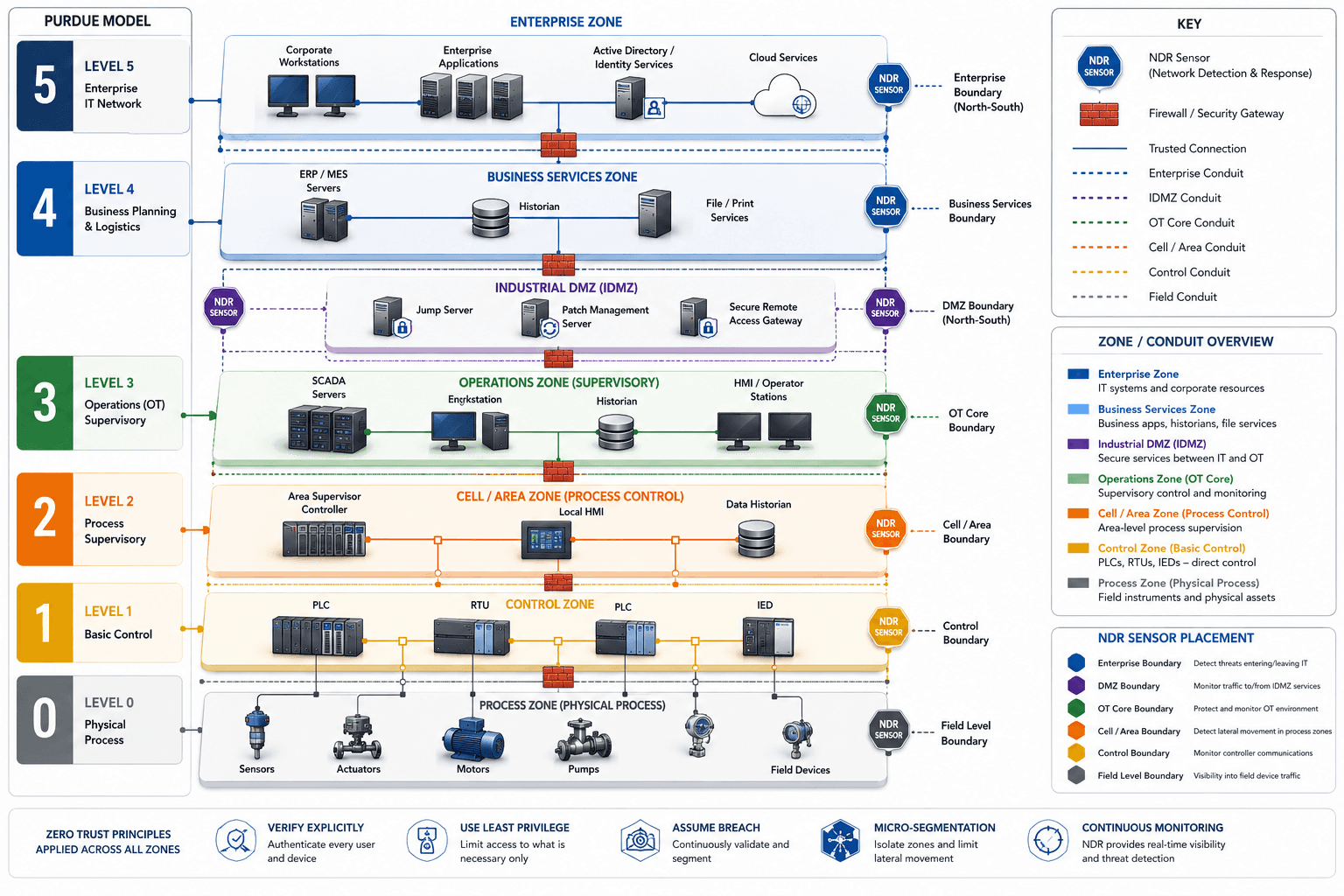
If Zero Trust is the philosophy, segmentation is the mechanism that makes it real inside an industrial network. Segmentation divides a network into distinct zones based on function, criticality, and risk, and then governs precisely what traffic is allowed to pass between them, commonly referred to as a conduit.

The Purdue Model and Modern Segmentation Strategies

The Purdue Enterprise Reference Architecture remains a useful mental model for industrial networks, separating the environment into levels from field devices and controllers at the bottom to enterprise business systems at the top. Effective segmentation enforces strict boundaries between these levels, particularly between Level 3 operations systems and Level 4 enterprise IT, where the vast majority of real-world OT compromises actually originate.

Modern industrial environments rarely map cleanly onto the classic Purdue levels anymore, thanks to cloud historians, remote monitoring platforms, and IIoT sensors. This has pushed many organizations toward a hybrid model that keeps Purdue's zone-and-conduit logic while layering in identity-aware controls for the connections that inevitably cross those boundaries.

Microsegmentation in Live Production Environments

Beyond broad zone separation, microsegmentation narrows control down to individual assets or small functional groups, such as isolating each production line's controllers from every other line, or separating a safety instrumented system entirely from the basic process control network it protects.

  • Group assets by function and criticality rather than by physical location alone.

  • Isolate safety instrumented systems as their own zone with the strictest possible conduit rules.

  • Treat engineering workstations as high-value targets and segment them away from general operator access.

  • Apply segmentation incrementally, validating each change against live process behavior before tightening the next boundary.

    Microsegmentation in Live Production Environments

Microsegmentation is often where organizations hesitate, worried that tightening internal boundaries will introduce operational risk of its own. In practice, the safest path is incremental and evidence-based: observe real traffic for a defined period, confirm which connections are genuinely required for the process to run, write policy around that confirmed baseline, and only then move from monitoring to enforcement. Skipping the observation phase is the single most common cause of segmentation projects that cause unplanned downtime and, as a result, lose the confidence of plant operations teams for years afterward.

How Zero Trust and Segmentation Strengthen NDR Together

NDR platforms are fundamentally pattern-recognition systems. They learn what normal looks like and flag what deviates from it. The quality of that baseline, and the speed at which a genuine threat surfaces above the noise, depends heavily on the network architecture feeding it data. This is where segmentation and Zero Trust turn a good NDR deployment into a genuinely powerful one.

Reducing Attack Surface and Improving Signal Quality

In a flat network, an NDR sensor watching a core switch sees an overwhelming mix of traffic from dozens of asset types and business functions, all blended together. Distinguishing a subtle, malicious command injection from routine chatter in that environment is extraordinarily difficult, even for well-tuned behavioral models.

Attack surface reduction is often discussed as an abstract security metric, but for OT teams it has a very concrete meaning: fewer devices reachable from any single point of compromise, fewer protocols exposed across zone boundaries, and fewer standing credentials that would grant an attacker broad reach if stolen. Every one of those reductions also simplifies what an NDR platform has to reason about, which is why organizations that pursue segmentation and detection together consistently report faster time-to-value from their monitoring investment than those who deploy detection onto an unchanged, flat network.

Signal quality compounds over time as well. A behavioral baseline built inside a well-defined zone stays accurate for longer, because the population of devices and communication patterns within that zone changes far less frequently than it would across an entire flat network. That stability translates directly into fewer baseline retraining cycles, fewer alert storms following routine maintenance windows, and a security operations team that trusts the alerts it receives instead of tuning them out.

Segmentation reinforces all of this by giving NDR sensors a much cleaner, more predictable baseline within each zone. A sensor watching only a bottling line's control network, for example, will see a narrow, repeatable set of communication patterns. Deviations become far easier to identify with confidence, and false positive rates drop meaningfully, which matters enormously for lean OT security teams who cannot chase noise all day.

Stopping Lateral Movement Before It Becomes a Breach

The most damaging industrial cyber incidents rarely involve a single compromised device. They involve an attacker moving quietly from an initial foothold toward a high-value target, whether that is a historian with credentials to spare, an engineering workstation with programming access, or a safety system controller. Segmentation converts every zone boundary into a chokepoint, and Zero Trust ensures that crossing that chokepoint requires explicit, verified authorization rather than simple network reachability.

For NDR, this is transformative. Instead of trying to catch a needle somewhere in an enormous haystack, the platform can focus intense scrutiny on the much smaller number of legitimate conduits between zones. An unexpected connection attempt across a segmentation boundary, particularly toward a safety or process control zone, becomes one of the highest-fidelity alerts a security team can receive.

There is also a response-speed dimension that often gets overlooked. In a flat network, containing a confirmed threat frequently means an uncomfortable choice between leaving a compromised device connected while the investigation continues, or disconnecting a broader swath of the network than necessary and risking a production impact of its own. A segmented environment allows a security team to isolate the affected zone precisely, cutting off the attacker's path forward while leaving unrelated production lines and systems running normally. That precision is often the difference between a contained incident that costs a few hours of investigation and a full-scale operational shutdown that makes headlines.

NDR Capability

Flat, Unsegmented Network

Segmented, Zero Trust Network

Baseline accuracy

Broad, noisy, mixed traffic types

Narrow, predictable, zone-specific baselines

Alert fidelity

High false-positive volume

Fewer, higher-confidence alerts

Time to detect lateral movement

Often delayed until damage is visible

Near-immediate flag at zone boundary

Containment speed

Manual, network-wide investigation

Isolate a single zone without halting operations

Investigation scope

Entire network must be reviewed

Narrowed to specific zone and conduit

Table 2: The practical impact of segmentation and Zero Trust on NDR detection and response quality.

Risks, Challenges, and Industry Insights

Real-World Incidents That Reveal the Cost of Flat Networks

Several widely documented industrial incidents illustrate exactly what happens when segmentation and monitoring are absent or incomplete.

  • In the 2015 and 2016 attacks on Ukrainian power distribution companies, attackers who initially gained access through phishing were able to move from corporate IT systems into operational networks with minimal resistance, ultimately manipulating breaker controls and cutting power to hundreds of thousands of customers.

  • The 2017 incident involving a Middle East petrochemical facility's safety instrumented system showed attackers reaching all the way to safety controller logic, a level of access that strong zone isolation around safety systems is specifically designed to prevent.

  • The 2019 ransomware event at a global aluminum producer forced a shift to manual operations across multiple plants after malware spread broadly through IT and operational networks that lacked strong internal boundaries.

  • The 2021 compromise of a Florida water treatment facility's remote access system demonstrated how a single unsegmented, loosely monitored remote connection can offer a direct path to safety-critical chemical dosing controls.

  • The 2021 ransomware disruption of a major U.S. fuel pipeline operator, while centered on IT systems, led to a precautionary shutdown of OT operations, underscoring how IT and OT interdependency without clear segmentation can turn an IT incident into an operational one.

None of these incidents happened because a single tool failed. In each case, a lack of enforced boundaries allowed an initial compromise to travel further and cause more damage than a properly segmented, continuously monitored environment would have allowed.

A pattern worth noting across nearly all of these events is that the initial entry point was rarely the operational network itself. Phishing emails, exposed remote access tools, and third-party vendor connections are consistently the opening move, with the real damage occurring only after the attacker was able to travel unimpeded from that initial foothold into systems that directly touch physical processes. This is exactly the travel that segmentation is designed to stop, and exactly the travel that a well-positioned NDR sensor at a zone boundary is designed to see the moment it happens.

The Business and Compliance Case for Getting This Right

Beyond the direct cost of downtime or a safety event, segmentation and Zero Trust increasingly intersect with regulatory and insurance expectations that OT security leaders now have to answer to directly. Frameworks referenced across the industry, including IEC 62443 for industrial automation and control system security and the NIST Cybersecurity Framework, both place network segmentation and access control at the center of a defensible security program. Cyber insurance underwriters have also grown noticeably more specific in their questionnaires, frequently asking directly whether IT and OT networks are segmented and whether remote access is scoped and monitored.

Business Driver

How Segmentation and Zero Trust Help

Regulatory alignment

Supports zone and conduit requirements common across industrial security standards

Cyber insurance posture

Addresses underwriting questions on segmentation and remote access directly

Incident cost containment

Limits blast radius, reducing downtime and recovery scope

Board and executive reporting

Provides clear, measurable evidence of reduced attack surface

Merger and acquisition due diligence

Demonstrates a mature, auditable security architecture

Table 4: How segmentation and Zero Trust support broader business, regulatory, and insurance priorities.

Common Implementation Challenges for OT Teams

Despite broad agreement that segmentation and Zero Trust improve security outcomes, OT teams consistently run into the same set of practical obstacles.

  • Legacy devices that cannot support modern authentication or encryption, requiring compensating controls rather than direct enforcement at the endpoint.

  • Production pressure that limits change windows, making it difficult to test and roll out new segmentation policies without risking downtime.

  • Incomplete asset inventories, since it is impossible to segment effectively around devices the organization does not know exist.

  • Cultural friction between IT teams who default to aggressive access controls and OT teams who prioritize uptime and process continuity above all else.

  • Vendor and third-party remote access arrangements that were built years ago around broad, standing network access rather than scoped, temporary sessions.

None of these challenges are reasons to delay. They are reasons to sequence the work carefully, starting with visibility, moving to the highest-risk boundaries first, and treating segmentation as an ongoing discipline rather than a single project with a fixed end date. Organizations that try to segment everything at once, everywhere, in a single initiative are the ones most likely to stall out or roll back changes after a production disruption. Organizations that phase the work around risk and operational readiness are the ones who still have their segmentation policy intact, and improving, two years later.

Practical Recommendations and Best Practices

Strengthening NDR through segmentation and Zero Trust does not require a single sweeping overhaul. The most successful industrial security programs treat this as a phased, risk-prioritized journey.

  • Build and maintain a complete, living asset inventory across every level of the environment, including field devices, controllers, workstations, and network infrastructure.

  • Map real communication flows before writing a single segmentation rule, using passive monitoring to understand what actually talks to what today.

  • Define zones and conduits around process function and criticality, starting with the highest-risk boundary: the connection between IT and OT.

  • Isolate safety instrumented systems into their own tightly controlled zone with the narrowest possible set of allowed conduits.

  • Deploy passive, protocol-aware NDR sensors at every critical zone boundary, not just at the network perimeter.

  • Replace standing vendor VPN access with scoped, time-bound, monitored remote access sessions tied to individual identities.

  • Establish a behavioral baseline for each zone before enforcing strict blocking, so legitimate operational traffic is never mistaken for a threat.

  • Run regular tabletop exercises that simulate lateral movement attempts, testing whether segmentation boundaries and NDR alerts actually catch the scenario as designed.

  • Review and tighten segmentation policy on a recurring schedule, since industrial networks change constantly as new equipment and integrations are added.

A useful discipline for OT security leaders is to treat each of these steps as a milestone with its own success criteria, rather than a single long project measured only at the end. Asset inventory completeness, the percentage of traffic flows mapped and explained, the number of zones with an enforced conduit policy, and the average time to detect a simulated lateral movement attempt during a tabletop exercise are all measurable indicators that can be reported to leadership, giving the security program clear, defensible progress markers rather than an open-ended initiative with no visible momentum.

NDR Platform Evaluation Criteria for OT Environments

When evaluating or strengthening an NDR platform for an industrial environment, security leaders should weigh the following criteria carefully.

Evaluation Criteria

Why It Matters

Passive deployment model

Avoids any risk of disrupting live control processes or safety systems

Deep OT protocol support

Enables command-level understanding of Modbus, DNP3, OPC UA, and similar protocols

Asset discovery and inventory

Provides the visibility foundation that segmentation and detection both depend on

Zone-aware behavioral baselining

Improves alert accuracy by learning normal patterns per segment, not network-wide

Integration with segmentation policy

Allows detection logic to prioritize and contextualize cross-zone traffic

Support for legacy and modern assets

Ensures visibility across both twenty-year-old controllers and new IIoT devices

Actionable, prioritized alerting

Reduces analyst fatigue and speeds up genuine incident response

Scalability across multiple sites

Supports consistent visibility for organizations with distributed plants or facilities

Table 3: Core criteria OT security leaders should use when evaluating or strengthening an NDR platform.

Frequently Asked Questions from OT Security Leaders

Does segmentation require replacing existing OT equipment?

No. The vast majority of segmentation work happens at the network layer, using switches, firewalls, and monitoring infrastructure, rather than by modifying or replacing field devices, controllers, or safety systems themselves. Legacy equipment stays in place; the network around it becomes more structured.

Will Zero Trust slow down operators and engineers during a shift?

When implemented well, it should not. Access policies are built around actual job function, so an operator or engineer retains fast, reliable access to the systems their role requires. What changes is that access to everything else is no longer available by default, which reduces risk without adding meaningful friction to daily work.

How long does a segmentation and Zero Trust rollout typically take?

Timelines vary by facility size and complexity, but most organizations see the clearest early wins within the first three to six months by focusing on the highest-risk boundary first, typically the connection between IT and OT, followed by isolation of safety systems, with broader microsegmentation phased in over twelve to twenty-four months alongside normal maintenance windows.

Can NDR be deployed before segmentation is complete?

Yes, and in most cases it should be. Deploying passive NDR early provides the visibility needed to design segmentation policy around real traffic patterns rather than assumptions, and continues to add value as segmentation matures, since detection quality improves incrementally as each new boundary is put in place.

How Shieldworkz Supports Organizations

Shieldworkz works alongside industrial operators, manufacturers, and critical infrastructure organizations to close the gap between architecture and detection, turning segmentation and Zero Trust from a theoretical framework into a practical, operational reality. Every engagement starts from the same premise: production continuity and safety come first, and security architecture has to be designed around that reality rather than against it.

  • Comprehensive OT asset discovery and risk assessment to build the accurate inventory that segmentation and detection both require.

  • Zone and conduit design tailored to real production workflows, developed alongside plant and engineering teams rather than imposed on them.

  • Deployment of passive, protocol-aware network monitoring at the boundaries that matter most, including IT/OT interfaces and safety system zones.

  • Zero Trust remote access strategies that replace broad standing vendor access with scoped, monitored, time-bound connections.

  • Continuous threat monitoring and incident response support built around industrial process context, not generic IT alerting.

  • Advisory support for phased, low-disruption rollout planning, so segmentation improvements happen without interrupting production schedules.

  • Ongoing security posture reviews and tabletop exercises to validate that defenses hold up against realistic attack scenarios.

The goal in every engagement is the same: give plant managers, engineers, and security teams a network they can trust, and detection tools that can finally see clearly enough to earn that trust back.

Conclusion

Network Detection and Response will always be central to industrial cybersecurity, but its effectiveness is never determined by the tool alone. It is determined by the architecture around it. Zero Trust principles and disciplined network segmentation give NDR the clean signal, narrow attack surface, and meaningful chokepoints it needs to detect real threats quickly and support a response that protects both operations and safety.

For OT security leaders, the path forward is not about ripping out existing infrastructure or forcing IT-style controls onto environments that cannot support them. It is about methodically mapping what exists, defining sensible boundaries around what matters most, and giving detection technology the structured environment it needs to do its job well. Organizations that make this investment consistently find that their existing security tools, including NDR, become dramatically more effective almost immediately.

The organizations that fare best when an incident does occur are rarely the ones with the single most expensive tool in their stack. They are the ones who spent the time beforehand mapping their assets, understanding their real traffic patterns, and building a network structure where a compromise in one corner of the plant cannot quietly become a compromise of the entire operation. Segmentation and Zero Trust are how that structure gets built, and stronger, faster, more trustworthy detection is one of the most immediate and measurable benefits that follows.

Ready to Strengthen Your OT Network Visibility?

Every industrial environment carries its own mix of legacy assets, production pressures, and safety requirements. Our team works with OT security leaders to map real risk, design segmentation that fits actual operations, and get more value out of the detection tools already in place.

Book a Free Consultation with Our Experts →

Additional resources:

Comprehensive Guide to Network Detection and Response NDR in 2026 here
NERC CIP-015 Internal Network Security Monitoring Readiness Checklist for Electric Utilities here
OT SOC Foundational Guide here
Managed SOC Service here
OT Cyber Threat Intelligence Advisory - Middle East here
NIS2 Directive Achieving NIS2 Compliance Through IEC 62443 here
What Is Removable Media? Risks, Policies, and Industrial OT Security Solutions here
Free Removable Media Policy Template for OT and IT Teams here

احصل على تحديثات أسبوعية

الموارد والأخبار

تعرف على كيفية معالجة حلولنا الرائدة في مجال أمن تكنولوجيا التشغيل (OT) للتحديات الأمنية الحيوية

قد تود أيضًا

BG image

ابدأ الآن

عزز موقفك الأمني لنظام CPS

تواصل مع خبرائنا في أمن CPS للحصول على استشارة مجانية.

BG image

ابدأ الآن

عزز موقفك الأمني لنظام CPS

تواصل مع خبرائنا في أمن CPS للحصول على استشارة مجانية.

BG image

ابدأ الآن

عزز موقفك الأمني لنظام CPS

تواصل مع خبرائنا في أمن CPS للحصول على استشارة مجانية.