Prayukth K V
The back-to-back cybersecurity disclosures involving two giants of Indian manufacturing viz., Tata Electronics and Bajaj Auto represent much more than a routine cluster of enterprise breaches. For seasoned Operational Technology (OT) and industrial cybersecurity practitioners, these events signal a fundamental shift in the regional threat and risk landscape.
While public announcements describe successful containment and localized impacts, looking closely at the technical realities a deeply systemic issue emerges. The manufacturing sector is undergoing rapid, aggressive digitalization but, the architectural strategies used to protect these operations are failing to keep pace.
Deconstructing both Incidents: Confirmed realities vs. architectural inferences
To analyze these events effectively, one must begin by consolidating verified facts and structural and architectural realities.
The Tata Electronics breach: Silent data exfiltration
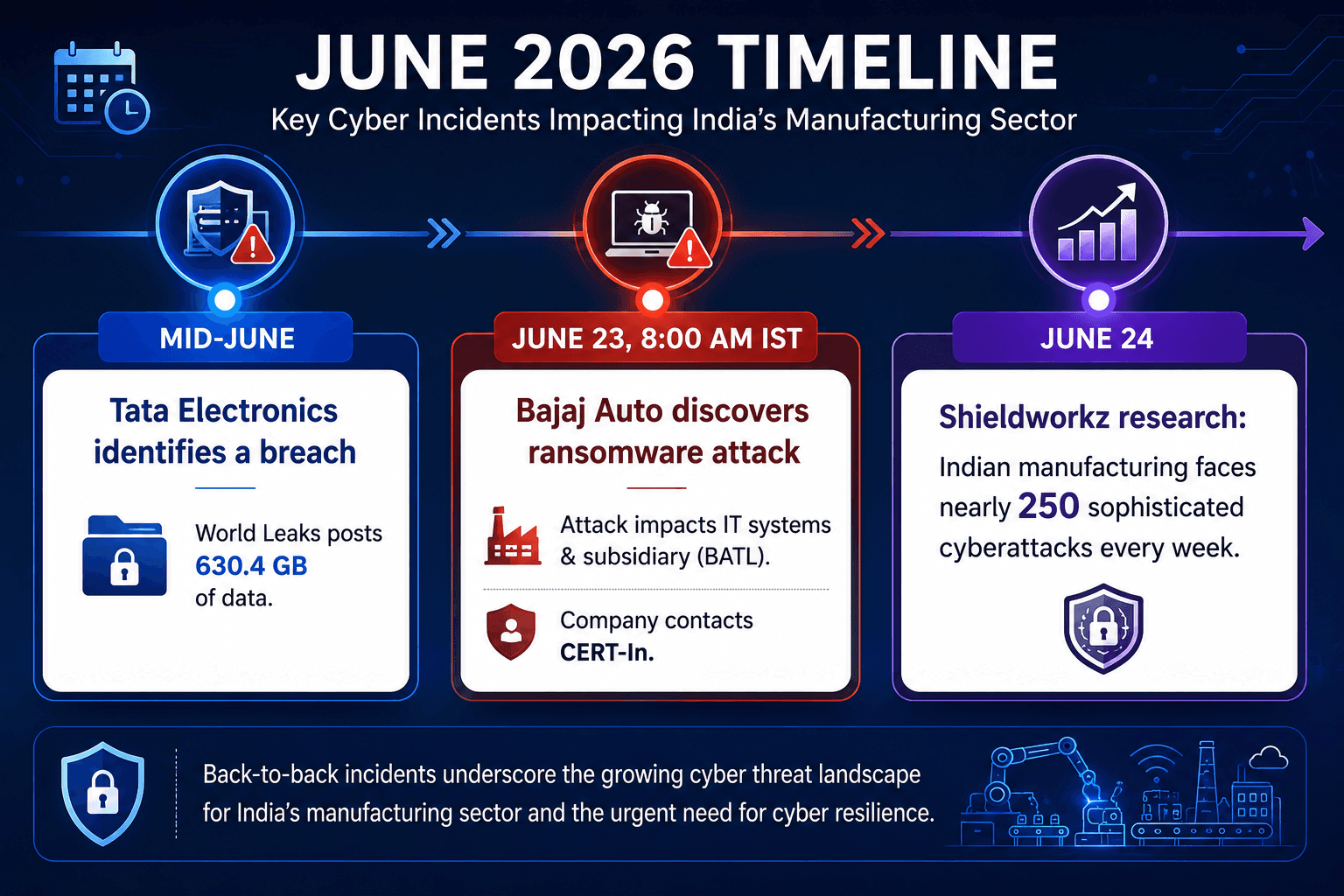
In mid-June 2026, the extortion group World Leaks (a rebranded offshoot of the pure-extortion entity Hunters International) published a 630.4 GB dataset consisting of 204,341 files. Tata Electronics confirmed the incident, stating that its core operations remained unaffected. It immediately hardened internal access controls and initiated a global forensic audit.
The composition of the leaked data is highly critical to this conversation. It reportedly contains schematics, component design papers, and mechanical drawings belonging to major global OEMs like Apple and Tesla.
The OT reality: This was not an operational disruption event via encryption. It was a prolonged, silent data exfiltration campaign targeting intellectual property (IP) and the supply chain.
Architectural Implications: The presence of event logs spanning several years within the leaked cache is concerning. It indicates a classic, long-term advanced persistent threat (APT) posture and deep interest the threat actor has on operations. The attackers maintained persistent access, likely blending into normal network behavior, without triggering standard perimeter alerts.
The Bajaj Auto ransomware attack: Active infrastructure compromise
On the morning of June 23, 2026, as a new shift took over, automotive giant Bajaj Auto detected an active ransomware attack. The incident targeted its primary IT infrastructure and its wholly owned technology subsidiary, Bajaj Auto Technology Limited (BATL), which handles engineering, R&D, and technology development. Bajaj Auto acted immediately, engaged internal and external experts, activated incident response protocols, and notified the Indian Computer Emergency Response Team (CERT-In).
The OT reality: While Bajaj Auto has not disclosed formal production halts, the technical signatures of the attack point to the standard ransomware execution triad: Data Encrypted for Impact (MITRE ATT&CK T1486), Service Stop (T1489), and Inhibit System Recovery (T1490).
The structural caveat: Targeting a technology subsidiary like BATL is an intentional strategy. In modern automotive engineering, R&D environments serve as a critical bridge. They house both intellectual property and the direct software configurations deployed to the factory floor.
Why manufacturing Is ground zero for extortion
The Shieldworkz OT security threat report published earlier this year brings out a new and unique dimension associated with the manufacturing sector. In addition to IP and operational disruption, threat actors were seen to maintain a stealthy presence in target for more days than ever before. This led to an immediate rise in the number of days taken to detect a cyberattack. Further, threat actors were seen to hijack several services to prevent anomalies from showing up in detection systems.
It is no coincidence that as per Shieldworkz research, Indian manufacturing faces nearly 250 sophisticated cyberattacks every week. This targeting persists for specific operational reasons:
The high cost of downtime
Unlike enterprise IT environments, where a system outage simply means delayed emails or deferred processing, manufacturing downtime is measured in thousands of dollars per minute. The physical reality of assembly lines, target markets, just-in-time logistics, and continuous-process systems means that manufacturers have a very low tolerance for operational disruption. Attackers exploit this urgency to pressure organizations into quick financial settlements.
The high-value target of proprietary blueprints
The primary motivation for attackers has shifted. They are moving away from simple encryption toward targeting production data, OEM relationships, and engineering designs.
In a modern vehicle or electronics assembly plant, the real value lies in the data. Which could be the exact composition of an alloy, the firmware flash files for an engine control unit (ECU), or the precise schematics of a next-generation semiconductor component. This data holds long-term strategic value for industrial espionage and secondary extortion.
The vulnerability of a borderless attack surface
Industry 4.0 has introduced technologies like Industrial Internet of Things (IIoT) sensors, cloud-managed manufacturing execution systems (MES), remote OEM maintenance tunnels, and AI-driven production co-pilots. Each one of these connections breaks the traditional, isolated model of industrial operations.
The window between adoption and exploitation has drastically shrunk. When an organization connects an outdated factory floor to an AI-driven optimization platform in the cloud, it creates a direct pathway for threat actors. Attackers can leverage this path to move straight from a compromised corporate email account down into a core production asset.
Geopolitics
Some of the attacks have geopolitical and geoeconomical undertones. Such attacks are designed to convey specific messages to segments or to create a disruption during a geopolitical episode. Increasingly, Chinese, Iranian and Russian threat actors are decoupling their actions from geopolitical incidents to create a new and active cyber incident baseline. This is helpful for state-backed actors in many ways. Such events help train new batches of threat actors, maintain deniability and event correlation and lastly ensure a state of high readiness to escalate events rapidly, if required.
The Myth of the Isolated IT Ransomware Attack
A common, outdated assumption among executive leadership teams is: "Our assembly line runs on a separate network, so an IT ransomware attack cannot stop production." This line of thinking overlooks the deep, hidden structural dependencies that tie corporate IT networks directly to the factory floor.
Why production still depends on enterprise IT
Modern manufacturing lines do not operate in a vacuum. A physical assembly line cannot run without active instructions from an Enterprise Resource Planning (ERP) system or a Manufacturing Execution System (MES). These platforms manage parts sequencing, bill-of-materials validation, and just-in-time inventory tracking.
If a ransomware attack encrypts the corporate IT database that feeds the MES, the assembly line stops immediately. This is not because the PLCs (Programmable Logic Controllers) are encrypted, but because the machines no longer know what to build, which component to sequence next, or where to route the finished product.
The safety risks of blended visibility loss
When an incident response team discovers ransomware on the corporate network, they often execute emergency isolation protocols. This means shutting down VPN tunnels, terminating cross-network active directories, and disconnecting IT/OT bridges.
Once these connections are severed, plant operators lose view of the operational environment. They can no longer see safety telemetry, environmental monitors, or process control loops. In a high-risk manufacturing environment, running blind without safety data is a major operational hazard, forcing an immediate, manual shutdown of production lines.
The technical challenges of industrial recovery
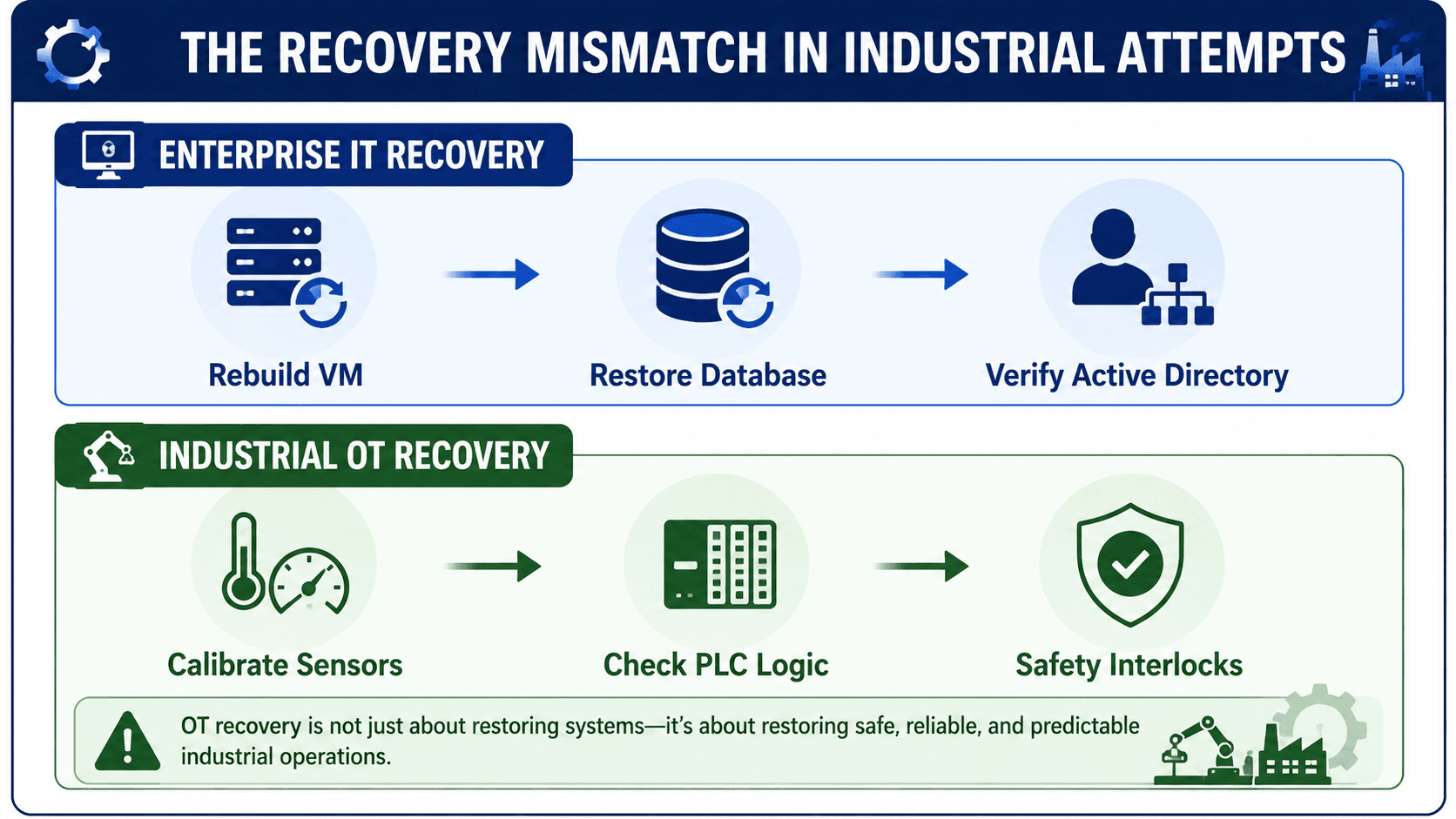
Recovering an enterprise IT environment is completely different from restarting a complex industrial asset. In an IT environment, recovery follows a straightforward path: spin up a virtual machine from an immutable backup, re-index the database, and verify Active Directory sync.
In an industrial OT environment, you cannot simply push a button to restore an entire factory floor. Recovery is a highly deliberate, painstaking process:
PLC Logic integrity verification: Every controller must be manually verified to ensure that its ladder logic or function block diagrams have not been altered or corrupted.
Physical calibration and alignment: After a sudden loss of power or communication, field devices, robotic joints, and sensor arrays must be physically recalibrated to prevent mechanical damage or quality defects upon restart.
Safety interlock sequencing: Safety instrumented systems (SIS) must be powered up and tested in a precise sequence to guarantee that emergency shutdown mechanisms will function properly if a hazard occurs.
The shift from cyber security to operational resilience
The back-to-back nature of the Tata and Bajaj incidents highlights a core truth that boards and executive leadership teams must face: traditional, compliance-driven cybersecurity is no longer sufficient. Organizations must move toward a model of true operational resilience.
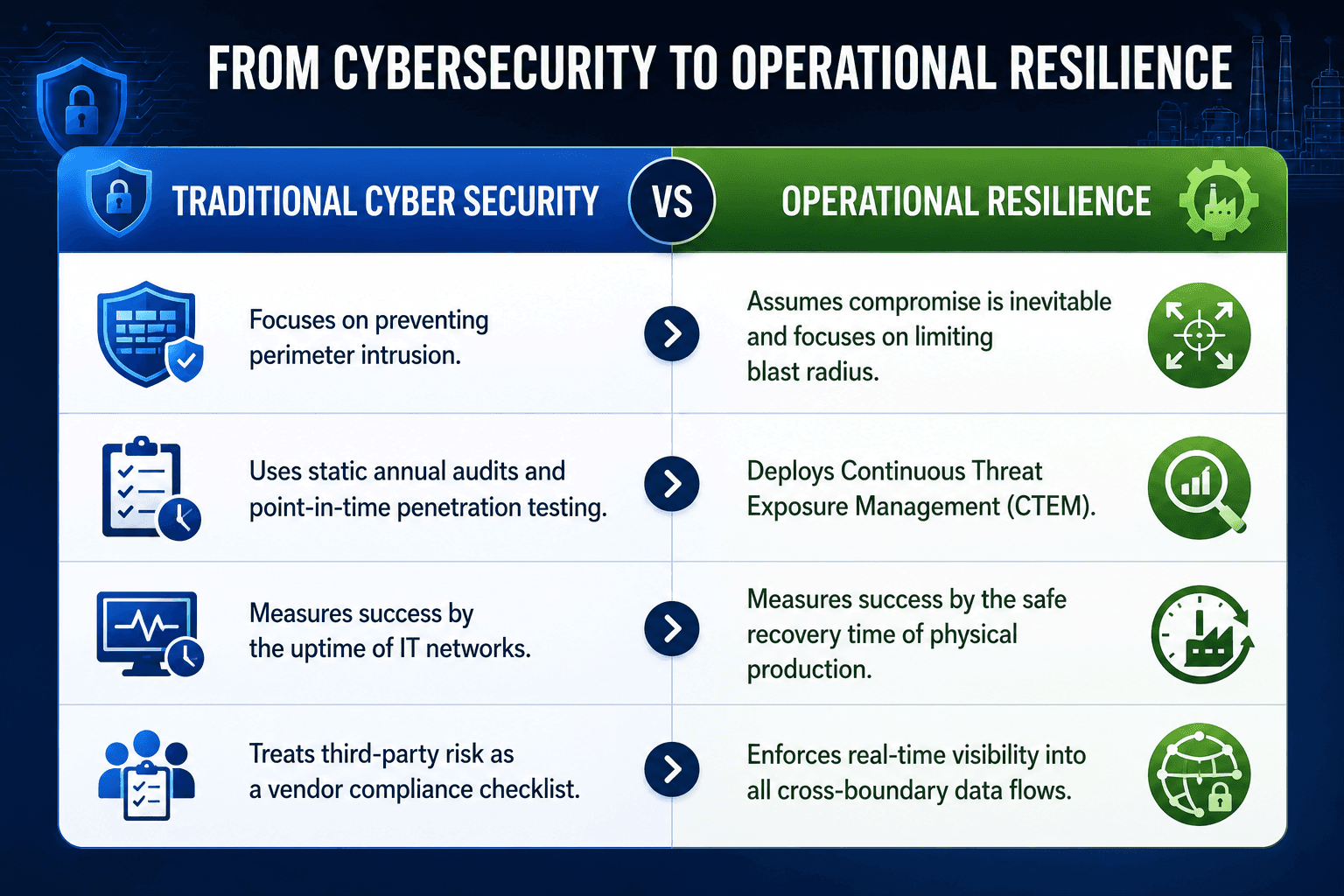
The Tata Electronics incident demonstrates the danger of relying purely on point-in-time compliance audits. A vendor can hold all the necessary security certifications on paper, yet still have an undetected threat actor silently exfiltrating hundreds of gigabytes of sensitive trade secrets over an authenticated session.
True resilience requires continuous visibility into internal network traffic (East-West monitoring) rather than simply trusting perimeter defenses (North-South monitoring). If an organization does not actively monitor internal file transfers, a large-volume data exfiltration event can easily go completely unnoticed.
Architectural mandates for the modern CISO
For industrial security leaders looking to protect their organizations against these evolving threats, four architectural priorities require immediate attention:
Enforce strict IT/OT network segmentation
The era of the flat network is over. Organizations must implement a strict, firewalled boundary between corporate IT networks and production OT environments, strictly adhering to the Purdue Model of industrial control systems architecture.
All communications between IT and OT must terminate in a highly restricted Demilitarized Zone (DMZ). No direct, cross-boundary connections should be permitted under any circumstances.
Implement phishing-resistant Multi-Factor Authentication (MFA)
Credential theft remains one of the primary vectors for initial access and subsequent lateral movement. Traditional, SMS-based MFA is highly vulnerable to interception and SIM-swapping attacks.
Manufacturing organizations must transition to phishing-resistant MFA, such as hardware keys or certificate-based authentication, across all remote access points, engineering workstations, and third-party vendor portals.
Deploy Continuous Threat Exposure Management (CTEM)
Relying on annual vulnerability scans leaves an organization highly exposed to emerging threats. Manufacturers must establish continuous monitoring frameworks to discover, prioritize, and remediate exploitable risks in real time. This includes keeping a close eye on the organization's external attack surface and actively looking for leaked credentials on the dark web.
Establish and validate manufacturing-specific Incident Response plans
An incident response plan that only addresses IT recovery is fundamentally incomplete. Organizations must develop integrated, manufacturing-specific incident response playbooks. These plans need to be regularly tested through executive tabletop exercises that include plant managers, safety engineers, operations leaders, and corporate security teams.
The primary metric for success during these exercises should not be data restoration speed alone. Instead, teams must focus on how quickly and safely physical production can resume after an incident.
Cyber resilience as a competitive advantage
The incidents at Bajaj Auto and Tata Electronics demonstrate that cybersecurity has evolved far beyond an isolated IT issue or a standard compliance checkbox. It is now a core requirement for business continuity, supply chain reliability, and corporate value.
When a manufacturer loses critical engineering schematics or faces an operational shutdown, the consequences ripple across the entire ecosystem. It impacts downstream OEMs, strains supplier commitments, invites regulatory scrutiny, and erodes customer trust.
For modern manufacturing enterprises, building deep cyber resilience is no longer just an operational expense. It is a critical business capability that directly determines whether an organization can reliably deliver on its commitments in an increasingly hostile digital landscape.
The next major manufacturing cyber incident will not be remembered because malware reached a PLC. It will be remembered because organizations underestimated the invisible links between engineering, operations, suppliers, and business systems. The companies that thrive over the next decade will not necessarily be those that prevent every intrusion. Instead they will be those that can continue to operate safely, recover predictably, and preserve trust when compromise inevitably occurs.
Learn more about our CPS protection solution.
Additional reading
OT security remediation guides
Regulatory playbook for NIS2, IEC 62443, NERC CIP compliance
The factory does not fail when the PLC stops functioning. It fails when the business systems that orchestrate production can no longer be trusted.
Get Weekly
Resources & News
See How Our Industry-Leading OT Security Solutions Address Critical Security Challenges
You may also like

What the French supermarket cyberattack reveals about OT security
Prayukth K V

Inside the Albert Heijn cyber incident: Investigating the attack, the IT/OT exposure, and the risks to critical operations
Team Shieldworkz

50°C by cyberattack? Inside France’s supermarket refrigeration crisis
Prayukth K V

Automating IEC 62443 Compliance Assessments Without Losing Expert Control
Team Shieldworkz

Investigative cyber threat intelligence report: Daiichi Kosho supply-chain data exposure
Prayukth K V

How AI Is Changing IEC 62443 Assessments
Team Shieldworkz