Prayukth K V
An evidence-focused investigation into McKesson's August 2026 cyber incident, examining the reported ShinyHunters claims, alleged social-engineering and identity attack vectors and SaaS exposure. We also look into data-extortion tactics, recovery implications, and defensive controls for large enterprises.
Summary
On August 25, 2026, healthcare and pharmaceutical distribution giant McKesson Corporation detected unauthorized activity within its IT environment involving third-party software applications. The incident was formally disclosed in a Form 8-K filing with the U.S. Securities and Exchange Commission (SEC) on August 28, 2026, followed by updates on the company’s website over the weekend of August 29–30, 2026.
The breach involved unauthorized access to third-party applications and the exfiltration of data associated with a subset of customers within McKesson’s Oncology and Multispecialty and Medical-Surgical business units. In parallel, the cybercrime group ShinyHunters listed McKesson on its Tor-based extortion site, claiming to have exfiltrated 1 Terabyte (TB) of data containing approximately 284 million database records and demanding a $55.2 million ransom payment with a September 1, 2026 deadline.
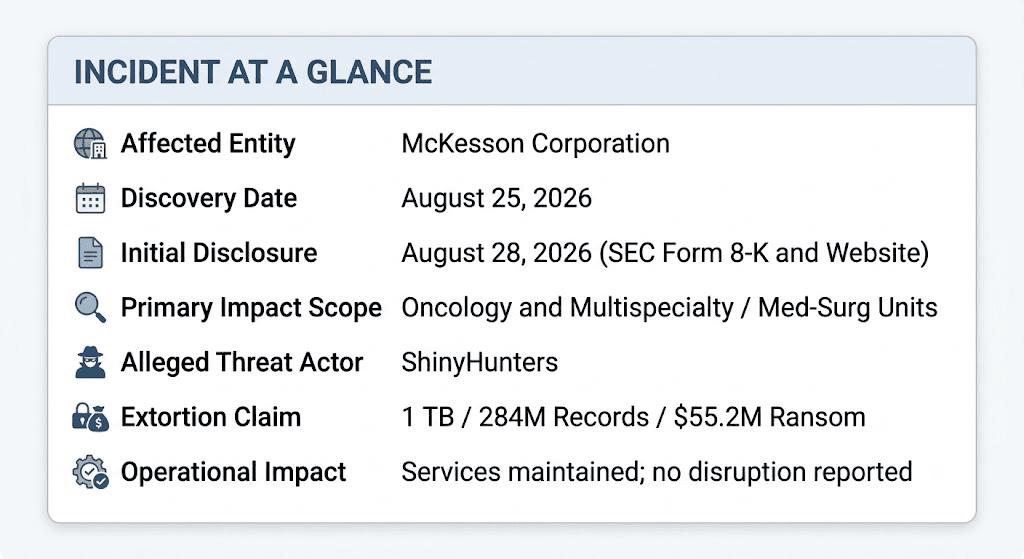
McKesson confirmed that unauthorized access was disrupted and stated that core services, pharmaceutical supply networks, and customer capabilities remained operational. While the company confirmed data exfiltration from third-party applications, it has not officially verified the threat actor's specific claims regarding dataset volume, stolen record counts, or initial access mechanisms.
Key Unanswered Questions:
What specific initial access vector was used (e.g., vishing/social engineering vs. credential stuffing)?
Were multi-factor authentication (MFA) tokens or session cookies phished or hijacked?
What exact patient (PHI) or customer datasets were exfiltrated, and how many unique individuals were affected?
What happened?
The attack vector unfolded in late August 2026. According to threat-actor statements provided to independent security outlets, unauthorized access began as early as August 21, 2026, and continued through August 25, 2026, when McKesson security teams detected the intrusion.
Visual: Incident Response Timeline
Purpose: Reconstruct the chronological sequence of events from initial access through public disclosure and extortion deadlines.
Placement: Directly below the chronologically reconstructed incident narrative.
Incident timeline
Date / Time (UTC) | Event | Evidence / Source | Confidence Level |
Aug 21, 2026 | Alleged initial access and data staging begins. | Threat-actor statements (ShinyHunters via BleepingComputer) | Unverified(Threat Actor Claim) |
Aug 21–25, 2026 | Alleged exfiltration of ~1 TB of data from third-party SaaS/Cloud environments. | Threat-actor claims | Unverified(Threat Actor Claim) |
Aug 25, 2026 | McKesson detects unauthorized cybersecurity incident involving third-party applications; initiates containment. | McKesson SEC Form 8-K / Official Company Statement | Confirmed(Primary Source) |
Aug 25, 2026 | Threat actor allegedly contacts McKesson demanding $55.2M with a 72-hour ultimatum. | Threat-actor statements | Unverified(Threat Actor Claim) |
Aug 28, 2026 | McKesson files SEC Form 8-K and posts initial breach notice on corporate cybersecurity portal. | SEC Form 8-K Filings / BleepingComputer | Confirmed(Primary Source) |
Aug 29, 2026 | McKesson confirms data exfiltration affecting subsets of Oncology and Multispecialty and Med-Surg divisions. | McKesson Public Security Statement | Confirmed(Primary Source) |
Aug 29–30, 2026 | ShinyHunters lists McKesson on Tor leak site; sets payment/contact deadline for Sept 1, 2026. | SecurityWeek / Leak Site Monitoring | Confirmed(Public Listing Observed) |
Sept 01, 2026 | Attacker-imposed ransom payment deadline expires. | SecurityWeek / Dark Web Tracking | Confirmed |
How did the attack happen?
McKesson's public disclosures explicitly confirm that the incident involved third-party applications and unauthorized data exfiltration. However, McKesson has not publicly detailed the precise technical root cause or attack path.
To understand how the compromise occurred, security analysts must evaluate claims made directly by the alleged threat actor (ShinyHunters) alongside observed TTPs from concurrent SaaS-focused campaigns.
Visual: Alleged Attack Path Visualization
Purpose: Map the threat actor's unverified claims regarding vishing, SSO compromise, and SaaS exfiltration alongside verified containment points.
Placement: Directly following the MITRE ATTandCK Mapping section.
Alt Text: Attack chain diagram mapping voice phishing to Okta credential theft, leading to Salesforce and Snowflake data exfiltration.
Alleged attack sequence (Threat Actor Narrative)
According to claims made by ShinyHunters to security publications:
Voice Phishing (Vishing): Attackers social-engineered corporate helpdesk or support personnel to obtain user credentials or session tokens.
SSO / Identity Abuse: compromised single sign-on (SSO) credentials within Okta were leveraged to authenticate into enterprise cloud applications.
SaaS Application Access: Attackers accessed cloud ecosystems including Salesforce (support cases and customer interactions) and Snowflake data storage environments.
Data Exfiltration: Extracted roughly 1 TB of structured records across a 4-day period.
Supported MITRE ATT&CK mapping
Note: The following mapping combines Confirmed corporate disclosures with Inferred / Reported technical claims. Unverified elements are explicitly noted.
Attack Phase | Technique / Sub-Technique | Observed / Alleged Activity | Evidence and Status |
Initial Access | Phishing: Voice Phishing (T1566.004) | Vishing calls to employees to harvest SSO credentials. | Inferred / Unverified(Claimed by ShinyHunters) |
Credential Access | Steal or Acquire Accounts (T1586) | Compromise of Okta Single Sign-On credentials/sessions. | Inferred / Unverified(Claimed by ShinyHunters) |
Defense Evasion | Valid Accounts: Cloud Accounts (T1078.004) | Authenticating via legitimate SSO flows to bypass basic access controls. | Inferred / Likely based on SaaS incident patterns |
Collection | Data from Cloud Storage (T1530) | Querying database records in third-party SaaS/Cloud systems. | Confirmed (McKesson confirmed third-party app access) |
Exfiltration | Exfiltration Over Web Service (T1567) | Removal of data subsets from third-party application platforms. | Confirmed (McKesson confirmed data exfiltration) |
What systems and data were impacted?
Affected Business Systems
McKesson confirmed that the unauthorized access was isolated to specific business divisions and third-party software environments:
Impacted Divisions: Oncology and Multispecialty and Medical-Surgical business units.
Third-Party Applications: Unauthorized access occurred within third-party applications hosting customer data.
Unimpacted Core Infrastructure: Core pharmaceutical distribution, operational networks, and patient care delivery systems remained unaffected and operational. There is no public evidence at the time of writing that ransomware encryption or destructive malware was deployed against McKesson's core enterprise environment.
Data Compromise Breakdown
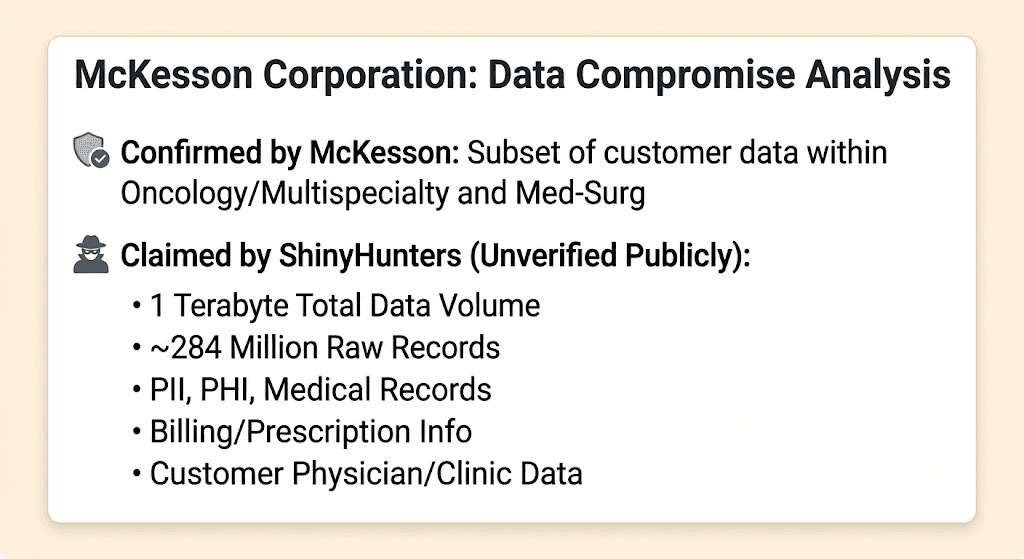
Understanding "284 Million Records":
ShinyHunters publicly stated that the "284 million" figure represents raw database rows/lines, not 284 million unique human individuals. In structured medical or sales databases, a single patient or clinic could account for hundreds of relational database entries (transactions, line items, billing codes).
Operational and recovery impact
Unlike traditional double-extortion ransomware attacks that paralyze operations using wiper software or file encryptors (e.g., Change Healthcare), the McKesson breach was primarily an extortion-only data breach.
Operational Continuity
Supply Chain Integrity: McKesson experienced no operational downtime across its core pharmaceutical supply network.
Customer Services: Systems remained online; customers were advised they could continue utilizing ordering and clinical software safely.
Intermittent Degradation: McKesson noted potential minor, transient service degradation during initial containment and triage, which was swiftly resolved.
Regulatory and Remediation Obligations
SEC Disclosure: McKesson filed an SEC Form 8-K under Item 1.05 to inform investors. As of late August 2026, McKesson stated the incident had not been determined to have a material impact on its financial condition or operations.
Credit Monitoring: McKesson proactively arranged complimentary identity protection and credit monitoring services for affected individuals.
Who was behind the attack?
Threat Actor Profiling: ShinyHunters
Attribution Analysis
Indicator / Metric | Evidence / Observed Activity | Assessment |
Leak Site Listing | McKesson added to official ShinyHunters dark-web portal with specific $55.2M ransom demand. | Verified Public Posting |
Tactics, Techniques, and Procedures (TTPs) | Use of vishing, targeting identity providers (Okta), and exfiltrating large SaaS databases (Salesforce, Snowflake). | Highly Consistent with 2024–2026 ShinyHunters campaigns. |
Direct Communication | Threat actors provided detailed record breakdowns to journalists. | Unverified claim, but matches group modus operandi. |
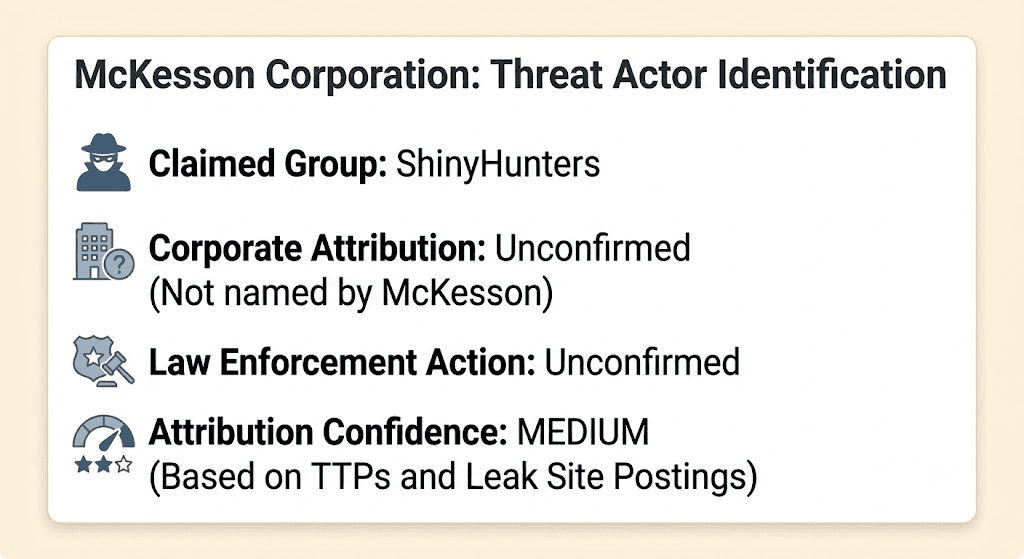
Attribution Verdict: MEDIUM CONFIDENCE (UNCONFIRMED BY PRIMARY ENTITY)
While ShinyHunters has publicly claimed the attack and the tactics align with their established playbook of cloud-data extortion, McKesson has not officially attributed the breach to ShinyHunters. Threat-actor claims must always be treated as unverified until corroborating forensic evidence is published by incident response firms or law enforcement.
Is this part of a larger pattern?
The McKesson incident is not an isolated event. It reflects a persistent cybercrime campaign targeting enterprise Identity Providers (IdPs) and Software-as-a-Service (SaaS) cloud databases.
Broader campaign patterns
Targeting Cloud Data Warehouses: Over 2024–2026, groups like ShinyHunters and UNC5537 systematically targeted enterprise environments (such as Snowflake and Salesforce) by acquiring legitimate administrative or user credentials.
Identity-Centric Exploitation: Rather than exploiting Zero-Day software flaws, attackers systematically exploit human operators using sophisticated voice phishing (vishing) or SIM swapping to bypass standard MFA.
Pure Extortion Shift: Attackers increasingly skip noisy malware deployment (ransomware encryption) in favor of silent exfiltration, leveraging regulatory non-compliance threats and public disclosure to enforce ransom demands.
Threat landscape context
The breach of a major pharmaceutical distributor highlights critical systemic risks in modern enterprise ecosystems:
SaaS and Cloud Visibility Gaps: Security operations centers (SOCs) frequently possess deep visibility into endpoint systems (via EDR) but lack real-time telemetry into third-party cloud applications and cross-SaaS API interactions.
The "MFA Identity Trap": Traditional SMS or push-based Multi-Factor Authentication is vulnerable to vishing and social engineering. Attackers who compromise the SSO tier gain unhindered lateral movement across all connected enterprise platforms.
Supply Chain Sensitivity: Even when operational supply chains are not physically disrupted, exfiltrating healthcare records, physician rosters, and pharmacy distribution data creates significant downstream fraud and phishing risks for partner networks.
Defensive lessons and recommended controls
Organized below are actionable security controls designed to mitigate the specific attack paths observed in this incident:
Identity and Access Controls
FIDO2 / Passkey Enforcement: Replace push-based and SMS MFA with phishing-resistant FIDO2 hardware keys or web authentication (WebAuthn) to render vishing attacks ineffective.
Strict Conditional Access Policies: Enforce location, compliant-device, and risk-based conditional access rules on all Identity Providers (e.g., Okta, Entra ID) before granting access to critical SaaS applications.
Data Security and Exfiltration Monitoring
SaaS Security Posture Management (SSPM): Implement continuous monitoring across cloud platforms (Salesforce, Snowflake) to detect unusual data download volumes, bulk API exports, or anomalous SQL queries.
Database Query Anomaly Detection: Establish behavioral baselines for database access. Flag and automatically terminate sessions attempting bulk table dumps exceeding normal operational bounds.
Helpdesk and Social Engineering Controls
Helpdesk Authentication Protocols: Mandate out-of-band verification (e.g., manager approval or in-app push verification) before resetting employee credentials, enrolling new MFA devices, or transferring session tokens.
What organizations should do differently
Use this prioritized executive checklist to address cloud-identity risks within your organization:
Priority | Security Measure | Threat Addressed | Recommended Action |
Immediate(0–30 Days) | Enforce Phishing-Resistant MFA | Voice Phishing / Vishing (T1566.004) | Mandate FIDO2/WebAuthn keys for all admins and employees accessing sensitive SaaS platforms. |
Near Term(30–90 Days) | Audit SaaS Access and Integration | Valid Cloud Accounts (T1078.004) | Audit all active sessions, OAuth grants, and third-party API integrations in Salesforce, Snowflake, and Okta. |
Medium Term (3–6 Months) | Deploy SSPM and Cloud DLP | Data Exfiltration (T1530) | Implement real-time cloud data loss prevention (DLP) to alert on unusual bulk exports. |
Strategic(6–12 Months) | Implement Zero Trust Architecture | Lateral Movement Across SaaS | Enforce micro-segmentation between identity providers and cloud applications based on device compliance and user risk scores. |
Unanswered questions
To maintain research integrity, the following critical aspects of the McKesson incident remain unresolved based on publicly available primary evidence:
Initial Access Proof: Was initial access strictly achieved via voice phishing of employees, or were secondary access vectors involved?
Actual Compromise Scope: What is the precise number of unique patients or customer entities affected within the 284 million database records?
Formal Corporate Attribution: Will McKesson or law enforcement formally attribute the intrusion to ShinyHunters?
Third-Party Application Names: Which specific third-party applications were directly compromised or misconfigured?
Analyst assessment
DISCLAIMER: The following section represents the independent analytical synthesis of cybersecurity researchers based on available evidence, TTPs, and industry threat intelligence.
Most Likely Attack Scenario: One plausible scenario, based on the threat actor's claims, is that social engineering was used to compromise an identity account or authentication session. Using valid authenticated sessions, the actor bypassed edge controls to access interconnected cloud environments (Salesforce and Snowflake) and exfiltrated structured databases without deploying destructive ransomware.
Confidence Level: Medium-High regarding the cloud exfiltration mechanics; Medium regarding exact threat actor identity pending official law enforcement confirmation.
Primary Security Weakness Exposed: Reliance on phish-susceptible MFA methods across identity gateways connecting core corporate databases.
Broader Pattern: This incident confirms that cybercrime threat actors are continuing to pivot away from system-encrypting ransomware in favor of low-noise, high-leverage cloud data extortion.
Book a meeting with Shieldworkz's Pharma cybersecurity expert
Recommended reading from Shieldworkz
Reference
SecurityWeek: McKesson Confirms Data Breach as Attacker Deadline Looms (Published August 31, 2026; Updated September 1, 2026).
U.S. Securities and Exchange Commission (SEC): McKesson Corporation Form 8-K Filing (Filed August 28, 2026).
McKesson Corporation Official Cybersecurity Portal: Cybersecurity Incident Notice (Published August 28–30, 2026).
BleepingComputer: McKesson discloses breach after ShinyHunters claims patient data theft(Published August 28, 2026).
Infosecurity Magazine: Healthcare Giant McKesson Investigates Data Breach Incident (Published September 1, 2026).
Disclaimer: Image is used for representative purposes only. This article has been written for educational purposes only.
Get Weekly
Resources & News
See How Our Industry-Leading OT Security Solutions Address Critical Security Challenges
You may also like

Yggdrasil, Russia-linked cyber operations, and emerging risks to global enterprises and governments
Prayukth K V

Cybersecurity Week in Review: Major Data Breaches, Critical Vulnerabilities and Supply-Chain Attacks (October 17–23, 2026)
Team Shieldworkz

NERC CIP Asset Inventory Management: Closing Visibility Gaps Across OT Networks
Team Shieldworkz

SBI data exposure: Evidence, attack scenarios and downstream fraud risk
Prayukth K V

Automate OT Security Assessments Without Losing Expert Control
Team Shieldworkz

Investigating pro-Russian cyber campaigns against France’s maritime and critical infrastructure
Prayukth K V