Prayukth K V
An evidence-based investigation into the September 2026 ransomware attack, enterprise IT compromise, operational resilience and the unanswered question of IT/OT containment
Summary
In the early morning hours of September 1, 2026, corporate IT infrastructure operated by municipal utility Stadtwerke Landsberg KU (Landsberg am Lech, Upper Bavaria, Germany) came under a targeted cyberattack. Threat actors gained sufficient access to the corporate IT environment to be able to encrypt central corporate IT systems and administrative infrastructure. The precise level of privilege obtained and whether Active Directory or other identity infrastructure was compromised has not been publicly disclosed. In response, Stadtwerke Landsberg KU executive leadership and IT teams activated and executed emergency crisis protocols, isolating internal networks and the organization disconnected its Internet connections as an emergency containment measure.
The attack let to immediate disruptions across corporate business functions. Central administrative systems, email communications, and direct landline telephony were either forced offline or severely throttled. Customer-facing communications were disrupted, particularly telephone and email access. However, public reporting indicated analysed by Shieldworkz indicates that the Stadtwerke website remained accessible and contract processing remained possible.
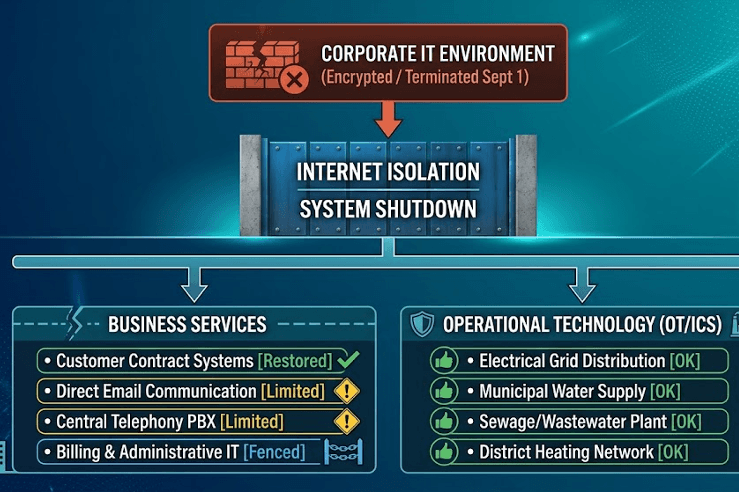
Despite corporate IT disruption, essential municipal services including the electric power grid, drinking water supply, gas, wastewater treatment, district heating (Fernwärme), fiber-optic communications, public charging stations, and municipal recreational infrastructure remained operational without any physical interruption. This functional separation highlights the primary technical operational dynamic of the incident: corporate IT compromise coexisting with intact physical service continuity.
It has to be noted that while the response to the attack provides evidence of operational resilience, it should not be treated as an undeniable forensic proof of complete IT/OT isolation.
Critical investigative gaps remain open as the forensic work continues. The initial entry vector whether via phishing, VPN credential theft, or edge-vulnerability exploitation has not been publicly disclosed yet. Similarly, no double-extortion ransomware syndicate has publicly claimed responsibility, and investigators have not publicly established whether exfiltration of customer or employee data occurred prior to system encryption.
This incident demonstrates how municipal critical infrastructure operators can absorb corporate IT compromise without triggering operational outages. It underscores the importance of strict IT/OT network segmentation, out-of-band operational resilience, and disciplined incident response under crisis conditions. All this is not to once again underscore the importance of deploying defense-in-depth to secure attack surfaces behind multiple layers of security.
Incident at a glance
Category | Finding | Source / Evidence |
Victim Organization | Stadtwerke Landsberg KU (Oberbayern, Germany) | Official Company Statement / Energate Messenger |
Country / Region | Germany / Upper Bavaria | Public Reporting |
Attack Date | Night of August 31 to September 1, 2026 | Radio Oberland / Company Notices |
Detection / Public Disclosure | September 1, 2026 (Detection) / September 3–4, 2026 (Public Reports) | Energie & Management/ Energate |
Confirmed Attack Type | Ransomware (Server/System Encryption) | Energate Messenger / Official Notices |
Systems Affected | Business IT, Email, Central Telephony, Administrative Databases | Radio Fantasy / Official Notices |
Critical Infrastructure Impact | None reported. Power, water, heating, and sewage remained operational. | Municipal Utility Bulletins |
OT / SCADA Impact | No physical disruption. Operational status was uncompromised. | Public Disclosures |
Data Exfiltration Status | Unconfirmed / Under Investigation. As of September 7, no publicly reported leak-site publication or credible public claim of stolen Stadtwerke data had been identified. This does not establish that no data was exfiltrated. | Forensic Status Reports |
Attribution | Unestablished. No threat group or state actor publicly identified. | Public Disclosures |
Primary Response Actions | Internet severance, system shutdown, crisis team assembly, engagement of external forensic specialists, police notification | Emergency Response Logs |
Current Operational Status | Partial Recovery. Core services maintained; customer service and contracting restored; email/phone restricted. | Energate Messenger(Sept 7, 2026) |
Incident timeline
The night of Aug 31 – Sep 1, 2026: Attacker executes ransomware payload; central business IT encrypted.
Sep 1, 2026 (Early Morning): Intrusion detected; emergency protocols initiated; Internet access severed.
Sep 1 – Sep 2, 2026:Emergency crisis staff established; external responders and police engaged.
Sep 3 – Sep 4, 2026:Public notifications released; OT isolation and continuity verified.
Sep 7, 2026:Customer inquiry workflows restored; email/phone remain throttled.
Reconstructing the incident
During the night leading into September 1, 2026, unauthorized threat actors launched an attack against the internal corporate IT environment of Stadtwerke Landsberg KU. Once network access was obtained, attackers executed encryption commands across central administrative IT servers.
Early on September 1, 2026, internal monitoring and system anomalies alerted IT staff to active file encryption. The organization executed its cyber emergency response plan, severing the corporate network's connections to the public Internet in order to block active command-and-control (C2) channels and prevent potential lateral movement. Concurrently, IT staff performed controlled emergency shutdowns of core administrative servers, domain controllers, and office workstations.
Following containment, executive leadership formed an internal crisis management team (Krisenstab) to direct recovery operations. External digital forensics and incident response (DFIR) specialists were brought in to preserve evidence, assist with containment, and evaluate the integrity of dormant network segments. Law enforcement authorities were formally notified to initiate criminal investigations.
Initial media advisories and regional broadcasts on September 3 and September 4, 2026, confirmed the ransomware attack. By September 7, 2026, trade publications (Energate Messenger) reported that Stadtwerke Landsberg had restored sufficient administrative infrastructure to resume core customer service processing and contract administration. However, incoming telephony and direct email communications remained throttled or operating under restricted capacity while forensic verification continued.
Technical and operational impact analysis
Corporate and business IT Impact
The ransomware attack severely compromised the utility’s enterprise domain:
Administrative Infrastructure: Central file systems, enterprise resource planning (ERP) databases, and administrative server clusters were rendered inaccessible via encryption or preemptive shutdown.
Communications: Corporate email hosting and Voice over IP (VoIP) telephony systems were severed from external networks, blocking direct customer inquiries.
Customer Services: Were impacted to varying degrees on specific channels.
Operational Technology and physical critical infrastructure
Physical utility delivery experienced zero documented outages:
Power grid distribution: Medium- and low-voltage electrical distribution systems operated without interruption.
Water and wastewater infrastructure: Municipal drinking water extraction, treatment plants, and the public sewage plant (Kläranlage) maintained normal operations.
District heating and auxiliary assets: Fernwärme plants, municipal fiber-optic distribution networks (Glasfaser), EV charging stations (Ladeinfrastruktur), the local public pool (Inselbad), and automated parking garages (Parkgaragen) continued functioning normally.
Analytical assessment: Service continuity vs. OT security
Public statements confirming that utility services operated normally establish that physical disruption was avoided. However, this does not definitively prove that OT networks remained uncompromised.
In industrial cybersecurity, a distinction exists between:
Absence of Operational Disruption: Physical processes continue functioning normally due to air-gapping, local manual controls, or autonomous PLC/RTU execution.
Absolute OT Non-Compromise: Verifiable forensic proof that zero threat actor activity or lateral probing occurred across the OT/ICS perimeter.
While physical continuity was maintained, confirming complete OT network integrity requires deep packet analysis, endpoint forensics on engineering workstations, and log audits across OT security boundaries.
Since the attack was detected early it is possible that an attempt to target OT was thwarted. It should be noted that the available public evidence does not establish whether the attackers attempted to move from the corporate environment toward operational networks. Determining that would require forensic examination of network traffic, authentication records, firewall logs and OT-adjacent systems.
What we know | What it means | What we cannot conclude |
Physical services continued | Operational resilience was maintained | OT was not compromised |
Corporate IT was encrypted | Enterprise environment was successfully attacked | OT networks were untouched |
No public operational outage | Safety/service continuity mechanisms worked | Attackers never attempted OT access |
IT/Internet was disconnected | Containment was rapid | Initial access or lateral movement path |
Attack vector and threat actor analysis
Initial Access Vector
As of early September 2026, the initial access vector has not been publicly disclosed by Stadtwerke Landsberg, forensic investigators, or law enforcement agencies.
Confirmed
Ransomware attack occurred.
Central IT systems were encrypted.
Attack occurred during the night of August 31/September 1.
Internet connections were disconnected.
Systems were shut down.
External forensic specialists were engaged.
Not established
Initial access vector
Initial compromised account
Privilege escalation
Lateral movement mechanism
Persistence mechanism
Data staging
Exfiltration
Ransom demand
Ransomware family
Threat actor
Candidate attack paths
External-facing infrastructure
Stolen credentials
Phishing
Third-party access
Relevant Attack Paths for Municipal Utilities
While the specific entry vector for this incident remains unconfirmed, utility IT networks commonly face risks from several established access vectors:
Exposed Edge Remote Infrastructure: Unpatched vulnerabilities or compromised credentials on perimeter devices (such as VPN gateways or remote desktop services).
Spear-Phishing & Credential Theft: Tailored phishing campaigns targeting administrative staff to harvest valid corporate credentials or execute malicious attachments.
Supply-Chain / Managed Service Provider (MSP) Compromise: Exploitation of trusted third-party vendor connections, remote maintenance portals, or software supply chains.
Threat actor attribution
Attribution has not been publicly established. No cybercrime group or state-sponsored threat actor has publicly claimed responsibility for the incident, and no specific ransomware payload family (LockBit, Black Basta, ALPHV/BlackCat) has been officially named.
Since no entity has come forward yet, the following scenarios cannot be ruled out:
· This was a trial run for a larger cyberattack
· The threat actor was a hacktivist without a post-attack playbook
· The attacker stayed in the background since the attack didn’t succeed fully
Exfiltration and data theft status
As of September 7, 2026, data exfiltration has not been confirmed by investigators, nor has any customer or employee data been posted on dark web leak sites.
The Diagnostic Gap: Encryption vs. Exfiltration
A core element of modern cyber investigations is the distinction between system encryption and data exfiltration:
Modern threat actors routinely employ "double extortion" tactics (stealing confidential records prior to launching encryption binaries). Determining whether exfiltration occurred requires forensic analysis of network perimeter logs, active egress netflow records, and staging area artifacts.
Because exfiltration analysis requires reviewing vast quantities of network and host log data, confirming or ruling out data theft often takes weeks. The absence of immediate leak-site postings does not guarantee that data was not stolen; it indicates that the investigation remains ongoing.
Incident response and containment evaluation
Stadtwerke Landsberg’s response aligned with standard industrial cyber incident handling principles:
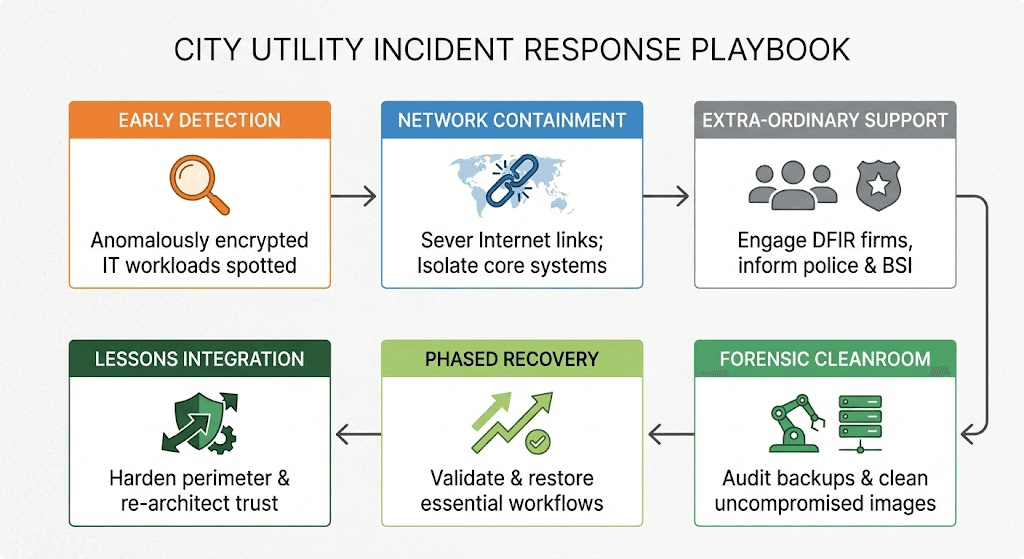
Immediate Containment: Upon discovering active encryption, IT personnel disconnected internal networks from the Internet to isolate the attack blast radius.
Operational Isolation: Business IT systems were systematically shut down to prevent secondary lateral propagation into adjacent segments.
Crisis Organization: Leadership established a dedicated crisis management team (Krisenstab) to oversee communications, operations, and forensic remediation.
Third-Party Specialist Engagement: External cybersecurity incident response professionals were engaged to conduct forensic triage, reconstruct the incident timeline, and assist with clean-room restoration.
Regulatory and Legal Compliance: Relevant state law enforcement agencies and supervisory authorities were notified in accordance with critical infrastructure reporting guidelines.
The apparent attack objective was therefore partially achieved at the enterprise level but did not translate into a physical service outage. Whether this reflects attacker intent, effective segmentation, rapid containment, architectural separation, or simply the limits of the attackers' access remains unknown.
Known vs. Unknown matrix
Area | Confirmed Facts | Unknown / Unverified |
Incident Details | Central IT encrypted on the night of Aug 31/Sep 1, 2026. Internet severed defensively. | Exact point of initial entry; total volume of encrypted systems. |
Physical Operations | Power, water, gas, heating, and sewage operated continuously without disruption. | Whether threat actors attempted to pivot from IT into OT boundaries. |
Attribution & Ransom | Ransomware strain and specific threat actor remain unconfirmed. | Specific ransom demand amount or communications, if any. |
Data Exfiltration | No public proof of exfiltration as of September 7, 2026. | Whether staging or unauthorized data transfer occurred prior to encryption. |
Recovery Status | Basic customer contract processing restored by September 7. | Complete timeline for full corporate IT restoration. |
The OT resilience question
The primary structural question arising from this incident is: Why did utility operations remain fully functional while central IT was encrypted?
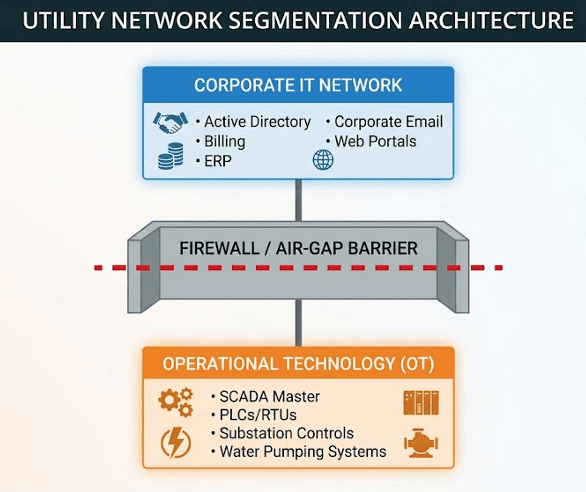
This operational separation points to key architectural controls commonly used in resilient municipal utility environments:
Strict Network Segmentation (Purdue Model): One possible explanation for the operational continuity is effective separation between enterprise IT and operational environments. In a Purdue-style architecture, segmentation, industrial DMZs, controlled conduits and restricted trust relationships can limit the ability of enterprise ransomware to propagate into control networks. However, the public information available on the Landsberg incident does not provide enough architectural detail to confirm that this was the specific mechanism responsible.
Autonomy of Physical Control Systems: Modern distribution networks utilize Programmable Logic Controllers (PLCs) and Remote Terminal Units (RTUs) designed to maintain autonomous operation using local feedback loops, even if connection to primary SCADA servers or corporate networks is lost.
Out-of-Band Telemetry: Critical telemetry networks for power, water, and heating grids are frequently operated over dedicated, segregated communication channels rather than sharing corporate IT routing.
Key lessons for utilities
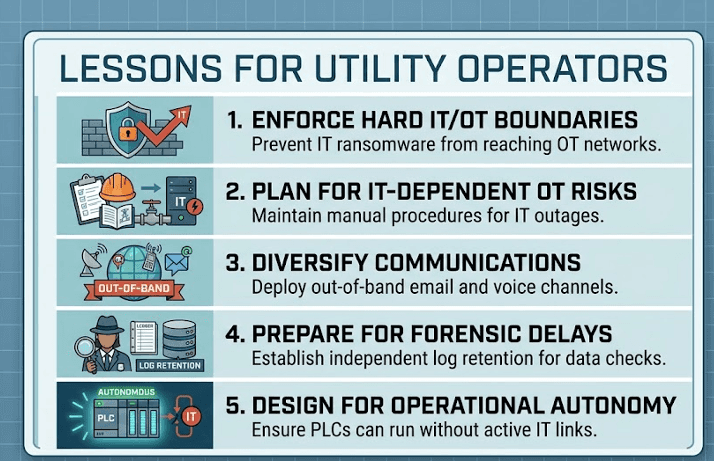
Enforce Hard IT/OT Segmentation: Maintaining strict administrative, identity, and network separation between corporate Active Directory domains and OT environments prevents ransomware from automatically propagating across boundaries.
Mitigate Indirect Operational Risks from IT Outages: Even when OT systems are uncompromised, the loss of corporate IT can impact field dispatch, logistics, customer service, and procurement. Utilities must maintain paper-based or out-of-band operational procedures.
Establish Out-of-Band Emergency Communications: When central VoIP and corporate email fail, crisis management relies on pre-provisioned, out-of-band communication channels (such as satellite communications or isolated secondary mobile voice systems).
Prepare for Forensic Delays in Exfiltration Assessments: Investigating potential data theft requires extensive log analysis. Utilities must maintain centralized, write-once-read-many (WORM) offsite logging to accelerate forensic assessments during an incident.
Design ICS Assets for Autonomous Operation: Critical physical processes should be engineered to run safely on local, deterministic controls without relying on continuous connectivity to enterprise IT systems.
Protect the Identity Plane Separately from the Production Domain: Privileged accounts, domain administrators, backup administrators and remote-access identities should use phishing-resistant MFA, dedicated administrative workstations and tightly controlled privilege escalation paths.
Actionable preventive and resilience framework
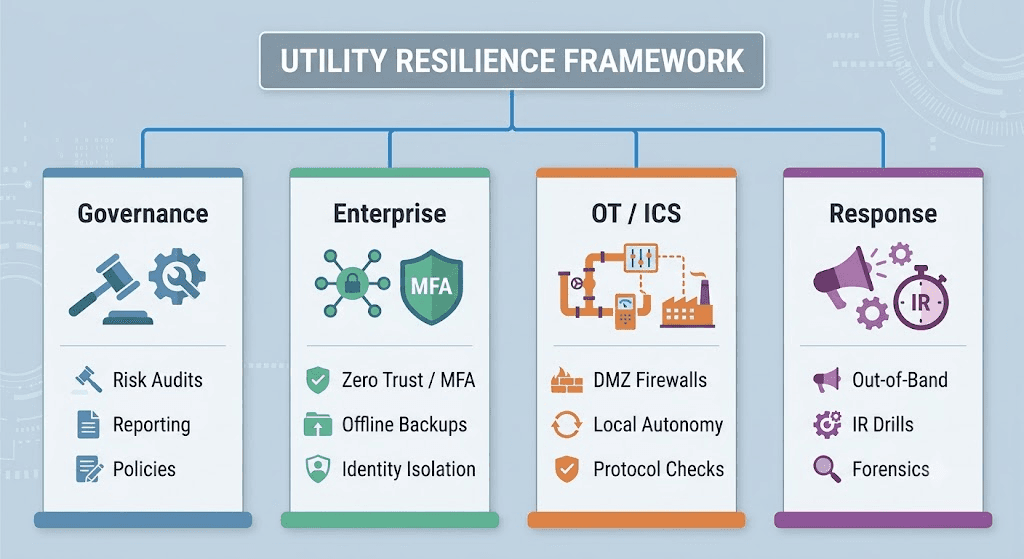
1. Governance and compliance
Crisis Management Protocols: Establish clear lines of authority between IT security, OT operations, and executive leadership to enable rapid isolation decisions during an incident.
Regulatory Readiness: Standardize incident notification procedures to align with regional CRITIS and cybersecurity reporting requirements.
2. Enterprise IT architecture
Identity Security and MFA: Implement phishing-resistant Multi-Factor Authentication (MFA) across all external access points, remote access gateways, and privileged administrative accounts.
Immutable, Air-Gapped Backups: Maintain offline, immutable backup copies of core administrative databases, operating system images, and configuration files to support clean restoration.
3. Operational Technology (OT / ICS) Hardening
Purdue Model Enforcement: Enforce strict DMZ boundaries between enterprise IT networks and operational control zones.
Privileged Remote Access Management: Restrict and monitor vendor remote access links into OT environments, requiring multi-factor authentication and explicit jump-box routing.
4. Incident Response and Forensic Readiness
Out-of-Band Communication Infrastructure: Maintain pre-configured, out-of-band communication systems to support operational management if corporate IT networks are lost.
Forensic Log Preservation: Configure security information and event management (SIEM) systems to export critical perimeter, firewall, and authentication logs to secure offsite storage.
Current status and open questions
As of September 7, 2026, Stadtwerke Landsberg is operating in a state of controlled recovery:
Service Restoration Status: Core business workflows are partially operational, allowing staff to process customer requests and execute contract agreements.
Communications Status: Direct email and primary landline telephony remain throttled or operating under restricted capacity while systems undergo security checks.
Ongoing Investigations: Digital forensics teams continue to review system artifacts, and law enforcement investigations remain open.
Open Questions
What was the initial compromise vector used to gain access to the network?
Did the threat actors exfiltrate sensitive customer, financial, or operational data prior to system encryption?
Which specific threat group executed the attack?
The Landsberg attack demonstrates that enterprise IT compromise and physical service disruption are not necessarily synonymous. The incident provides evidence of operational resilience, but the available public record is not sufficient to determine whether that resilience resulted from segmentation, autonomous OT operation, rapid containment, attacker limitations, or some combination of these factors.
For utility operators, the incident highlights a key operational reality: preventing corporate IT compromise requires constant vigilance, but containing that compromise to prevent physical service disruption is the true measure of critical infrastructure resilience.
Sign up for a free briefing on utility security and NIS2 compliance
Access our curated remediation guides section to fix security gaps
Download our regulatory playbook to enhance your compliance drive
Get Weekly
Resources & News
See How Our Industry-Leading OT Security Solutions Address Critical Security Challenges
You may also like

OT Removable Media Security: NIST SP 1334 Implementation Guide
Team Shieldworkz

CVE-2026-92817: Ignition SCADA Privilege Escalation - Affected Versions & Mitigation
Team Shieldworkz

Preventing USB-Based Cyberattacks in OT: From Malware Detection to Secure File Approval
Team Shieldworkz

OpenPLC Runtime v3 Security Advisory: Potential Risks for Industrial Deployments
Team Shieldworkz

Yggdrasil, Russia-linked cyber operations, and emerging risks to global enterprises and governments
Prayukth K V

Cybersecurity Week in Review: Major Data Breaches, Critical Vulnerabilities and Supply-Chain Attacks (October 17–23, 2026)
Team Shieldworkz