
Prayukth K V
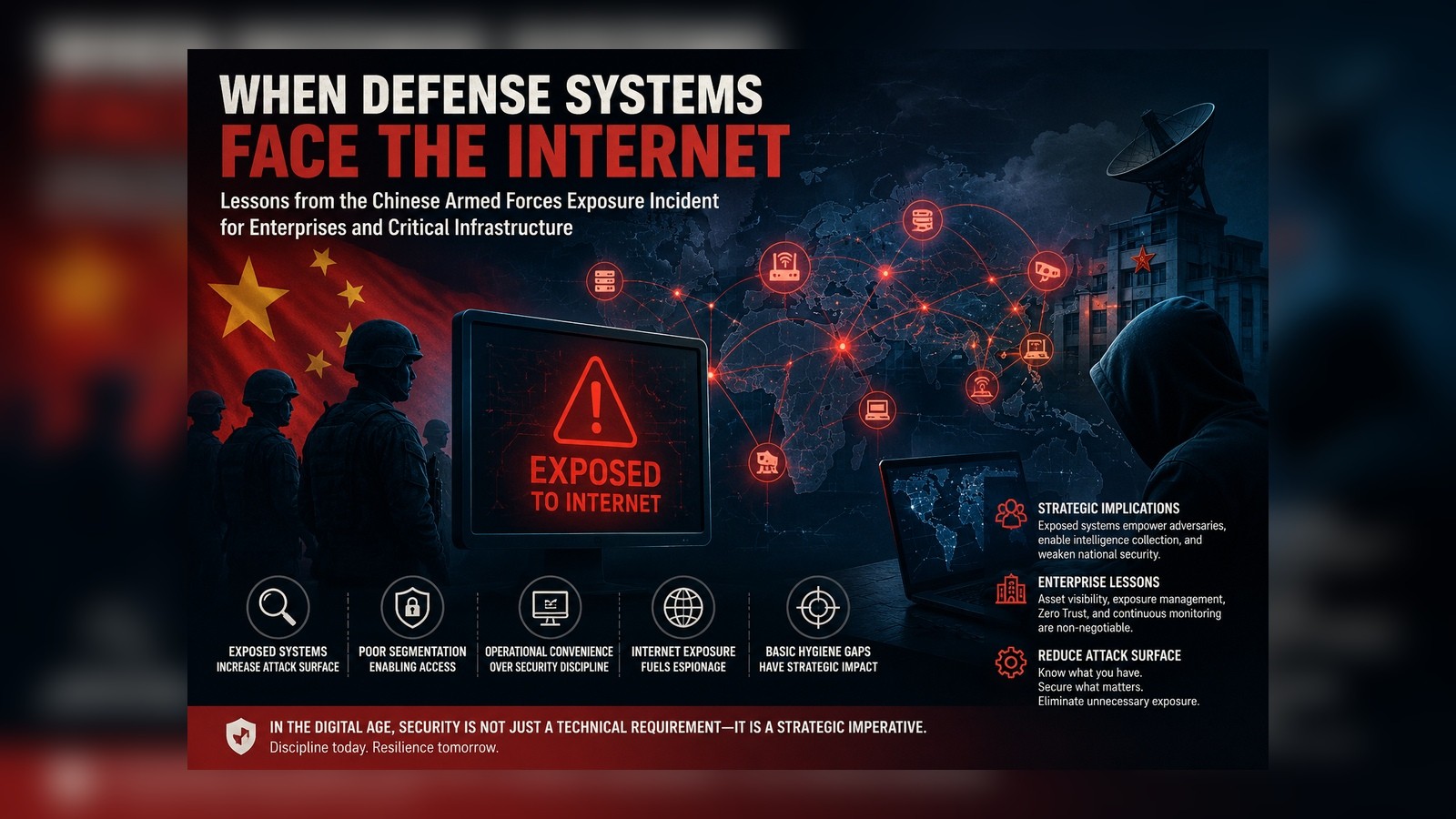
In contemporary cyber intelligence, a sort of persistent paradox remains. State-sponsored offensive actors capable of engineering sophisticated, multi-stage supply chain attacks often suffer from elementary defensive hygiene failures within their infrastructure. Recent open-source intelligence (OSINT) monitoring, including technical indicators aggregated and analyzed by platforms like the International Cyber Digest, highlights several instances where internet-facing systems and critical infrastructure nodes associated with the Chinese armed forces and defense contractor ecosystems have been left exposed to the public internet. Such an exposure doesn’t just render the Chinese armed forces vulnerable to long term surveillance and/or offensive cyber action, but this episode also offers many lessons for defense entities and enterprises everywhere.
Although overall risk exposure depends on multiple factors, exposing internet-facing ports and assets can severely weaken every other defense measure. It is among the most basic and avoidable security failures an organization can make.
Our analysis evaluates the architectural breakdowns, strategic implications, and systemic operational security (OPSEC) failures that often lead to such exposures. For intelligence analysts, military cyber operators, and critical infrastructure executives, this episode serves as a stark reminder. Internet-exposed systems remain one of the most severe liabilities in modern security governance. A single unmanaged edge device or even a misconfigured gateway can compromise years of strategic security and operational investments.
This article builds on the research of conducted by the International Cyber Digest group accessible from here.
Before we move forward, don’t forget to check out our previous blog post on why traditional OT risk assessments are broken and how OThello Assess fixes that here.
Breakdown of the incident
Publicly available internet scanning data and intelligence tracking reveal that the exposed assets primarily comprise edge infrastructure, unmanaged remote access gateways, and localized staging environments. While specific internal military command-and-control (C2) cores seem to remain heavily segmented, the perimeter vulnerabilities typically map to auxiliary networks, research institutes, and third-party defense logistics providers.
Nature of the exposure
The exposed systems generally present via the following vectors:
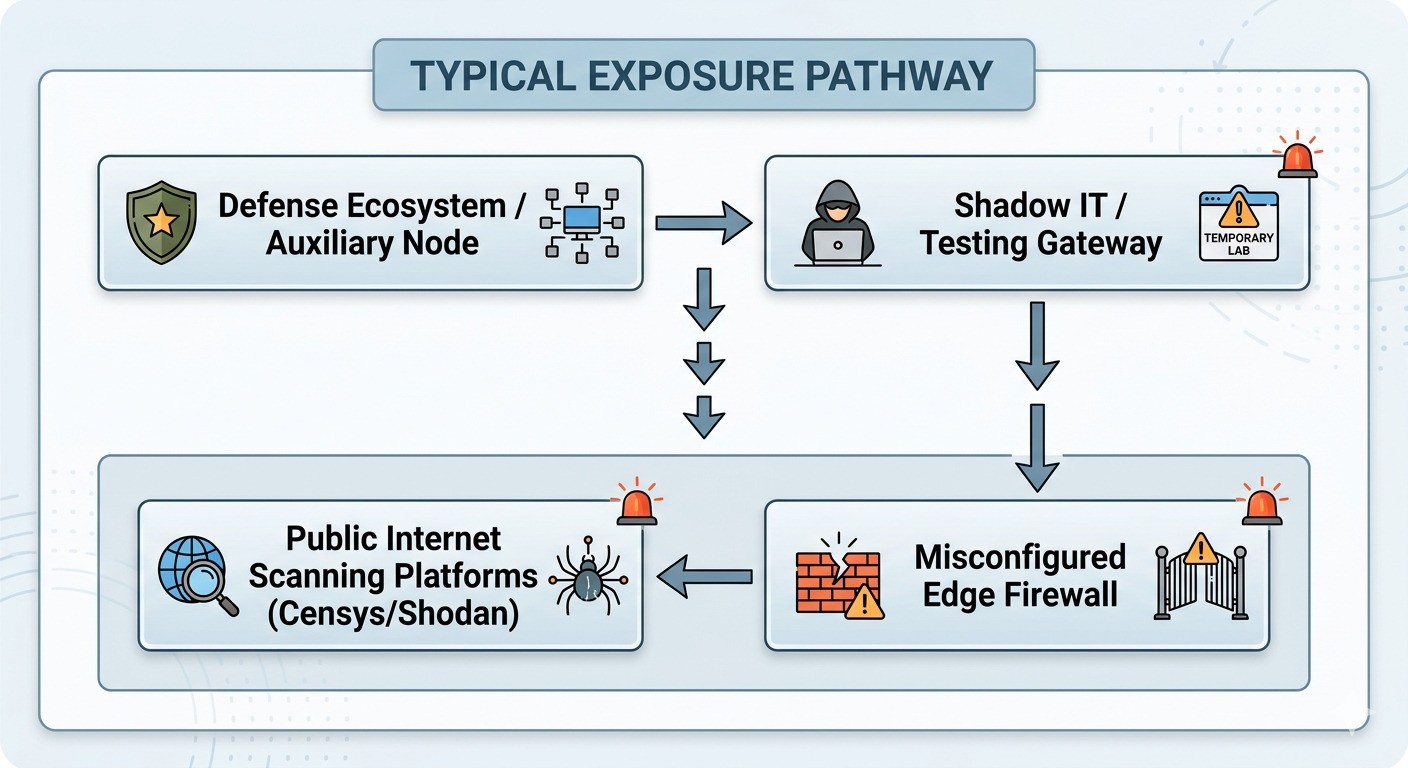
Misconfigured Edge Routing and Firewalls: External interfaces left accessible through standard web protocols (HTTP/HTTPS) or remote management ports (SSH, RDP) without any IP white-listing or mandatory multi-factor authentication (MFA).
Exposed Industrial IoT and Building Management Systems (BMS): Environmental controls and secondary facilities automation systems directly queryable via global scanning engines like Shodan or Censys.
Shadow IT Staging Environments: Software testing environments and data repositories utilized by defense sub-contractors that mirror production environments but lack core security policy enforcement.
Underlying architectural gaps
This exposure indicates a breakdown in foundational asset management, cyber hygiene practices and protocols and governance rather than a failure of advanced security tools. It points directly to weak network segmentation and inadequate Asset Lifecycle Management (ALM).
When auxiliary nodes or development networks get connected to production infrastructure without strict, deterministic egress and ingress filtering, even a perimeter exposure at a low-tier research institute can provide a clear pathway for adversarial reconnaissance, persistence and lateral movement.
Strategic and geopolitical implications
When military-grade or state-affiliated infrastructure is exposed, the strategic consequences extend far beyond immediate patch management.
Operational preparation of the battlefield (OPB)
For opposing intelligence services, public exposures are an invaluable source of accurate passive intelligence. Adversaries do not need to actively scan or probe the network as these actions that might trigger intrusion detection systems. Instead, they can simply harvest data from historical internet-wide scanning repositories to:
Map the digital footprint and physical location of state-affiliated entities.
Identify specific hardware vendors and firmware versions in use, allowing them to stockpile targeted N-day or Zero-Day exploits.
Correlate autonomous system numbers (ASNs) and IP allocations with specific units or military directorates.
The paradox of military modernization
As global militaries undergo transformation, integrating cloud architectures, data-driven logistics, and interconnected command structures, their attack surface expands exponentially. In the case of the Chinese armed forces, the focus on operational outcomes far outweighed the security priorities leading to the emergence of a series of security gaps that expanded in both security implications and scope for disruption over a period. For a military that prides itself on operating advanced defense systems, this incident reflects poorly on its security posture.
This episode illustrates that military modernization without corresponding, strictly enforced defensive hygiene creates an asymmetric risk. The complexity of managing billions of connected endpoints often outpaces the bureaucratic and operational mechanisms designed to secure them.
Unique and underreported aspects of this episode
Analyses of state-sponsored cyber operations often focus heavily on advanced offensive capabilities while overlooking the practical realities of daily network administration.
The operational asymmetry: Offensive sophistication does not equal defensive maturity. An organization can field elite cyber-espionage units while simultaneously failing to secure its own mundane edge routing infrastructure. This dichotomy can have not so favorable outcomes on the battlefield during times of conflict.
Convenience vs. security discipline
Inside defense ecosystems, the primary driver of shadow IT and unauthorized internet exposure is often operational friction. Analysts, developers, and researchers often bypass rigid central security controls to facilitate remote work, data sharing, or rapid prototyping. When security architectures are overly restrictive or slow to adapt, personnel create unauthorized workarounds, such as deploying unauthorized VPNs or exposing staging servers, to maintain the desired level of operational velocity.
The vulnerability of the contractor ecosystem
Modern defense structures rely on a vast web of commercial contractors, academic institutions, and logistics providers. This extended ecosystem is often the soft underbelly of field operations. While a central military branch may enforce rigorous air-gapping and zero-trust policies, a tier-three software contractor or component supplier may operate with standard commercial security practices, effectively serving as an unmonitored back door into the broader strategic framework. This in turn becomes a single point of failure.
Enterprise and critical infrastructure lessons
For Chief Information Security Officers (CISOs) and critical infrastructure operators, this incident provides actionable takeaways for securing complex environments.
The primacy of External Attack Surface Management (EASM)
You cannot protect what you do not know exists. Traditional asset inventories are inside-out; they rely on internal tools to report active assets. Modern defense requires an outside-in perspective. Organizations must continuously monitor the public IPv4/IPv6 space from an adversarial viewpoint to detect rogue assets, forgotten staging environments, and unauthorized configurations before malicious actors do.
Core architecture mitigations
Defensive Pillar | Operational Implementation |
Zero Trust Network Access (ZTNA) | Replace traditional perimeter-based VPNs with identity- and context-aware access proxies. No asset should be trusted implicitly based on network location. |
Micro-Segmentation | Isolate development, staging, and administrative environments from production networks using strict, default-deny firewall policies. |
Automated Exposure Validation | Employ continuous, automated scanning and red-teaming tools to validate that perimeter defenses are functioning as intended. |
OT/ICS and critical infrastructure perspective
The intersection of information technology (IT) and operational technology (OT) within critical infrastructure represents an acute area of vulnerability. If state-affiliated entities struggle to maintain clean perimeters on auxiliary networks, the risk to industrial control systems (ICS) that govern manufacturing, energy grids, and water utilities, is severe.
Exposed human-machine interfaces (HMIs) or programmable logic controllers (PLCs) represent a disproportionate operational risk. Unlike traditional IT assets, where a compromise typically results in data exfiltration, a compromise in an OT environment can cause physical destruction, prolonged operational downtime, and threats to human life. The convergence of IT and OT requires that any bridge between the two layers be heavily guarded by unidirectional security gateways (data diodes) and rigorous protocol validation.
Cyber threat intelligence and adversary tradecraft
State-sponsored advanced persistent threats (APTs) systematically exploit perimeter exposures as their primary initial access vector.
Automated ingestion and weaponization
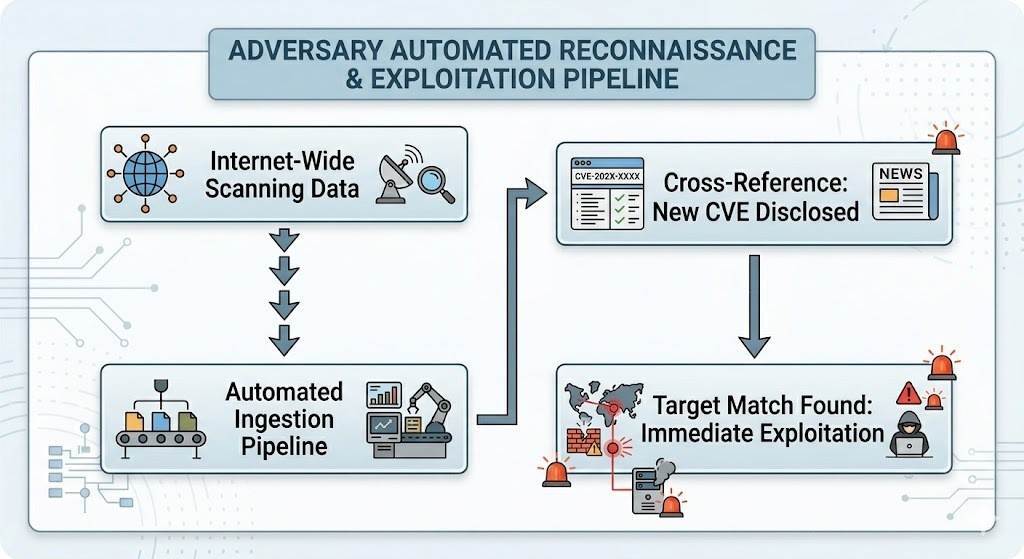
Modern adversary tradecraft relies heavily on automated reconnaissance pipelines. Sophisticated threat actors maintain continuous ingestion feeds from commercial and proprietary internet-wide scanning platforms. When a new vulnerability in an edge device (e.g., a critical flaw in a major firewall or VPN appliance) is disclosed, these pipelines automatically cross-reference the vulnerability against their database of exposed assets.
The use of Operational Relay Networks (ORNs)
To obscure their attribution and geographic origin, state actors increasingly leverage compromised small office/home office (SOHO) routers and IoT devices as operational relay networks (ORNs). These hijacked devices form a highly distributed proxy mesh. If an actor's own infrastructure suffers from exposure or poor configuration, their covert proxy networks can become visible to counter-intelligence teams, disrupting active espionage campaigns globally.
Recommendations and defensive measures
To defend complex enterprise and critical infrastructure environments against state-level threat capabilities, Shieldworkz recommends that security leaders should implement the following structural controls:
Establish a bi-directional asset inventory: Reconcile internal configuration management databases (CMDB) with continuous external EASM scanning data at least weekly. Discrepancies must be treated as critical incidents.
Enforce strict egress filtering: Restrict internal systems from establishing outbound connections to the internet unless explicitly required and whitelisted. Many exposure incidents are discovered because compromised internal assets successfully call home to malicious external infrastructure.
Decommission legacy infrastructure: Mandate a strict lifecycle policy for legacy hardware and software. Systems that cannot support modern authentication mechanisms (such as SAML/OIDC with hardware-backed MFA) must be removed from internet-facing perimeters entirely.
Establish executive accountability boundaries: Governance frameworks must hold business unit leaders and third-party vendors legally and operationally accountable for unauthorized internet deployments (Shadow IT). Perimeters must be managed via centralized, audited change-control processes without exception.
Learn more about Othello Assess, an IEC 62443-based risk assessment tool that enables you to conduct comprehensive risk assessments, architecture reviews, SL level analysis, compliance tracking, security gap review and more in less than one day. You can sign up for an Othello test drive here.
Get Weekly
Resources & News
See How Our Industry-Leading OT Security Solutions Address Critical Security Challenges
You may also like

Preventing USB-Based Cyberattacks in OT: From Malware Detection to Secure File Approval
Team Shieldworkz

OpenPLC Runtime v3 Security Advisory: Potential Risks for Industrial Deployments
Team Shieldworkz

Yggdrasil, Russia-linked cyber operations, and emerging risks to global enterprises and governments
Prayukth K V

Cybersecurity Week in Review: Major Data Breaches, Critical Vulnerabilities and Supply-Chain Attacks (October 17–23, 2026)
Team Shieldworkz

NERC CIP Asset Inventory Management: Closing Visibility Gaps Across OT Networks
Team Shieldworkz

SBI data exposure: Evidence, attack scenarios and downstream fraud risk
Prayukth K V