
Team Shieldworkz
Every industrial operator eventually reaches the same uncomfortable realization: the network that runs the plant floor was never designed with an adversary in mind. Programmable logic controllers, human-machine interfaces, and supervisory control systems were built for uptime, precision, and safety , not for resisting a determined intruder. As these systems have connected outward, to corporate IT networks, remote vendors, and cloud-based historians, that original design gap has become one of the most consequential risks facing modern industry.
Before we begin, don’t forget to check out our previous post on “Cyber resilience assessment against Iran-linked threat pathways for water and wastewater systems” here.
Network Detection and Response, commonly known as NDR, has emerged as one of the most practical answers to this problem. But not all NDR is created equal. A platform built for corporate IT traffic will misread, ignore, or simply fail to parse the protocols that keep a refinery, power substation, or assembly line running. Effective OT-focused NDR depends on a specific set of advanced detection controls , behavioral analytics, protocol-aware inspection, intelligent segmentation, and correlation with real-world threat intelligence, working together as a single system rather than as isolated tools.
This Blog walks through exactly what those controls look like in practice, why they matter to plant managers and CISOs alike, and how organizations can build a detection program that catches sophisticated threats early, without drowning security teams in false alarms.
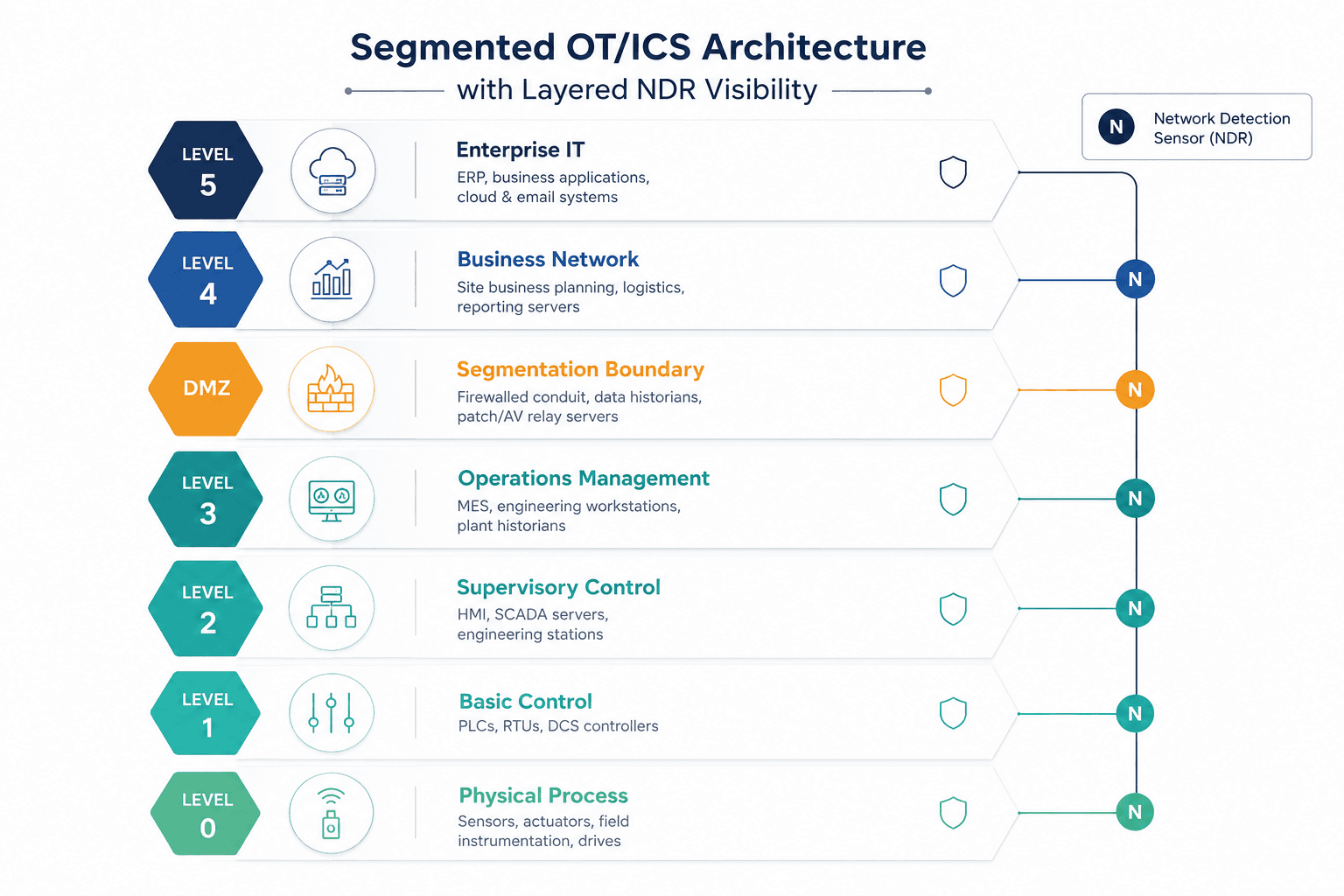
A properly segmented OT/ICS architecture gives NDR sensors clear, layered visibility across every level of the Purdue model.
Why Threat Detection in OT Environments Demands a Different Approach
Information technology and operational technology may share a network cable today, but they were built around fundamentally different priorities. IT security is oriented around confidentiality , protecting data. OT security is oriented around availability and safety, keeping a physical process running without harming people, equipment, or the environment. That single distinction changes almost everything about how threat detection needs to work.
Legacy Devices That Were Never Meant to Defend Themselves
Many programmable logic controllers, remote terminal units, and distributed control systems in active use today were installed ten, twenty, or even thirty years ago. They lack the processing overhead to run endpoint security agents, they cannot always be patched without halting production, and their communication protocols, Modbus, DNP3, Profinet, EtherNet/IP, and similar industrial languages , were designed decades before cybersecurity was a serious consideration. This is precisely why passive, network-based detection has become the only realistic way to monitor these assets without disrupting the process itself.
Flat Networks and Implicit Trust
A large share of industrial sites still operate on networks where a single compromised engineering workstation can reach nearly every controller in the facility. Segmentation, when it exists at all, is often incomplete or undocumented. Attackers who understand this reality do not need to breach every layer of a defense-in-depth model, they simply need one weak entry point and a flat network to move laterally toward the process itself.
The Consequences Are Physical, Not Just Digital
When an IT system is compromised, the outcome is typically data loss, downtime, or reputational damage. When an OT system is compromised, the outcome can include halted production lines, damaged equipment, environmental incidents, or in the most severe cases, threats to human safety. This raises the stakes of detection dramatically, a missed or delayed alert in an industrial environment does not just cost money, it can put people at risk.
Real-World Industry Examples That Illustrate the Stakes
Industrial cybersecurity is no longer a theoretical concern discussed at conferences , it has a well-documented, real-world track record. A few incidents in particular continue to shape how security leaders think about detection and segmentation.
The Ukrainian power grid attacks. In events that first drew global attention in 2015 and again in 2016, attackers gained remote access to utility control systems and manually opened circuit breakers, cutting power to hundreds of thousands of customers. Investigators later confirmed the intrusions began months earlier through spear-phishing and lateral movement across networks that lacked meaningful segmentation between IT and OT, a gap that early network monitoring could plausibly have surfaced.
A major U.S. fuel pipeline disruption. In 2021, a ransomware attack on the corporate IT side of a critical fuel pipeline operator led the company to proactively shut down OT operations as a precaution, since the two environments were not confidently segmented enough to guarantee the operational side remained unaffected. The shutdown triggered fuel shortages across several states, illustrating how an IT-only breach can still force an OT-wide response when segmentation and detection boundaries are unclear.
An aluminum producer's ransomware incident. In 2019, a major Norwegian aluminum manufacturer was forced to switch parts of its production to manual operation after ransomware spread across its global network, affecting both business and plant systems. The company's transparent public response became a widely studied example of both the operational cost of poor segmentation and the value of having tested incident response plans ready.
A water treatment facility intrusion attempt. In early 2021, an operator at a Florida water treatment plant noticed a cursor on their screen moving on its own, briefly increasing the level of sodium hydroxide in the water supply to a dangerous concentration before the change was manually reversed. The intrusion reportedly came through remote access software that lacked strong monitoring, underscoring how even small facilities are viable targets and how critical real-time visibility into operator and remote sessions has become.
These examples share a common thread: in nearly every case, better network visibility, tighter segmentation, or earlier behavioral detection could have shortened the window between initial access and impact. That window, often called dwell time, is exactly what advanced NDR controls are designed to compress.
The Advanced Detection Controls That Make OT-Focused NDR Effective
Not every network monitoring tool deserves to be called NDR, and not every NDR deployment is built for the realities of industrial environments. The controls below represent the layers that, working together, distinguish a detection program that genuinely reduces risk from one that simply generates dashboards.
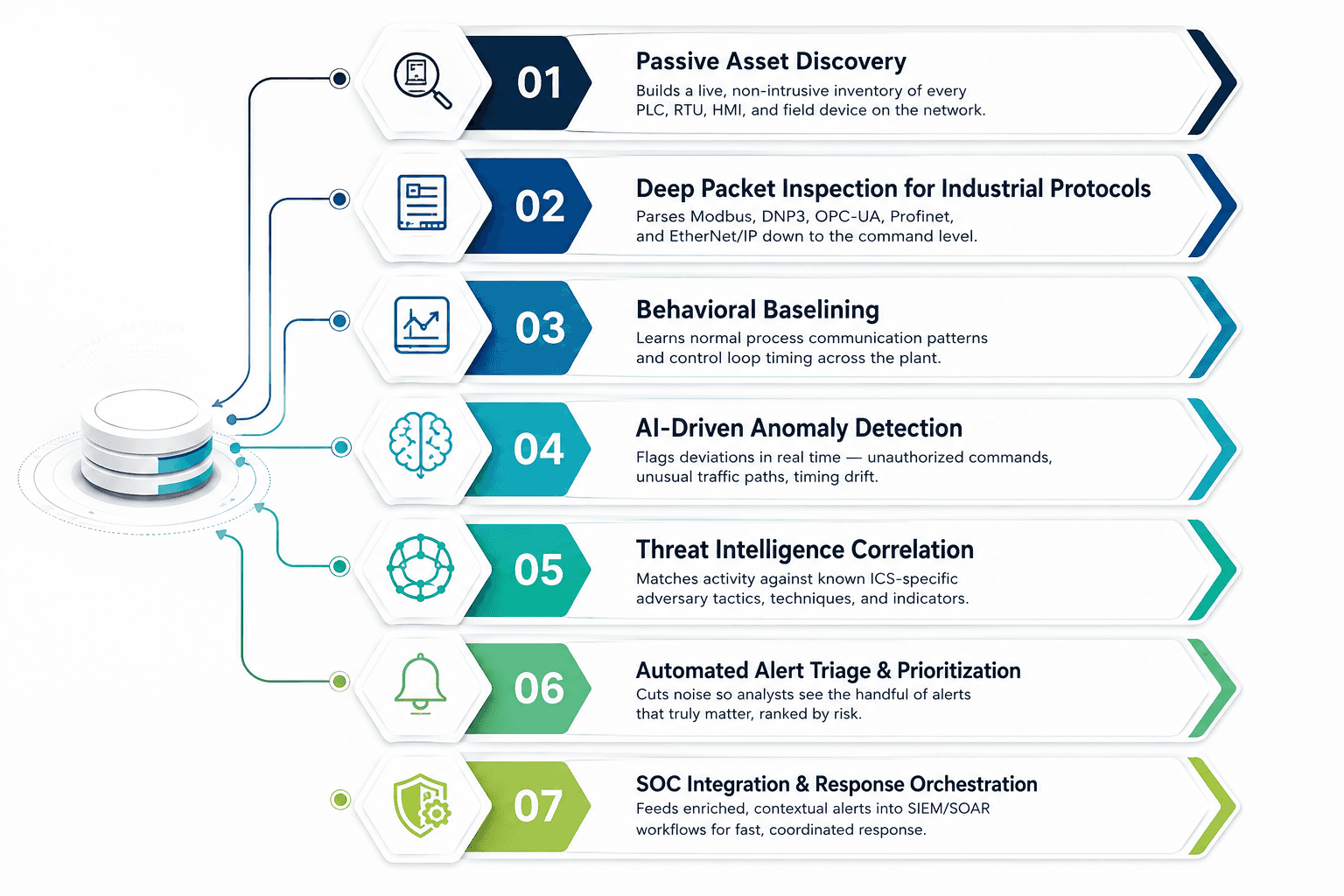
Effective OT NDR is not one feature , it is a coordinated stack of seven capabilities working together.
1. Passive, Non-Intrusive Asset Discovery
Detection starts with visibility. Many industrial sites are still surprised to learn how many devices are actually connected to their networks once a passive discovery exercise is completed , shadow assets, contractor laptops, forgotten test equipment, and undocumented remote access points routinely surface. Passive monitoring, which listens to network traffic without sending queries to fragile devices, is essential in OT because active scanning can crash legacy controllers that were never built to handle unexpected requests.
2. Deep Packet Inspection for Industrial Protocols
Generic IT-focused tools typically see industrial traffic as unrecognized noise. Effective NDR platforms parse Modbus, DNP3, OPC-UA, Profinet, IEC 61850, and EtherNet/IP down to the function-code and command level, which means they can distinguish between a routine polling request and an unauthorized command attempting to change a setpoint, stop a process, or reprogram a controller.
3. Behavioral Baselining and Anomaly Detection
Industrial processes are remarkably repetitive by nature , the same devices talk to the same devices, at the same intervals, in largely the same sequence, day after day. This predictability is a gift for defenders. By building a behavioral baseline of what normal communication looks like, detection systems can flag subtle deviations, a new device suddenly polling a PLC, a command issued outside of a maintenance window, or timing drift in control loop communication, long before those deviations become a full-blown incident.
4. AI and Machine Learning-Driven Analytics
Machine learning models add a layer of pattern recognition that static rules cannot match. Rather than waiting for a known malicious signature, these models can identify statistically unusual behavior across thousands of data points simultaneously, unusual traffic paths, atypical command sequences, or coordinated activity across multiple assets that would be nearly impossible for a human analyst to catch manually. The result is earlier detection of sophisticated, previously unseen attack techniques.
5. Threat Intelligence Correlation
Detection becomes far more actionable when it is correlated against known adversary tactics, techniques, and procedures specific to industrial environments. Understanding how known threat groups have historically targeted energy, manufacturing, and utility networks allows detection systems to prioritize alerts that match established attack patterns, rather than treating every anomaly as equally urgent.
6. Automated Alert Triage to Reduce False Positives
Alert fatigue is one of the most under-discussed risks in industrial cybersecurity. When analysts are flooded with low-value alerts, genuinely dangerous activity gets lost in the noise. Advanced NDR platforms apply automated scoring and correlation to reduce thousands of raw events down to a small number of prioritized, high-confidence alerts, allowing security teams to focus their attention where it actually matters.
7. Seamless SOC and Incident Response Integration
Detection alone does not stop an attack , response does. The most effective programs feed enriched, contextual alerts directly into a security operations center's existing workflows, whether that is a SIEM, a SOAR platform, or a dedicated OT incident response playbook, so that the time between detection and containment is measured in minutes rather than days.
Industrial Protocols and the Risks Effective NDR Must Address
Understanding which protocols run across a facility , and what risks each one carries , is foundational to designing detection controls that actually work. The table below summarizes the protocols most commonly encountered across manufacturing, energy, and utility environments.
Protocol | Common Use | Primary Risk if Unmonitored |
Modbus TCP/RTU | PLCs, RTUs, legacy field devices | No authentication; commands can be spoofed or replayed |
DNP3 | Utilities, SCADA in energy and water systems | Limited native security; vulnerable to unauthorized control commands |
OPC-UA | Modern SCADA and MES data exchange | Misconfigured security modes can expose data and control paths |
Profinet | Manufacturing and motion control networks | Broadcast-heavy traffic can mask malicious reconnaissance |
EtherNet/IP | Discrete manufacturing and packaging lines | Shares IT network infrastructure, increasing exposure to lateral movement |
IEC 61850 | Substation automation in power utilities | Complex configurations increase risk of undetected misconfiguration |
Network Segmentation: The Foundation Detection Depends On
No amount of analytics can fully compensate for a flat, unsegmented network. Segmentation and detection are not competing strategies, they are complementary halves of the same defense. Segmentation limits how far an attacker can move if they gain access, while detection ensures that any movement, however small, gets noticed.
Zones and Conduits
The most widely adopted approach to OT segmentation groups assets into zones based on function and risk level, then tightly controls the conduits , the defined pathways , through which traffic is allowed to pass between them. A well-designed zone and conduit model, aligned with recognized frameworks such as the Purdue Enterprise Reference Architecture, gives NDR sensors clear, logical boundaries to monitor rather than an undifferentiated sea of traffic.
The DMZ as a Choke Point, Not Just a Buffer
The demilitarized zone between enterprise IT and the OT environment should be treated as an active monitoring point, not simply a passive buffer. Because nearly all legitimate IT-to-OT traffic must pass through this boundary, it is one of the highest-value locations to deploy detection sensors , a single well-placed sensor at this chokepoint can provide visibility that would otherwise require dozens of sensors scattered across the plant floor.
Segmentation Reduces the Attack Surface Detection Has to Cover
Every additional segment reduces the volume of traffic any single detection sensor needs to analyze, which in turn improves detection accuracy and reduces false positives. Organizations that combine strong segmentation with behavioral analytics consistently report clearer, more actionable alerts than those relying on detection alone across a flat network.
Risks, Challenges, and Industry Insights
Even organizations that recognize the need for advanced detection controls often encounter the same set of obstacles during implementation. Understanding these challenges in advance makes it far easier to plan around them.
Alert fatigue from poorly tuned tools: Detection systems that are not properly tuned to an environment's specific behavior generate excessive noise, leading teams to eventually tune out or ignore alerts altogether , including the genuinely critical ones.
Limited OT security staffing: Many industrial sites do not have dedicated OT security personnel, which means alerts often land with IT teams who lack the context to interpret industrial protocol activity correctly.
Remote and third-party vendor access: Equipment vendors and system integrators frequently require remote access for maintenance, creating a persistent entry point that is difficult to monitor without dedicated visibility into session activity.
IT and OT convergence outpacing security: As plants adopt cloud-connected historians, predictive maintenance platforms, and Industrial Internet of Things sensors, the attack surface is expanding faster than many security programs can adapt.
Difficulty justifying investment without clear metrics: Security leaders often struggle to translate detection capability into business terms that resonate with executive leadership, making budget approval harder than the technical case alone would suggest.
Inconsistent visibility across multiple sites: Organizations with several facilities frequently find that detection maturity varies widely from site to site, leaving inconsistent coverage across the broader enterprise.
None of these challenges are unusual, and none of them are disqualifying. They are simply the realistic starting conditions that a well-designed detection program needs to account for from day one.
Practical Recommendations and Best Practices
Building an effective detection program does not require solving every challenge simultaneously. A phased, deliberate approach consistently produces better long-term outcomes than attempting a single large deployment.
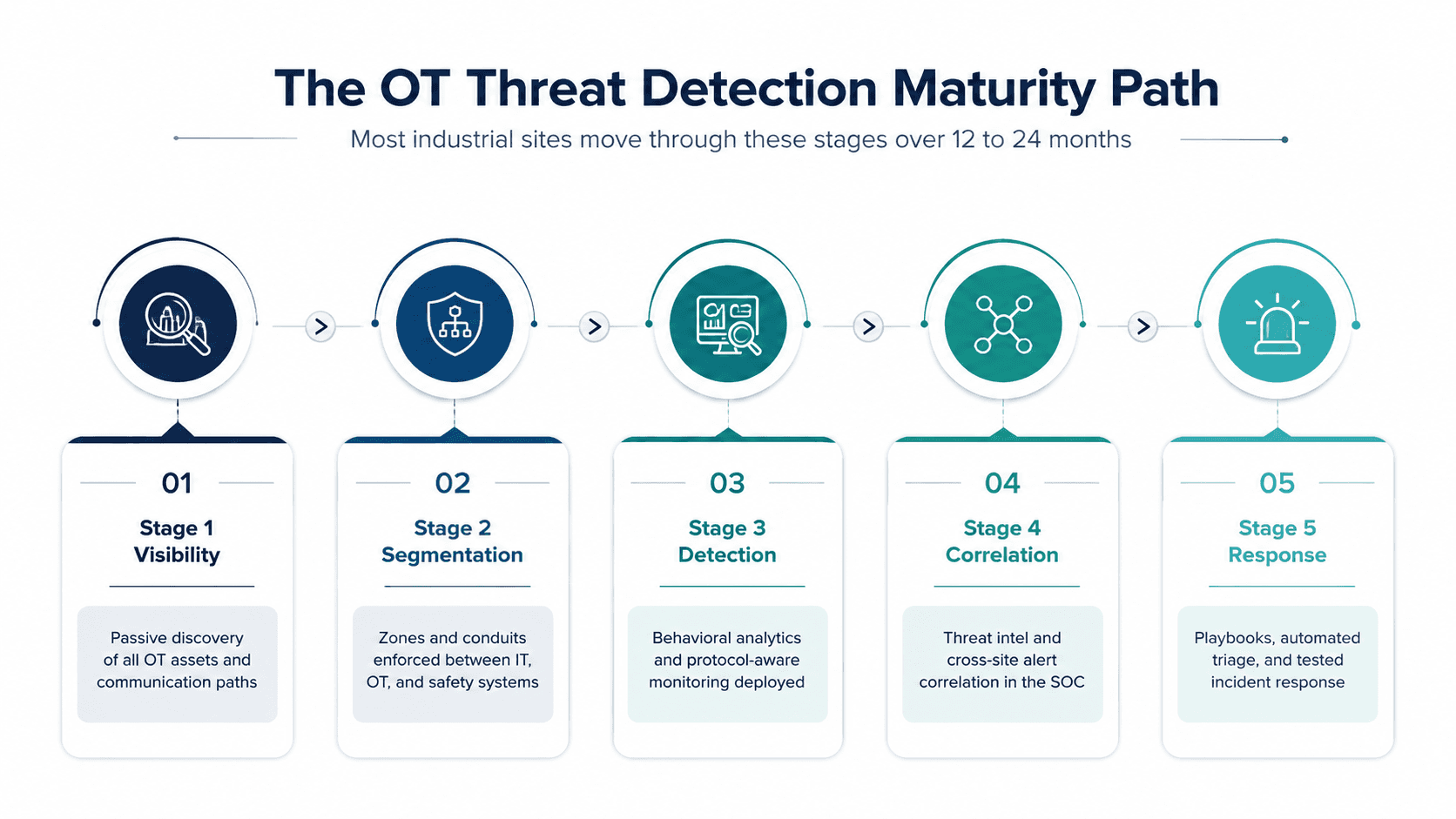
A realistic maturity path takes most industrial organizations twelve to twenty-four months from initial visibility to tested response.
Start With Visibility Before Anything Else
It is impossible to protect what cannot be seen. Before investing heavily in advanced analytics, organizations should complete a comprehensive, passive asset inventory across every facility. This single step routinely uncovers unmanaged devices, undocumented connections, and forgotten remote access tools that represent immediate risk.
Prioritize High-Risk Zones First
Rather than attempting facility-wide deployment on day one, focus initial detection and segmentation efforts on the zones with the greatest safety, environmental, or production impact if compromised. This produces measurable risk reduction quickly and builds internal momentum for broader rollout.
Tune Detection to the Specific Environment
Out-of-the-box detection rules rarely reflect the true behavior of a specific facility. Investing time in baselining actual operational patterns, rather than relying solely on generic thresholds , dramatically improves alert accuracy and analyst trust in the system over time.
Build Cross-Functional Response Plans
OT incident response cannot live exclusively within the security team. Plant operations, engineering, safety, and IT security all need clearly defined roles before an incident occurs, along with a tested plan for how a detected threat translates into a physical, operational decision on the plant floor.
Treat Detection as an Ongoing Program, Not a One-Time Project
Threat actors continuously adapt their techniques, and industrial environments themselves change as equipment is upgraded, replaced, or reconfigured. Detection baselines, segmentation policies, and response playbooks all require periodic review to remain effective over time.
Measure and Report Progress in Business Terms
Translating technical detection metrics, dwell time, false-positive rates, mean time to detect , into business-relevant outcomes such as avoided downtime, regulatory readiness, and insurance posture makes it far easier to sustain executive support for continued investment.
Recommended Controls by Implementation Priority
Priority | Control | Typical Timeframe |
Immediate | Passive asset discovery and inventory | 0 – 3 months |
Immediate | Monitoring of the IT/OT DMZ boundary | 0 – 3 months |
Near-term | Zone and conduit segmentation for critical assets | 3 – 9 months |
Near-term | Behavioral baselining across core production lines | 3 – 9 months |
Ongoing | Threat intelligence correlation and alert tuning | 9 – 18 months |
Ongoing | Cross-functional incident response testing | 12 – 24 months |
How Shieldworkz Supports Organizations
Shieldworkz works alongside industrial operators, plant managers, and security leaders to build detection and segmentation programs that reflect the realities of live production environments , not generic IT playbooks applied to the plant floor. Our approach centers on practical, measurable risk reduction rather than one-size-fits-all deployments.
Comprehensive OT asset visibility: We deliver passive, non-intrusive discovery across every connected device, giving your team a complete and continuously updated picture of the environment.
Protocol-aware threat detection: Our monitoring is built to understand the industrial protocols specific to your operations, distinguishing legitimate control activity from unauthorized commands.
Segmentation strategy and design: We help design and validate zone and conduit architectures aligned with recognized industrial security frameworks, tailored to your specific facility layout.
Behavioral baselining tuned to your operations: Rather than applying generic thresholds, we build detection baselines around how your specific processes actually behave day to day.
Alert correlation and noise reduction: Our approach prioritizes high-confidence, actionable alerts so your team spends time responding to real risk, not chasing false positives.
SOC integration and response planning: We help connect detection outputs into your existing security operations workflows and support the development of tested, cross-functional incident response plans.
Guidance across the full maturity path: Whether your organization is just starting with asset visibility or refining an established detection program, we provide the expertise to move forward at the right pace.
Our goal is straightforward: give industrial organizations the visibility and confidence to detect real threats early, respond decisively, and keep production running safely.
Frequently Asked Questions
1.How is OT-focused NDR different from traditional network monitoring tools?
Traditional monitoring tools are generally built around IT traffic patterns and standard enterprise protocols. They can detect that unusual traffic is occurring, but they typically cannot interpret what an industrial command actually means. OT-focused NDR is built to parse protocols like Modbus, DNP3, and Profinet at the command level, which means it can distinguish between routine polling and a potentially dangerous change to a setpoint or control logic. That level of context is what separates genuine OT detection from a repurposed IT tool.
2.Will deploying detection sensors disrupt plant operations?
Properly designed OT NDR relies on passive monitoring, meaning sensors observe a copy of network traffic through a switch port or network tap rather than actively querying devices. This approach carries essentially no risk of disrupting sensitive legacy equipment, which is one of the primary reasons passive detection has become the industry standard for live production environments.
3.How long does it typically take to see meaningful results?
Most organizations gain useful asset visibility within the first few weeks of deployment, since passive discovery does not require lengthy configuration. Behavioral baselining that produces highly accurate, low-noise alerts generally takes longer, often eight to twelve weeks , since the system needs to observe a full range of normal operational cycles, including maintenance windows, shift changes, and seasonal production variation, before it can reliably flag genuine anomalies.
4.Do smaller facilities really need this level of detection?
Facility size is a poor predictor of risk. Smaller water treatment plants, regional manufacturers, and municipal utilities have all been targeted in real incidents, often precisely because attackers assume smaller sites have weaker defenses. The scale of the detection deployment can certainly be adjusted to match the size of the facility, but the underlying need for visibility and behavioral monitoring applies just as much to a single-site operator as it does to a multinational enterprise.
5.How does segmentation work if the plant cannot tolerate downtime for reconfiguration?
Segmentation projects do not need to happen all at once. A phased approach , starting with monitoring existing traffic patterns, then gradually introducing firewall rules and zone boundaries during scheduled maintenance windows, allows segmentation to be implemented without forcing an unplanned outage. Passive network visibility gathered beforehand also makes it far easier to predict the operational impact of each segmentation change before it is applied.
Conclusion
The industrial environments that keep modern life running , power grids, water systems, manufacturing lines, and energy infrastructure, were not originally built with cybersecurity in mind, and retrofitting them requires a fundamentally different approach than the one used in corporate IT. Advanced threat detection controls, from protocol-aware deep packet inspection to behavioral analytics and intelligent alert correlation, give security teams the visibility they need to catch sophisticated threats before they escalate into physical consequences.
Segmentation and detection are not separate projects to be tackled independently , they are two halves of the same strategy, each making the other more effective. Organizations that invest deliberately in both, guided by a realistic maturity roadmap and grounded in the specific behavior of their own operations, put themselves in a fundamentally stronger position than those relying on generic tools or hoping legacy systems simply go unnoticed.
The industry examples discussed throughout this guide all share the same lesson: the gap between initial intrusion and physical impact is where detection earns its value. Closing that gap is one of the most consequential investments an industrial organization can make.
Ready to See Where Your OT Detection Program Stands?
Every facility's risk profile is different. Our team can walk through your current environment, identify practical next steps, and help you understand exactly where advanced detection and segmentation would make the biggest difference, no pressure, just a clear-eyed conversation between industrial security professionals.
Book a Free Consultation with Our Experts
Additional resources:
Comprehensive Guide to Network Detection and Response NDR in 2026 here
NERC CIP-015 Internal Network Security Monitoring Readiness Checklist for Electric Utilities here
OT SOC Foundational Guide here
Managed SOC Service here
OT Cyber Threat Intelligence Advisory - Middle East here
NIS2 Directive Achieving NIS2 Compliance Through IEC 62443 here
What Is Removable Media? Risks, Policies, and Industrial OT Security Solutions here
Free Removable Media Policy Template for OT and IT Teams here
Get Weekly
Resources & News
See How Our Industry-Leading OT Security Solutions Address Critical Security Challenges
You may also like

Fresenius medical care cyber incident: Investigating trusted access, third-party exposure and enterprise blast radius
Team Shieldworkz

OT Removable Media Security: Close the USB Risk Gap Before It Reaches Production
Team Shieldworkz
The Canva breach and the hidden risk of third-party trust
Prayukth K V

NERC CIP Compliance Assessment: Find Gaps Before Auditors Do
Team Shieldworkz

Beyond substitution: Strategic takeaways from India’s SCADA indigenisation
Team Shieldworkz

Investigative cyber threat research report: Colorado water utilities OT attacks
Prayukth K V