Team Shieldworkz
Ransomware targeting Operational Technology (OT) and Industrial Control Systems (ICS) represents an immediate operational emergency. Unlike an enterprise IT incident where encrypted servers mean data loss and business downtime, OT ransomware threatens physical process control, environmental safety, personnel lives, and critical infrastructure availability.
When ransomware manifests near or within industrial control environments, standard enterprise IT playbooks—specifically automated endpoint isolation and blanket network disconnections—can trigger sudden, unsafe process trips. This article provides an authoritative incident response guide designed specifically for CISOs, Heads of OT Security, control-room operators, and OT SOC teams.
The OT-Specific Incident-Response Context
Enterprise IT incident response prioritizes data confidentiality, network containment, and rapid endpoint remediation. Industrial control systems prioritize personnel safety, process safety, operational availability, and process integrity.
Indiscriminate containment measures in OT carry severe operational risk. Unplanned shutdowns can lead to over-pressurization, thermal runaways, hazardous chemical releases, heavy equipment damage, or regional power grid instability.
Why OT ransomware response differs from enterprise IT
Safety and Stability First: The primary objective of OT response is containing the cyber threat while maintaining a safe operating state. Halting malware cannot come at the expense of process safety.
Process Dependencies & Visibility Loss: Blindly severing network access to human-machine interfaces (HMIs), engineering workstations, or Supervisory Control and Data Acquisition (SCADA) servers deprives control-room operators of visibility and manual override capabilities.
Legacy Infrastructure & Legacy Protocols: OT environments frequently run unsupported operating systems alongside unauthenticated, unencrypted industrial protocols (e.g., Modbus TCP, DNP3, EtherNet/IP). These protocols lack basic native security controls like encryption or payload validation.
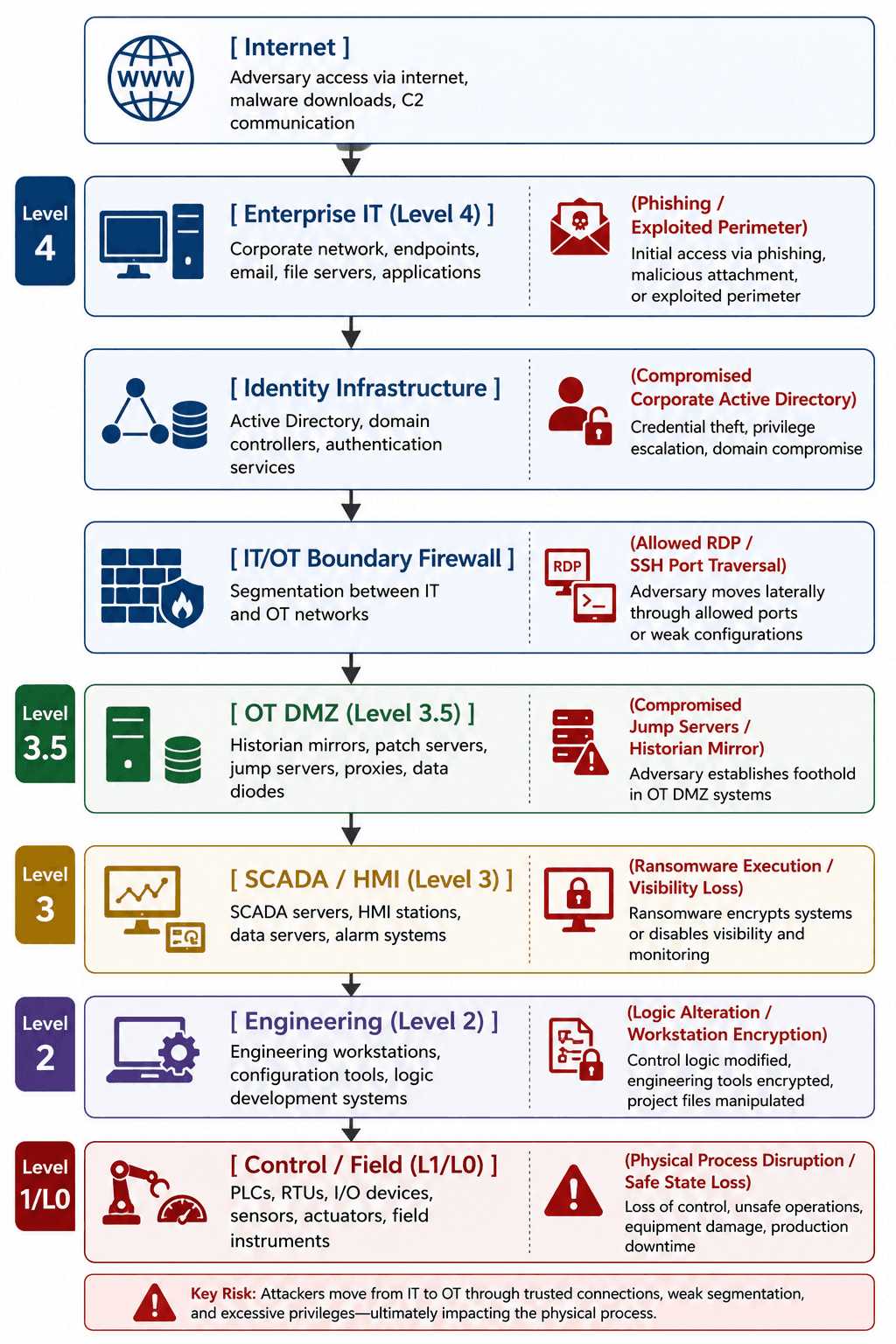
IT-to-OT Lateral Movement: Ransomware rarely originates on Level 1 field devices (PLCs/RTUs). It typically breaches Enterprise IT (Level 4), traverses the OT DMZ (Level 3.5), and targets SCADA components, engineering software, and historians (Level 3/2).
Modern OT response must align with NIST SP 800-82 Rev. 3 (Guide to Operational Technology Security), NIST SP 800-61 Rev. 3 (Incident Response Recommendations and Considerations), CISA ICS Incident Handling Guidelines, and ISA/IEC 62443. Disconnecting systems blindly violates CISA's operational principle that containment must never degrade safety instrumented functions (SIF) or critical control loops.
The Top 7 Incident Response Steps
Step 1: Declare and Classify the Incident
Rapidly determine the blast radius and establish whether the threat is strictly an IT event, an OT-adjacent risk, or an active physical process compromise.
What to Do: Formally declare an OT cyber incident, establish an Incident Command Structure integrating both IT Security and Plant Operations, and assign an operational severity tier.
Why It Matters: Prevents IT security teams from taking unilateral containment actions that disrupt plant operations without control-room awareness.
Who Should Do It: Incident Commander, CISO, Head of OT Security, Lead Plant Operations Manager.
What NOT to Do: Do not attempt to quietly remediate active ransomware infections on Level 3 infrastructure without declaring an incident and notifying plant operators.
OT Considerations: Verify whether the ransomware encrypts underlying OS files or simply disrupts access to SCADA human-machine interface executables.
Evidence/Logs to Preserve: Firewalls logs (IT/OT DMZ), Active Directory logs, initial user reports, endpoint detection alert captures, memory dumps of affected jump hosts.
Decision Points: Is the ransomware confined to Level 4 enterprise systems, Level 3.5 DMZ, or has it reached Level 3/2 control networks?
Common Mistakes: Classifying an incident purely as an "IT issue" when enterprise Active Directory (which manages OT jump hosts) is compromised.
Initial Triage Checklist:
[ ] Confirm reported symptoms (e.g., .locked extensions, ransom notes, HMI application crashes).
[ ] Determine if safety instrumented systems (SIS) or safety logic solvers remain online and uncompromised.
[ ] Verify operator visibility on all primary physical process loops.
[ ] Convene joint IT/OT Incident Command call within 15 minutes of suspected detection.
Step 2: Protect Safety and Stabilize the Industrial Process
Determine the operational safety status before executing technical containment or forensic commands.
What to Do: Engage control-room operators to assess whether real-time telemetry, alarm monitoring, remote control capabilities, and safety systems remain functional and trustworthy.
Why It Matters: If operators lose HMI visibility or process control, the plant must transition to a controlled, manual safe state or execute an orderly emergency shutdown (ESD).
Who Should Do It: Shift Supervisor, Control-Room Operators, Plant Automation Engineers.
What NOT to Do: Do not issue mass-reboot commands or power down engineering servers while operators rely on them to monitor critical process parameters.
OT Considerations: Cyber incident response teams must defer to certified plant operators regarding physical safety and shutdown procedures.
Evidence/Logs to Preserve: Alarm history logs, operator action logs, historian trend data, process safety event recorders.
Decision Points: Can operators maintain a safe state manually if all Level 3 SCADA software fails? If no, initiate controlled safe process shutdown.
Common Mistakes: Treating loss of HMI screen updates as a simple software glitch rather than a cyber-induced loss of visibility.
Process Safety Checklist:
[ ] Verify functional operation of Safety Instrumented Systems (SIS) independent of basic process control systems (BPCS).
[ ] Confirm manual override controls for critical valves, breakers, and pumps are operational.
[ ] Ensure auxiliary communication channels (radios, landlines) between control room and field technicians are active.
Step 3: Contain the Attack Without Blindly Disrupting OT
Apply targeted network and identity containment to prevent ransomware propagation without severing critical control communications.
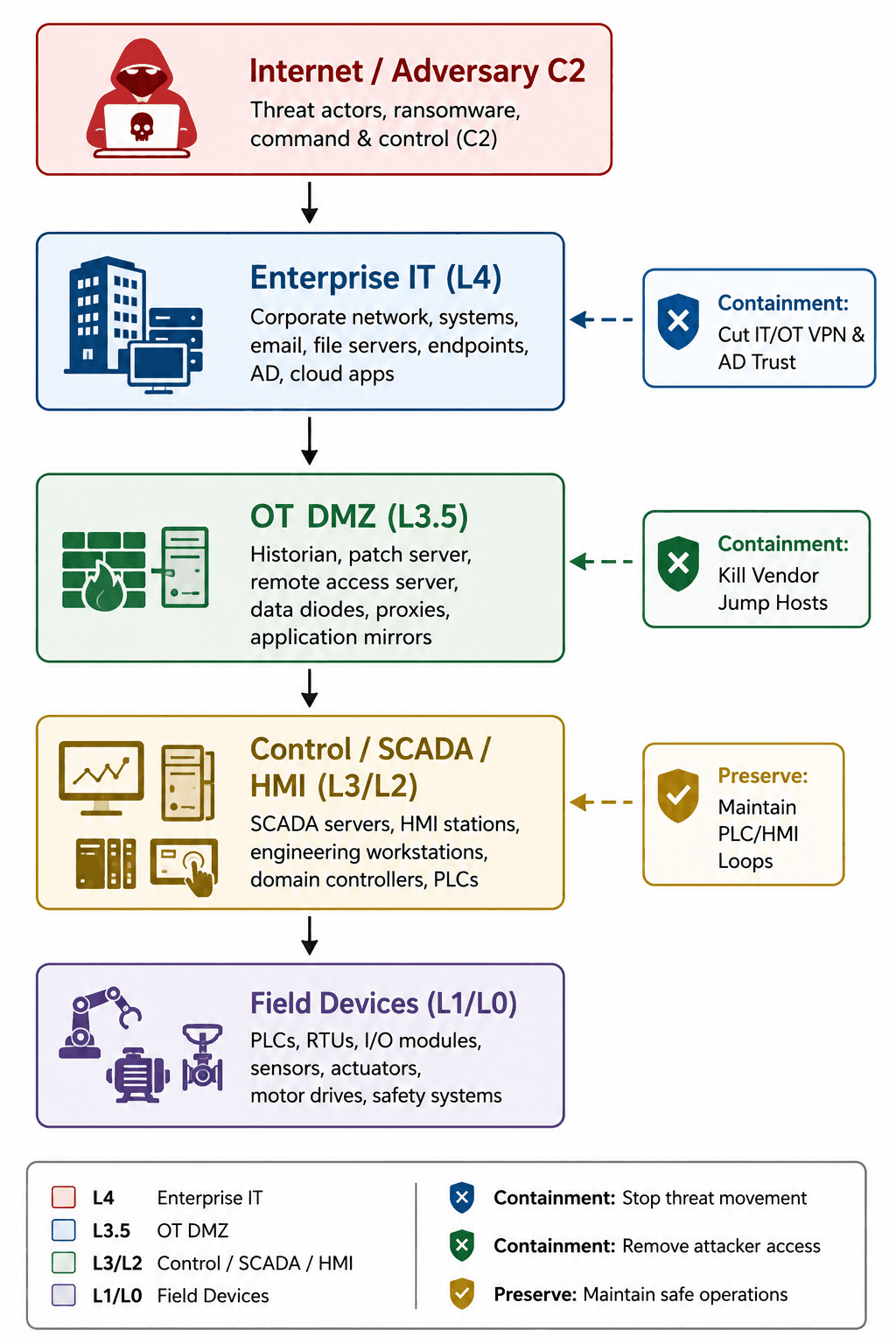
What to Do: Sever non-essential IT-to-OT boundary connections, terminate remote vendor access (VPNs, jump boxes), restrict compromised service accounts, and block malicious C2 IP addresses at the OT DMZ firewall.
Why It Matters: Containment prevents lateral movement from enterprise IT networks into Level 3 operational networks while allowing internal OT communication (PLCs to HMIs) to continue functioning.
Who Should Do It: OT Network Engineers, Firewalls/Network Security Specialists, OT SOC Analysts.
What NOT to Do: Do not execute blanket network port shutdowns at the core OT switch level or disable internal OT domain controllers without evaluating process impact.
OT Considerations: Disconnecting an OT domain controller can cause legacy HMIs to fail authentication, losing control interface access instantly.
Evidence/Logs to Preserve: Firewall change logs, VPN active session logs, isolated endpoint PCAP files, active directory privilege changes.
Decision Points: When to isolate IT from OT? Isolate immediately at the OT DMZ firewall when enterprise Active Directory is compromised or when ransomware is actively spreading across Level 4.
Common Mistakes: Disconnecting network links that carry vital process synchronization or safety interlock data between physical units.
Step 4: Perform OT-Focused Triage and Evidence Preservation
Locate the adversary’s footprint across OT-specific infrastructure while preserving volatile evidence safely.
What to Do: Collect volatile memory, triage forensic artifacts (MFT, Event Logs, shimcache), examine engineering project files, and review PLC/DCS logic configuration baselines.
Why It Matters: Adversaries often deploy ransomware as a destructive cover for secondary objectives, such as modifying safety parameters, altering PLC logic, or stealing proprietary process documentation.
Who Should Do It: Lead OT Digital Forensics & Incident Response (DFIR) Specialists, Automation Engineers.
What NOT to Do: Do not run invasive, high-volume vulnerability scanners (e.g., active Nmap sweeps) across legacy OT networks, as this can crash legacy PLCs.
OT Considerations: Prioritize collecting data from jump servers, engineering workstations (EWS), and historians, which serve as key pivot points for attackers.
Evidence/Logs to Preserve: RAM captures, system event logs (System.evtx, Security.evtx), network flow captures, PLC project files (.ACD, .ap13, etc.), historian databases.
Decision Points: Has the adversary modified PLC/DCS program logic, or is the threat isolated to the underlying Windows/Linux operating system environments?
Common Mistakes: Re-imaging an infected HMI before extracting RAM or disk artifacts, destroying evidence required to identify the root cause.
OT Triage Checklist
[ ] Audit active directory accounts for newly created unauthorized administrative users.
[ ] Verify engineering project file checksums against known offline baselines.
[ ] Extract and preserve memory/logs from targeted jump hosts and historians.
[ ] Review external remote access logs (RDP, TeamViewer, AnyDesk, SSH) for anomalous access.
Step 5: Eradicate the Threat and Validate the Environment
Eliminate adversary persistence, malicious tooling, and compromised credentials across both corporate and operational domains.
What to Do: Purge unauthorized user accounts, reset all enterprise and OT domain credentials, revoke compromised API keys, rebuild impacted endpoints from verified images, and patch exploited vulnerabilities.
Why It Matters: Ransomware binaries are merely the payload. Leaving active backdoors, scheduled tasks, or compromised SSH keys allows attackers to re-encrypt systems days after initial restoration.
Who Should Do It: OT Security Engineers, Systems Administrators, DFIR Specialists.
What NOT to Do: Do not assume that deleting the ransomware payload file .exe completes eradication.
OT Considerations: Credential resets must be orchestrated carefully. Changing passwords on service accounts bound to hardcoded SCADA/DCS database connections can crash application services.
Evidence/Logs to Preserve: Post-cleanup vulnerability scan outputs, configuration change audits, baseline validation hashes.
Decision Points: Are all persistence vectors identified and purged across both IT and OT environments before beginning full system restoration?
Common Mistakes: Failing to reset local administrator passwords across non-domain-joined legacy HMIs.
Eradication Validation Checklist:
[ ] Complete 100% password reset for all OT domain accounts, service accounts, and local admin accounts.
[ ] Terminate and re-issue all remote access certificates and multi-factor authentication (MFA) tokens.
[ ] Remove all persistence mechanisms (unauthorized services, scheduled tasks, registry run keys).
[ ] Validate PLC/DCS firmware signatures and verify ladder logic code against clean offline reference copies.
Step 6: Recover OT Systems Safely
Rebuild and restore OT applications, databases, and control nodes systematically using clean, verified backups.
What to Do: Restore system images and process databases from verified, air-gapped backups. Validate logic, perform functional off-line testing, and execute a controlled, phased reconnection.
Why It Matters: Restoring an unvalidated backup may reintroduce dormant malware persistence or corrupted process configurations into the live control environment.
Who Should Do It: Automation Engineers, Systems Administrators, Plant Operations Team.
What NOT to Do: Do not reconnect restored OT networks to the enterprise IT environment until the IT environment is fully sanitized and validated.
OT Considerations: Validate that restored historian databases and SCADA project files match pre-incident operational parameters before placing systems in control.
Evidence/Logs to Preserve: Restoration validation logs, pre-startup check lists, operational sign-off documentation.
Decision Points: Is the offline backup clean, uncorrupted, and verified safe for production deployment?
Common Mistakes: Booting restored virtual machines attached to live production networks without isolating them for initial security verification.
Step 7: Conduct Post-Incident Analysis and Strengthen Resilience
Analyze the root cause, identify structural gaps, and harden OT defenses against future destructive attacks.
What to Do: Perform a comprehensive Root Cause Analysis (RCA), document the attack timeline, identify security control failures, and execute a formal corrective action plan.
Why It Matters: Ransomware attacks expose underlying systemic weaknesses in network architecture, access controls, and visibility that will be exploited again if unaddressed.
Who Should Do It: CISO, Head of OT Security, External Forensic Partners, Plant Leadership.
What NOT to Do: Do not limit post-incident reviews to technical IT remediation while ignoring operational procedural gaps or vendor management flaws.
OT Considerations: Update OT-specific incident response playbooks and re-tune passive anomaly detection engines based on observed adversary Tactics, Techniques, and Procedures (TTPs).
Evidence/Logs to Preserve: Final incident post-mortem report, timeline artifacts, remediation tracking matrix.
Decision Points: What architectural modifications (e.g., zero-trust remote access, strict Purdue Level 3.5 enforcement) are required prior to resuming normal operations?
Common Mistakes: Treating the incident as closed immediately after process restoration without completing the formal RCA and resilience updates.
OT Ransomware: The First 60 Minutes
The first hour of a suspected OT ransomware incident determines whether the event is safely contained or escalates into a catastrophic plant outage.
Time Window | Priority Action | Primary Owner | Operational Objective |
0–10 min | Verify report authenticity; confirm HMI/alarm operational status; declare Tier-1 OT Incident. | Shift Supervisor / OT SOC | Establish initial process safety status and prevent panic actions. |
10–20 min | Isolate IT/OT DMZ boundary links (firewalls, remote VPN access); preserve local internal OT communication channels. | OT Network / Security Team | Halt lateral movement from corporate IT to OT without disrupting local field loops. |
20–30 min | Assess physical safety systems (SIS), check manual process control readiness, confirm operator HMI visibility. | Lead Control Room Operator | Ensure physical safety of plant operations and prevent unmonitored process drift. |
30–45 min | Revoke compromised domain credentials; terminate active vendor RDP/SSH jump sessions. | Identity / SysAdmin Team | Block ongoing adversary remote access pathways into Level 3 networks. |
45–60 min | Perform volatile data preservation on key jump hosts/historians; initiate structured log collection. | OT DFIR Lead | Preserve perishable evidence required for root cause analysis prior to system resets. |
Master OT Ransomware Incident-Response Checklist
Detection and Triage
[ ] Confirm ransomware presence via technical indicator (ransom note, encrypted extensions, binary capture).
[ ] Determine affected systems across Purdue Levels 0–4.
[ ] Verify functionality of Safety Instrumented Systems (SIS).
[ ] Assess physical process impact and operator visibility loss.
[ ] Establish initial incident severity tier and activate Incident Command.
Containment
[ ] Sever IT/OT boundary connectivity at the OT DMZ firewall.
[ ] Disconnect all external vendor remote access (VPNs, cellular gateways).
[ ] Disable compromised Active Directory user and service accounts.
[ ] Isolate compromised Level 3 systems only if operationally safe to do so.
[ ] Preserve network and volatile endpoint evidence prior to power-downs.
Investigation
[ ] Identify initial access vector (e.g., phishing, exposed RDP, supply chain vendor).
[ ] Map lateral movement pathways and compromised domain credentials.
[ ] Perform forensic analysis on engineering workstations, jump hosts, and historians.
[ ] Verify PLC/DCS program logic, ladder logic checksums, and configuration files against clean baselines.
[ ] Check for secondary backdoors or persistent access mechanisms.
Recovery
[ ] Validate offline backups for integrity and absence of malware infection.
[ ] Rebuild affected endpoints using clean images in an isolated staging network.
[ ] Restore process configuration and application databases.
[ ] Perform operational sanity checks with control-room operators prior to live attachment.
[ ] Execute a controlled, phased reconnection of OT network segments while continuously monitoring telemetry.
Post-Incident
[ ] Conduct comprehensive Root Cause Analysis (RCA).
[ ] Document complete attack timeline and technical report.
[ ] Implement network segmentation and access control hardening measures.
[ ] Update OT Incident Response playbooks and train staff on lessons learned.
CISO vs. OT Operator Viewpoints
Successful OT incident response requires bridging the fundamental perspective gap between enterprise security leadership and plant control-room operators.
Strategic Focus Area | CISO / Security Leadership View | OT / Control-Room Operator View | Integrated Operational Synthesis |
Primary Goal | Eradicate threat, prevent data exfiltration, ensure regulatory compliance. | Maintain physical safety, process stability, and continuous production uptime. | Contain threat safely without compromising physical process integrity or personnel safety. |
Containment Action | Isolate affected networks and endpoints immediately to stop malware spread. | Keep systems running; stopping network traffic risks dropping HMI control loops. | Execute surgical, planned boundary isolation while preserving local control loop integrity. |
Incident Command | Governed by enterprise risk frameworks, legal Counsel, and regulatory mandates. | Governed by plant emergency operating procedures (EOP) and physical safety protocols. | Joint Incident Command structure with dual authorization required for disruptive actions. |
Evidence & Forensics | Preserve volatile memory, disk images, and network PCAPs for root cause analysis. | Prioritize rapid system reboots or manual overrides to restore HMI screen visibility. | Conduct rapid triage and volatile memory capture before executing essential reboots. |
Recovery Governance | Rebuild all systems from scratch; enforce full password resets and patch cycles. | Minimize downtime; verify legacy software compatibility before applying patches. | Phased recovery with rigorous security checks integrated into standard plant restart procedures. |
The IT-to-OT Boundary: Attack Propagation Path
Understanding how ransomware traverses the IT-to-OT boundary allows responders to place targeted chokepoints during an incident.
Perimeter Defense and Investigative Considerations
Enterprise IT (Level 4): Initial compromise occurs via email phishing, malicious attachments, or unpatched edge devices. Investigative focus: Email logs, edge VPN/firewall logs, corporate EDR alerts.
Identity Infrastructure: Attackers harvest administrative credentials and leverage trust relationships between enterprise and OT Active Directory domains. Investigative focus: Kerberos ticket requests, domain controller event logs (4624, 4672).
IT/OT Boundary Firewall: Attackers exploit dual-homed servers or open RDP/SSH rules traversing the boundary. Investigative focus: Firewall state tables, blocked/allowed traffic logs between L4 and L3.5.
OT DMZ (Level 3.5): Attackers compromise jump boxes, patch management servers, or historian mirrors to pivot into control networks. Investigative focus: Jump host RDP session logs, PowerShell execution logs, process creation events.
SCADA / HMI Infrastructure (Level 3/2): Ransomware payloads execute on Windows/Linux-based HMIs and engineering stations, encrypting database files and project directories. Investigative focus:Endpoint file system modifications, application execution logs, SCADA server process crashes.
OT Ransomware Response Mistakes That Can Make the Incident Worse
Treating OT Like Enterprise IT: Executing automated endpoint isolation scripts across OT environments, crashing critical HMIs or breaking control loops.
Disconnecting Networks Without Checking Process Dependencies: Severing network links without realizing that field PLCs require specific network timing signals or interlocks to operate safely.
Rebooting Impacted Systems Before Preserving Evidence: Power-cycling encrypted HMIs or domain controllers, destroying volatile memory (RAM) where encryption keys and active malware artifacts reside.
Restoring from Unvalidated Backups: Restoring system images without validating whether the backup contains dormant adversary persistence mechanisms or corrupted configuration logic.
Assuming Ransomware is the Only Malicious Activity: Focusing exclusively on ransomware file encryption while missing underlying adversary actions like SCADA logic alteration or safety system tampering.
Failing to Investigate Compromised Credentials: Cleaning endpoint binaries while leaving compromised domain passwords, SSH keys, or vendor remote access tokens active.
Ignoring Engineering Workstations (EWS): Focusing containment solely on HMIs while failing to inspect EWS nodes, where proprietary PLC project files and control software reside.
Reconnecting Operational Networks Prematurely: Attaching restored OT segments back to corporate networks before the enterprise environment has been thoroughly remediated and sanitized.
OT Ransomware Response Decision Framework
Use this structured decision framework to navigate high-pressure choices during an active industrial ransomware incident:
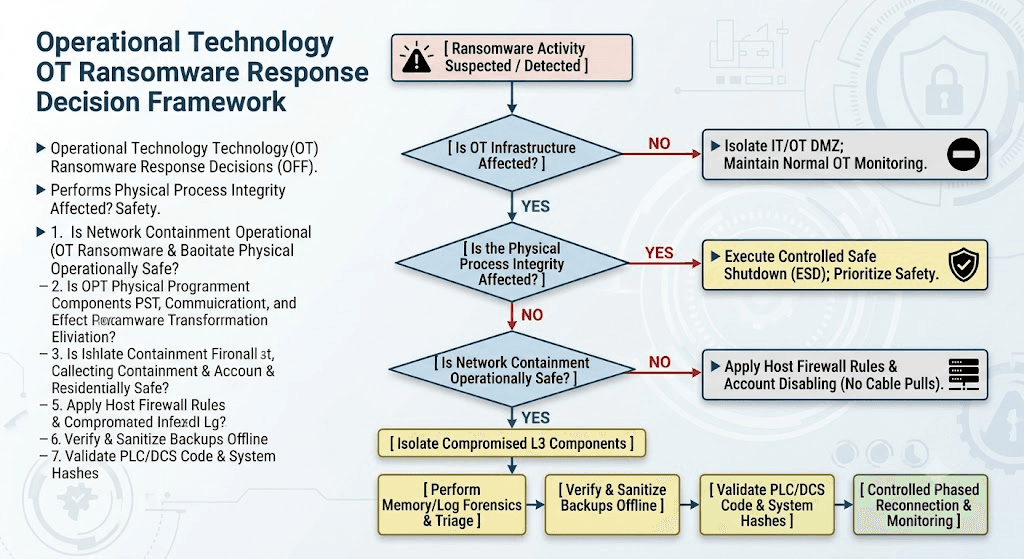
When ransomware strikes an operational network, stopping the malware is secondary to preserving physical safety and process control.
By executing these seven structured steps—declaring the incident, protecting safety, containing threats surgically, triaging thoroughly, eradicating persistence completely, recovering safely from clean baselines, and strengthening system resilience—organizations can successfully navigate complex OT cyber incidents.
In OT ransomware response, success is defined not just by how fast endpoints are restored, but by keeping people safe, maintaining control of physical processes, preserving critical evidence, and bringing trustworthy industrial operations back online.
Sources and authoritative references
This response framework aligns with official government and international standard guidance for industrial control system cybersecurity:
NIST SP 800-82 Rev. 3: Guide to Operational Technology (OT) Security: Establishes core safety, availability, and segmentation principles for industrial networks.
NIST SP 800-61 Rev. 3: Incident Response Recommendations and Considerations: Formulates incident handling lifecycles adaptively across organizational domains.
NIST Cybersecurity Framework (CSF) 2.0 & Ransomware Risk Management Profile (NIST IR 8374): Outlines foundational security posture and recovery guidelines specific to ransomware threats.
CISA ICS Incident Handling Guidance: Provides procedural directives for handling operational incidents across critical infrastructure sectors.
ISA/IEC 62443 Series: Defines technical standards for security levels, zone/conduit segmentation, and risk assessment in industrial automation.
Get Weekly
Resources & News
See How Our Industry-Leading OT Security Solutions Address Critical Security Challenges
You may also like

What the French supermarket cyberattack reveals about OT security
Prayukth K V

Inside the Albert Heijn cyber incident: Investigating the attack, the IT/OT exposure, and the risks to critical operations
Team Shieldworkz

50°C by cyberattack? Inside France’s supermarket refrigeration crisis
Prayukth K V

Automating IEC 62443 Compliance Assessments Without Losing Expert Control
Team Shieldworkz

Investigative cyber threat intelligence report: Daiichi Kosho supply-chain data exposure
Prayukth K V

How AI Is Changing IEC 62443 Assessments
Team Shieldworkz