Team Shieldworkz
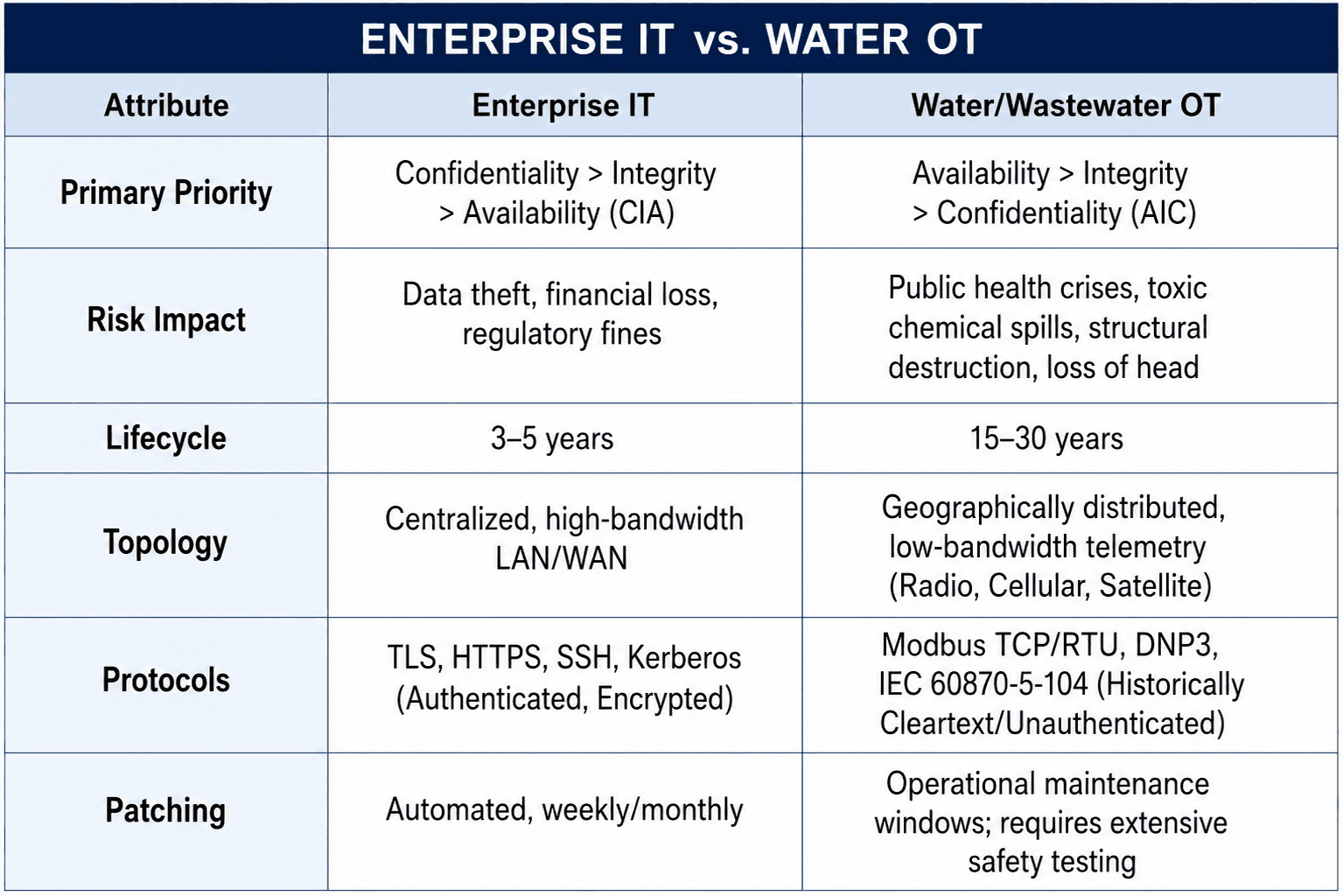
Water and wastewater utilities operate critical infrastructure where cyber-attacks can directly impact public health, environmental safety, and community continuity. Traditional enterprise IT cybersecurity models which prioritize confidentiality and rely heavily on centralized, soft-perimeter security fail in Operational Technology (OT) environments. Water systems feature highly distributed geographically remote assets (pumping stations, lift stations, dosing skids) connected via constrained telemetry links, legacy unauthenticated serial/IP protocols, and tight physical-cyber physical loops.
The ISA/IEC 62443 series provides an engineering-grade, risk-informed framework designed specifically for Industrial Automation and Control Systems (IACS). This article provides a comprehensive blueprint for water utility CISOs, OT architects, and SCADA engineers to model, design, implement, and operate a compartmentalized defense-in-depth architecture using IEC 62443. By establishing a rigorous System Under Consideration (SuC), partitioning the environment into logical Zones and Conduits, enforcing Security Levels (SL) based on detailed risk assessments, and aligning controls with the seven Foundational Requirements (FRs), water utilities can bound attack surfaces and prevent lateral movement across their systems.
Why water utilities require a different defense model
Water operational technology environments possess distinct physical, operational, and architectural characteristics that distinguish them from corporate IT and other industrial sectors.
Process characteristics and physical impact
Water utilities comprise two major operational domains:
Water Treatment and Distribution: Encompasses raw water intakes, coagulation/flocculation, sedimentation, filtration (membrane/sand), disinfection (chlorine gas, sodium hypochlorite, UV, ozone), clearwells, high-service pumping stations, elevated storage tanks, and distribution mains.
Wastewater Collection and Treatment: Encompasses lift stations, influent screening, grit removal, primary clarification, secondary biological treatment (activated sludge, trickling filters), tertiary treatment, anaerobic digestion, and effluent discharge.
A failure or malicious manipulation within these processes causes physical damage rather than just data loss:
Chemical Dosing Manipulation: Altering setpoints in automated chemical feed systems (such as sodium hydroxide for pH adjustment, chlorine/sodium hypochlorite for disinfection, fluorosilicic acid) can lead to toxic chemical distribution into municipal drinking networks or secondary biological kill-offs in wastewater operations.
Pump and Valve Manipulation: Rapidly cycling variable frequency drives (VFDs) or abruptly closing remote isolation valves induces destructive water hammer (hydraulic shock waves), rupturing transmission mains, blowing out pump seals, or causing pump cavitation.
Loss of Visibility and Control: Blinding operators at the Central Human-Machine Interface (HMI) while silently altering Programmable Logic Controller (PLC) logic can cause clearwells to dry-pump or storage tanks to overflow, flooding surrounding municipal infrastructure.
Environmental Contamination: Disabling influent lift stations or aeration blowers in wastewater treatment plants leads to raw sewage bypasses directly into local waterways, incurring massive environmental damage and regulatory penalties.
IEC 62443 as the foundation
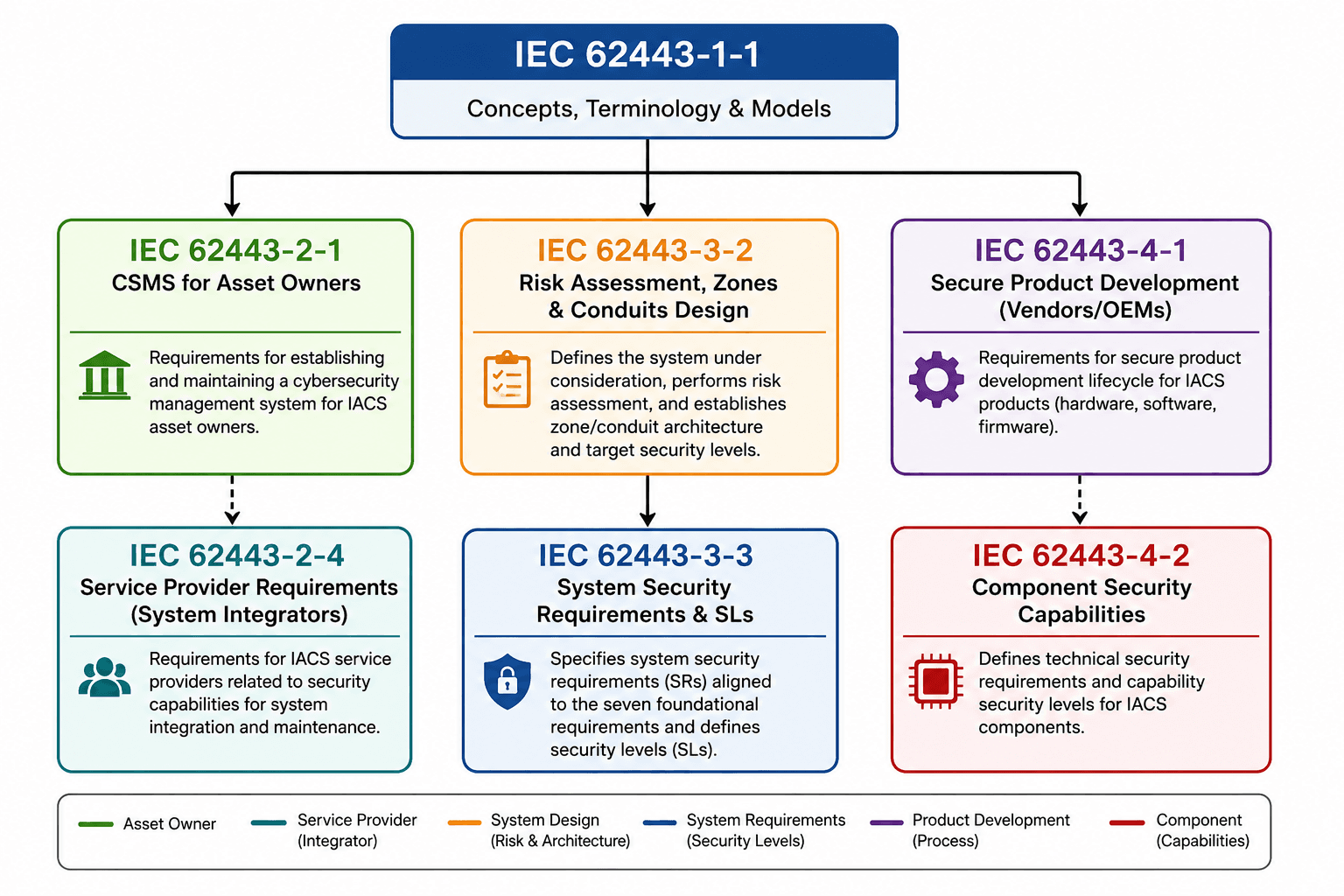
The ISA/IEC 62443 standard provides a structured lifecycle approach to securing Industrial Automation and Control Systems (IACS). To model defense effectively, a water utility must understand how the specific parts of the standard interlock.
Core standards breakdown
IEC 62443-1-1 (Concepts and Models): Defines core terminology, including System Under Consideration (SuC), Zones, Conduits, and Security Levels.
IEC 62443-2-1 (Security Program Requirements for IACS Asset Owners): Outlines requirements for establishing an OT Cybersecurity Management System (CSMS) covering policy, risk management, personnel, and operational security.
IEC 62443-2-4 (Security Program Requirements for IACS Service Providers): Specifies requirements for system integrators and maintenance providers delivering integration and support services to water utilities.
IEC 62443-3-2 (Target Security Levels and Zone/Conduit Design): Mandates the methodology for partitioning an IACS into zones and conduits, performing risk assessments, and assigning Target Security Levels ($\text{SL-T}$).
IEC 62443-3-3 (System Security Requirements and Security Levels): Specifies the technical system security requirements (SRs) associated with the seven Foundational Requirements (FRs) for achieving defined Security Levels.
IEC 62443-4-1 (Secure Product Development Lifecycle Requirements): Defines developer capabilities for secure product lifecycle processes for hardware, software, and PLC firmware.
IEC 62443-4-2 (Technical Security Requirements for IACS Components): Details component-level security capabilities (SL-C) required for PLCs, RTUs, HMIs, network switches, and firewalls.
The ecosystem responsibility matrix
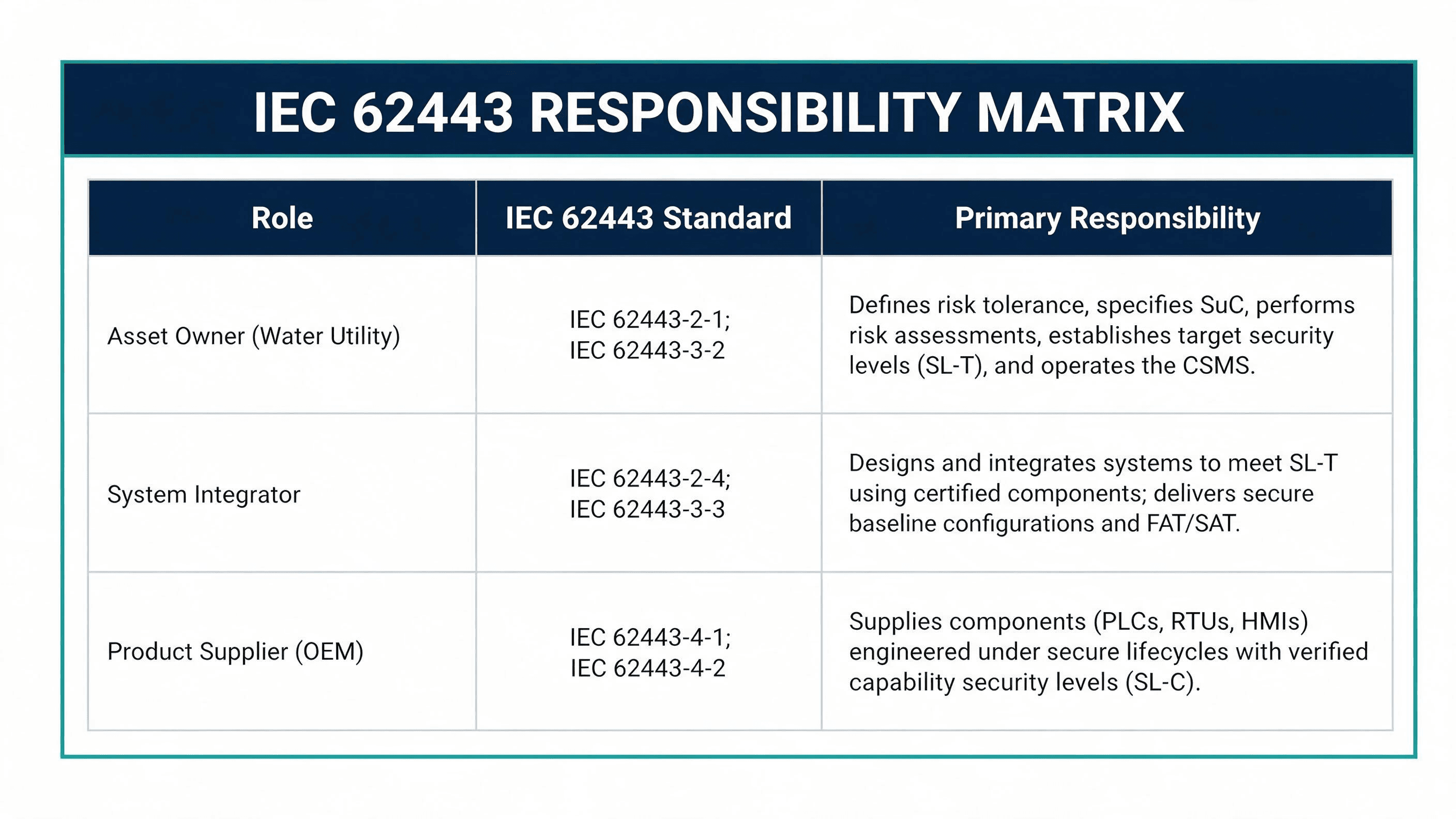
Cybersecurity in a water utility cannot be delegated entirely to technology vendors or system integrators. IEC 62443 divides responsibility across three primary stakeholders:
Building the System Under Consideration (SuC)
Before establishing security zones, a water utility must define its System Under Consideration (SuC) as mandated by IEC 62443-3-2. The SuC establishes the explicit boundary of the IACS environment being assessed and secured.
Practical SuC Definition Methodology
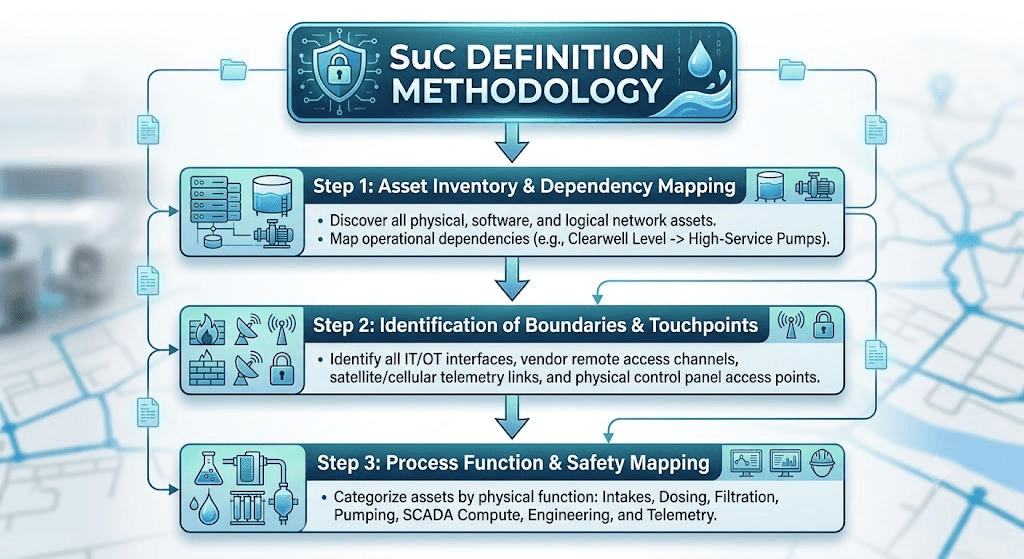
Why automated Asset Discovery alone is not enough
Passive network monitoring tools and active scanners identify IP addresses, MAC addresses, firmware versions, and open ports. However, they fail to reveal process context, safety interlocks, and operational criticality.
For example, an active scanner may identify two identical Modbus-enabled PLCs. Contextual process mapping reveals that PLC-A controls backwash blowers (low critical impact), while PLC-B controls sodium hypochlorite injection rates directly upstream of the clearwell (catastrophic critical impact). The SuC definition must pair technical asset inventories with P&ID (Piping and Instrumentation Diagrams) and operational control narratives.
Modelling the water utility using Zones and Conduits
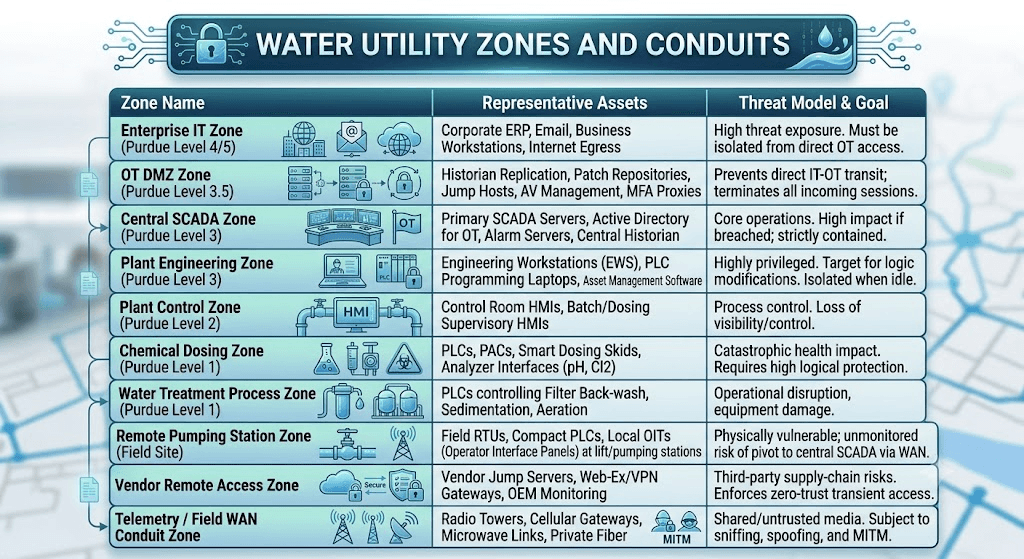
IEC 62443-3-2 requires partitioning the SuC into logical groupings called Zones, which communicate with each other exclusively through explicitly defined communication paths called Conduits.
Zone: A logical or physical grouping of cyber assets that share common security requirements, operational criticality, and risk profiles. A zone has defined physical and logical boundaries.
Conduit: A specialized zone that connects two or more zones, encapsulating all communication channels passing between them. Conduits enforce security policies, access controls, and data flow restrictions.
Below is an illustrative, water-utility-specific zone and conduit architecture tailored to account for centralized treatment plants and geographically distributed remote telemetry assets.
Modelling the Conduits
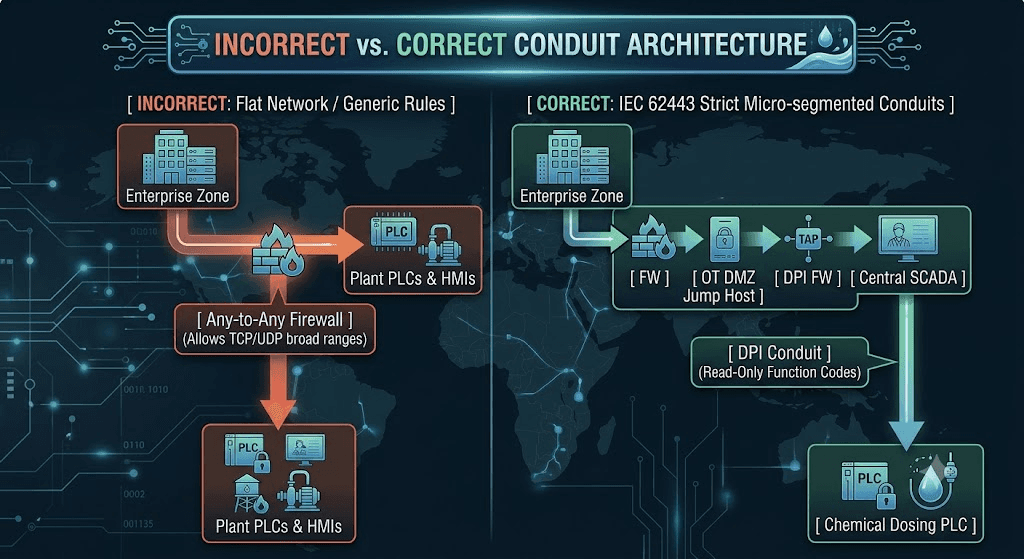
A conduit must be treated as a strict access boundary. Every conduit crossing a zone boundary requires technical policy enforcement (typically stateful firewalls, industrial security appliances, or unidirectional security gateways).
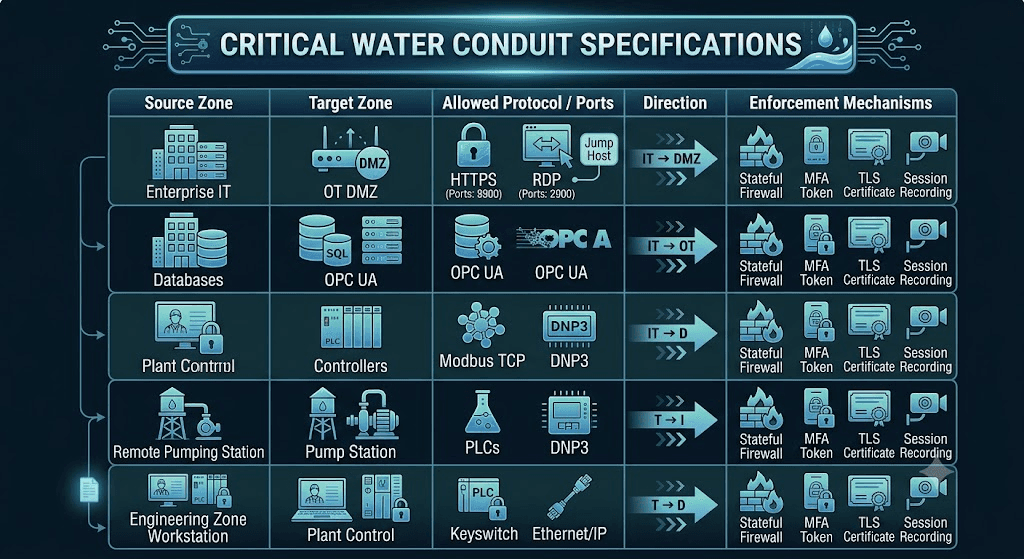
Protocol deep-dive and micro-segmentation constraints
Generic firewalls configured with `ALLOW TCP 502` (Modbus TCP) leave controllers exposed to exploitation. Industrial conduits must enforce Deep Packet Inspection (DPI) to inspect protocol payloads down to function codes and memory register addresses.
Modbus TCP (Port 502): Unauthenticated, unencrypted. Conduits must restrict SCADA-to-PLC Modbus traffic to Read Function Codes (e.g., `0x01` Read Coils, `0x03` Read Holding Registers). Write Function Codes (`0x05` Write Single Coil, `0x10` Write Multiple Registers) must be restricted strictly to authorized supervisory control IPs and alerted on when generated elsewhere.
DNP3 (Port 20000) / IEC 60870-5-104 (Port 2404): Widely used for telemetry across remote water pumping stations. Legacy implementations transmit cleartext. Conduits traversing field WAN links must mandate DNP3 Secure Authentication (SA v5) or encapsulate traffic inside IPSec/TLS tunnels with hardware-backed certificate authentication.
OPC UA (Port 4840): Preferred for supervisory-to-historian and inter-zone communication. Conduits must mandate OPC UA Security Profiles utilizing `Basic256Sha256` or `Aes128_Sha256_RsaOaep` encryption with mutual X.509 certificate validation. `None` mode must be globally prohibited.
Risk assessment and Security Levels
IEC 62443-3-2 mandates a risk-based approach to assigning Security Levels (SL) to zones and conduits. The standard defines three distinct types of Security Levels:
1. Target Security Level (SL-T): The desired level of security assigned to a specific zone or conduit based on risk assessment.
2. Achieved Security Level (SL-A): The actual level of security provided by the implemented architectural controls and countermeasures.
3. Capability Security Level (SL-C): The inherent security capabilities built into an IACS component or system out-of-the-box (per IEC 62443-3-3 / 4-2).
Security Level Definitions (IEC 62443-1-1 / 3-3)
SL 1: Protection against casual or coincidental violation.
SL 2: Protection against intentional violation using simple means with low resources, generic skills, and low motivation.
SL 3: Protection against intentional violation using sophisticated means with moderate resources, IACS-specific skills, and moderate motivation.
SL 4: Protection against intentional violation using sophisticated means with extended resources, IACS-specific skills, and high motivation (e.g., nation-state threat actors).
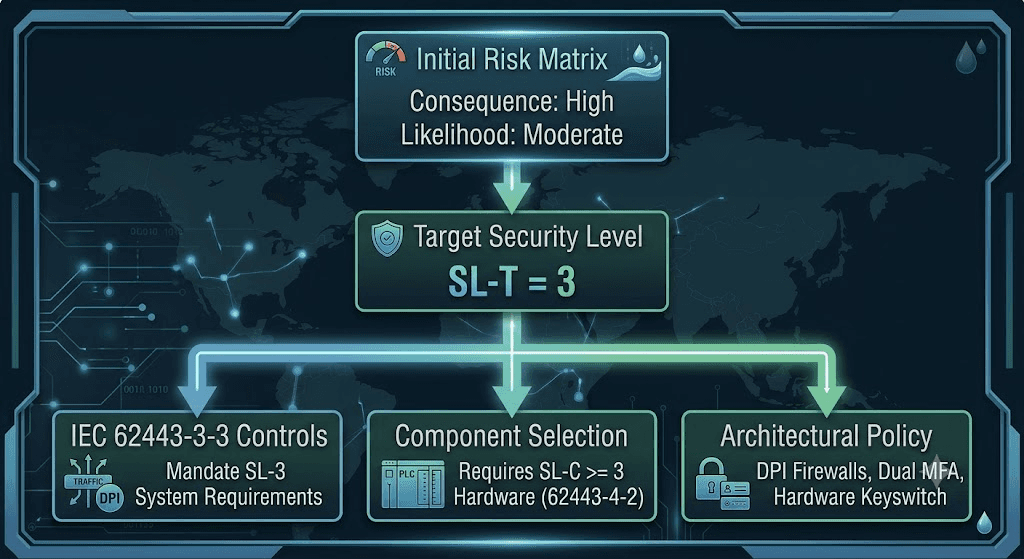
Example: Chemical dosing system Risk Assessment and SL-T determination
To assign an SL-T to the Chemical Dosing Zone of a 50 MGD (Million Gallons per Day) Water Treatment Plant:
Step 1: Consequence evaluation
Scenario: Adversary manipulates PLC analog output registers controlling sodium hypochlorite (disinfection) and sodium hydroxide (pH adjustment) metering pumps.
Impact: Over-dosing causes toxic chemical contamination in the distribution system; under-dosing leads to pathogenic biological exposure (such as Cryptosporidium*, *Giardia*, *E. coli*).
Severity: Catastrophic (Safety & Public Health); immediate threat to human life and long-term loss of public trust.
Step 2: Threat capability assessment
Threat Vector: Attackers exploit a vulnerable vendor remote-access link, pivot to the SCADA server, and issue unauthenticated industrial protocol commands to the dosing PLC.
Likelihood: High exposure due to legacy remote maintenance connections.
Step 3: SL-T Assignment
Because the consequence involves direct catastrophic public health impacts and the threat vector requires moderate to high IACS expertise.
Transforming IEC 62443 into true Defense-in-Depth
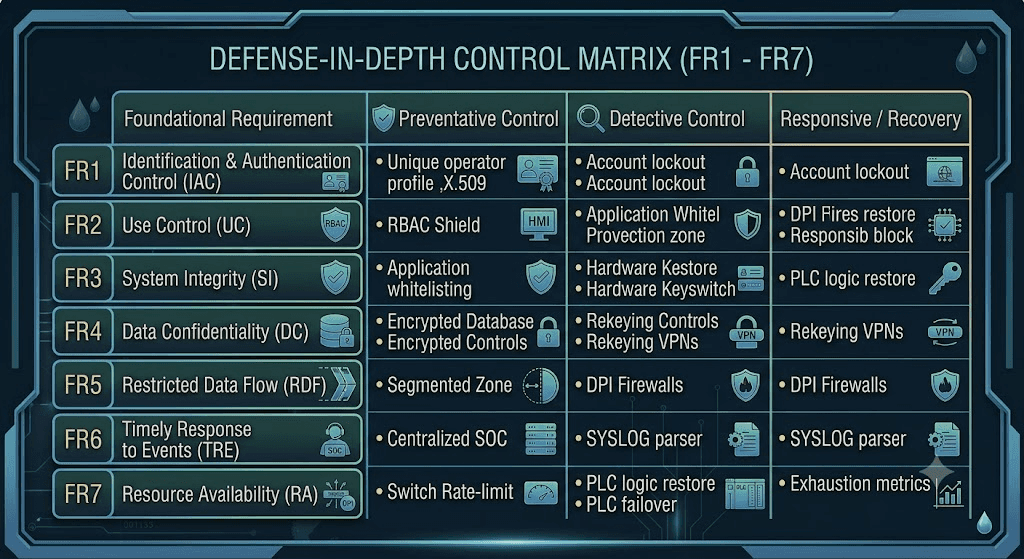
IEC 62443-3-3 defines Seven Foundational Requirements (FRs) that form the backbone of IACS technical security. Below is a comprehensive control matrix translating these FRs into actionable controls for a water utility.
Model the attack surface
To validate the architectural model, a water utility must evaluate potential threat vectors against its zones and conduits. Below are three classic threat vectors in water utilities and the mechanism by which an IEC 62443 architecture breaks the attack pathway.
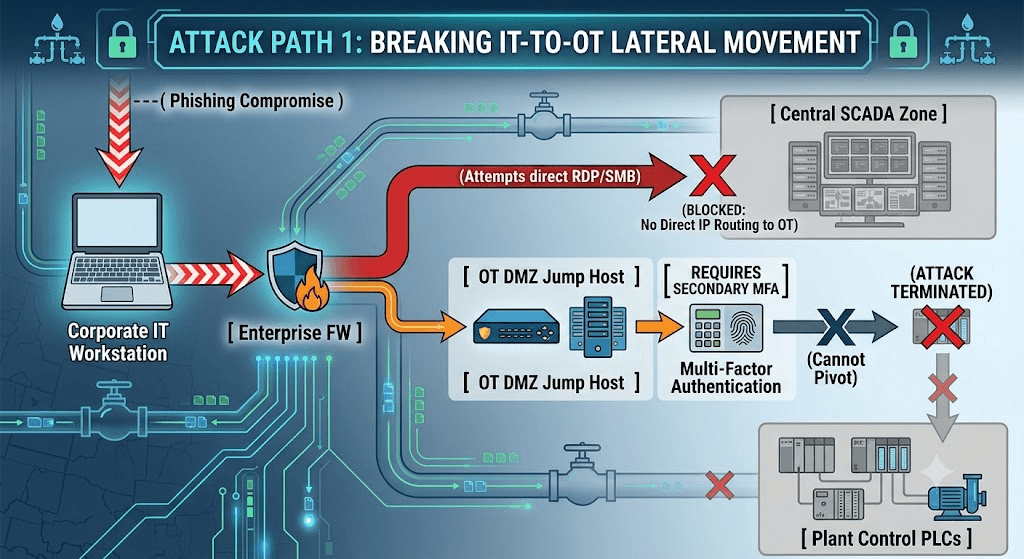
Attack Path 1: IT Breach Pivoting to Central SCADA
· Initial Access: Spear-phishing email compromises an accounting employee's workstation in the Enterprise IT Zone.
· Lateral Movement (Unsegmented): Attacker scans corporate subnet, identifies open SMB/RDP ports directly on the SCADA server, and pivots directly.
· IEC 62443 Containment: The Enterprise Zone is separated from the Central SCADA Zone by an OT DMZ. Direct IP routing between IT and SCADA is blocked. The attacker reaches the OT DMZ Jump Host, which requires hardware MFA (FR1). The attacker cannot supply the second factor, terminating lateral movement at the DMZ boundary.
Attack Path 2: Compromised Vendor Laptop modifying PLC Logic
· Initial Access: A third-party chemical vendor technician connects a malware-infected maintenance laptop directly to an Ethernet port inside a water plant treatment building.
· Lateral Movement: Malicious software scans local subnet for exposed PLCs and issues unauthenticated write requests to alter PLC ladder logic.
· IEC 62443 Containment: Physical switch ports require 802.1X Network Access Control tied to utility-managed certificates (FR1). Unrecognized devices are assigned to a remediation VLAN with no routing. Furthermore, the dosing PLCs require a physical key-switch to be rotated to `REMOTE PROGRAMMING` mode before logic downloads are accepted (FR3), neutralizing automated logic overwrites.
Attack Path 3: Remote Pumping Station Cellular Pivot
· Initial Access: Attacker physically opens an unmonitored remote sewage lift station cabinet, connects to the RTU serial/Ethernet port, or compromises the cellular router.
· Lateral Movement: Attacker attempts to route backwards through the cellular Field WAN connection to gain access to the central SCADA core.
· IEC 62443 Containment: The Remote Pumping Station Zone is linked to the central site via a dedicated Telemetry Conduit. The central VPN concentrator enforces strict firewall rules that only permit DNP3 protocol traffic (TCP 20000) destined for the dedicated Telemetry Front-End Processor (FEP). Direct IP access to central engineering workstations, HMIs, or corporate networks is explicitly dropped at the gateway (FR5).
Design the reference architecture
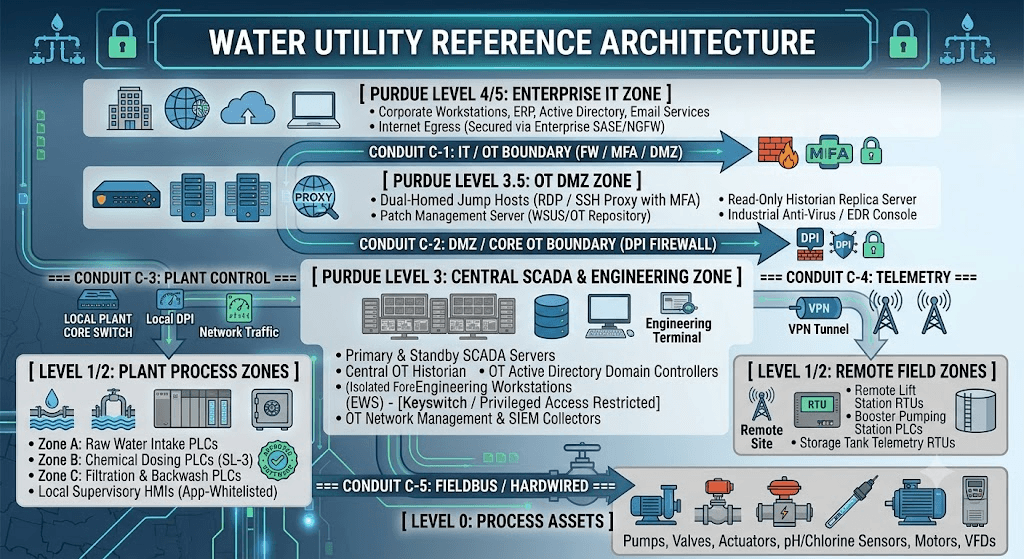
Below is a practical reference architecture mapping an IEC 62443 defense model for a medium-to-large water utility.
Architectural "Never Connect" Rules
To preserve structural integrity, the reference architecture mandates explicit connection prohibitions:
· NEVER connect Level 1/0 PLCs/RTUs directly to corporate IT networks or the internet.
· NEVER allow dual-homed machines that span directly between the Enterprise IT Zone and Level 3 SCADA without terminating through an OT DMZ.
· NEVER route unencrypted, cleartext industrial protocols (Modbus TCP, DNP3 plain text) across public cellular or unencrypted wireless networks.
· NEVER share user identity stores (e.g., Active Directory) between Corporate IT and OT environments. OT must maintain a dedicated, untrusted identity forest.
Multi-layer defense in depth
Defense-in-depth requires overlaying eight distinct functional security layers across all defined zones and conduits.
· Layer 1 — Physical: High-security fence perimeters, physical intrusion detection sensors on remote lift station hatches, tamper-evident locks on PLC enclosures, and CCTV coverage at critical intake facilities.
· Layer 2 — Network: Zone micro-segmentation, DPI firewalls enforcing least-privilege conduits, disabling unallocated switch ports, and VLAN isolation.
· Layer 3 — System: OS hardening (disabling unused services/protocols), patch management validated by OT vendors, and Application Whitelisting (Default-Deny execution) on HMIs and EWS.
· Layer 4 — Identity: Centralized OT Active Directory, hardware-based MFA for remote access, role-based access control (RBAC), and privileged access management (PAM) with session recording.
· Layer 5 — Application / Control: SCADA software hardening, HMI limits enforcing valid numerical setpoint ranges (e.g., rejecting a chemical feed rate input above defined thresholds), and hardware keyswitches on PLCs.
· Layer 6 — Detection: Passive OT network monitoring sensors deployed on TAP/SPAN ports, continuous behavior baselining, and centralized log aggregation into an OT-aware SIEM.
· Layer 7 — Response: Tested OT incident response playbooks, automated firewall containment triggers, defined operational escalation paths, and manual failover procedures.
· Layer 8 — Recovery: Offline, immutable, air-gapped backups of SCADA databases, HMI projects, and PLC golden-master logic files; validated bare-metal restoration plans.
Remote access and Third-Party Risk management
Vendor remote access represents one of the primary attack vectors for critical infrastructure. IEC 62443 demands treating remote access not merely as a network connectivity problem, but as a dedicated, highly controlled Zone and Conduit architecture.
Operational Rules for Secure Third-Party Access
1. No Persistent Connections: Vendor VPN connections must be disabled by default ("Always-Off") and enabled only on-demand for specific maintenance windows.
2. Explicit Plant Operator Approval: Even with valid credentials, a vendor session cannot connect until a plant operator manually approves the active request inside the SCADA interface.
3. Time-Bound Ephemeral Access: Access permissions automatically expire after a set time window (e.g., 2 hours). Extensions require re-authorization.
4. Full Session Recording: All vendor RDP and SSH sessions must be recorded at video resolution and stored for audit and forensic review.
OT Monitoring and Detection
Traditional IT Intrusion Detection Systems (IDS) rely on signature files and expect frequent connection state changes. Passive OT Network Monitoring tools operate non-intrusively via Network TAPs or Switch SPAN ports to build behavioral baselines of industrial protocols.
Incident Response: IT Containment vs. OT Containment
Containment strategies in IT environments frequently rely on rapidly isolating machines, shutting down subnets, or killing processes. In a water utility, applying IT containment logic can induce catastrophic operational failures.
Response Playbook Example: Compromised Engineering Workstation (EWS)
1. Safety Verification: Plant operators immediately verify physical process parameters (clearwell levels, distribution pressures, dosing rates) using local panel meters and independent hardwired gauges.
2. Isolate Logical Conduit: Drop C-2 Conduit (EWS to Level 1 PLCs) at the DPI firewall. Do not power off the EWS immediately to preserve volatile RAM evidence.
3. Rotate Controller Keyswitches: Manually switch all field PLCs to `RUN` (disable remote programming capability) across all treatment skids.
4. Engage Hardwired Fallback: If HMI manipulation is detected, switch process skids to Local Manual Control mode using physical control panel hand-off-auto (HOA) switches.
5. Forensic Investigation & Master Recovery: Capture forensic image of EWS. Re-image workstation from trusted offline media, reinstall verified software, and execute cryptographically signed PLC logic comparison against golden master backups.
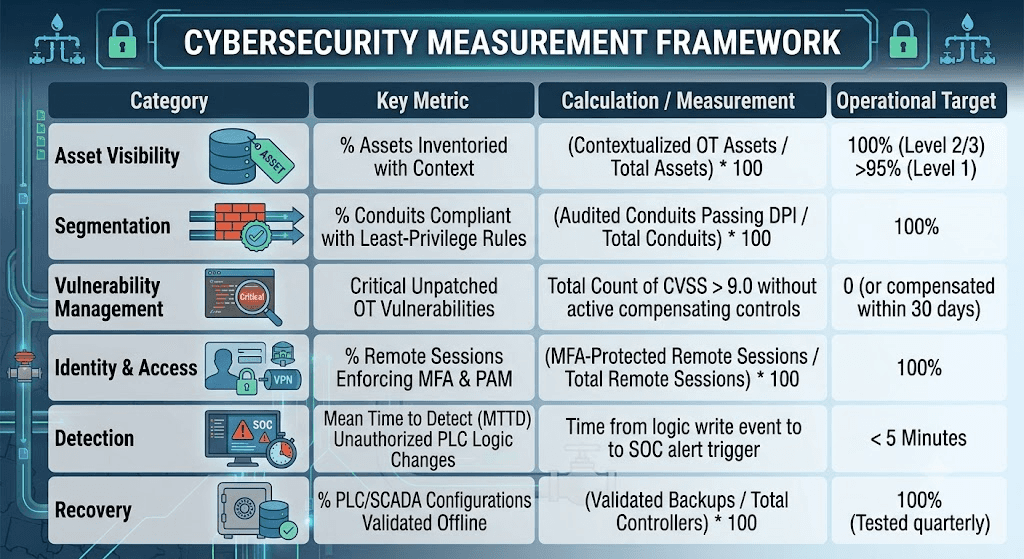
Metrics Framework: KPIs and KRIs
A water utility cybersecurity management system must measure performance against explicit targets.
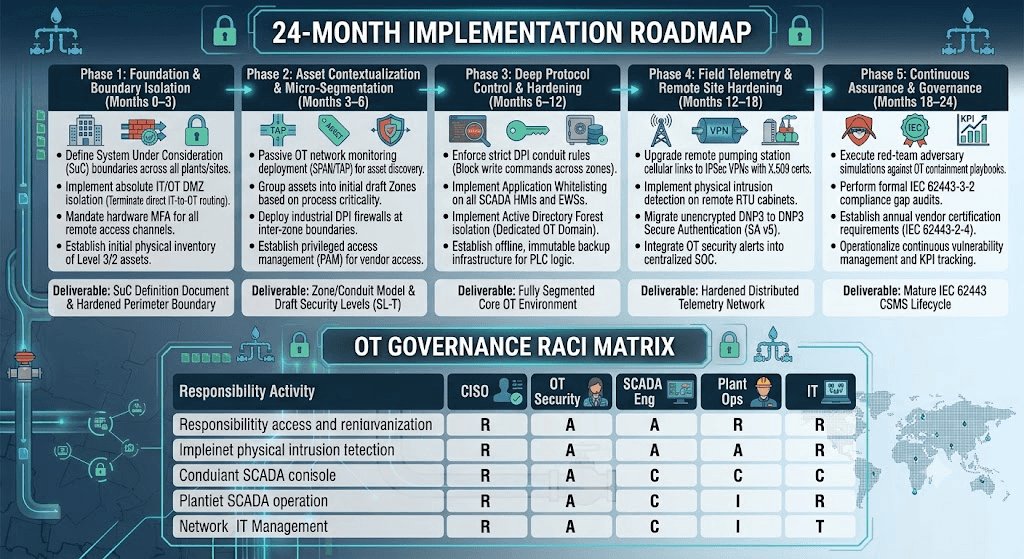
Implementation Roadmap (0–24 Months) and governance RACI Matrix
Implementing an IEC 62443 architecture across a water utility requires a phased approach prioritizing risk reduction over technology acquisition.
10 Common mistakes water utilities make when implementing IEC 62443
· Treating IEC 62443 as a One-Time Compliance Checklist: Viewing the standard as a static audit rather than an ongoing engineering and operational lifecycle process.
· Structuring Zones Purely by Network Topology: Drawing zones based solely on existing IP subnets rather than grouping assets by operational process criticality and safety impact.
· Assigning Target Security Levels ($\text{SL-T}$) Arbitrarily: Setting blanket $\text{SL-T} = 3$ across the entire utility without performing the detailed risk assessments required by IEC 62443-3-2, leading to unsustainable operational overhead.
· Relying on IT Firewalls Without Industrial Deep Packet Inspection (DPI): Allowing raw Modbus TCP or DNP3 through firewalls without inspecting protocol function codes and payload boundaries.
· Ignoring Distributed Remote Assets: Securing the central water treatment plant while leaving unmonitored lift station RTUs connected over unencrypted cellular links.
· Sharing Active Directory Domains Across IT and OT: Utilizing corporate credentials for OT SCADA login, allowing corporate phishing compromises to immediately inherit administrator rights in OT.
· Over-relying on Passive Monitoring as a Compensating Control: Deploying passive network anomaly detection while leaving flat, unsegmented networks with open physical USB and switch ports intact.
· Granting Persistent Vendor VPN Access: Giving third-party OEMs permanent, unmonitored access channels instead of implementing time-bound, operator-approved, jump-host architectures.
· Neglecting Physical Security at Remote Field Sites: Implementing high-level software security controls while leaving field control panel cabinets unlocked and accessible using standard physical master keys.
· Applying IT Incident Containment Procedures to Process Environments: Powering off HMIs or severing entire network connections during an incident without evaluating physical safety, hydraulic impacts, or local manual control availability.
Practical implementation checklist and final defense lifecycle
A resilient water utility cybersecurity program operates on a continuous feedback loop:
Verification checklist
[ ] STEP 1: BOUNDARY DEFINITION
[ ] System Under Consideration (SuC) explicitly documented.
[ ] All IT/OT touchpoints, remote access gateways, and field links mapped.
[ ] STEP 2: ZONING & CONDUITS
[ ] OT DMZ deployed; zero direct IP routing between Corporate IT and Level 3 OT.
[ ] Critical process areas (Chemical Dosing, Intakes) isolated into discrete zones.
[ ] Firewalls enforcing conduits utilize Deep Packet Inspection (DPI) for OT protocols.
[ ] STEP 3: IDENTITY & ACCESS CONTROL
[ ] Dedicated, isolated Active Directory domain established for OT.
[ ] Multi-Factor Authentication (MFA) enforced on all remote access channels.
[ ] Third-party access routed through a privileged access management (PAM) jump host.
[ ] STEP 4: SYSTEM & APPLICATION HARDENING
[ ] Application Whitelisting enabled on all HMIs and Engineering Workstations.
[ ] Hardware keyswitches on PLCs set to RUN mode during normal operations.
[ ] Unused physical switch ports disabled; 802.1X enforced where operational.
[ ] STEP 5: DETECTION & RECOVERY
[ ] Passive OT security monitoring sensors deployed on core TAP/SPAN ports.
[ ] SCADA, HMI, and PLC logic backups stored in offline, air-gapped immutable storage.
[ ] OT-specific incident response playbooks tested via tabletop exercises annually.
References and source list
1. ISA/IEC 62443-1-1:2018 — *Security for industrial automation and control systems — Part 1-1: Terminology, concepts and models.*
2. ISA/IEC 62443-2-1:2009 — *Security for industrial automation and control systems — Part 2-1: Establishing an industrial automation and control system security program.*
3. ISA/IEC 62443-3-2:2020 — *Security for industrial automation and control systems — Part 3-2: Security risk assessment for system design.*
4. ISA/IEC 62443-3-3:2013 — *Security for industrial automation and control systems — Part 3-3: System security requirements and security levels.*
5. ISA/IEC 62443-4-2:2019 — *Security for industrial automation and control systems — Part 4-2: Technical security requirements for IACS components.*
6. CISA Water and Wastewater Sector Cybersecurity Services — *Cybersecurity and Infrastructure Security Agency (CISA), Water Sector Guidance.*
7. NIST Special Publication 800-82 Revision 3 — *Guide to Operational Technology (OT) Security*, National Institute of Standards and Technology.
8. AWWA G430-13 — *Security Practices for Operation and Management*, American Water Works Association.
9. AWWA J100-10 — *Risk and Resilience Management of Water and Wastewater Systems*, American Water Works Association.
Get Weekly
Resources & News
See How Our Industry-Leading OT Security Solutions Address Critical Security Challenges
You may also like

What the French supermarket cyberattack reveals about OT security
Prayukth K V

Inside the Albert Heijn cyber incident: Investigating the attack, the IT/OT exposure, and the risks to critical operations
Team Shieldworkz

50°C by cyberattack? Inside France’s supermarket refrigeration crisis
Prayukth K V

Automating IEC 62443 Compliance Assessments Without Losing Expert Control
Team Shieldworkz

Investigative cyber threat intelligence report: Daiichi Kosho supply-chain data exposure
Prayukth K V

How AI Is Changing IEC 62443 Assessments
Team Shieldworkz