
Team Shieldworkz
Industrial environments are under immense pressure from two opposing fronts. On one side, cyber attackers relentlessly target operational technology (OT) with ransomware, phishing, remote access abuse, and supply chain compromises. On the other side, plants must maintain continuous production, guarantee human safety, and keep legacy systems running-systems that were never designed to face today’s hostile threat landscape. Because of this tension, many industrial leaders struggle to turn high-level security standards into real, plant-floor action.
This is exactly where IEC 62443 mapping becomes your most valuable tool. The newly updated NIST CSF 2.0 provides an enterprise-friendly, board-ready way to organize cyber risk. Meanwhile, the IEC 62443 series delivers the deep, OT-specific technical and procedural requirements necessary for industrial automation and control systems (IACS). Together, they build a practical, actionable bridge between high-level business risk, plant-floor reality, and technical engineering controls. When you add NIST SP 800-82 into the mix as your foundational OT guidebook, you establish a clear, direct path from corporate strategy to safe implementation.
In this comprehensive guide, we will break down how to connect NIST CSF 2.0, IEC 62443, and NIST SP 800-82 into a single, cohesive framework. We will explore how to conduct a proper risk assessment, define zones and conduits, select the right controls, and prepare for incidents without jeopardizing your uptime. Most importantly, you will walk away with practical, actionable tactics you can deploy immediately to strengthen your Industrial OT Security.
Before we move forward, don’t forget to check out our previous blog post on “Deploying IEC 62443 security controls in IACS: A practical implementation guide” here.
Why IEC 62443 Mapping Matters in Industrial OT Security
A common pitfall in industrial cybersecurity is treating security frameworks as abstract documents that sit on a shelf. This siloed approach inevitably creates operational gaps. Business leaders demand clear visibility into risk. OT engineers require plant-safe controls that will not trip a process. CISOs need measurable, reportable governance. IEC 62443 mapping solves this friction by helping all three groups speak a unified language.
The Power of NIST CSF 2.0
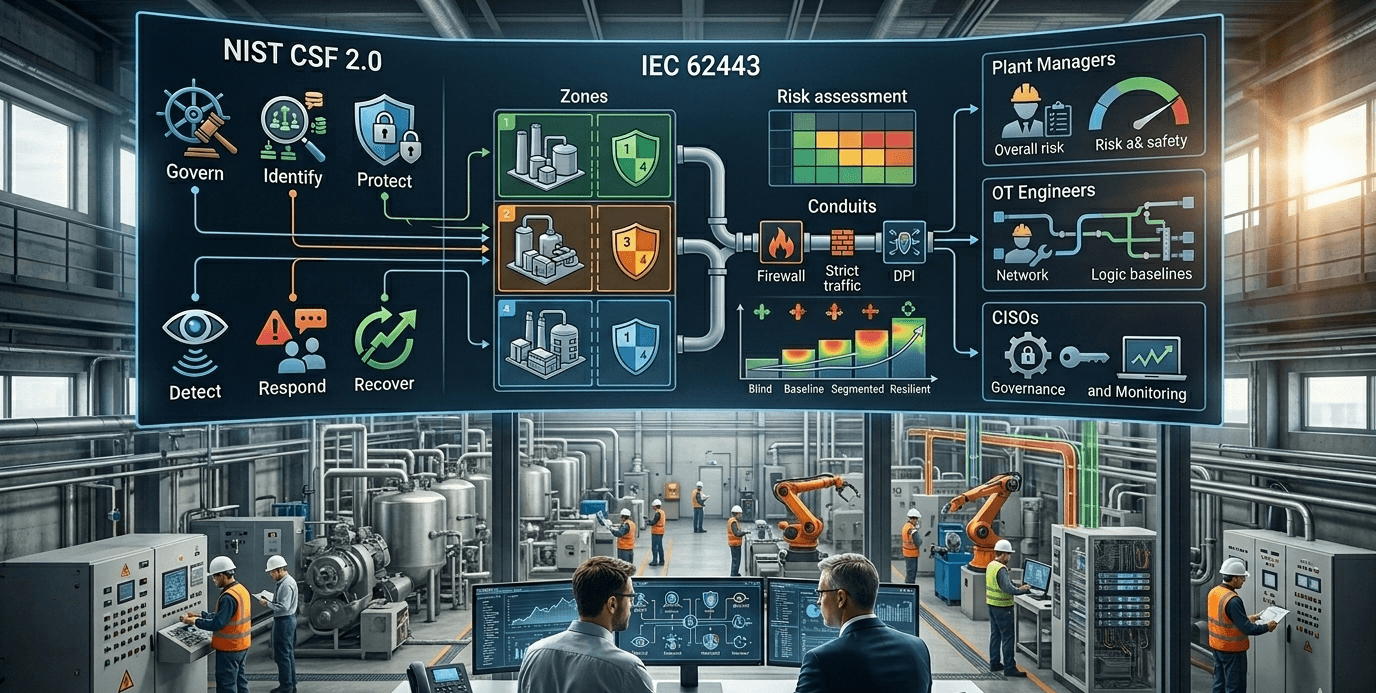
NIST CSF 2.0 excels at organizing cybersecurity risk across the entire enterprise. It breaks down complex cyber programs into six core functions: Govern, Identify, Protect, Detect, Respond, and Recover. The newest addition, the Govern function, is critical because it places risk strategy, supply chain management, and executive oversight at the center of the model. It answers the question: What outcomes matter to the business?
The Depth of IEC 62443
While NIST provides the "what," IEC 62443 provides the "how" for the OT side. It is the global standard for securing industrial automation.
IEC 62443-2-1 and 2-4 define the security programs for asset owners and service providers.
IEC 62443-3-2 focuses on defining your system, partitioning it into zones and conduits, and conducting a targeted risk assessment to establish target Security Levels (SL-T).
IEC 62443-3-3 dictates the system security requirements needed to meet those levels.
IEC 62443-4-1 and 4-2 address the secure development and technical requirements of the components themselves.
The Context of NIST SP 800-82 Rev. 3
NIST SP 800-82 fills in the operational context. It explains the unique topologies of OT, highlights common threats and vulnerabilities specific to industrial control systems (ICS), and recommends countermeasures that preserve performance, reliability, and human safety.
The formula is simple: CSF 2.0 dictates the strategic outcomes, IEC 62443 outlines how to build industrial security around those outcomes, and SP 800-82 explains how to apply those concepts in a live plant.
The Reality of Today’s OT Threat Landscape
To understand why this mapping is so urgent, we must look at the realities of modern industrial threats. Industrial control systems face a volatile mix of IT-born threats crossing over into operational networks, alongside highly targeted, OT-specific malware. In practice, our teams at Shieldworkz see the following critical threats daily:
Ransomware Spillover: Attacks that begin in enterprise IT but force preemptive OT shutdowns because the plant relies on IT for billing, scheduling, or active directory.
Remote Access Abuse: Attackers exploiting weak, unmonitored vendor connections (like VPNs or remote desktop tools) maintained for third-party troubleshooting.
Credential Theft: Phishing campaigns that harvest engineer credentials, allowing lateral movement directly into the OT environment.
Supply Chain Compromise: Insecure products, compromised software updates, or vulnerabilities introduced by trusted integrators.
Flat Network Architectures: Plants lacking segmentation, meaning a single compromised HMI (Human Machine Interface) grants attackers total access to PLCs (Programmable Logic Controllers) across the entire facility.
Legacy Vulnerabilities: Unpatched Windows XP/7 systems and older firmware that simply cannot be updated without halting production.
Unsafe Logic Changes: Unauthorized modifications to PLC code or historian data that alter physical processes, leading to safety incidents or spoiled batches.
In an IT environment, a cyber event causes data loss. In an OT environment, a cyber event can cause physical equipment damage, environmental disasters, or loss of life. OT Security must be architected around physical process reality.
The Practical IEC 62443 Mapping Blueprint
To make these frameworks actionable, we treat NIST CSF 2.0 as the management and reporting layer and IEC 62443 as the engineering and implementation layer. Here is how we map the six core NIST functions to actionable industrial security.
1. GOVERN: Strategy, Roles, and Oversight
The Govern function is where leadership sets the rules of engagement. In OT, this means clearly defining who owns cyber risk, who is authorized to approve exceptions for legacy gear, who signs off on remote access, and how security budgets are balanced against plant uptime.
IEC 62443 Alignment: * IEC 62443-2-1: Asset owner security program policies and procedures.
IEC 62443-2-4: Security program expectations for industrial service providers and integrators.
Practical Tasks:
Establish an OT cybersecurity steering committee featuring voices from plant operations, control engineering, IT, safety (HSE), and procurement.
Define hard rules for managing legacy assets that cannot natively support modern security protocols.
Implement strict vendor risk management policies, ensuring third-party integrators adhere to IEC 62443-2-4 standards before touching your network.
What Good Looks Like: Security is no longer viewed as an IT roadblock. It is an integrated part of daily plant governance, safety briefings, and procurement cycles.
2. IDENTIFY: Assets, Zones, and Risk Assessment
You cannot protect what you do not understand. The Identify function is where you map your digital and physical reality. In the industrial world, this requires an accurate inventory of assets, mapping data flows, and executing a rigorous risk assessment.
IEC 62443 Alignment: * IEC 62443-3-2: Defining the System Under Consideration (SUC), partitioning into zones and conduits, and performing unmitigated and mitigated cyber risk assessments.
NIST SP 800-82: Guidance on OT architectures and vulnerability identification.
Practical Tasks:
Build a dynamic, passive inventory of PLCs, HMIs, Engineering Workstations (EWS), historians, VFDs (Variable Frequency Drives), and remote access gateways.
Map the network traffic passing between IT and OT, as well as between different operational cells.
Group your assets into logical "Zones" based on their function, criticality, and safety impact.
What Good Looks Like: You possess a living map of your crown jewels, you understand their dependencies, and you know exactly where your highest risks reside.
3. PROTECT: Segmentation and Hardened Safeguards
The Protect function aims to stop a threat from becoming an incident. In an industrial setting, "protection" rarely means installing intrusive antivirus software that might quarantine a vital control file. Instead, it relies on strict architecture, identity management, and physical isolation.
IEC 62443 Alignment: * IEC 62443-3-3: System security requirements and security levels (Foundational Requirements like Identification & Authentication Control, System Integrity).
IEC 62443-4-1 & 4-2: Secure component design and lifecycle management.
Practical Tasks:
Transition away from a flat network by implementing "Conduits" (e.g., industrial firewalls) between your zones. Restrict traffic strictly to necessary industrial protocols (e.g., allowing only OPC-UA or Modbus TCP from the supervisory zone to the cell zone).
Enforce the principle of least privilege. Operators, engineers, and vendors should only have access to the specific systems they need, exactly when they need them.
Disable unused ports, services, and protocols on all operational assets.
Ensure critical configuration backups are stored completely offline.
What Good Looks Like: Your most critical safety and production systems are insulated. Even if a threat breaches the IT network or a vendor laptop, lateral movement into the plant floor is blocked.
4. DETECT: Continuous Visibility and Anomaly Hunting
A robust Protect function will eventually fail; you must be ready to Detect. Unfortunately, this is where many OT programs fall dangerously short. Traditional IT detection tools rely on malware signatures and internet lookups, which are ineffective and risky in air-gapped or sensitive OT networks.
IEC 62443 Alignment: * IEC 62443-3-3: Technical requirements for continuous monitoring, event logging, and system integrity verification.
Practical Tasks:
Deploy passive network monitoring via SPAN ports or network TAPs to inspect OT traffic without adding latency.
Establish a baseline of "normal" industrial communications. Alert on deviations-such as an engineering workstation suddenly trying to push new ladder logic to a PLC at 2:00 AM on a Sunday.
Centralize logs from your OT firewalls, remote access jump hosts, and critical Windows-based HMIs.
Tune out the noise. OT operators suffer from alarm fatigue; security alerts must be highly specific and actionable.
What Good Looks Like: You detect unauthorized logic changes or suspicious vendor connections immediately, allowing you to intercept the threat before it forces a plant shutdown.
5. RESPOND: Playbooks and Coordinated Action
When an alert fires, what happens next? The Respond function is about executing fast, disciplined, and pre-planned actions. In an industrial plant, pulling the plug on a network switch might cause more physical damage than a cyberattack. Response requires careful coordination.
IEC 62443 Alignment: * IEC 62443-2-1: Incident response policies, procedures, and training.
Practical Tasks:
Develop highly specific OT incident response playbooks. Do not rely on IT playbooks. You need scenarios for: "Ransomware on the HMI network," "Loss of view/Loss of control," and "Compromised third-party remote session."
Define an absolute chain of command. Who possesses the authority to physically isolate a production zone? Who can authorize a transition to manual plant operation?
Conduct cross-functional Tabletop Exercises (TTX) involving the CISO, plant managers, control engineers, and public relations.
What Good Looks Like: During a crisis, there is no panic. The team executes a practiced playbook that isolates the threat safely while maintaining (or safely shutting down) physical processes.
6. RECOVER: Restoration and Resilience
The Recover function governs how you return to normal operations securely. In the industrial sector, recovery is complex. You cannot simply re-image a server and walk away. You must verify the integrity of the process, calibrate sensors, and ensure safety systems are fully operational.
IEC 62443 Alignment: * IEC 62443-2-1: Business continuity, disaster recovery, and post-incident review procedures.
IEC 62443-3-3: Backup and restore technical capabilities.
Practical Tasks:
Maintain validated, air-gapped backups of PLC logic, HMI configurations, switch configurations, and historian databases.
Test your restoration procedures during scheduled maintenance windows. A backup is only theoretical until you have successfully restored it to live hardware.
Post-incident, conduct a rigorous "lessons learned" review to update your risk assessments, adjust your target security levels, and tighten conduit firewall rules.
What Good Looks Like: Recovery times are highly predictable, safety is prioritized during spin-up, and the organization continuously learns from near-misses.
Mastering the Zone and Conduit Model (IEC 62443-3-2)
At the heart of mapping these frameworks is the Zone and Conduit model, heavily influenced by the Purdue Enterprise Reference Architecture (PERA). You cannot apply NIST CSF 2.0 controls uniformly across a factory. Risk must be compartmentalized.
Zones: Logical or physical groupings of assets that share the same cybersecurity requirements. For example, a "Safety Instrumented System (SIS) Zone" requires an incredibly high level of protection, whereas a "Supervisory HMI Zone" has different requirements.
Conduits: The communication pathways between zones. A conduit is where you apply your Protect and Detect controls-like an industrial Deep Packet Inspection (DPI) firewall or a secure remote access gateway.
By mapping NIST’s Identify and Protect functions directly to IEC 62443 zones and conduits, you move away from subjective risk guessing. You look at a specific traffic path (e.g., a vendor updating a robotic arm) and clearly define the trust level required for that specific interaction.
Role-Specific Action Plans: What You Should Do Differently Tomorrow
Frameworks are only valuable if they change daily behavior. Here is how different leaders should apply this IEC 62443 mapping:
For Plant Managers
You hold the ultimate accountability for production output and worker safety. Your objective is to ensure cybersecurity initiatives are operationally realistic and do not cause unplanned downtime.
Action 1: Demand a simplified, prioritized OT risk register. You need to know which operational cells are most vulnerable to disruption.
Action 2: Institutionalize security maintenance windows. Stop allowing integrators to bypass security just to "get the machine running faster."
Action 3: Mandate that cyber incident response scenarios are integrated into your standard physical safety and emergency drills.
For OT and Control Systems Engineers
You are the guardians of the physical process. You understand the code, the controllers, and the catastrophic failure modes. Your role is translating high-level security policies into plant-safe engineering controls.
Action 1: Validate your zone and conduit architecture on the live network. Ensure that firewall rules genuinely reflect the approved traffic flows.
Action 2: Document the "known good" baseline for your critical assets. Security teams need you to define what normal operations look like so they can detect anomalies.
Action 3: Take ownership of OT-specific backups. Ensure PLC code and proprietary device configurations are backed up securely and offline.
For Chief Information Security Officers (CISOs)
You are responsible for corporate governance, but you cannot secure a factory the same way you secure a corporate data center. You must achieve enterprise consistency while respecting the fragility of OT.
Action 1: Utilize NIST CSF 2.0 Current and Target Profiles to report OT risk to the board. Show them exactly where the plant stands today versus where it needs to be.
Action 2: Adapt your corporate security policies to align with IEC 62443-2-1. Do not force an IT password rotation policy on an HMI that multiple operators must access simultaneously during a safety event.
Action 3: Fund non-intrusive monitoring and segmentation projects that the OT team can realistically support and maintain.
Building a Practical Roadmap: The 30-60-90 Day Plan
Transforming your security posture requires phased execution. We recommend a structured 90-day sprint based on the mapped frameworks to achieve rapid time-to-value.
30-60-90 Day Rollout Plan
Timeframe | Core Focus (NIST CSF) | Tactical Actions (IEC 62443) |
First 30 Days | Identify & Govern | Deploy passive discovery tools to inventory critical assets. Map all external vendor remote access paths. Form the cross-functional OT security committee. |
Days 31-60 | Protect & Detect | Group assets into IEC 62443 Zones. Deploy conduit firewalls to isolate critical cells. Tune monitoring alerts for high-fidelity anomalies, filtering out IT noise. |
Days 61-90 | Respond & Recover | Draft OT-specific ransomware playbooks. Conduct a tabletop exercise with plant operators. Verify the successful restoration of offline PLC and historian backups. |
Tracking Your Maturity
Using NIST CSF 2.0 Tiers alongside IEC 62443 Security Levels (SL) helps you track your journey from reactive to optimized.
Stage 1 - Blind (Reactive): Unknown assets, flat networks, IT/OT mixed. High risk of systemic failure.
Stage 2 - Baseline (Aware): Assets inventoried, basic zones identified. Governance policies drafted.
Stage 3 - Segmented (Protected): Strict conduits established. Remote access tightly controlled. Vulnerabilities managed via compensating controls.
Stage 4 - Resilient (Optimized): Continuous passive monitoring. Tested incident response. Rapid, proven recovery capabilities built into plant culture.
Common Mistakes to Avoid in Industrial OT Security
Even with a perfect framework mapping, execution can fail. At Shieldworkz, we frequently see organizations stumble over these common pitfalls:
The IT "Copy-Paste" Approach: Deploying active IT vulnerability scanners in an OT environment. Pinging a legacy PLC can cause it to crash, halting production. You must use passive discovery and OT-native tools.
Focusing Only on Blinkey Boxes: Buying expensive security appliances but failing to address governance, training, and change management. IEC 62443 heavily emphasizes people and processes. A firewall is useless if an engineer leaves the default password as
admin/admin.Ignoring the Supply Chain: Service providers often require deep access to your systems for maintenance. If you do not enforce IEC 62443-2-4 standards on your vendors, you are implicitly accepting their internal security flaws as your own.
Failing to Test Recovery: Assuming a backup works because the software says "Success." If you have never restored a critical engineering workstation onto bare metal in a crisis, your recovery plan is a dangerous illusion.
How Shieldworkz Accelerates Your Journey
The hardest part of securing industrial infrastructure is not reading the standards-it is contextualizing those standards into a working program that respects your assets, your personnel, and your uncompromising production schedules.
That is exactly where Shieldworkz steps in. We specialize in helping industrial organizations navigate the complex intersection of business risk and plant-floor reality. Our holistic approach is built around:
Deep-Dive OT Risk Assessments: We utilize IEC 62443-3-2 methodologies to identify your critical assets, expose hidden attack vectors, and pinpoint exact control gaps.
Expert IEC 62443 & NIST Mapping: We connect your corporate governance, network architecture, and recovery protocols to the right framework outcomes, ensuring compliance and real-world resilience.
Actionable Industrial Playbooks: We provide battle-tested incident response playbooks tailored specifically for the nuances of OT environments.
Strategic Remediation Roadmaps: We deliver prioritized, practical steps that balance necessary security enhancements with your operational uptime and safety mandates.
Our ultimate mission is to help your organization transition from "We understand the NIST standards" to "We can mathematically prove our plant is secure and resilient."
NIST CSF 2.0 and IEC 62443 are not competing methodologies; they are two halves of a comprehensive defense strategy. Used together, they provide a seamless pathway from boardroom risk governance down to the bits and bytes of OT implementation. CSF 2.0 frames the business conversation, IEC 62443 engineers the technical reality, and NIST SP 800-82 ensures it all works safely within the unique constraints of an industrial plant.
The fundamental takeaway for modern industrial leaders is this: Industrial OT Security is not a product you buy; it is a lifecycle you manage. Start by establishing solid governance, conduct an honest risk assessment, segment your networks into zones and conduits, implement hardened safeguards, and continuously test your response capabilities. By mapping these frameworks, security transcends mere compliance and becomes the bedrock of your operational resilience.
Additional resources
A downloadable report on the Stryker cyber incident here
Removable media scan solution vendor evaluation and selection checklist here
IEC 62443-based OT/ICS risk assessment checklist for the food and beverage manufacturing sector here
Get Weekly
Resources & News
See How Our Industry-Leading OT Security Solutions Address Critical Security Challenges
You may also like

What the French supermarket cyberattack reveals about OT security

Prayukth K V

Inside the Albert Heijn cyber incident: Investigating the attack, the IT/OT exposure, and the risks to critical operations
Team Shieldworkz

50°C by cyberattack? Inside France’s supermarket refrigeration crisis
Prayukth K V

Automating IEC 62443 Compliance Assessments Without Losing Expert Control
Team Shieldworkz

Investigative cyber threat intelligence report: Daiichi Kosho supply-chain data exposure
Prayukth K V

How AI Is Changing IEC 62443 Assessments
Team Shieldworkz