Team Shieldworkz
Power utilities sit at an uncomfortable intersection today. On one side, generation, transmission, and distribution operations depend on industrial control systems that were never designed with cybersecurity in mind. On the other, regulators, insurers, and the public now expect these same systems to withstand the kind of threats that were once reserved for banks and defense contractors. The Central Electricity Authority's cybersecurity regulations were written precisely because that gap had become too wide to ignore.
For OT security leaders, CISOs, plant managers, and engineers responsible for keeping the lights on, IT/OT segmentation has moved from being a technical nicety to a compliance obligation and, more importantly, an operational necessity. This guide walks through what CEA compliance actually requires, why segmentation sits at the center of that requirement, and how power utilities can build a segmentation program that survives contact with real plant conditions.
Why the CEA Introduced Cybersecurity Regulations for the Power Sector
India's power grid is one of the largest interconnected systems in the world, spanning thousands of substations, generation units, and control centers. A disruption at any single node can cascade across regions within minutes. Recognizing this, the Central Electricity Authority introduced dedicated cybersecurity regulations for the power sector, requiring generation, transmission, and distribution utilities to build formal cybersecurity programs, appoint accountable leadership, and report incidents within defined timelines.
These regulations did not appear in isolation. They followed a pattern of grid-related cyber incidents worldwide that demonstrated how vulnerable power infrastructure can be when information technology and operational technology environments are allowed to intermingle without controls.
What the Regulations Broadly Expect
Formation of a Cybersecurity Crisis Management Plan aligned with national frameworks
Appointment of a Chief Information Security Officer (CISO) responsible for OT and IT security oversight
Mandatory reporting of cyber incidents to the designated computer emergency response authority within a fixed window
Periodic vulnerability assessment and penetration testing of critical systemsUse of trusted and tested equipment for critical infrastructure deployments
Network architecture that demonstrably separates business IT systems from control and automation systems
That last point is where most utilities find themselves under-prepared. Many power sector networks grew organically over two or three decades, with SCADA systems, remote terminal units, engineering workstations, and corporate IT sharing the same physical or logical network far more often than anyone would like to admit. CEA compliance forces that legacy architecture to be re-examined and, in most cases, rebuilt.
Why IT/OT Segmentation Sits at the Heart of Compliance
Segmentation is the practice of deliberately dividing a network into separate zones, each with its own security controls, so that a compromise in one zone cannot freely spread into another. For power utilities, this typically means separating corporate IT (email, ERP, business applications) from OT (SCADA, distributed control systems, protection relays, RTUs, and engineering workstations).
Without segmentation, a single phishing email opened on a corporate laptop can, within a matter of hours, provide an attacker a direct path to a substation's protection relays. This is not a hypothetical scenario. It is close to the exact sequence that played out in some of the most consequential grid cyberattacks on record.
Real-World Incidents That Shaped Today's Regulatory Thinking
Incident | Year | What Happened | Segmentation Lesson |
Ukraine grid attack (BlackEnergy) | 2015 | Attackers moved from corporate IT into SCADA systems, remotely opening breakers and cutting power to roughly 230,000 customers for several hours. | Flat networks allowed lateral movement from IT into breaker control systems with minimal resistance. |
Ukraine grid attack (Industroyer) | 2016 | A purpose-built malware framework directly manipulated substation protocols, automating what had previously required manual remote access. | Purpose-built OT malware exploits the absence of protocol-aware monitoring at the IT/OT boundary. |
Petrochemical safety system attack (Triton/Trisis) | 2017 | Attackers targeted safety instrumented systems at an industrial facility, attempting to disable protective shutdown mechanisms. | Safety systems require the strictest isolation zone in any segmentation design, separate even from general OT. |
Pipeline ransomware disruption | 2021 | A ransomware attack on IT systems forced a major fuel pipeline operator to proactively shut down OT operations as a precaution. | Even when OT itself is not breached, poor segmentation and unclear boundaries force costly precautionary shutdowns. |
Reported grid disturbance investigation, Mumbai region | 2020 | A large-scale power outage prompted investigations into possible malware presence within power sector networks, highlighting exposure at the IT/OT interface. | Utilities without clear network zoning struggle to rule in or rule out cyber causation quickly, prolonging recovery and regulatory scrutiny. |
The common thread across every one of these incidents is not sophistication of the attacker. It is the absence, or weakness, of a boundary between systems that should never have been able to talk to each other directly. CEA's segmentation requirements exist to close exactly that gap before it becomes a headline.
CEA Cybersecurity Requirements at a Glance
The regulation covers a broad set of obligations. The table below summarizes the requirements most directly tied to network architecture and segmentation, which is typically where utilities need the most structured planning support.
Requirement Area | What It Means in Practice | Segmentation Relevance |
Network Architecture Review | Utilities must document and periodically review how IT and OT networks are connected, including all remote access paths. | Direct, forms the baseline for defining zones and conduits. |
CISO Appointment | A named, accountable executive must own cybersecurity governance across both IT and OT. | Indirect, segmentation decisions need executive sign-off and budget ownership. |
Incident Reporting | Cyber incidents affecting grid operations must be reported within a defined timeframe to the relevant authority. | High, segmented environments make it far easier to scope and report an incident accurately and quickly. |
Vulnerability Assessment & Penetration Testing | Periodic testing of critical systems, including boundary controls between zones. | Direct, segmentation boundaries are prime test targets. |
Trusted Equipment Sourcing | Critical infrastructure components must come from vetted, trusted sources. | Supporting, reduces supply-chain risk within each defined zone. |
Crisis Management Plan | A documented, rehearsed response plan for cyber incidents affecting power operations. | Supporting, segmentation determines how quickly a zone can be isolated during a live incident. |
Building a Practical IT/OT Segmentation Framework
Segmentation is often discussed as if it were a single project with a defined end date. In practice, it is closer to a discipline that a utility adopts and refines continuously. The framework below reflects how well-run power sector organizations approach it in phases, rather than as a single network redesign exercise.
Step 1: Build a Complete Asset Inventory
You cannot segment what you cannot see. Before any firewall rule or VLAN change, utilities need an accurate, living inventory of every device on the OT network, protection relays, RTUs, HMIs, engineering laptops, historians, and every third-party connection. Passive network monitoring tools designed for OT protocols are typically used here, since active scanning can destabilize legacy control equipment.
Step 2: Define Zones Using a Layered Reference Model
Most power utilities adapt a layered zone model, commonly derived from the Purdue Enterprise Reference Architecture, to organize systems by function and criticality rather than by physical location alone.
Zone | Typical Systems | Recommended Controls |
Enterprise / Corporate IT | Email, ERP, business applications, general employee devices | Standard IT security stack, endpoint protection, identity management |
DMZ (Demilitarized Zone) | Historian replication servers, patch management relays, data diodes | Strict one-way or tightly brokered data flow; no direct IT-to-OT traffic permitted |
Supervisory / SCADA Zone | SCADA servers, engineering workstations, HMIs | Network access control, application allow-listing, protocol-aware monitoring |
Control Zone | PLCs, RTUs, protection relays, distributed control systems | Deny-by-default firewall rules, physical access controls, change management for firmware |
Safety Instrumented Systems | Safety relays, emergency shutdown systems | Complete isolation from all other zones except for controlled maintenance windows |
Step 3: Establish a Controlled DMZ Between IT and OT
The DMZ is the single most important architectural element in any segmentation program. It ensures that no system in the corporate IT environment ever initiates a direct connection into the OT network. Instead, data such as production reports or historian feeds flow through broker servers sitting in the DMZ, often supported by one-way data diode technology for the most sensitive links.
Step 4: Apply Granular Access Control Within OT
Segmentation does not stop at the IT/OT boundary. Within OT itself, further micro-segmentation, separating substations from each other, or separating generation units from shared engineering networks, limits how far an intrusion can travel even after it crosses the outer boundary. This is particularly relevant for transmission utilities managing dozens or hundreds of geographically dispersed substations over a shared wide-area network.
Step 5: Monitor the Boundaries Continuously
A segmentation architecture is only as strong as the visibility maintained at its boundaries. Continuous, protocol-aware monitoring at DMZ and zone boundaries allows security teams to detect unauthorized crossing attempts, unusual protocol behavior, or unexpected new devices, well before they become the kind of incident that triggers a CEA reporting obligation.
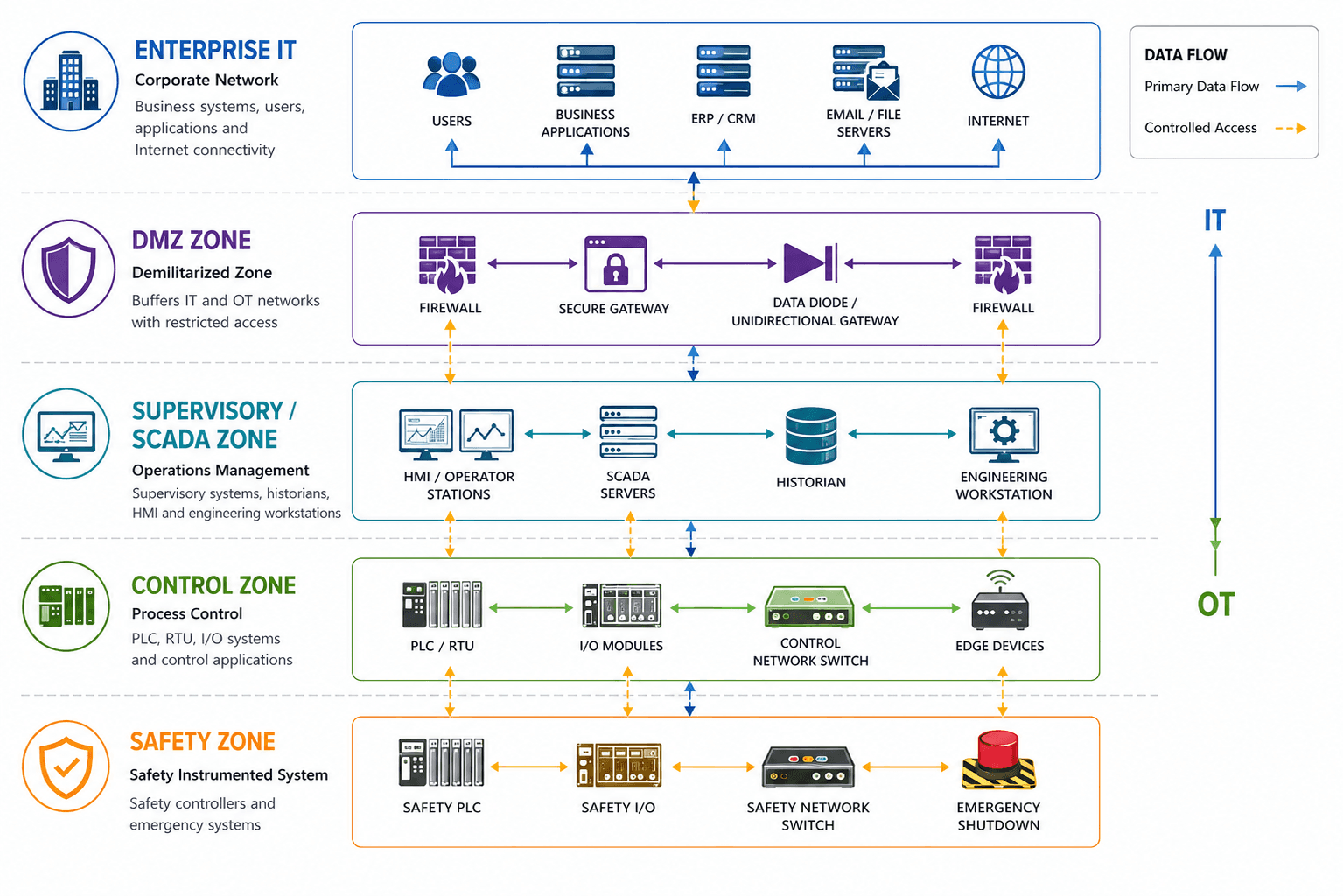
A reference zone-and-conduit model adapted for power generation, transmission, and distribution environments.
Common Challenges Power Utilities Face During Segmentation
Segmentation projects rarely fail because the architecture on paper is wrong. They stall because of operational realities that are specific to power infrastructure.
Legacy equipment: Many relays and RTUs in service today were installed 15 to 25 years ago, without native support for modern authentication or encryption, making them difficult to place behind conventional security controls without added compensating measures.
Continuous uptime requirements: Generation and transmission assets often cannot be taken offline for maintenance windows longer than a few hours a year, which limits when segmentation changes can be safely implemented and tested.
Vendor remote access: Original equipment manufacturers frequently require remote access for maintenance and warranty support, creating persistent conduits that must be tightly governed rather than eliminated outright.
Distributed geography: Transmission and distribution utilities may operate hundreds of substations across a wide service territory, each requiring consistent segmentation policy despite varying levels of local IT support.
Cultural friction between IT and OT teams: IT teams are trained to prioritize confidentiality and patch quickly; OT teams are trained to prioritize availability and change control. Segmentation programs succeed only when both teams design the architecture together.
Budget and resourcing cycles: Utility capital planning cycles can run one to three years, meaning segmentation investment often has to be phased and justified against the specific compliance deadlines set by the regulation.
Practical Recommendations for CEA-Aligned Segmentation
The utilities that move through CEA compliance most smoothly tend to follow a phased, risk-prioritized roadmap rather than attempting a single large-scale network overhaul. A realistic sequence looks like this:
Phase | Typical Duration | Key Activities | Outcome |
1. Assess | 6–10 weeks | Passive asset discovery, network architecture review, gap analysis against CEA requirements | Documented current-state map and prioritized risk register |
2. Design | 4–8 weeks | Zone and conduit design, DMZ architecture, access control policy definition | Approved target-state architecture and implementation plan |
3. Implement (Phase 1) | 3–6 months | DMZ deployment, critical substation or plant segmentation, monitoring tool deployment | IT/OT boundary enforced at highest-risk sites |
4. Implement (Phase 2) | 6–12 months | Extend segmentation across remaining sites, micro-segmentation within OT, vendor access hardening | Consistent segmentation posture across the fleet |
5. Sustain | Ongoing | Continuous monitoring, periodic VAPT, incident response drills, policy review | Demonstrable, auditable compliance posture |
Additional Best Practices Worth Prioritizing
Document every conduit: Every legitimate connection between zones should be documented with its business justification, owner, and review date, undocumented conduits are the most common audit finding.
Treat vendor remote access as a managed service, not an exception: Use jump servers, session recording, and time-bound access rather than standing VPN connections.
Align segmentation with incident response: Zones should map directly to how quickly a team can isolate a compromised segment during an active incident, since CEA's reporting timelines assume utilities can scope an incident fast.
Test boundaries, not just perimeters: Vulnerability assessments should specifically validate that DMZ and zone boundary rules behave as designed, not only that external-facing systems are patched.
Build internal fluency, not just documentation: Plant engineers and control room operators should understand why segmentation rules exist, since they are often the first to notice when something behaves unexpectedly.
How Shieldworkz Supports Organizations
Shieldworkz works with power generation, transmission, and distribution utilities to translate CEA cybersecurity requirements into a segmentation architecture that fits real operational conditions, not a generic template. Our approach is built specifically around the constraints that power infrastructure teams live with every day: legacy equipment, continuous uptime demands, and distributed assets.
Comprehensive OT asset discovery using passive, non-disruptive monitoring suited to legacy relays, RTUs, and control equipment
Zone and conduit architecture design aligned to CEA regulatory expectations and layered reference models
DMZ and data diode design to eliminate direct IT-to-OT connectivity while preserving necessary business reporting flows
Vendor and third-party remote access governance, including secure jump-server and session-monitoring implementation
Continuous, protocol-aware threat monitoring at zone boundaries to detect intrusion attempts before they escalate
Vulnerability assessment and penetration testing programs scoped specifically to segmentation boundaries and critical control assets
Support in building the documentation, crisis management plans, and audit evidence utilities need to demonstrate CEA compliance
Hands-on training for plant, control room, and IT teams to build shared ownership of the segmented architecture
Conclusion
CEA's cybersecurity regulations are not simply a compliance checkbox for India's power utilities, they reflect a hard-earned lesson from grid attacks around the world: the boundary between IT and OT is where the most damaging incidents begin, and it is also where they can be stopped. Well-designed IT/OT segmentation gives utilities the ability to contain what they cannot always prevent, and it gives regulators, customers, and boards the confidence that critical power infrastructure is being protected with the seriousness it deserves.
The utilities that treat segmentation as an ongoing operational discipline, rather than a one-time project, are the ones that will meet CEA requirements comfortably and hold up under real-world attack conditions when it matters most.
Ready to Assess Your CEA Compliance Readiness? Every utility's network is different, and so is the path to compliant, resilient segmentation. Our team can walk through your current architecture, identify the highest-priority gaps, and outline a practical roadmap tailored to your operations. Book a Free Consultation with Our Experts |
DOWNLOAD
The CEA 2026 OT Security Compliance Checklist here
The CEA Cyber Security in Power Sector Regulation 2026 here
The CEA Compliance OT Security Implementation Roadmap here
CEA Cybersecurity Regulations 2026: What Indian Power Companies Need to Do here
Get Weekly
Resources & News
See How Our Industry-Leading OT Security Solutions Address Critical Security Challenges
You may also like

What the French supermarket cyberattack reveals about OT security
Prayukth K V

Inside the Albert Heijn cyber incident: Investigating the attack, the IT/OT exposure, and the risks to critical operations
Team Shieldworkz

50°C by cyberattack? Inside France’s supermarket refrigeration crisis
Prayukth K V

Automating IEC 62443 Compliance Assessments Without Losing Expert Control
Team Shieldworkz

Investigative cyber threat intelligence report: Daiichi Kosho supply-chain data exposure
Prayukth K V

How AI Is Changing IEC 62443 Assessments
Team Shieldworkz