
Prayukth K V
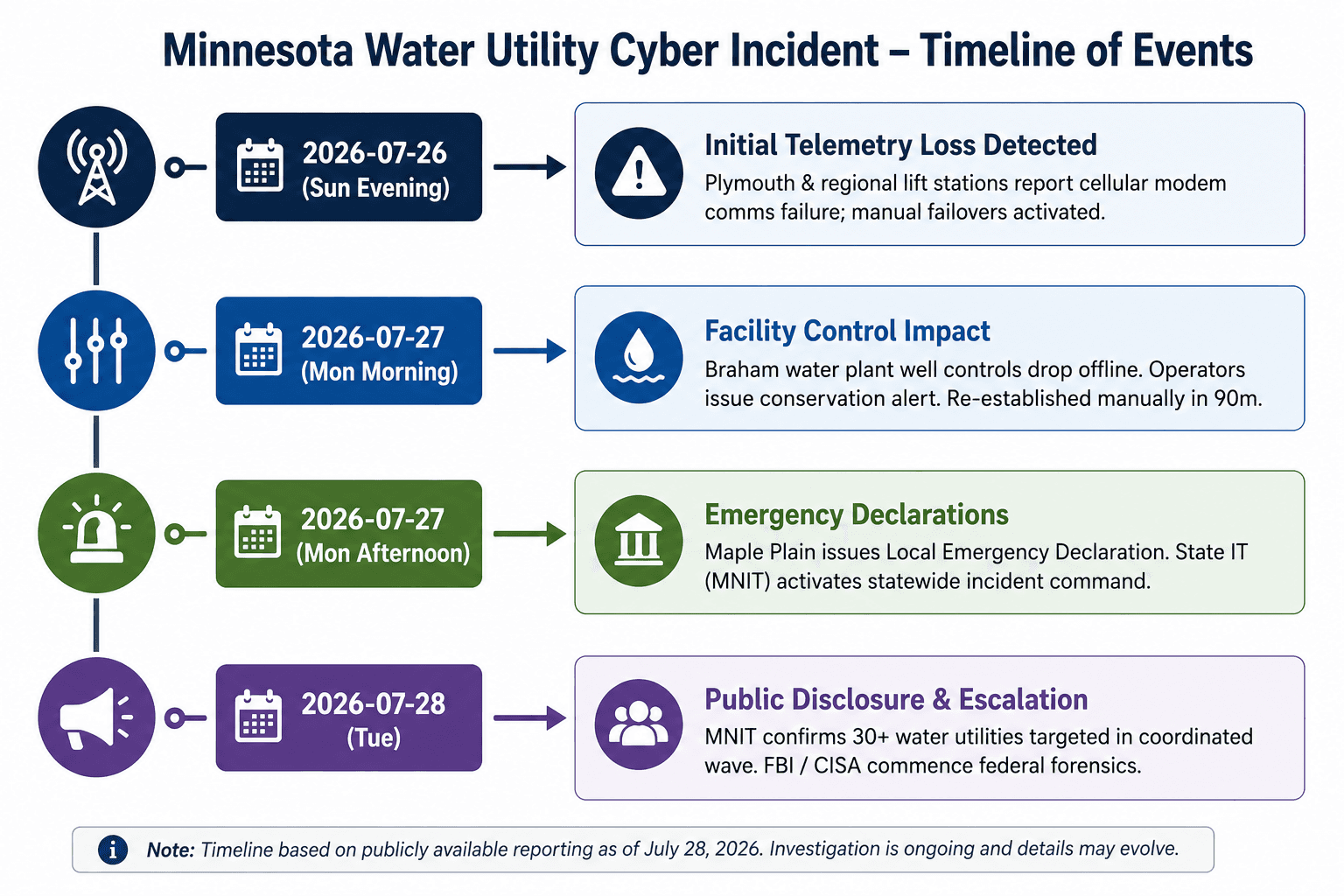
Between July 26 and July 27, 2026, a coordinated cyber incident targeted more than 30 municipal and community water systems across Minnesota. Impacted municipalities including Plymouth, South St. Paul, Maple Plain, and Braham reported disrupted automated SCADA communications, disabled cellular telemetry controllers, and compromised well-head/treatment control systems. In Braham, operators lost control over well pumps, forcing a temporary shutdown of the treatment facility and prompt resident water conservation notices before manual overrides restored functionality within 90 minutes. Few other municipalities immediately switched to physical walk-throughs and manual workarounds (as per to municipal statements where available) at lift stations and water towers. State IT authorities (MNIT), the Minnesota Department of Health, and federal law enforcement (FBI/CISA) activated a statewide incident response protocol.
At the time of writing, public health and water purity remain uncompromised across all affected systems.
Unprecedented incident
This activity marks a significant escalation on the operational scale in North American water sector targeting. It is among the largest publicly disclosed coordinated disruptions affecting municipal water utilities in the United States.Rather than an isolated breach of a single vulnerable Human-Machine Interface (HMI) or programmable logic controller (PLC), this campaign achieved concurrent impact across over 30 distinct local infrastructure entities within a short 48-hour window. The systematic, synchronized nature of the outage is consistent with a shared dependency exploitation (such as compromised Managed Service Providers (MSPs), cellular telemetry gateways, or centralized remote access software), rather than independent, manual intrusions into 30+ separate networks.
Strategic significance for critical infrastructure
The targeting of water and wastewater systems (WWS) highlights persistent structural vulnerabilities in small-to-midsize utilities: legacy automation, unsegmented cellular modems, reliance on third-party integration, and exposed OT edges. The capability to trigger simultaneous communication drops or control locks across a geographic region demonstrates campaign-level intelligence gathering and operational readiness by threat actors, setting a dangerous precedent for multi-facility critical infrastructure disruption.
Event timeline
Gap analysis and unknowns
Pre-July 26 access: Unknown date of initial intrusion. Attackers likely spent days or weeks conducting reconnaissance on common remote access or cellular infrastructure prior to executing disruptive actions.
Command and control execution window: Unclear whether disruption was executed via automated script/command broadcast or manual operator interaction per entity.
Dwell time: Precise dwell time across the 30+ victim environments remains unconfirmed.
Confirmed facts
To ensure clear intelligence attribution and evidence classification, all statements are categorized by confidence levels:
Statement / Claim | Classification | Supporting Evidence & Analytical Basis |
30+ Minnesota water systems targeted simultaneously (July 26–27, 2026) | Confirmed | Official declarations by MNIT, MN Dept. of Health, and municipal press releases. |
Braham treatment plant lost automated well pump controls (~90 min outage) | Confirmed | Public statements from Braham municipal public works leadership and local mayor. |
Water purity, chemical balances, and public safety were fully preserved | Confirmed | State health department testing and continuous manual testing logs. |
Disruption localized to cellular telemetry, remote SCADA links, and field controllers (Loss of cellular communications and remote telemetry) | Confirmed | Technical statements from Plymouth, South St. Paul, and municipal IT teams. |
Intrusion executed via shared MSP / central remote management software | Likely (High Confidence) | Statistical improbability of 30+ independent manual breaches within a 48-hour window. |
Attackers deployed custom destructive OT malware or firmware wipers | Unlikely (Low Confidence) | Systems recovered rapidly via manual reboots/overrides without hardware replacement. |
Primary objective was financial extortion (Ransomware) | Unlikely (Low Confidence) | Confirmed absence of ransom notes, encryption payloads, or extortion communications. |
Technical and attack path analysis
Initial access possibilities
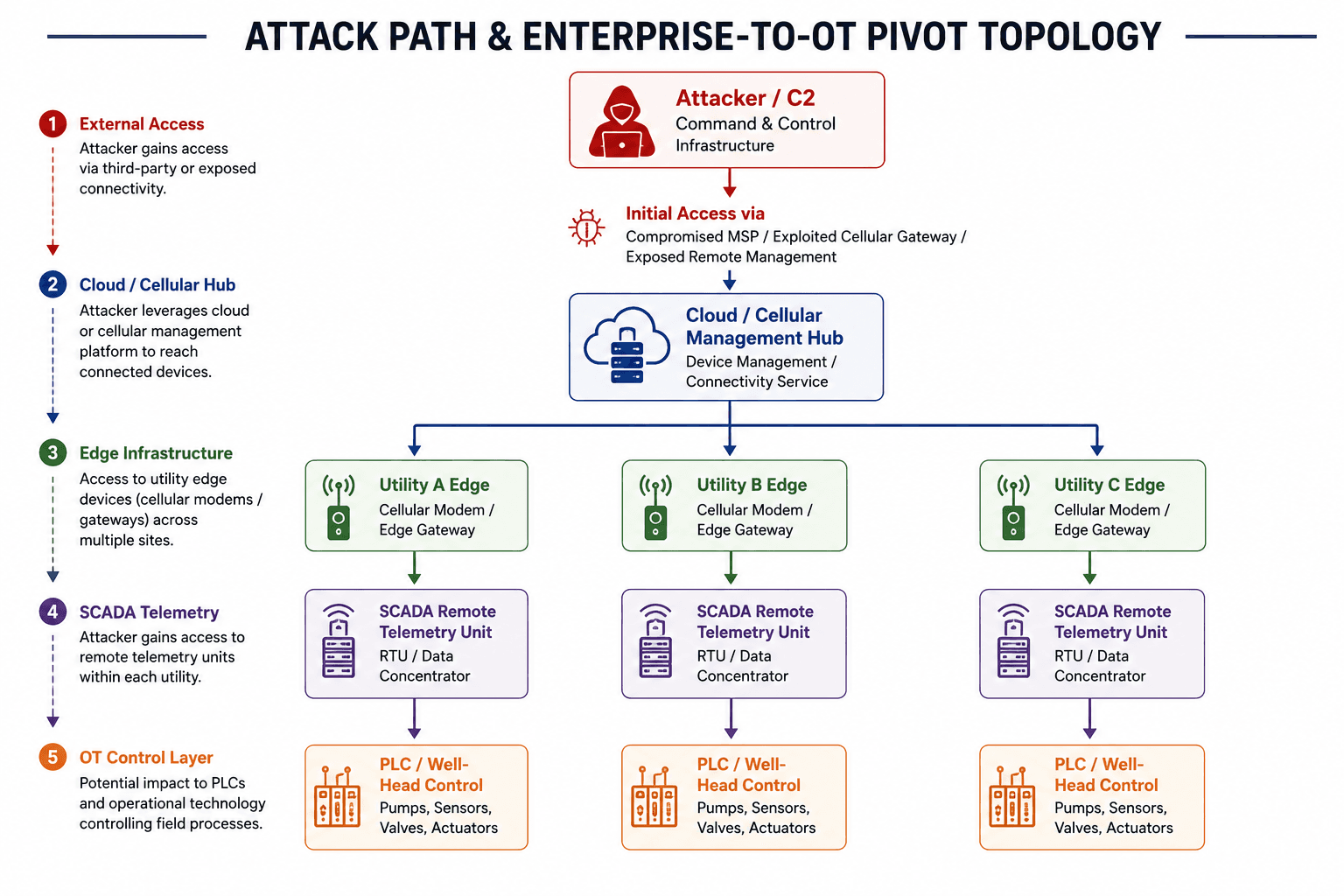
Compromise of shared MSP/Integrator systems: Third-party system integrators manage SCADA software, remote telemetry units (RTUs), and cellular routers across multiple small municipal utilities. Compromise of an MSP's central management portal allows bulk push commands to client endpoints.
Exploitation of edge cellular gateways: Direct internet exposure of cellular modems/routers (such as Sierra Wireless, Cradlepoint, Moxa) with default credentials, unauthenticated remote command execution (RCE) flaws, or weak VPN tunnels.
Exploitation of Exposed HMIs/Web Portals: Internet-facing VNC/RDP sessions or exposed HMI web panels without Multi-Factor Authentication (MFA).
ICS/OT Attack Path Mapping
Enterprise-to-OT Pivot: Access gained at the remote edge management layer bypassing traditional IT network perimeters due to direct cellular-to-PLC connectivity.
Identity Compromise: Theft or misuse of shared admin credentials utilized by third-party maintenance contractors.
PLC/HMI Implications: Attackers altered configuration states, rebooted cellular links, or changed mode switches (Potential mechanisms include putting PLCs into STOP mode or revoking automated logic execution).
Potential MITRE ATT&CK Mapping
MITRE ATT&CK for Enterprise
T1195.002 (Supply Chain Compromise): Compromise of third-party software/service provider.
T1133 (External Remote Services): Exploitation of exposed VPNs, cellular modems, or remote desktop protocols.
T1078 (Valid Accounts): Use of compromised credentials on external remote management software.
MITRE ATT&CK for ICS
T0822 (External Remote Services): Direct access to OT field networks via cellular interface.
T0836 (Modify Parameter): Changing operational control logic or setpoints controlling well pumps.
T0806 (Loss of Control): Temporary disruption of automated PLC command sequences forcing manual operation.
T0826 (Loss of Availability): Disruption of SCADA-to-PLC telemetry over cellular links.
It should be noted that while Braham experienced temporary Loss of Control (T0806), many of the other 30+ utilities primarily suffered Loss of Availability/View (T0826) due to severed telemetry links.
Most likely attack scenarios
Scenario 1: Third-Party Integrator / Shared MSP Remote Access Compromise
Confidence Level: HIGH
Supporting Evidence: Simultaneous impact across 30+ separate municipal utilities within 48 hours. Small municipal water departments in Minnesota frequently outsource SCADA and telemetry maintenance to a few regional engineering vendors.
Contradicting Evidence: Lack of public statement from specific vendors confirming a breach (typical during early stages of CTI investigations).
Potential Objective: Strategic disruption, probing defense response times, showcasing capability.
Scenario 2: Campaign-Wide Exploitation of Internet-Exposed Cellular Modems
Confidence Level: MEDIUM-HIGH
Supporting Evidence: City of Plymouth specifically attributed the disruption to equipment connected via cellular communications. Known threat actors frequently run Shodan/Censys scans to mass-exploit cellular gateways connected to industrial hardware.
Contradicting Evidence: Mass scanning usually yields asymmetrical results over days/weeks rather than a tightly synchronized 48-hour event, unless automated via a custom botnet/script.
Potential Objective: Broad-spectrum opportunistic disruption and pre-positioning.
Scenario 3: Hacktivist / State-Sponsored Disruptive Sabotage
Confidence Level: MEDIUM
Supporting Evidence: State CISO explicitly stated the objective was "disruption, not financial gain." Matches operational patterns seen in state-aligned intrusions targeting critical infrastructure OT edges.
Contradicting Evidence: Lack of public defacement claims or overt political messaging on compromised HMIs (unlike typical hacktivist operations like CyberAv3ngers).
Potential Objective: Operational disruption, signaling capability, testing critical infrastructure resilience.
Threat actor assessment
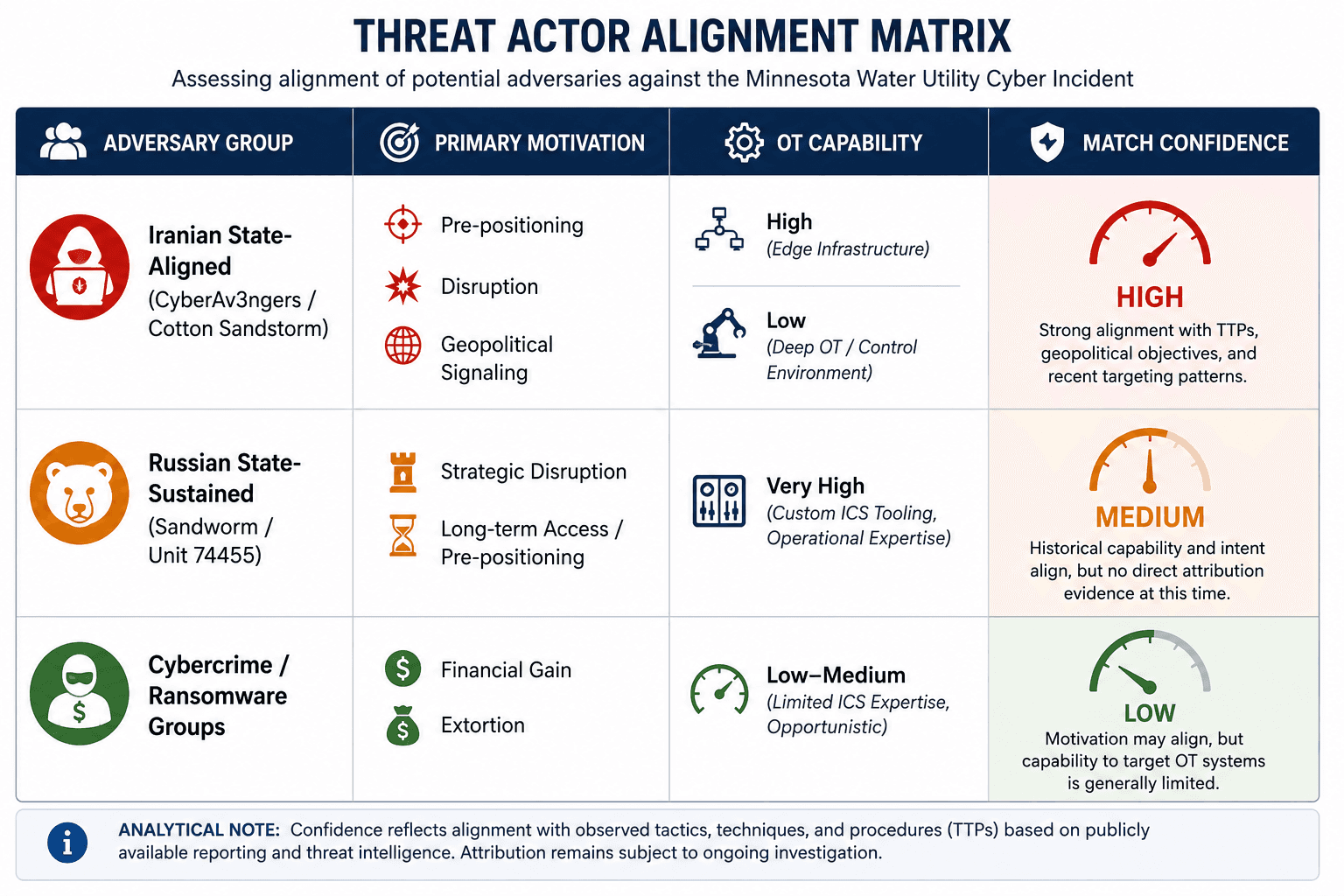
Which threat actor could be behind this?
Iranian state-aligned Actors (such as CyberAv3ngers) — MEDIUM-HIGH FIT
Historical TTPs: In late 2023 / 2024, CyberAv3ngers targeted water utilities across the US (e.g., Aliquippa, PA) by mass-exploiting internet-facing Israeli-made Unitronics Vision Series PLCs via default passwords over cellular networks.
Motivation: Low-cost, high-publicity disruption targeting US municipal infrastructure.
Capabilities: Focuses on OT edge exposure (cellular routers, HMIs, exposed PLCs) rather than complex, custom OT malware. Fits the Minnesota profile of edge cellular disruption.
Russian state-sponsored actors (Sandworm / GRU) — HIGH FIT
Historical TTPs: Demonstrated history of deep OT disruption (Industroyer, BlackEnergy, FrostyGoop). Recently observed targeting water utilities in Texas and Poland via exposed HMI reconfigurations.
Motivation: Strategic pre-positioning, psychological operations, testing operational capabilities.
Capabilities: Highly sophisticated. While capable of this attack, targeting over 30 small municipal water systems without deploying destructive wipers or payload modification suggests either an early-stage campaign or a lower-tier proxy actor.
Cybercriminal / ransomware operators — LOW FIT
Rationale: No extortion demands, ransom notes, or system encryption have been reported. State IT officials specifically noted the absence of financial motives.
While Iranian aligned CyberAv3ngers historically exploited exposed Unitronics PLCs directly over port 20256, a shared MSP compromise points toward higher operational maturity such as Cotton Sandstorm (IRGC) or Sandworm (GRU Unit 74455) using legitimate remote management credentials.
Detection engineering opportunities
Although the precise intrusion vector remains unknown, the observed disruption patterns provide valuable opportunities for proactive detection engineering. Organizations operating distributed water infrastructure should prioritize telemetry, authentication, remote access, and network anomaly detections capable of identifying coordinated activity across multiple facilities.
Sigma detection opportunities
Rule 1 – Multiple Remote Administrative Logins
Detect a single privileged account authenticating to multiple SCADA gateways or engineering workstations within a short time window.
Alert on concurrent VPN or RDP sessions originating from geographically disparate IP addresses.
Rule 2 – New Administrative Account Creation
Monitor for the creation of privileged local or domain accounts on OT jump servers, engineering workstations, and remote access gateways.
Rule 3 – PLC Engineering Software Execution
Detect execution of engineering tools (e.g., Studio 5000, EcoStruxure Control Expert, TIA Portal, CODESYS, Ignition Designer) outside approved maintenance windows.
Rule 4 – Remote Service Configuration Changes
Alert on modifications to VPN configurations, firewall rules, cellular gateway settings, or remote desktop services.
Suricata detection opportunities
Develop signatures to detect:
Modbus function codes issued from unexpected IP addresses.
DNP3 write requests outside maintenance periods.
IEC 104 control commands originating from non-engineering workstations.
New outbound communications from RTUs or cellular gateways to previously unseen external IPs.
VPN connections to unusual destinations.
Beaconing behavior from remote telemetry devices.
ICS network detection
Monitor for:
PLC mode transitions (RUN → STOP → PROGRAM).
Unexpected logic downloads.
Configuration uploads.
Controller firmware updates.
RTU restarts.
Loss of SCADA polling.
Simultaneous communication failures across multiple sites.
Sudden polling interval changes.
Unexpected engineering workstation connections.
Unauthorized write commands.
OT and critical infrastructure implications

Operational impact breakdown
Actual Impact: SCADA telemetry links lost over cellular networks. Loss of automated start/stop commands for well pumps in Braham, Minn. Municipalities forced to deploy manual field operations to monitor lift stations and water towers.
Potential Impact: Prolonged loss of automated pump controls leading to tower exhaustion, localized pressure loss, pipe backs, or untreated water distribution if manual intervention were delayed.
Worst-Case Scenario: Malicious manipulation of chemical dosing setpoints (e.g., sodium hydroxide, chlorine) or deliberate pump destruction via rapid power cycling (hammering) bypassing physical interlocks.
Intelligence gaps
Initial Vector Certainty: Exact entry point (compromised MSP vs. exploited cellular router firmware vs. credential stuffing) remains unverified.
Persistence Mechanisms: Unclear whether threat actors placed persistent backdoors within field networks or if rebooting modems permanently severed access.
Extent of Reconnaissance: Unknown whether actors exfiltrated network diagrams, SCADA logic schematics, or customer database records prior to executing disruptive commands.
Firmware Integrity: Lack of confirmation on whether field controllers (PLCs/RTUs) suffered malicious logic replacement or logic corruption.
Unique and under-discussed insights
Campaign planning vs. opportunistic exploitation
A simultaneous disruption across 30+ distinct municipal water systems cannot be dismissed as random, isolated opportunistic scanning. It reflects deliberate campaign planning. Threat actors either built an inventory of vulnerable water infrastructure credentials/devices over months or targeted a central choke point—such as a single Managed Service Provider or shared cellular APN (Access Point Name) infrastructure—to execute a batch command attack.
Supply-chain Single-Point-of-Failure (SPOF)
Small water utilities face severe resource constraints and frequently rely on the same regional engineering and SCADA integrators. This incident underscores that an adversary does not need to breach 30 individual utilities; they only need to breach one regional vendor with administrative access to those 30 entities.
Asymmetric reconnaissance for geopolitical escalation
Simultaneous disruption of low-tier municipal systems serves as a live-fire test of state and federal incident response speeds. By triggering low-level operational disruptions, threat actors measure how fast CISA, state IT, and local operators detect, contain, and recover from OT anomalies, providing valuable intelligence for future, higher-stakes critical infrastructure operations.
Cellular-connected Edge as the new vulnerability surface
Traditional OT security models emphasize isolating the Enterprise network from the Plant network (Purdue Model Levels 3 vs 2). However, remote telemetry nodes (lift stations, distant well-heads, tank monitors) routinely bypass the central enterprise network entirely, connecting directly to field PLCs via cellular modems. This creates a distributed, unmonitored OT perimeter that bypasses corporate firewalls.
Future risks and sector-wide forecast
Follow-On Campaign Likelihood: HIGH. Adversaries utilizing shared access vectors often hit additional targets in neighboring states (e.g., Wisconsin, Iowa) before access mechanisms are remediated.
Copycat Operations: HIGH. Low-complexity attacks on public utilities generate disproportionate news coverage and regulatory panic, making them attractive to hacktivist groups seeking visibility.
Cross-Sector Risks: Wastewater, small municipal gas distributors, and rural electric cooperatives share identical reliance on cellular modems, legacy PLCs, and third-party integrators, facing identical operational risks.
Actionable recommendations
Executive leadership
Audit Third-Party Access: Immediately mandate an inventory of all third-party integrators, MSPs, and vendors with remote access to OT environments.
Enforce Contractual Security Minimums: Require multi-factor authentication (MFA) and dedicated access logging for all vendor access contracts.
Security Operations Center (SOC) Teams
Monitor Cellular Gateway Traffic: Set up alerts for unexpected inbound/outbound connections to cellular modems, especially traffic originating from non-US IP space or unknown VPN providers.
Threat Hunt for Valid Accounts: Review remote authentication logs (VPN, VNC, RDP, SSH) for anomalous login times or concurrent logins across multiple utility clients.
OT engineers and plant operators
Isolate Cellular Modems: Enforce strict firewall rules on cellular routers. Block direct internet exposure of web portals, Telnet, SSH, and SCADA protocols (Modbus, DNP3, EtherNet/IP).
Verify Manual Overrides: Regularly test physical manual overrides and mechanical interlocks (e.g., hardwired high-level float switches) to ensure operations can continue if digital controls fail.
Incident responders
Preserve Cellular Router Logs: Prior to rebooting modems or PLCs, capture volatile memory, connection tables, and system logs to assist forensic analysis.
Isolate Compromised Integration Links: Sever third-party management connections until vendor environments are confirmed clean.
Chief Information Security Officers (CISOs)
Zero Trust Edge Architecture: Implement private APNs or centralized perimeter zero-trust network access (ZTNA) for remote SCADA telemetry.
Network Segmentation: Enforce strict micro-segmentation between IT networks, remote telemetry modems, and local controller backplanes.
The evolution of OT targeting
This multi-facility incident across Minnesota’s water infrastructure signals a critical shift in how adversaries approach Operational Technology targeting. Historically, OT cyber incidents fell into two distinct categories: highly sophisticated, custom malware attacks against high-value targets (e.g., Stuxnet, Industroyer) or isolated, opportunistic intrusions against individual unprotected assets (e.g., exposed VNC panels).
What occurred in Minnesota represents a dangerous convergence: the use of supply-chain choke points and automated edge exploitation to achieve multi-target regional disruption. Adversaries no longer need to develop complex, custom industrial malware to cause operational impact. By exploiting weak remote access mechanisms, unsegmented cellular modems, or compromised third-party integrators, threat actors can achieve widespread operational paralysis using basic administrative tools and native commands.
The vulnerability of the water sector
The water and wastewater sector remains uniquely vulnerable within critical infrastructure. Unlike the bulk electric power grid, which operates under strict, mandatory NERC CIP cybersecurity standards, the water sector comprises over 50,000 highly decentralized, underfunded local utilities across the United States. Many of these systems rely on single IT/OT staff members, legacy control hardware, and third-party contractors who utilize shared credentials across dozens of municipal clients. Threat actors recognize this asymmetric balance: breaking into a small water utility yields high psychological impact and news coverage with minimal operational friction.
Global lessons for defense and governance
Water utilities worldwide must view this event not as an isolated anomaly, but as a blueprint for modern critical infrastructure harassment. Operating under the assumption that OT networks are air-gapped is no longer valid; cellular connectivity, IoT sensors, and remote vendor access have dissolved the traditional perimeter.
Governments and infrastructure operators must act decisively:
Mandate security standards for OT remote access: Regulators must move beyond voluntary guidelines to enforce mandatory baseline security controls—specifically eliminating direct internet-facing PLCs/HMIs and mandating hardware-token MFA for all vendor connections.
Secure the service provider chain: Third-party integrators must be treated as high-risk environments. A breach at an engineering firm must not grant an adversary automated access to dozens of municipal control systems.
Prioritize physical and mechanical resilience: Defensive posture must extend beyond software. The ultimate safeguard for critical infrastructure is the retention of trained human operators, manual workarounds, and hardwired mechanical safety interlocks that prevent catastrophic physical damage regardless of digital system compromise.
Ultimately, we at Shieldworkz believe that resilience lies in the ability to maintain continuous safe operations when digital infrastructure fails under all sorts of circumstances. The rapid response of local operators in Minnesota demonstrated that strong operational continuity planning can mitigate cyber disruption. However, relying on operator vigilance to counter systematic supply-chain exploitation is an unsustainable defense strategy. Critical infrastructure security must evolve to protect the edge before control is lost.
Get Weekly
Resources & News
See How Our Industry-Leading OT Security Solutions Address Critical Security Challenges
You may also like

IEC 62443 for Pharmaceutical Manufacturing: Secure Critical Production OT
Team Shieldworkz

Investigative cyber threat research report: Cyberattacks on U.S.-bound energy tankers
Team Shieldworkz

The OT Lull: What a 30-day decline in direct intrusion activity actually tells us
Prayukth K V

Inside the Revolut data disclosure incident
Prayukth K V

NERC CIP Compliance Software: 9 Capabilities Utilities Should Compare
Team Shieldworkz

Investigative Cyber Threat Research Report: Alleged Cyberattack and U.S. Investigation of VLCC VL Prosperity
Prayukth K V