Team Shieldworkz
Every industrial operation runs on a simple, unspoken assumption: that the people and systems touching a control network are the people and systems who are supposed to be there. That assumption is increasingly fragile.
As plants connect programmable logic controllers, human-machine interfaces, historians, and remote engineering tools to broader corporate and vendor networks, the boundary between the physical process and the digital world keeps thinning. Access control, once treated as a background IT function, has become one of the most consequential decisions an operational technology leader will make this year.
This is not a theoretical concern. It shows up in the form of a contractor's laptop still holding administrator rights months after a project closed. It shows up when a single remote access account, meant for emergency use, is left active and unmonitored. It shows up when nobody in the organization can say, with confidence, exactly how many devices are connected to the control network on a given day. Cyber physical systems, unlike conventional IT environments, blend software, hardware, and physical processes together, which means an access control failure does not just risk data. It risks safety, production continuity, and in some sectors, public wellbeing.
This Blog examines why access control has become the front line of industrial cybersecurity, what makes it different in operational environments compared to conventional IT, and how organizations can build a practical, phased approach that strengthens security without disrupting operations.
None of this is presented as a call to overhaul an entire environment overnight. Industrial operations cannot pause for a security transformation, and any credible access control strategy has to work within planned maintenance windows, change control processes, and the realities of equipment that may outlast several generations of IT infrastructure. What follows is intended as a working reference: grounded in how these systems actually fail, and structured around changes that can be sequenced sensibly rather than forced through all at once.
Why Access Control Is the Foundation of Cyber Physical System Security
Cyber physical systems sit at the intersection of computing, networking, and physical machinery. A programmable logic controller does not just process information, it opens valves, starts motors, and adjusts pressure. When access to that controller is not properly governed, the consequence of a mistake or a malicious action is not a corrupted file. It is a physical event.
Access control is foundational because it answers three questions that every other security control depends on: who is allowed to connect, what are they allowed to do once connected, and how do we know when that access is being misused. Firewalls, monitoring tools, and detection platforms all become more effective when the access layer beneath them is disciplined. Without it, even the most sophisticated monitoring stack is watching a system with too many open doors.
Industrial environments have historically relied on the assumption that physical isolation was enough protection. Air-gapped networks, dedicated engineering workstations, and closed vendor connections created a sense of security that no longer matches reality. Remote diagnostics, cloud-connected historians, remote maintenance contracts, and the steady convergence of information technology and operational technology have all eroded that isolation. Access control has to do the work that physical separation used to do.
Why This Question Belongs on Every OT Leader's Agenda Right Now
Access control decisions made years ago are now being tested by conditions those decisions never anticipated. Remote work arrangements that began as temporary accommodations have become permanent fixtures. Predictive maintenance contracts now require vendors to reach deep into control networks on a recurring basis. Insurance underwriters increasingly ask pointed questions about privileged access governance before renewing industrial policies. Regulatory frameworks across energy, water, and manufacturing sectors are steadily raising the bar for demonstrable access governance, not just stated policy.
For a plant manager or CISO, this creates a specific kind of pressure. The technology stack protecting the control environment may be adequate, yet the access model sitting beneath it can still be the weakest link, simply because it accumulated over years of operational necessity rather than deliberate design. Reading through how access control actually functions in cyber physical systems, and where it typically breaks down, gives OT leaders a clearer basis for prioritizing investment, briefing executive leadership, and answering audit questions with confidence rather than assumption.
This is also, fundamentally, a business continuity question. A production line halted by a ransomware event that entered through an unmonitored vendor connection does not distinguish between a security failure and an operational one. The cost lands on both sides of the organization at once, which is precisely why access control deserves attention from operations leadership and not only the security function.
Understanding the Access Challenges Unique to Industrial Environments
Access control in a corporate IT environment and access control in a plant are built on different physics. A few structural realities explain why industrial organizations cannot simply copy an IT access model onto the plant floor.
Long Equipment Lifecycles
Controllers, relays, and human-machine interfaces are often deployed for ten, fifteen, or even twenty years. Many were designed before modern authentication standards existed, and some cannot support multi-factor authentication or centralized identity integration without additional compensating controls.
Availability Comes Before Confidentiality
In a corporate network, a compromised account can often be locked out immediately. On a production line, forcing a re-authentication at the wrong moment, or revoking access mid-session, can interrupt a physical process. Access control strategies in cyber physical systems have to account for operational continuity, not just security purity.
A Wide and Shifting Population of Users
Plant environments are accessed by far more than employees. Original equipment manufacturers, system integrators, calibration technicians, and remote support engineers all need periodic access, often for narrow windows of time. Many of these relationships are managed informally, through shared credentials or standing VPN connections that are never fully deactivated.
Limited Visibility Into What Is Actually Connected
It is common for an organization to discover, during an assessment, devices on the control network that nobody currently employed remembers installing. Undocumented remote access tools, forgotten test equipment, and legacy connections accumulate quietly over years of plant operation.
Real-World Lessons: What Happens When Access Control Fails
Industrial access control failures have produced some of the most widely studied cybersecurity incidents of the past decade. Three patterns recur across nearly every serious case.
A water treatment facility in Florida experienced an intrusion in which an operator watched a chemical setpoint change in real time, traced back to unauthorized use of a remote access tool that had weak authentication and was rarely monitored.
A major pipeline operator halted fuel delivery across a large region after attackers used a single compromised password tied to a legacy remote access account that lacked multi-factor authentication.
Coordinated attacks against a national power grid used remote access credentials, obtained well in advance of the attack, to manipulate substation control systems and cause widespread outages.
A global manufacturer experienced a ransomware event that spread from enterprise systems into production environments, forcing a temporary return to manual operations across multiple facilities.
What connects these events is not a single sophisticated technique. In nearly every case, the initial access point was ordinary: a password, a remote connection, a credential that had outlived its purpose. The lesson for operational technology leaders is direct. Advanced threat actors do not need to defeat advanced defenses if basic access hygiene leaves a door unlocked.
It is worth pausing on why these particular failures repeat across so many unrelated sectors and geographies. Passwords and remote access accounts are rarely treated as high-value assets in the way a firewall rule or a detection alert is. They are set up during a project, used for a specific purpose, and then quietly forgotten once that purpose is served. Nobody owns the task of asking whether the account is still needed. That absence of ownership, more than any technical shortcoming, is what allows small oversights to persist for years until an attacker finds them.
The business consequences extend well beyond the incident response timeline. Production downtime affects contractual commitments and customer trust. Regulatory bodies in critical infrastructure sectors may require formal incident disclosure and remediation evidence. Insurance premiums for industrial operators increasingly reflect the maturity of access governance, meaning weak controls carry a measurable financial cost even before an incident occurs. Recovery from a significant operational technology incident routinely takes weeks, not days, because restoring trust in control system integrity requires more than restoring from backup.
Traditional IT vs. Industrial Access Control: A Side-by-Side View
Understanding why a one-size-fits-all approach does not work starts with recognizing how differently these two environments are constrained.
Dimension | Traditional IT Access Control | Industrial / CPS Access Control |
Primary priority | Confidentiality of data | Availability and safety of physical processes |
Session tolerance | Can force logout or re-authentication anytime | Interrupting a session may halt a process or trigger unsafe conditions |
Device lifespan | Refreshed every few years | Controllers and HMIs may run for a decade or more |
Patch cadence | Regular, often automated | Constrained by maintenance windows and vendor validation |
User population | Employees, known and centrally managed | Employees, contractors, OEM engineers, and remote vendors |
Credential model | Individual accounts, frequently rotated | Often shared, static, or vendor-default accounts |
Consequence of failure | Data loss, downtime, reputational harm | Safety incidents, environmental impact, production loss |
Table 1: Key differences between IT and cyber physical system access control priorities
The Core Pillars of Industrial Access Control
A resilient access control strategy for cyber physical systems rests on a small number of interlocking pillars. None of them work in isolation; each compensates for the limitations of the others.
Access Control Pillar | What It Addresses | Common Gap in the Field |
Identity management | Confirms who or what is requesting access, whether human, application, or machine-to-machine connection | Vendor and contractor identities are often untracked once a project ends |
Least privilege | Limits each identity to the minimum functions needed for its role | Engineering-level permissions left active long after commissioning |
Privileged access management | Governs high-risk accounts that can change logic, firmware, or configurations | Shared administrator credentials used across multiple sites |
Secure authentication | Verifies identity through strong, phishing-resistant methods before granting access | Single-factor passwords still common on remote access gateways |
Network segmentation | Separates zones and conduits so access does not imply unrestricted reach | Flat networks where a single foothold reaches the entire plant |
Asset visibility | Provides a live, accurate inventory of every connected device and its access rights | Inventories built once, then left unmaintained as systems change |
Table 2: Core pillars of industrial access control and where organizations commonly fall short
Zero Trust for Cyber Physical Systems: What It Actually Means
Zero trust is frequently misunderstood as a product category. In practice, it is an operating principle: no user, device, or application is trusted by default, regardless of whether it sits inside or outside the network perimeter. Every access request is evaluated on its own merit, using identity, device posture, and context, before it is granted.
Applying this principle to a cyber physical system does not mean re-authenticating a controller every few seconds or introducing friction that slows down plant operations. It means building verification into the access path itself, so that a compromised laptop, a stolen credential, or a misconfigured vendor connection cannot automatically translate into control-level access.
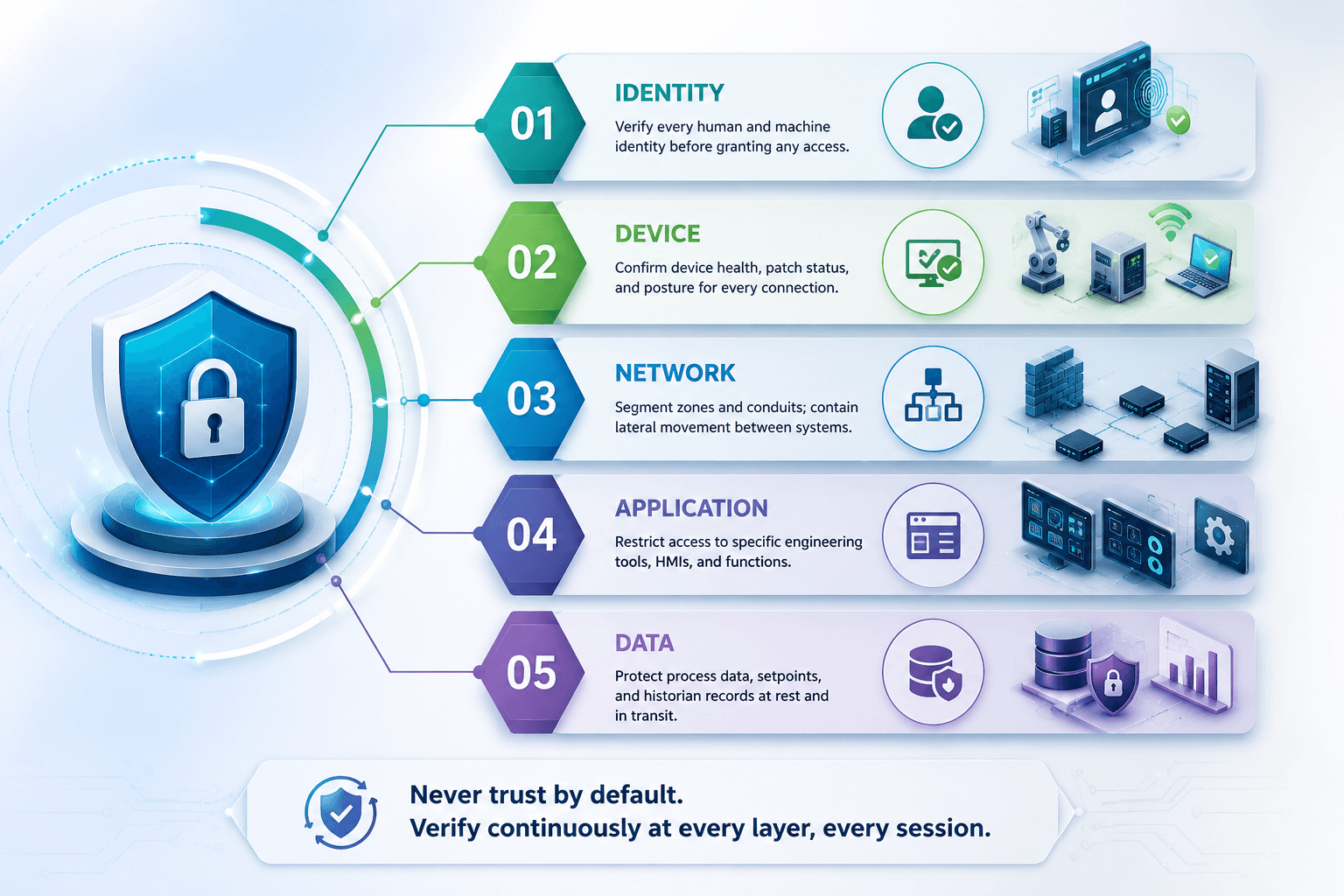
Figure 1: A layered zero trust approach applied to industrial identity, device, network, application, and data access
In an industrial context, zero trust typically takes shape through five reinforcing layers, moving from the identity making the request down to the data being protected. Weakness at any single layer, particularly identity or network segmentation, undermines the layers built on top of it. Organizations that succeed with zero trust in operational environments tend to start narrow, applying the model first to remote vendor access and high-privilege accounts, before expanding it across the wider environment.
A common misconception is that zero trust requires replacing legacy equipment before any progress can be made. In practice, most organizations apply zero trust principles around legacy assets rather than inside them. A controller that cannot support modern authentication can still sit behind a segmented zone, reachable only through a jump host that does enforce strong identity verification and session logging. The zero trust boundary moves to where enforcement is possible, rather than waiting for every device in the environment to be replaced.
Asset Visibility and Inventory: The Prerequisite Everyone Skips
It is difficult to control access to something you cannot see. Yet asset visibility is consistently the most underinvested part of industrial security programs, in part because it feels less urgent than deploying a new detection tool, and in part because building an accurate inventory in a live production environment is genuinely difficult.
A complete asset inventory for a cyber physical environment goes beyond a spreadsheet of controller models. It includes firmware versions, communication protocols in use, which accounts have access to which devices, and how each asset connects to the broader network. Without this baseline, access control policies are built on assumptions rather than facts, and gaps remain invisible until an incident, or an audit, exposes them.
Effective asset visibility programs share a few common traits. They combine passive network monitoring with periodic physical verification, since not every device announces itself on the network. They treat the inventory as a living record rather than a one-time project, updating it whenever equipment is added, replaced, or reconfigured. And they connect the inventory directly to access governance, so that every device on the list has a documented answer to the question: who is allowed to reach this, and why.
Practical Recommendations for Strengthening Access Control
Improving access control across a cyber physical environment does not require a single large transformation project. It is better approached as a sequence of deliberate, measurable steps, each one closing a specific gap without disrupting production.
1. Build and Maintain a Living Asset Inventory
Establish a baseline inventory of every connected device, then assign ownership for keeping it current. Treat inventory maintenance as an operational responsibility, not a one-time audit deliverable. A useful test of maturity is simple: if a new device appeared on the network tomorrow, would anyone notice within a day, or only during the next scheduled audit?
2. Eliminate Shared and Default Credentials
Replace shared logins and vendor-default passwords with individual accounts wherever technically feasible. Where legacy equipment cannot support individual accounts, compensate with strict physical controls and detailed access logging. Shared credentials are convenient precisely because they remove friction, which is the same reason they remove accountability when something goes wrong.
3. Apply Least Privilege by Role, Not by Convenience
Define access based on the specific function a user performs, rather than granting broad engineering-level access because it is easier to configure. Review these permissions on a regular schedule, and immediately upon a role change or contract completion. Broad access granted during a commissioning project rarely gets narrowed afterward unless someone is explicitly responsible for doing so.
4. Strengthen Authentication on Every Remote Path
Any connection that reaches into the control environment from outside the plant, whether from a vendor, a corporate network, or a remote engineer, should require strong, phishing-resistant authentication. Legacy single-factor remote access remains one of the most common entry points in real incidents, and it is often the easiest gap to close once it has been identified.
5. Segment the Network Around Access, Not Just Traffic
Segmentation should reflect who needs to reach what, not only which traffic types are permitted. A contractor account that only needs access to one production cell should have no visibility into others. Well-designed zones and conduits turn a single compromised credential into a contained event rather than a facility-wide one.
6. Time-Bound and Monitor Privileged Access
Privileged accounts, especially those used by vendors and integrators, should be granted for defined windows tied to specific work, then automatically revoked. Every privileged session should be logged and reviewable, so that a change to controller logic can always be traced back to an approved, time-stamped activity.
7. Review Access Continuously, Not Annually
Access rights decay over time as roles change, projects end, and staff turn over. Quarterly, rather than annual, reviews catch dormant accounts and unnecessary privileges before they become liabilities. A short, recurring review cycle is far less disruptive than the large remediation effort that follows a delayed one.
8. Align Access Policy With Change Management
Access provisioning and de-provisioning should be a formal step within existing change management and offboarding processes, not a separate afterthought. When a contract ends or a project closes, revoking access should be as routine as returning equipment or badges.
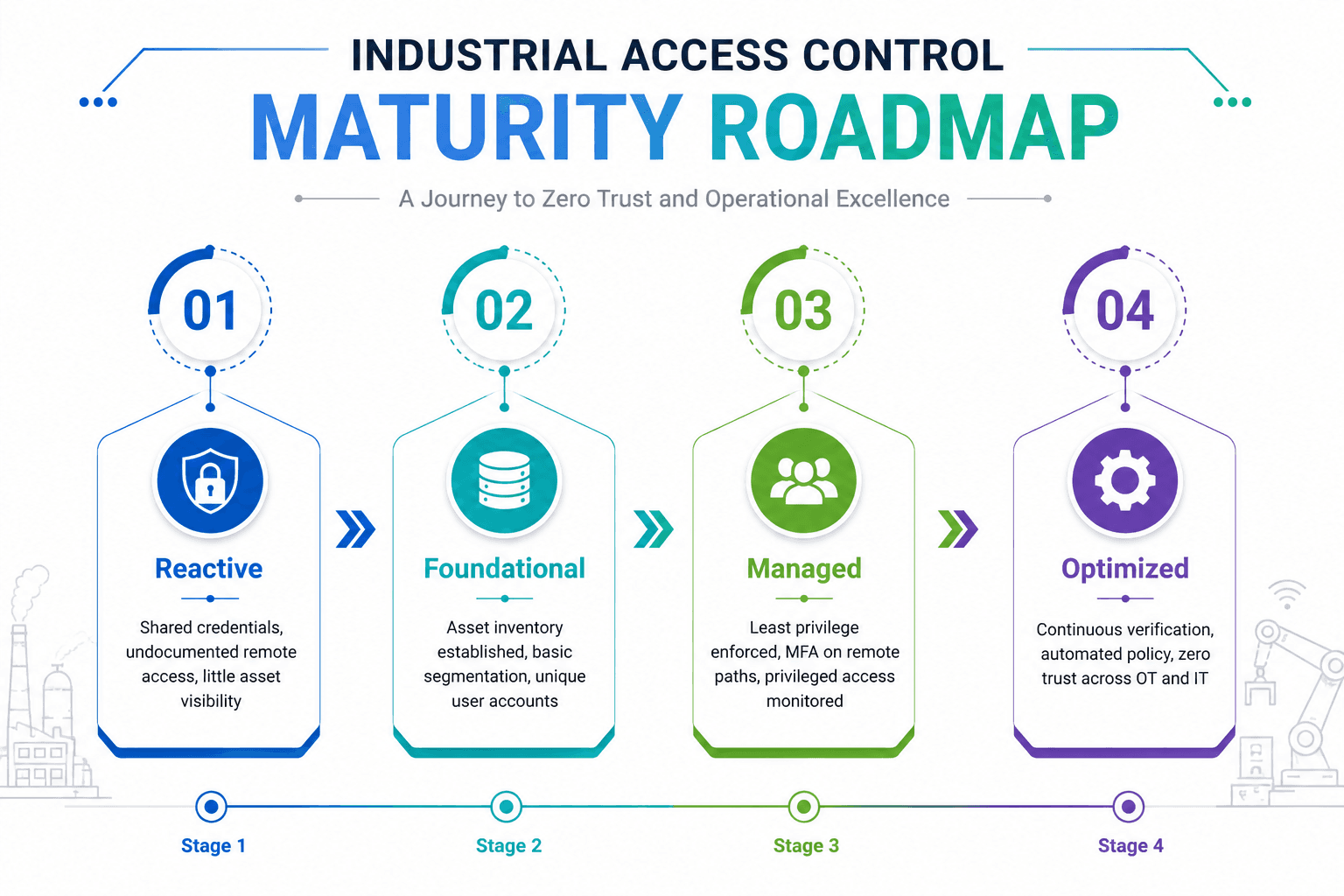
Figure 2: A phased maturity path for strengthening industrial access control without disrupting operations
Organizations rarely move from reactive to optimized access control in a single step, and attempting to do so often creates more operational risk than it removes. A phased roadmap, grounded in the current state of asset visibility and privileged access, allows security improvements to be sequenced around planned maintenance windows and validated without touching live production unnecessarily.
Common Misconceptions That Slow Down Access Control Programs
Several recurring beliefs quietly stall access control improvements before they start. Addressing them directly tends to unlock faster progress than any single technical control.
“Our network is air-gapped, so this does not apply to us.”
True air gaps are rarer than most organizations assume. Diagnostic laptops, USB drives, temporary vendor connections, and cross-connected historians frequently create indirect paths between the control network and the outside world, even where no permanent connection exists on paper.
“Adding access controls will slow down our engineers.”
Poorly designed controls can certainly create friction. Well-designed ones, built around role-based permissions and time-bound privileged access, tend to reduce the confusion and delay that comes from ambiguous, undocumented access arrangements. Engineers generally welcome clarity about what they are authorized to do.
“We will address this during our next major system upgrade.”
Major upgrades are often years apart, and access control gaps do not wait for a convenient refresh cycle to become exploitable. Most of the improvements outlined in this guide, from credential hygiene to privileged access time-bounding, can be implemented independently of any broader modernization project.
Measuring Whether an Access Control Program Is Actually Working
Access control maturity should be visible in operational evidence, not only in policy documents. A small set of practical indicators tends to separate programs that are working from those that only look complete on paper.
Every account with access to the control network can be tied to a named individual or a documented service, with no unexplained or shared logins remaining active
Privileged access requests are logged, time-bound, and reviewable, with a clear record of who approved each request and why
The asset inventory reflects devices added or removed within the last reporting period, rather than lagging months behind actual plant conditions
Remote access paths, including those used by vendors and integrators, require strong authentication rather than a password alone
Access reviews happen on a defined recurring schedule, and dormant accounts are identified and removed as a matter of routine, not exception
Organizations that can answer these points with specific evidence, rather than general assurance, are in a materially stronger position when facing both cyber incidents and regulatory scrutiny.
How Shieldworkz Supports Organizations
Shieldworkz works alongside industrial operators, plant leadership, and security teams to close access control gaps in a way that respects the realities of live production environments. Our approach is built around practical, sequenced improvement rather than disruptive overhauls.
Comprehensive asset discovery and inventory services that build an accurate, continuously updated picture of every connected device across the operational environment
Access control assessments that identify shared credentials, dormant accounts, excessive privileges, and unmonitored remote access paths before they become entry points
Zero trust architecture guidance tailored to operational constraints, prioritizing identity, device, and network layers without interrupting production schedules
Privileged access governance frameworks that bring vendor, contractor, and engineering accounts under time-bound, monitored control
Secure authentication design for remote and third-party access, matched to the realities of legacy controllers and constrained maintenance windows
Ongoing advisory support that helps security and operations leaders sequence improvements around real maintenance and change windows, not arbitrary deadlines
Every engagement begins with understanding how a specific facility actually operates, because an access control strategy that ignores operational reality will not survive contact with the plant floor.
Conclusion
Access control is no longer a background administrative task in industrial environments. It is the layer that determines whether every other security investment, from network monitoring to incident response planning, actually functions as intended. The organizations that treat identity, privilege, authentication, and asset visibility as connected disciplines, rather than separate checkboxes, are the ones best positioned to withstand the access-driven incidents that continue to define this industry.
The path forward does not require perfection on day one. It requires an honest accounting of what is currently connected, who can reach it, and where the gaps between convenience and control have quietly widened over time. From that honest starting point, a phased, operationally aware access control strategy can close those gaps without slowing down the plant it is meant to protect.
Facilities that begin this work now, rather than after an incident forces the issue, are the ones that get to shape their own timeline. The first step is rarely technical. It is simply deciding that access control deserves the same deliberate attention as any other safety-critical system in the plant, and assigning clear ownership for keeping it that way.
Ready to Strengthen Access Control Across Your Operational Environment?
Every facility has its own mix of legacy systems, vendor relationships, and operational constraints. Our team can help you assess where your current access control posture stands and build a practical roadmap suited to your environment.
Additional resources
Comprehensive Guide to Network Detection and Response NDR in 2026 here
OT Security Risk Exposure Calculator Workbook here
A downloadable report on the Stryker cyber incident here
Remediation Guides here
OT Security Best Practices and Risk Assessment Guidance here
IEC 62443-based OT/ICS risk assessment checklist for the food and beverage manufacturing sector here
Get Weekly
Resources & News
See How Our Industry-Leading OT Security Solutions Address Critical Security Challenges
You may also like

IEC 62443 for Pharmaceutical Manufacturing: Secure Critical Production OT
Team Shieldworkz

Investigative cyber threat research report: Cyberattacks on U.S.-bound energy tankers
Team Shieldworkz

The OT Lull: What a 30-day decline in direct intrusion activity actually tells us
Prayukth K V

Inside the Revolut data disclosure incident
Prayukth K V

NERC CIP Compliance Software: 9 Capabilities Utilities Should Compare
Team Shieldworkz

Investigative Cyber Threat Research Report: Alleged Cyberattack and U.S. Investigation of VLCC VL Prosperity
Prayukth K V