Use Case
Continuous Monitoring of Upstream and
Downstream Operations
Industry: USE CASE | OIL & GAS
No signup required!
Unifying OT Security Across the Oil & Gas Value Chain
An integrated oil and gas company was operating upstream wellpad and gathering operations alongside a downstream refinery, but its OT security capabilities had evolved separately across each segment. Different tools, different teams, different monitoring approaches, and no shared visibility meant leadership could not obtain a single, company-wide view of OT security posture.
Shieldworkz established a continuous monitoring capability spanning both upstream and downstream operations, bringing asset visibility, threat detection, risk prioritization, OT SOC coverage, governance, and reporting into one unified view.
Value proposition: Unified OT visibility across the value chain, consistent risk prioritization, continuous monitoring, coordinated incident response, and enterprise-ready reporting without maintaining two disconnected security efforts.
Oil & Gas OT Security Challenges
Oil and gas companies operating across the value chain often develop security capabilities independently within upstream and downstream environments. Over time, this can create isolated monitoring and governance practices:
No shared visibility. Upstream and downstream security operations ran on different tools, making it difficult to establish a single view of operational risk.
Disconnected monitoring efforts. Each segment maintained its own monitoring approach, creating separate views of the security environment.
No correlation between segments. An event detected in one part of the business had no effective way of being linked to activity in another.
Inconsistent detection coverage. Differences in monitoring maturity between segments created gaps that were not always visible to leadership.
Manual board reporting. Company-wide risk reporting required teams to reconcile information from two different formats by hand.
Understanding the Oil & Gas OT Risk Landscape
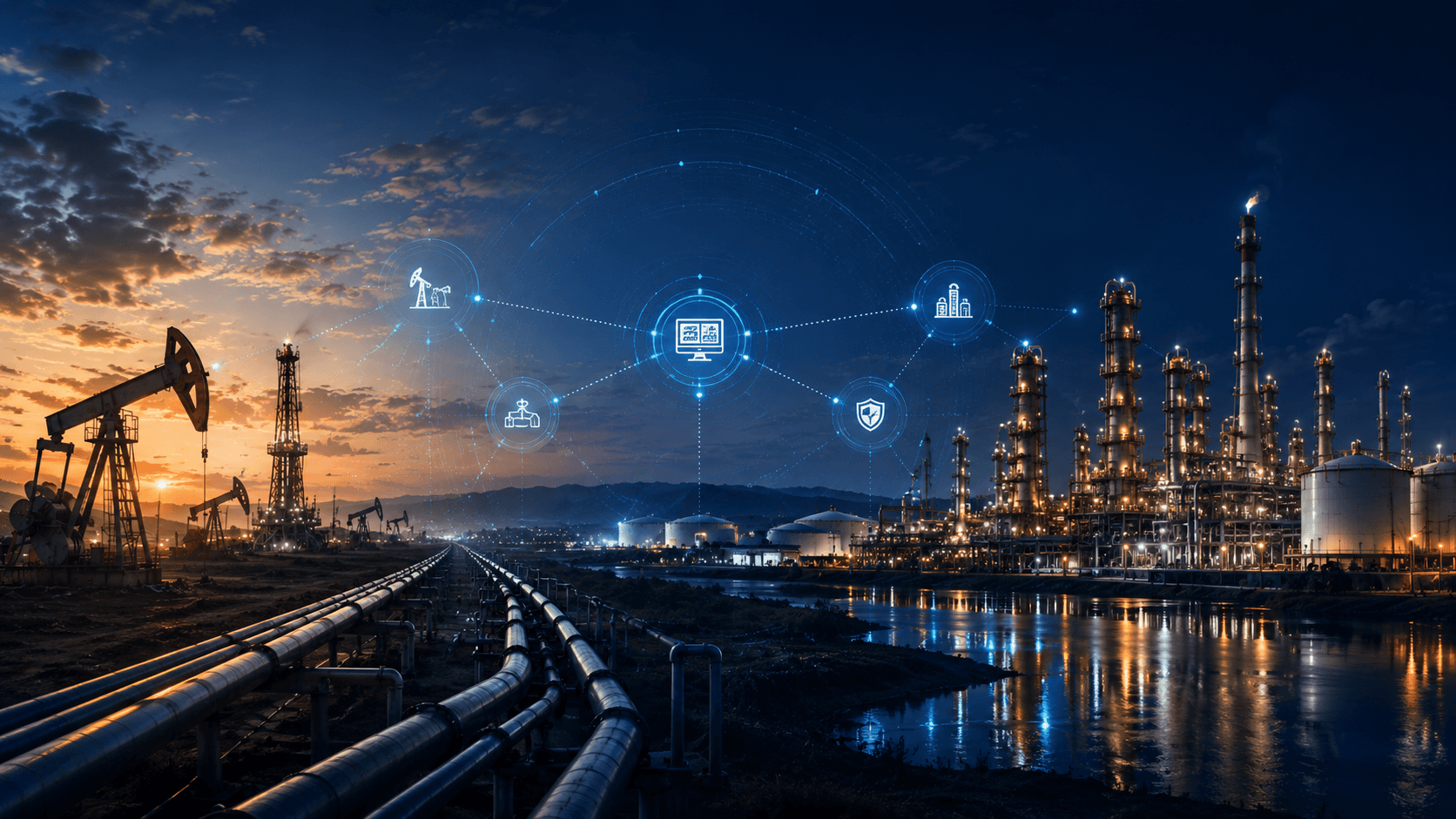
Integrated oil and gas environments span very different operational technologies and environments, from upstream field operations and wellpads to gathering infrastructure and downstream refinery control systems.
When these environments are monitored independently, operational risk can become fragmented across the organization. Upstream and downstream teams may have different tools, processes, detection coverage, and reporting structures, making it difficult to compare findings or understand enterprise-wide exposure.
A unified monitoring strategy creates a common operational picture across the value chain, allowing security teams and leadership to correlate events, prioritize risks consistently, and maintain visibility from field operations through refinery control systems.
Common OT Security Challenges Across Upstream and Downstream Operations
Inconsistent detection coverage between upstream and downstream environments
Disconnected OT monitoring efforts operating independently
Limited correlation between events across different operational segments
Different methodologies for asset discovery and risk assessment
Manual reconciliation of company-wide security and risk reporting
Segment-by-segment security investment decisions without a unified risk picture
Limited visibility for board-level and insurer reporting
How Shieldworkz Solves Oil & Gas OT Security Challenges
Shieldworkz delivers an end-to-end OT security program designed to bring upstream and downstream environments into one coordinated security model:
Unified Asset Discovery: A consistent methodology is applied across upstream and downstream environments, creating a single company-wide asset inventory.
Architecture Review: Data from each operational segment is structured to feed into a shared monitoring and reporting view.
Unified Continuous Monitoring / OT NDR: Both segments feed into a single monitoring capability, tuned to upstream telemetry and downstream DCS traffic.
Protocol-Specific Threat Detection: OT monitoring is aligned with the operational technologies and traffic characteristics across both environments.
Consistent Risk Prioritization: Findings from upstream and downstream operations are ranked against each other using a consistent methodology.
Cross-Segment Incident Response Planning: Incident response coordination is defined for events that involve or affect both operational segments.
Single OT SOC: Monitoring and escalation are consolidated into one OT SOC instead of maintaining two separate arrangements.
End-to-End Platform Capabilities
Unified OT asset visibility across upstream wellpad, gathering, and downstream refinery environment
Continuous monitoring / OT NDR across both operational segments
OT-specific visibility tuned to upstream telemetry and downstream DCS traffic
Protocol-specific threat detection across the operational environment
Consistent risk prioritization across upstream and downstream findings
Cross-segment incident response coordination for events touching multiple operational environments
Single OT SOC coverage for monitoring and escalation across the value chain
The Business Value of Unified OT Visibility
A unified OT security model provides measurable operational and governance value across the oil and gas enterprise:
A single company-wide asset inventory spanning upstream and downstream operations for the first time.
Unified continuous monitoring replacing two previously disconnected monitoring efforts.
Consistent risk prioritization allowing leadership to compare upstream and downstream findings on the same basis.
One OT SOC providing coverage and escalation across both operational segments.
Simplified board and insurer reporting drawn from a single source rather than manually reconciled from two.
Validated cross-segment incident response for events that touch both parts of the business.
Secure Your Oil & Gas Operations
Your upstream and downstream environments should not operate as two disconnected security programs.
Shieldworkz helps oil and gas organizations establish one continuous OT security capability across the value chain, bringing together asset discovery, monitoring, detection, risk prioritization, OT SOC operations, incident response, governance, and enterprise reporting.
Schedule Your Free Consultation with Shieldworkz OT Security Experts
Get the Full Continuous Monitoring of Upstream and Downstream Operations Use Case Understand how an integrated oil and gas company moved from separate upstream and downstream security capabilities to continuous, unified monitoring across both segments, creating one company-wide view of OT security posture.
Book Your Consultation Today!
Protect your upstream and downstream operations from cyber threats before they cause critical downtime. Book your OT security assessment today.