Defense Sector
OT/ICS Cybersecurity
Defense Sector
OT/ICS Cybersecurity
Defense Sector
OT/ICS Cybersecurity
Defense OT/ICS Cybersecurity
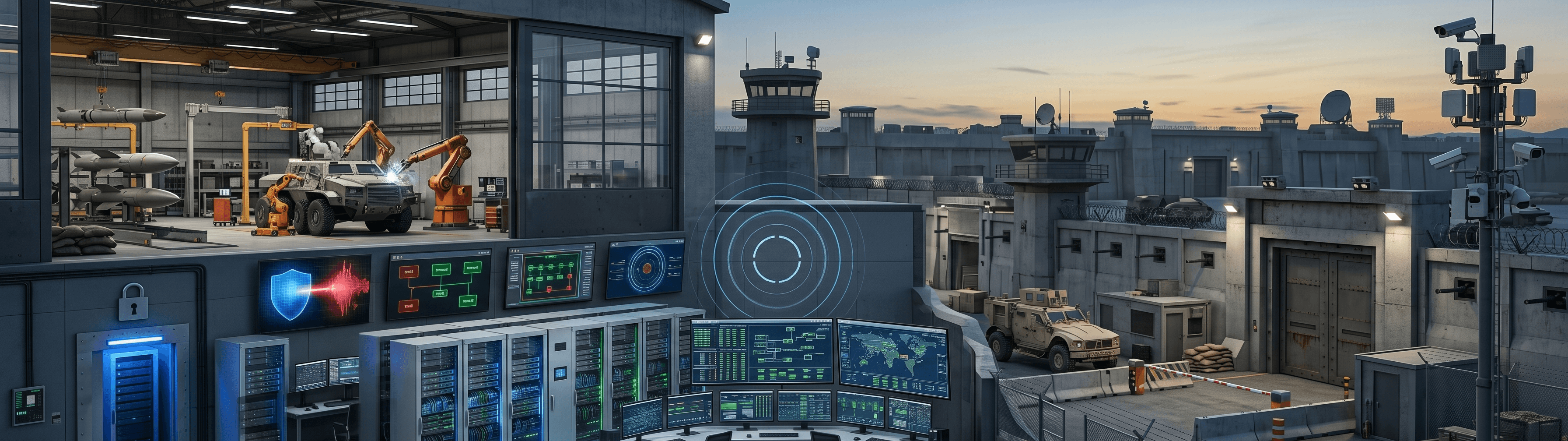
Defense organizations operate at the convergence of two worlds that were never designed to meet: the digital and the kinetic. Today, command-and-control infrastructure, weapon platform networks, military base utility systems, border surveillance automation, and defense manufacturing facilities all depend on interconnected operational technology. That interconnection, while operationally necessary, has permanently altered the cybersecurity posture of the defense sector.
Unlike civilian critical infrastructure, defense OT environments carry a dual burden - they must satisfy sovereign security mandates while maintaining mission readiness under adversarial pressure. A compromised base power SCADA system doesn't just disrupt operations; it degrades the fighting capacity of an entire installation. An integrity attack on the PLC network governing a weapons manufacturing line doesn't just halt production; it introduces undetectable quality failures into national defense materiel.
Shieldworkz understands that defense OT is not a variant of enterprise IT security. It is its own discipline, governed by different physics, different consequences, and different rules of engagement. This is where we operate.
OT Security, or operational technology security, is the practice of protecting critical infrastructure and industrial systems from cyber threats. These systems, which include everything from power grids and water treatment facilities to manufacturing plants and transportation networks, are the backbone of modern society. Unlike traditional IT systems, OT systems are designed to control physical processes and often operate in real-time, making them both unique and highly vulnerable to cyberattacks.
OT/ICS/IoT Risk Landscape in Defense
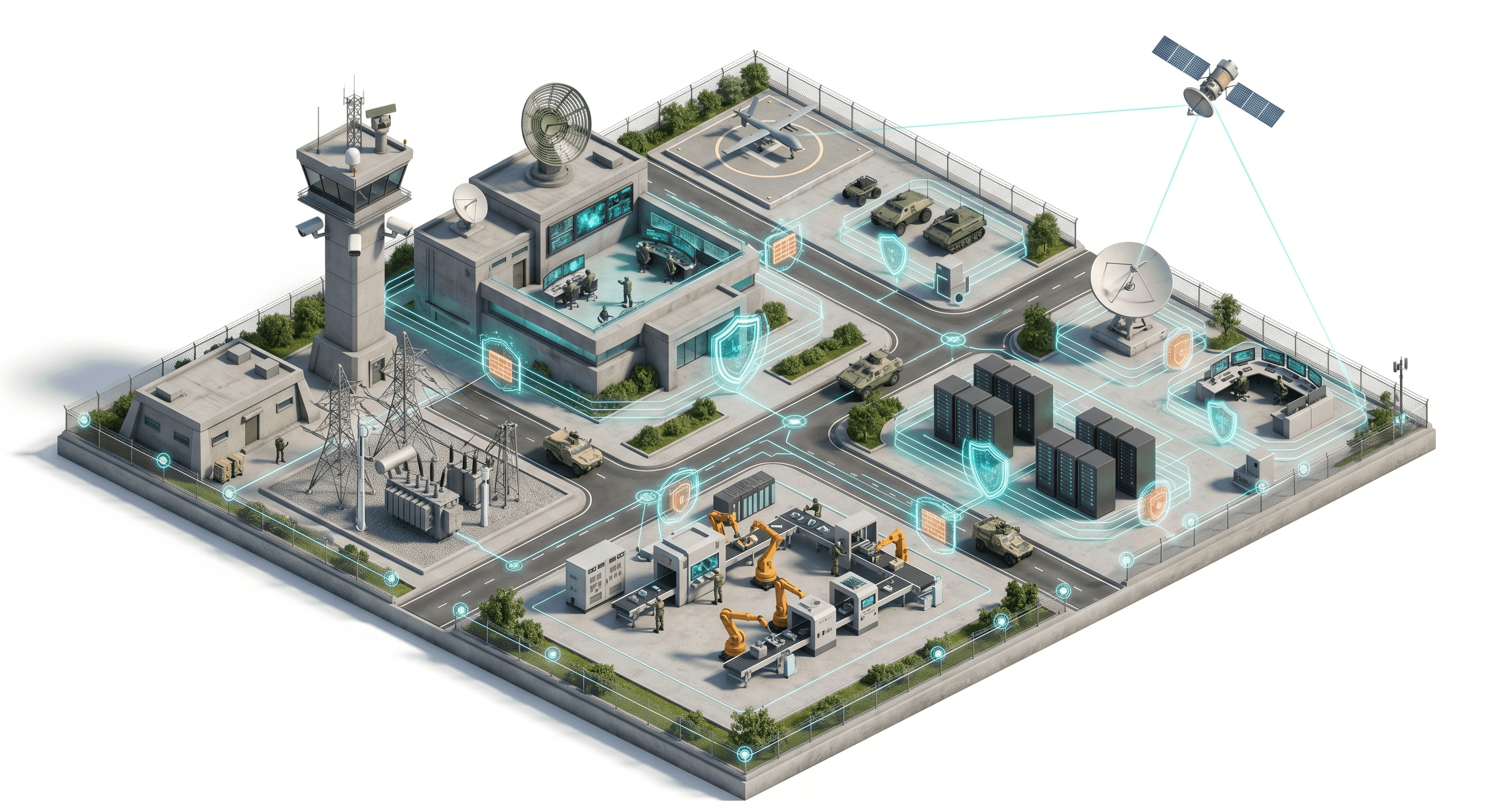
The attack surface within a modern defense environment spans a complex ecosystem of operational technology:
Programmable Logic Controllers (PLCs) govern automated processes in defense manufacturing - from CNC machining of precision components to munitions assembly lines. A logic modification that falls outside detection thresholds can produce physically defective output that passes digital quality checks.
SCADA and DCS systems manage the utility backbone of military installations - power distribution, water treatment, HVAC in secured facilities, and fuel management. These systems were engineered for availability and real-time control, not adversarial resilience.
Human-Machine Interfaces (HMIs) and engineering workstations represent the most accessible OT attack vector. Often running legacy operating systems on flat networks, they serve as pivot points from the enterprise into the control plane.
Embedded sensors and IIoT-connected assets - spanning radar systems, perimeter surveillance networks, unmanned vehicle diagnostic buses, and environmental monitoring infrastructure - are frequently deployed without firmware update mechanisms, creating permanent vulnerabilities.
Legacy military systems present a unique challenge: platform lifecycles of 20 to 40 years mean that weapon system controllers and base automation platforms pre-date modern cybersecurity architecture entirely. Many communicate over proprietary serial protocols with no authentication, no encryption, and no native logging capability.
Air-gapped and semi-connected classified networks introduce their own risk category. True air-gaps are increasingly rare. Maintenance laptops, removable media, and out-of-band management interfaces create bridging opportunities that sophisticated threat actors routinely exploit to insert malicious code into isolated environments.

OT/ICS/IoT Risk Landscape in Defense
The attack surface within a modern defense environment spans a complex ecosystem of operational technology:
Programmable Logic Controllers (PLCs) govern automated processes in defense manufacturing - from CNC machining of precision components to munitions assembly lines. A logic modification that falls outside detection thresholds can produce physically defective output that passes digital quality checks.
SCADA and DCS systems manage the utility backbone of military installations - power distribution, water treatment, HVAC in secured facilities, and fuel management. These systems were engineered for availability and real-time control, not adversarial resilience.
Human-Machine Interfaces (HMIs) and engineering workstations represent the most accessible OT attack vector. Often running legacy operating systems on flat networks, they serve as pivot points from the enterprise into the control plane.
Embedded sensors and IIoT-connected assets - spanning radar systems, perimeter surveillance networks, unmanned vehicle diagnostic buses, and environmental monitoring infrastructure - are frequently deployed without firmware update mechanisms, creating permanent vulnerabilities.
Legacy military systems present a unique challenge: platform lifecycles of 20 to 40 years mean that weapon system controllers and base automation platforms pre-date modern cybersecurity architecture entirely. Many communicate over proprietary serial protocols with no authentication, no encryption, and no native logging capability.
Air-gapped and semi-connected classified networks introduce their own risk category. True air-gaps are increasingly rare. Maintenance laptops, removable media, and out-of-band management interfaces create bridging opportunities that sophisticated threat actors routinely exploit to insert malicious code into isolated environments.
Key Threats and Challenges
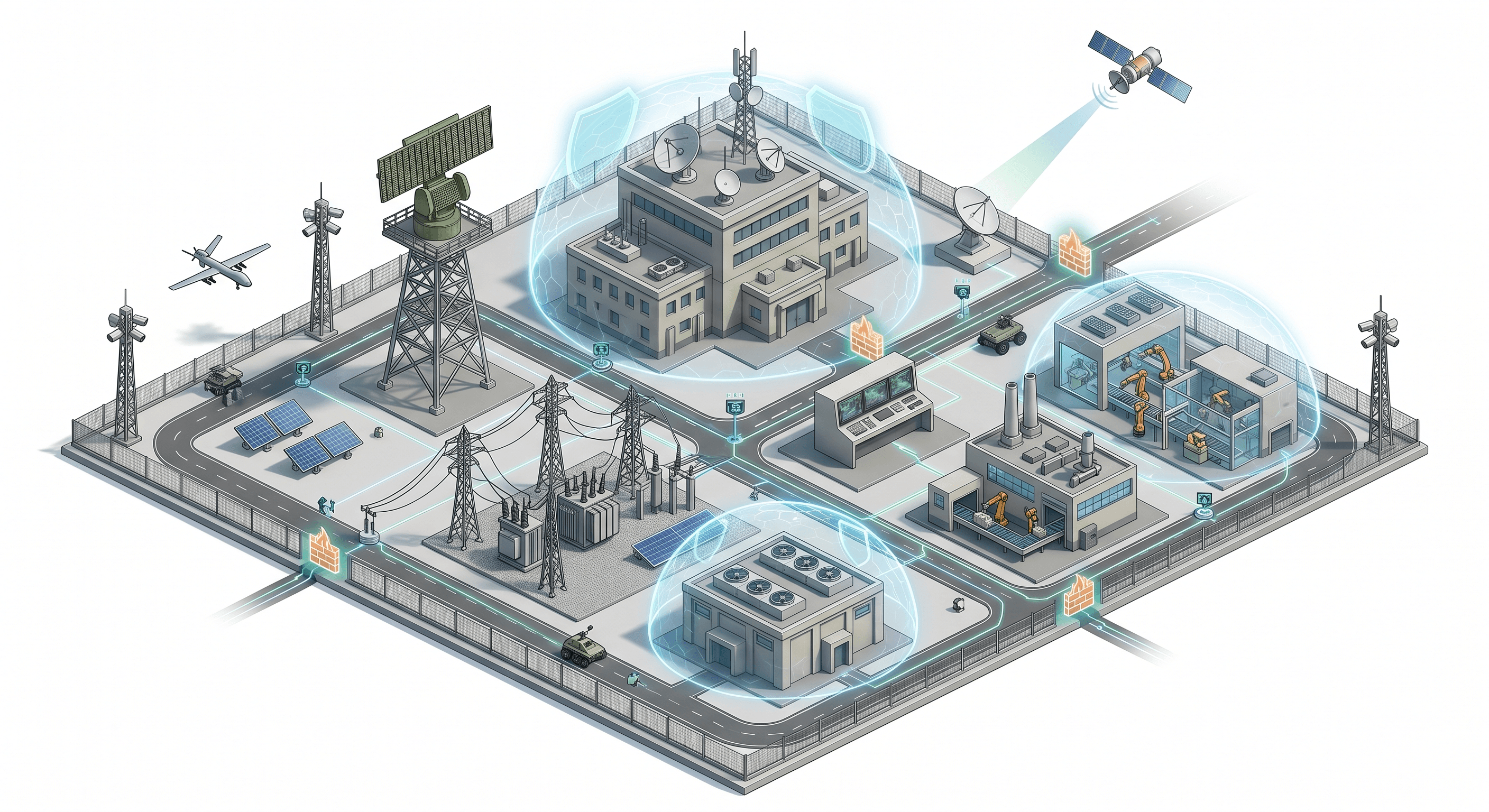
Nation-State Sponsored APTs State-aligned intrusion sets targeting defense OT are not performing reconnaissance - they are pre-positioning. Adversaries embed persistent footholds in ICS environments months or years before activation, staging cyber-kinetic capabilities designed to execute during geopolitical escalation. The objective is not data theft; it is the ability to halt a production line, disable a base power grid, or manipulate a weapon system's control logic at a moment of strategic consequence.
Supply Chain Infiltration Defense supply chains are deep and complex. Tier-2 and tier-3 subcontractors - component manufacturers, software integrators, OEM maintenance providers - represent the weakest links. Compromised firmware embedded in a field-deployable PLC, a backdoored remote maintenance gateway, or a poisoned software update delivered through a trusted vendor channel can bypass perimeter controls entirely. SBOM (Software Bill of Materials) gaps make it nearly impossible to detect embedded malicious code without active validation.
Insider Threats Cleared personnel with legitimate access to classified OT environments represent a threat category that technical controls alone cannot solve. Whether motivated by ideology, coercion, or financial gain, insiders can introduce physical media, manipulate control logic, or establish persistent remote access in ways that evade standard network monitoring.
Cyber-Physical Sabotage Defense OT attacks are not theoretical. Manipulating process variables on a solid propellant mixing system, altering metallurgical settings on armour plate production, or introducing timing errors in weapons integration test environments can create catastrophic physical failures with no visible digital signature at the point of sabotage.
Electronic Warfare and Cyber Intersection Modern adversaries conduct simultaneous electronic warfare and cyber operations against defense targets. GPS spoofing attacks directed at military navigation systems can cascade into ICS environments. Radar jamming correlated with cyberattacks on surveillance network controllers exploits the confusion created by degraded sensor feeds to mask deeper operational intrusions.
Mission-Critical Operational Disruption The most immediate threat to operational readiness is disruption. Ransomware variants engineered for OT environments - targeting historian servers, MES systems, and HMI platforms - can halt military manufacturing for weeks, not hours, because the recovery path requires validated, tested restoration of control system configurations, not simply restoring files from backup.
Key Threats and Challenges
Nation-State Sponsored APTs State-aligned intrusion sets targeting defense OT are not performing reconnaissance - they are pre-positioning. Adversaries embed persistent footholds in ICS environments months or years before activation, staging cyber-kinetic capabilities designed to execute during geopolitical escalation. The objective is not data theft; it is the ability to halt a production line, disable a base power grid, or manipulate a weapon system's control logic at a moment of strategic consequence.
Supply Chain Infiltration Defense supply chains are deep and complex. Tier-2 and tier-3 subcontractors - component manufacturers, software integrators, OEM maintenance providers - represent the weakest links. Compromised firmware embedded in a field-deployable PLC, a backdoored remote maintenance gateway, or a poisoned software update delivered through a trusted vendor channel can bypass perimeter controls entirely. SBOM (Software Bill of Materials) gaps make it nearly impossible to detect embedded malicious code without active validation.
Insider Threats Cleared personnel with legitimate access to classified OT environments represent a threat category that technical controls alone cannot solve. Whether motivated by ideology, coercion, or financial gain, insiders can introduce physical media, manipulate control logic, or establish persistent remote access in ways that evade standard network monitoring.
Cyber-Physical Sabotage Defense OT attacks are not theoretical. Manipulating process variables on a solid propellant mixing system, altering metallurgical settings on armour plate production, or introducing timing errors in weapons integration test environments can create catastrophic physical failures with no visible digital signature at the point of sabotage.
Electronic Warfare and Cyber Intersection Modern adversaries conduct simultaneous electronic warfare and cyber operations against defense targets. GPS spoofing attacks directed at military navigation systems can cascade into ICS environments. Radar jamming correlated with cyberattacks on surveillance network controllers exploits the confusion created by degraded sensor feeds to mask deeper operational intrusions.
Mission-Critical Operational Disruption The most immediate threat to operational readiness is disruption. Ransomware variants engineered for OT environments - targeting historian servers, MES systems, and HMI platforms - can halt military manufacturing for weeks, not hours, because the recovery path requires validated, tested restoration of control system configurations, not simply restoring files from backup.
Regulatory and Compliance Landscape
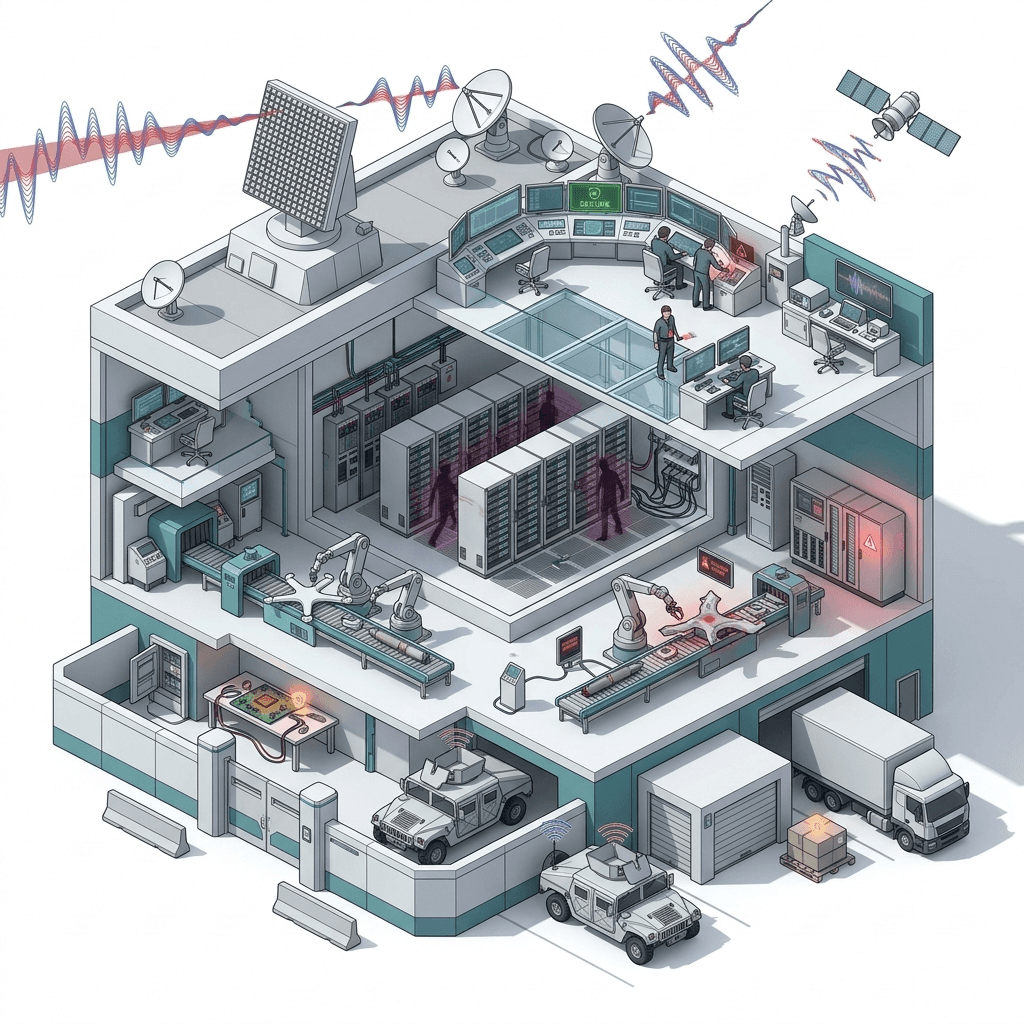
Defense OT environments are subject to an increasingly rigorous compliance architecture:
NIST SP 800-82 provides the foundational framework for securing industrial control systems, establishing guidance across asset identification, access control, network segmentation, and incident response - all mapped to the unique operational constraints of OT environments.
IEC 62443 defines the international standard for industrial cybersecurity architecture, introducing Security Levels (SL-1 through SL-4) that allow defense organisations to calibrate their protection posture against the sophistication of the adversary they face. Environments facing nation-state threats must target SL-3 or SL-4, requiring protection against intentional violations using sophisticated, well-resourced means.
CMMC (Cybersecurity Maturity Model Certification) mandates that defense contractors and subcontractors handling Controlled Unclassified Information (CUI) demonstrate verified cybersecurity maturity. OT assets processing classified schematics, test data, or manufacturing parameters for defense programs fall within the CMMC authorisation boundary and require the same access control, logging, and encryption rigour as IT systems.
NATO Cybersecurity Directives extend these requirements across alliance operations, mandating interoperability in secure communications infrastructure and consistent cyber hygiene standards for member-state defense organizations and their industrial partners.
Compliance is not a one-time certification. It is a continuously verified state of active controls, and Shieldworkz builds programmes that sustain it.
Regulatory and Compliance Landscape
Defense OT environments are subject to an increasingly rigorous compliance architecture:
NIST SP 800-82 provides the foundational framework for securing industrial control systems, establishing guidance across asset identification, access control, network segmentation, and incident response - all mapped to the unique operational constraints of OT environments.
IEC 62443 defines the international standard for industrial cybersecurity architecture, introducing Security Levels (SL-1 through SL-4) that allow defense organisations to calibrate their protection posture against the sophistication of the adversary they face. Environments facing nation-state threats must target SL-3 or SL-4, requiring protection against intentional violations using sophisticated, well-resourced means.
CMMC (Cybersecurity Maturity Model Certification) mandates that defense contractors and subcontractors handling Controlled Unclassified Information (CUI) demonstrate verified cybersecurity maturity. OT assets processing classified schematics, test data, or manufacturing parameters for defense programs fall within the CMMC authorisation boundary and require the same access control, logging, and encryption rigour as IT systems.
NATO Cybersecurity Directives extend these requirements across alliance operations, mandating interoperability in secure communications infrastructure and consistent cyber hygiene standards for member-state defense organizations and their industrial partners.
Compliance is not a one-time certification. It is a continuously verified state of active controls, and Shieldworkz builds programmes that sustain it.
How Shieldworkz Solves These Problems
Shieldworkz delivers an end-to-end OT security program purpose-built for defense environments - one that begins before a threat actor ever touches the network and remains active through detection, response, and recovery.
Asset Discovery Without Disruption: Shieldworkz deploys passive discovery across air-gapped and connected OT networks without injecting active scan traffic. Every PLC, RTU, IED, HMI, and embedded sensor is catalogued - including firmware version, protocol usage, backplane configuration, and network communication profile - without risking process interruption on sensitive defense systems.
Services oriented towards infrastructure hardening: Helps defense sectors secure its assets against the most sophisticated threats and actors through configured managed security services.
Network Segmentation of Classified OT Zones: We architect zone-and-conduit frameworks aligned to IEC 62443, creating logical security boundaries around weapon system controllers, base utility SCADA, manufacturing PLCs, and classified communication infrastructure. Inter-zone traffic is governed by hardware-enforced industrial firewalls with protocol-aware inspection, ensuring that east-west lateral movement is architecturally blocked rather than just monitored.
Continuous Threat Monitoring and Anomaly Detection: Shieldworkz establishes baseline profiles of normal machine-to-machine communication across protocols including PROFINET, Ethernet/IP, DNP3, Modbus, and IEC 61850. Any deviation - an unauthorised Modbus write, an unexpected firmware download, a CPU stop command issued outside an approved maintenance window - triggers an immediate, prioritised alert correlated against current threat intelligence.
Incident Response for OT Environments: Our incident response playbooks are engineered for the physical process, not the IT environment. Containment actions are sequenced to sever the IT/OT boundary without triggering dangerous shutdowns. Recovery prioritises Mean Time to Continued Industrial Operations (MTCIO), with pre-validated golden image restoration procedures for HMIs, engineering workstations, and control system configurations.
Secure Remote Access for Distributed and Forward-Deployed Sites: Shieldworkz provides a brokered secure remote access architecture for OT environments - replacing always-on VPNs with just-in-time (JIT) access provisioning, time-boxed maintenance windows, session recording, and real-time oversight by facility personnel with instant session termination capability.
Platform capabilities
Passive Asset Visibility across air-gapped and connected OT networks with zero traffic injection and full protocol parsing
Vulnerability Management: Helps address CVEs and vulnerabilities
Media Scan Solution: A unique solution that helps defense entities deploy files in a secure manner across environments. It ensures secure interactions with portable media.
Protocol-Aware Deep Packet Inspection across 300+ OT and ICS protocols, including proprietary defense communication stacks
Real-Time Defense Sector focused Cyber Threat Intelligence correlation mapping active campaigns, APT groups, known CVEs, and adversary TTPs against the live asset inventory
OT SIEM Integration delivering unified visibility across the IT/OT boundary with OT-native alert taxonomy and triage workflows
Zero-Trust Architecture Enforcement with identity-based micro-segmentation, continuous authentication validation, and least-privilege access controls applied at the controller level
Book a free consultation with our experts today!
Shieldworkz professional services
OT/ICS Security Risk Assessments for Defense Installations Comprehensive gap analysis of OT security posture across military base automation, weapon system networks, and defense manufacturing facilities - mapped to NIST SP 800-82, IEC 62443, and CMMC requirements.
Penetration Testing of Industrial Control Networks Adversarial simulation against OT environments using safe, non-disruptive testing methodologies validated for classified and operational environments, including testing of HMI access paths, vendor remote access channels, and IT/OT boundary controls.
OT SOC Services 24x7 managed monitoring of defense OT environments with OT-specialist analysts, threat hunting across ICS protocol telemetry, and escalation procedures aligned to defense operational priorities.
Vulnerability Management Continuous identification and prioritisation of OT-specific CVEs across the asset inventory, with compensatory control recommendations for assets that cannot be patched without operational impact.
Supply Chain Risk Assessments End-to-end evaluation of OEM vendors, software integrators, and sub-tier suppliers providing systems and components to defense programs, with contractual cybersecurity clause development and ongoing third-party monitoring.
Cybersecurity Training for Defense OT Personnel Hands-on training programmes for operations engineers, ICS administrators, and security teams - covering threat recognition, secure configuration practices, incident response for physical process environments, and OT-specific social engineering awareness.
Shieldworkz professional services
OT/ICS Security Risk Assessments for Defense Installations Comprehensive gap analysis of OT security posture across military base automation, weapon system networks, and defense manufacturing facilities - mapped to NIST SP 800-82, IEC 62443, and CMMC requirements.
Penetration Testing of Industrial Control Networks Adversarial simulation against OT environments using safe, non-disruptive testing methodologies validated for classified and operational environments, including testing of HMI access paths, vendor remote access channels, and IT/OT boundary controls.
OT SOC Services 24x7 managed monitoring of defense OT environments with OT-specialist analysts, threat hunting across ICS protocol telemetry, and escalation procedures aligned to defense operational priorities.
Vulnerability Management Continuous identification and prioritisation of OT-specific CVEs across the asset inventory, with compensatory control recommendations for assets that cannot be patched without operational impact.
Supply Chain Risk Assessments End-to-end evaluation of OEM vendors, software integrators, and sub-tier suppliers providing systems and components to defense programs, with contractual cybersecurity clause development and ongoing third-party monitoring.
Cybersecurity Training for Defense OT Personnel Hands-on training programmes for operations engineers, ICS administrators, and security teams - covering threat recognition, secure configuration practices, incident response for physical process environments, and OT-specific social engineering awareness.
Business benefits
Operational Resilience
Continuous protection that sustains mission readiness under advanced persistent threat conditions, with validated rapid-recovery capabilities for OT environments
Reduced Attack Surface
Systematic elimination of unnecessary network exposures, legacy system vulnerabilities, and third-party access risks across the full OT environment
Regulatory Compliance
Verified alignment with NIST SP 800-82, IEC 62443, CMMC, and applicable NATO directives, with continuous control monitoring to sustain compliance between audits
Operational Resilience
Continuous protection that sustains mission readiness under advanced persistent threat conditions, with validated rapid-recovery capabilities for OT environments
Reduced Attack Surface
Systematic elimination of unnecessary network exposures, legacy system vulnerabilities, and third-party access risks across the full OT environment
Regulatory Compliance
Verified alignment with NIST SP 800-82, IEC 62443, CMMC, and applicable NATO directives, with continuous control monitoring to sustain compliance between audits
Full Kill-Chain Threat Visibility
Unified detection across the entire OT kill chain from initial access and lateral movement through to payload execution and process manipulation
Protection of National Security Infrastructure
A defense-in-depth posture designed around the specific consequence scenarios that matter most: the systems, processes, and assets whose compromise would have strategic national impact
Full Kill-Chain Threat Visibility
Unified detection across the entire OT kill chain from initial access and lateral movement through to payload execution and process manipulation
Protection of National Security Infrastructure
A defense-in-depth posture designed around the specific consequence scenarios that matter most: the systems, processes, and assets whose compromise would have strategic national impact
Why Shieldworkz for Defense?
Defense organizations do not need a cybersecurity vendor. They need a strategic partner who understands the operational consequences of getting it wrong. Shieldworkz brings deep, specialised OT expertise - not generalised IT security repackaged for the industrial environment. Our methodology is built around the principle that protection must never compromise the operational availability of the systems it secures. We operate with a no-disruption approach: every tool, technique, and process we deploy is validated against the reality of mission-critical OT environments where uptime is a national security requirement, not a commercial preference. We are classified-environment ready. Our teams are experienced in operating within the access constraints, data handling requirements, and security protocols of defense facilities. Our platform supports deployment in air-gapped architectures where no telemetry leaves the secure perimeter. Our engagements are treated with the confidentiality that defense programs demand.
OT Security, or operational technology security, is the practice of protecting critical infrastructure and industrial systems from cyber threats. These systems, which include everything from power grids and water treatment facilities to manufacturing plants and transportation networks, are the backbone of modern society. Unlike traditional IT systems, OT systems are designed to control physical processes and often operate in real-time, making them both unique and highly vulnerable to cyberattacks.
Take the Next Step
Protect What Cannot Afford to Fail
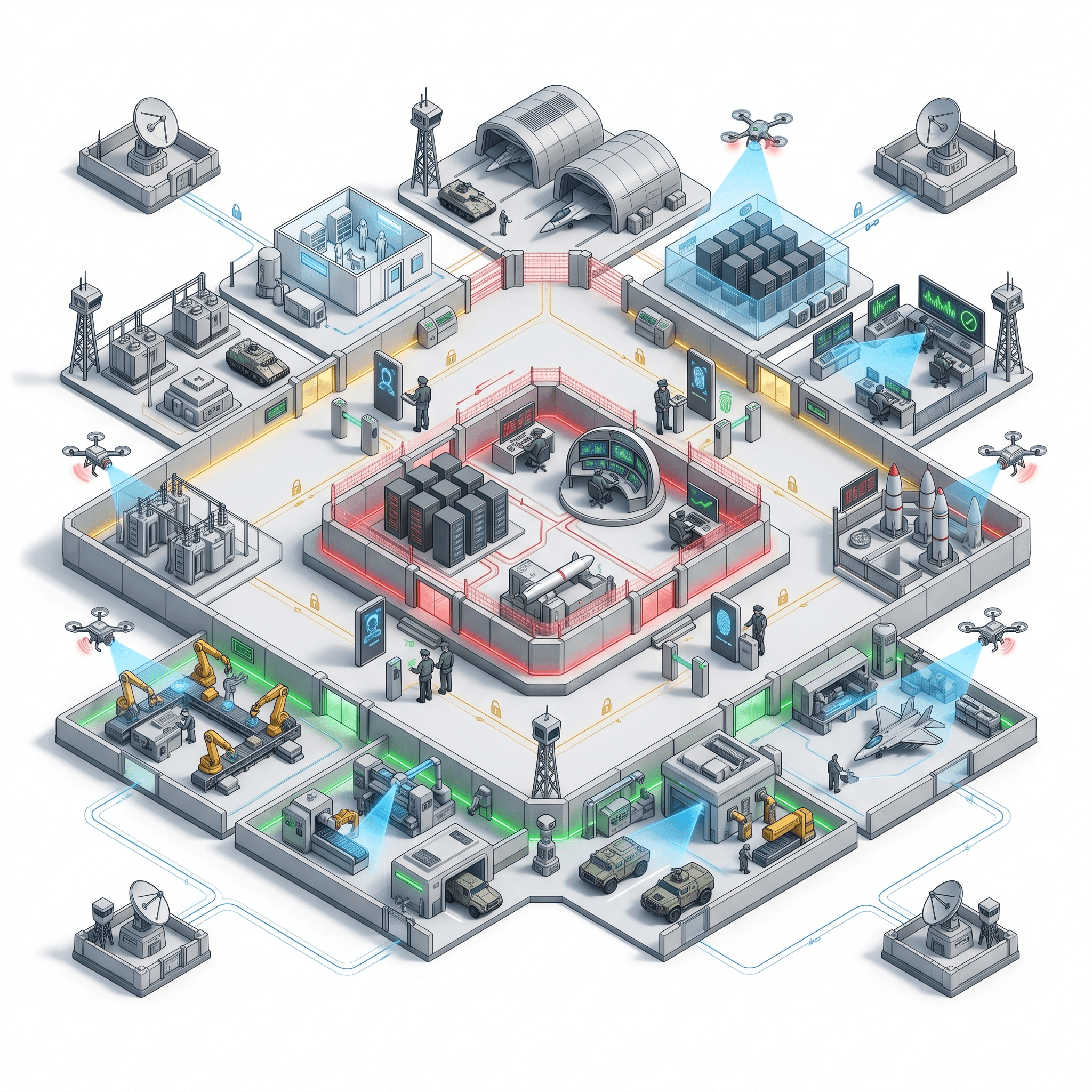
The infrastructure that sustains national defense operates in a threat environment that most organisations will never face. The adversaries targeting it are sophisticated, patient, and well-resourced. The consequences of a successful attack extend far beyond operational disruption - they touch mission readiness, personnel safety, and national sovereignty. Shieldworkz exists to ensure those consequences never materialise.
Whether you represent a defense ministry, a prime contractor, a system integrator, or a government procurement body, our team is ready to engage at the classification level your programme requires. No generic presentations. No off-the-shelf proposals. A direct, technical conversation about your environment, your threat exposure, and what a purpose-built OT security programme looks like for your organisation.
Book a Free Confidential Consultation with Shieldworkz Experts.
Request a demo
Take the Next Step
Protect What Cannot Afford to Fail
The infrastructure that sustains national defense operates in a threat environment that most organisations will never face. The adversaries targeting it are sophisticated, patient, and well-resourced. The consequences of a successful attack extend far beyond operational disruption - they touch mission readiness, personnel safety, and national sovereignty. Shieldworkz exists to ensure those consequences never materialise.
Whether you represent a defense ministry, a prime contractor, a system integrator, or a government procurement body, our team is ready to engage at the classification level your programme requires. No generic presentations. No off-the-shelf proposals. A direct, technical conversation about your environment, your threat exposure, and what a purpose-built OT security programme looks like for your organisation.
Book a Free Confidential Consultation with Shieldworkz Experts.
Request a demo